
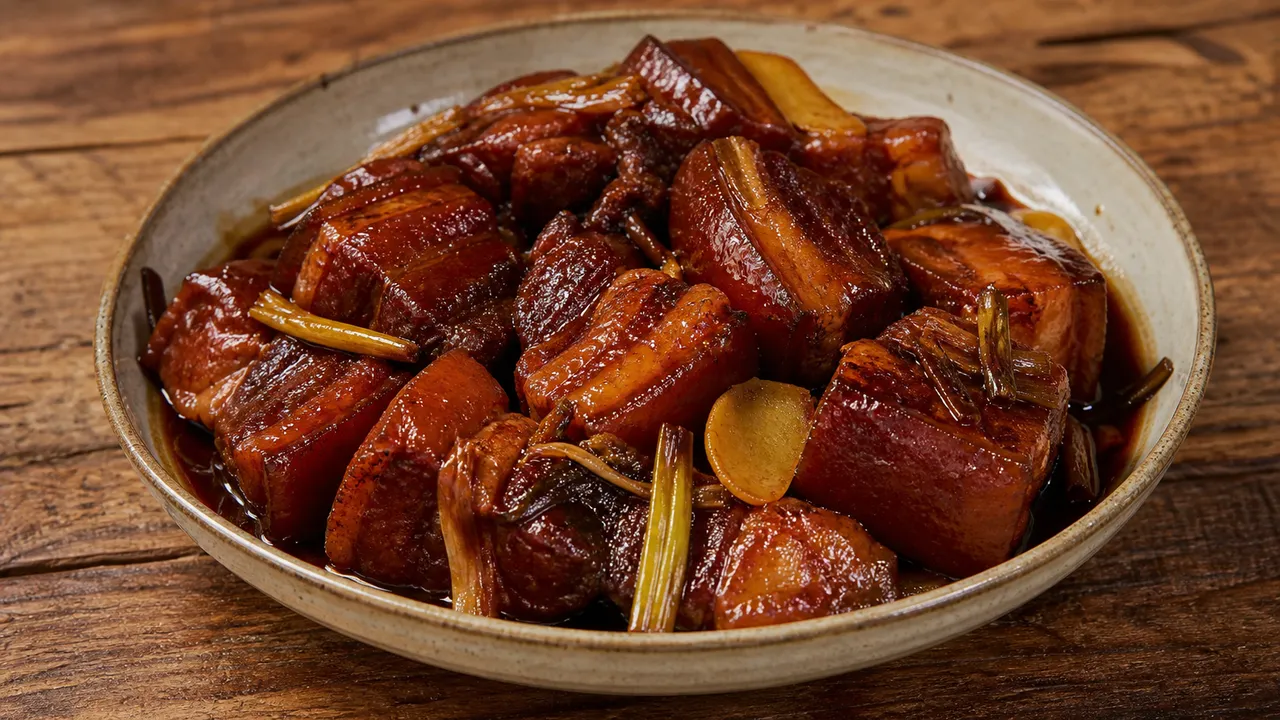
Hongshao Rou (Red-Braised Pork Belly) and Scallion Oil Noodl
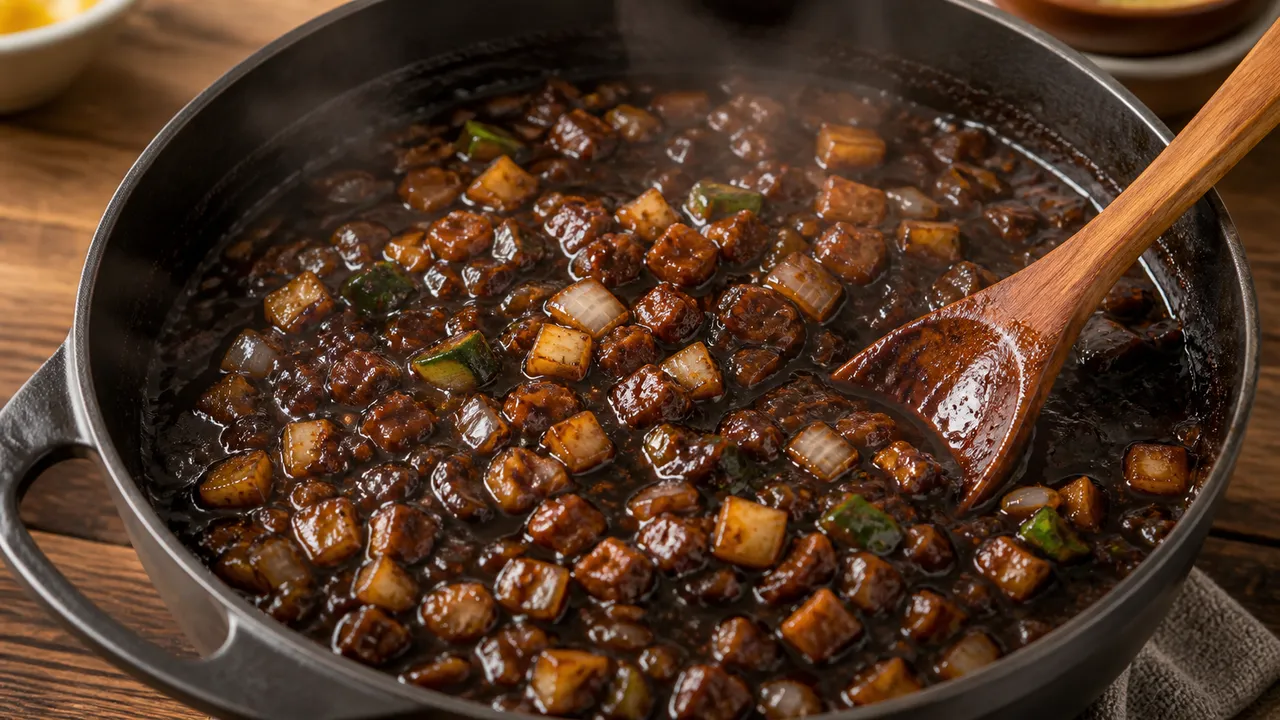
* 이미지는 AI가 생성한 참고 이미지로, 실제 조리 결과물과 다를 수 있습니다.
A recipe for Hongshao Rou (Red-Braised Pork Belly), a national dish of China, served with Shanghai-style Scallion Oil Noodles.
📋 2 recipes — Select to view
This is a recipe for Hongshao Rou, a beloved Chinese national dish of braised pork belly in soy sauce.
📝 Editor's Notes
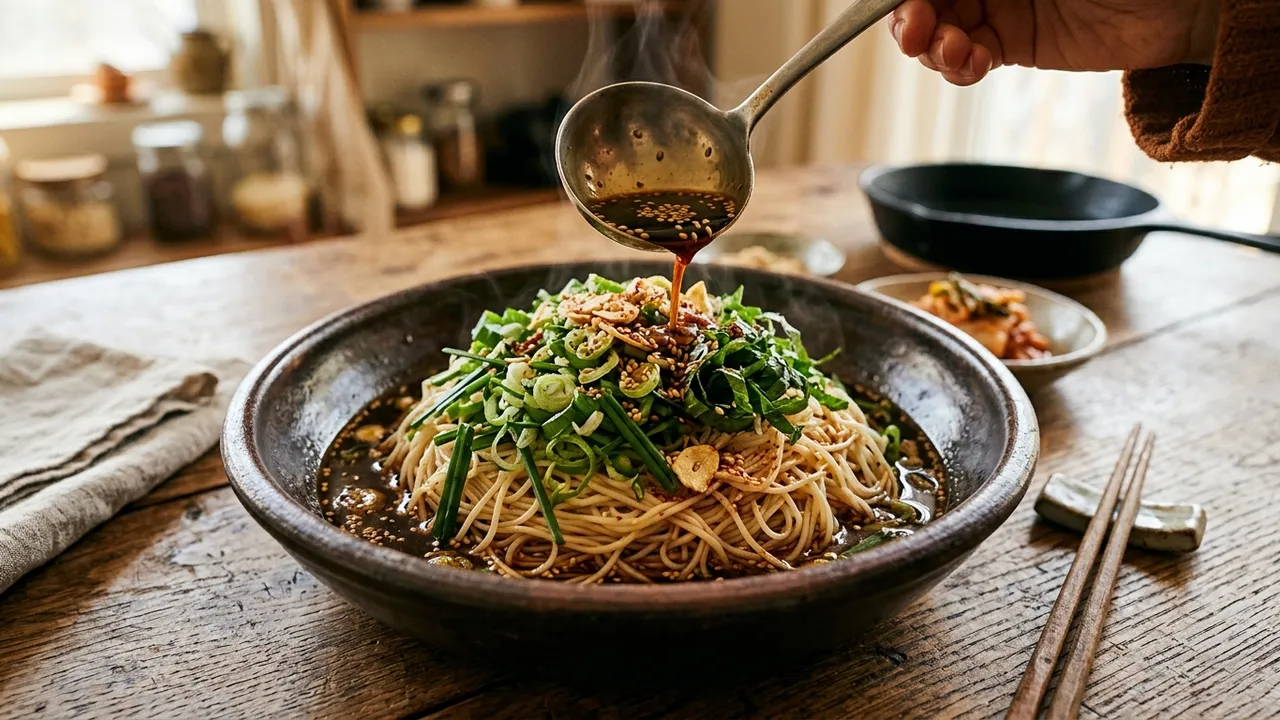
Scallion Oil Noodles is an appealing noodle dish that offers a deep umami flavor, harmonizing savory scallion oil with a salty-sweet soy sauce dressing.
Its biggest advantage is that anyone can easily make it without complex ingredients or techniques.
It pairs exceptionally well with rich and hearty dishes, especially Shanghai-style Hongshao Rou (红烧肉).
This dish is perfect for a warm meal, unexpected guests, or a late-night snack, making it a simple yet special menu item suitable for all seasons.
The savory and salty taste, combined with the fragrant scallion aroma, makes it utterly irresistible.
🛒 Ingredient Tips
The key to these Scallion Oil Noodles lies in fresh scallions and other aromatic vegetables.
When choosing scallions, look for vibrant, fresh green leaves and firm white parts.
Especially for making scallion oil, you'll want good, unwilted scallions to ensure a strong aroma.
For garlic and ginger, use those with clean, firm skins and no sprouts to fully appreciate their fresh fragrance.
While medium wheat noodles (중면, jungmyeon) are used, kalguksu noodles or spaghetti noodles are also suitable if you prefer a chewier texture.
For oil, we recommend neutral-flavored vegetable oils such as sunflower oil or grapeseed oil.
🔄 Substitution Guide
A few main ingredients can be substituted.
Instead of medium wheat noodles (중면, jungmyeon), using thin wheat noodles (소면, somyeon) will result in a softer texture, while kalguksu noodles or spaghetti noodles will create a chewier and more satisfying dish.
However, as the noodles get thicker, the sauce absorption may vary, so you might need to adjust the amount of seasoning slightly.
You can also use the green parts of leeks (대파, daepa) instead of scallions for the scallion oil, but the aroma might be stronger and lack the unique sweetness of scallions.
Finally, dark soy sauce (노추, nochu) cannot be perfectly substituted with regular soy sauce to achieve its distinct color, subtle sweetness, and umami.
If you don't have dark soy sauce, you can try adding a tiny bit of dark brown sugar or a drop or two of caramel coloring to regular soy sauce to mimic the color.
Please note that the depth of flavor might be slightly different.
🥘 Ingredients
👨🍳 Cooking Points
Here are three important tips for making delicious Scallion Oil Noodles.
First, when making scallion oil, it is crucial to fry the aromatic vegetables slowly over low heat.
If the heat is too high, the aromatics can burn and turn bitter, so be patient and wait until they are golden brown.
This is key to achieving that savory flavor.
Second, when making the sauce, it's important to stir until the sugar is completely dissolved.
If the sugar doesn't fully dissolve, the sauce may taste unbalanced.
Third, when mixing the noodles, start by adding the fried scallion oil and sauce in a 1:1 ratio.
Then, adjust the amount of oil or sauce to your preference, tasting as you go.
It's difficult to correct if you add too much initially, so it's recommended to adjust gradually.
👨🍳 Directions
Sear the skin side of the pork belly over a flame to remove any hairs, then continue searing until the skin turns golden brown. (Since this is not the main searing step, a regular pot can be used.)
Transfer the seared pork belly to a bowl, cover with cold water, and soak for about 30 minutes to remove excess blood.
After 30 minutes, scrape off any remaining impurities from the pork belly skin with a knife. Then, cut the pork belly into bite-sized 3-4 cm (approximately 1.2-1.6 inch) cubes.
Place the prepared pork belly cubes in a wok (or pan) and sear them until golden brown, achieving a Maillard reaction, without adding any seasonings (like oyster sauce or chicken powder). Do not sear the skin side as the fat will splatter excessively.
Remove the seared pork belly from the pan and wipe off the excess oil with a paper towel. Return the seared pork belly to the pan, add 10 thumb-sized slices of ginger and 10 scallions (white parts), and stir-fry together.
Add 4 tbsp of Shaoxing wine, 3 tbsp of soy sauce, and 3 tbsp of dark soy sauce (노추, nochu) to the stir-frying pork. Mix well and stir-fry until the meat turns a dark reddish-brown color.
Add 2.8 oz (80g) of rock sugar and 1 tbsp of brown sugar (or dark brown sugar). Stir-fry until the sugar melts and the sauce thickens. (Regular granulated sugar can also be used as a substitute.)
Pour in enough water to just barely cover the meat, then close the lid and cook on low heat for 1 hour.
After 1 hour, turn off the heat. Transfer the Hongshao Rou to a serving plate and drizzle with the remaining sauce to finish.
💡 Tips
Hongshao Rou is characterized by its slightly less tender and saltier taste compared to Dongpo Rou. It pairs wonderfully with rice or as an accompaniment to alcoholic beverages.
For an even more delicious experience, serve Hongshao Rou with vegetables like scallions or bok choy.
Shaoxing wine and rock sugar can be substituted with soju (소주) and regular granulated sugar, respectively, without significantly altering the taste.
Using dark soy sauce (노추, nochu) will give the dish a dark reddish-brown color, similar to Jokbal (족발), and a rich, savory umami flavor, allowing you to enjoy the authentic taste of China. It is a key ingredient for Hongshao Rou, so its use is highly recommended.
📦 Storage & Reuse
Scallion Oil Noodles are best enjoyed immediately after preparation, as the noodles can become soggy.
However, the scallion oil and sauce can be made in advance and stored, allowing you to enjoy the noodles conveniently anytime.
Once cooled, the scallion oil can be stored in an airtight container in the refrigerator for 1-2 weeks.
The sauce should also be stored in an airtight container in the refrigerator and consumed within a week.
Cook the noodles fresh each time you eat.
Before using, let the stored scallion oil and sauce sit at room temperature for a short while or warm them slightly in the microwave to enhance their flavor.
Leftover scallion oil is also excellent for fried rice or other stir-fried dishes.
🥢 Who This Is For
These Scallion Oil Noodles are an excellent dish for anyone looking to enjoy a quick, simple, yet special meal in their busy daily life.
They can also be a 'secret weapon' for students living alone or newlywed couples, making them seem like skilled cooks.
In particular, when served alongside rich meat dishes like Hongshao Rou (红烧肉), Tangsuyuk (탕수육), or Kkanpunggi (깐풍기), they become a fantastic side dish that cuts through richness while adding flavor.
Adding crunchy pickled radish (단무지, danmuji) or fresh kimchi (겉절이 김치, geotjeori kimchi) will complete the perfect meal.
🔥 Nutrition Info
A single serving of Scallion Oil Noodles (based on 100g of medium wheat noodles) is estimated to be approximately 630-680 kcal.
Carbohydrates from the noodles are the main energy source, along with about 16g of protein and 25g of fat.
Trace amounts of vitamins, minerals, and dietary fiber can also be obtained from scallions, garlic, and ginger.
Notably, scallions and garlic contain allicin, which can aid in antioxidant activity and immune system enhancement.
However, due to the use of soy sauce and scallion oil, the sodium content may be somewhat high, so those who prefer less salt should adjust the soy sauce amount.
It is also beneficial for health to moderate the amount of scallion oil to avoid excessive fat intake.
💬 Frequently Asked Questions
- Q. What ingredients do I need for Hongshao Rou (Red-Braised Pork Belly) and Scallion Oil Noodles (Shanghai Style)?
- Main ingredients include Pork Belly (skin on), Scallion roots (white parts of green onions), Ginger, Shaoxing Wine (황주), Soy Sauce. The most important ingredient determining the taste of Hongshao Rou is the pork belly with skin on. Choose a cut with a balanced ratio of lean meat, fat, and skin to enjoy both tender and chewy textures. Fresh pork belly should have clean, elastic skin, bright red lean meat, and white fat. Second, Dark Soy Sauce (老抽, 노추) is a key ingredient for Hongshao Rou's characteristic dark reddish-brown color and deep umami flavor, so it's highly recommended to have it. It can be easily found in Chinese grocery stores or online. Finally, for scallions, use fresh and fragrant ones, as the white root parts are used as aromatics when stir-frying the Hongshao Rou, and the green parts are used for the Scallion Oil Noodles.
- Q. What are the key tips for making Hongshao Rou (Red-Braised Pork Belly) and Scallion Oil Noodles (Shanghai Style)?
- The first key cooking point for this recipe is properly preparing the pork belly skin and achieving a golden-brown Maillard reaction on its surface. Removing hair from the skin, searing it to add flavor, then soaking to remove blood, and scraping off impurities are crucial steps for eliminating gamey odors and ensuring a clean taste. Searing the surface of the pork cubes sufficiently will develop a deep umami flavor. The second key is to braise the meat over low heat for 1 hour to allow the seasoning to thoroughly permeate. Braising over too high heat can make the meat tough and cause the sauce to burn easily, so cover and simmer gently until the meat becomes tender. If the liquid reduces too much, add warm water gradually as needed.
- Q. How should I store leftover Hongshao Rou (Red-Braised Pork Belly) and Scallion Oil Noodles (Shanghai Style)?
- Finished Hongshao Rou can be stored in an airtight container in the refrigerator for 3-4 days. For longer storage, portion it into individual servings and freeze. It can be frozen for up to about a month. To reheat, steam or gently warm over low heat to maintain its moist texture. The sauce for Scallion Oil Noodles can be stored in an airtight container in the refrigerator for about a week, but the noodles are best consumed immediately after cooking. Leftover Hongshao Rou can be repurposed as an ingredient for rice bowls or fried rice, or even as a filling for sandwiches to enjoy a different flavor.
- Q. How many calories are in Hongshao Rou (Red-Braised Pork Belly) and Scallion Oil Noodles (Shanghai Style)?
- This recipe is as rich in nutrition as it is in flavor. For one serving, if you consume 200g of Hongshao Rou and one serving of Scallion Oil Noodles (based on 100g medium noodles), the estimated calorie count is approximately 1000-1200 kcal. The main ingredient, pork belly, provides around 40g of protein, which helps with muscle maintenance and growth. However, its fat content is also high, at approximately 80g, so moderate consumption is important. Carbohydrates from the noodles and sugar in the seasoning amount to about 70g. Pork is rich in B vitamins (especially B1) and iron, which are beneficial for fatigue relief and anemia prevention. However, due to the use of soy sauce and dark soy sauce, the sodium content can be somewhat high, so please keep this in mind. It is recommended to serve with vegetables to aid in sodium excretion and maintain nutritional balance.
- Q. Can I substitute ingredients in Hongshao Rou (Red-Braised Pork Belly) and Scallion Oil Noodles (Shanghai Style)?
- In this recipe, Shaoxing Wine (황주) can be substituted with soju or cheongju (Korean rice wine). While the unique deep aroma of Shaoxing wine might be reduced, it will still effectively remove gamey odors and enhance flavor. Rock Sugar (빙탕) can be replaced with regular granulated sugar. Rock sugar melts slowly, providing a subtle, refined sweetness and a glossy finish. If using regular sugar, which can taste more directly sweet, it's recommended to use slightly less than the amount specified in the recipe. The most crucial ingredient, Dark Soy Sauce (노추), is essential for Hongshao Rou's dark reddish-brown color and rich umami flavor, so its use is highly recommended. If it's truly difficult to find, you can try adding a small amount of oyster sauce to regular soy sauce for umami, and a tiny bit of caramel color or stir-fried chunjang (black bean paste) to enhance the color. However, keep in mind that it will be challenging to fully replicate the authentic deep and rich flavor.
💬 Comments
No comments yet. Be the first to comment!