
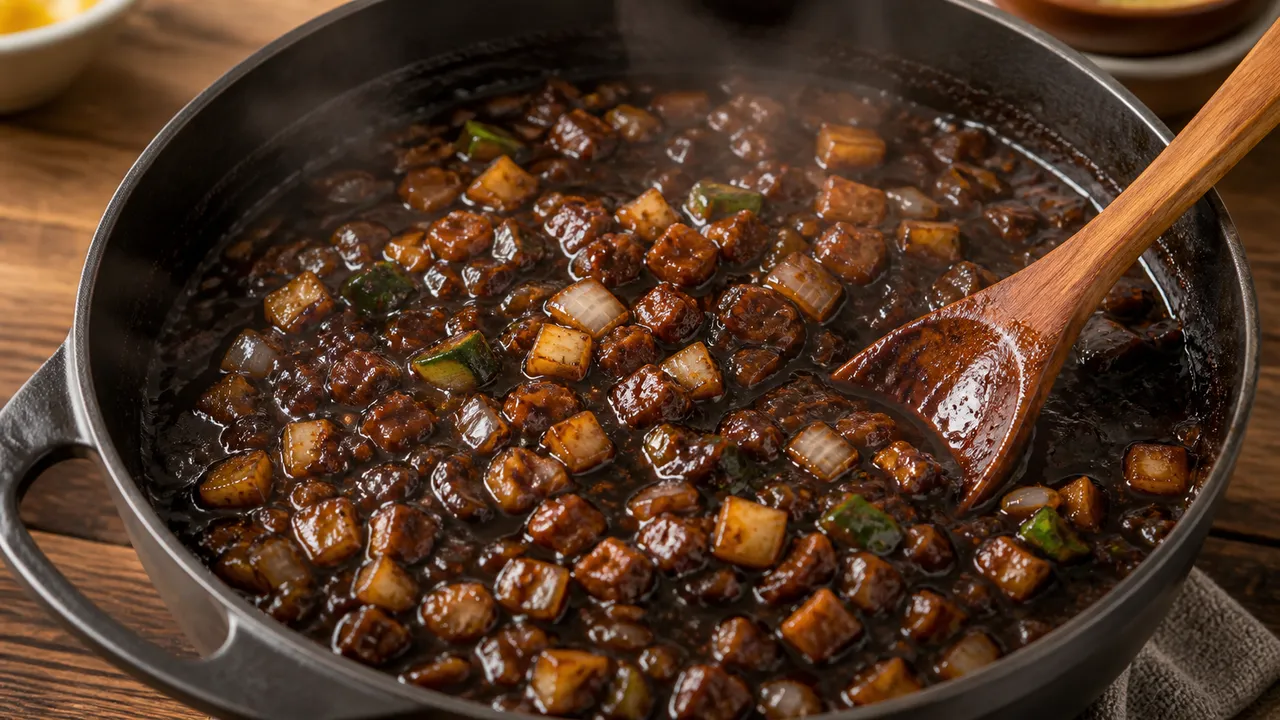
Quick Chinese-Restaurant-Style Black Bean Sauce Recipe
* 이미지는 AI가 생성한 참고 이미지로, 실제 조리 결과물과 다를 수 있습니다.
A Chinese-restaurant-style black bean sauce made in 5 minutes with Korean black bean paste (chunjang 춘장), pork, and potatoes.
📝 Editor's Notes
With Korean black bean paste (chunjang 춘장), pork, and potatoes, you can make Chinese-restaurant-style black bean sauce in just 5 minutes.
Since there is no need to fry the paste separately, this is approachable even for beginners.
The savory sauce pairs beautifully with the gentle sweetness of potatoes and onions, making it great over rice or noodles.
It makes about 4 servings, so it is ideal for a weekend family lunch or for days when you crave black bean sauce without ordering delivery.
🛒 Ingredient Tips
Choose a pre-fried Korean black bean paste (chunjang 춘장), such as Saja brand, for a milder taste and easier use.
After opening, seal it well and refrigerate it so the surface does not dry out.
Ground pork gives a softer texture, while larger curry-cut pork pieces add more bite.
Slightly fatty cuts such as pork shoulder or neck add extra richness.
Choose potatoes that are firm, smooth, and free of sprouts.
Storage potatoes tend to be fluffier than new potatoes and work better in this sauce.
🔄 Substitution Guide
If pork is too heavy or you have an allergy, you can use chicken breast or ground beef instead.
Chicken makes the sauce lighter, while beef adds deeper savoriness but costs more.
If replacing potatoes with sweet potatoes, reduce any added sugar because they are naturally sweeter.
If you do not have Korean zucchini (aehobak 애호박), zucchini or cabbage works well.
Korean black bean paste (chunjang 춘장) is hard to replace, but in a pinch you can use store-bought black bean sauce powder or ready-made black bean sauce.
The deep roasted aroma will be weaker, so try adding a drop or two of sesame oil.
MSG seasoning (Miwon 미원) can be omitted or replaced with Korean beef stock powder (Dashida 다시다).
🥘 Ingredients
👨🍳 Cooking Points
The most important step is stir-frying the vegetables well.
After adding the onion and zucchini, stir-fry them for 2 to 3 minutes as if coating them, which helps them keep their texture instead of falling apart.
Add only half the Korean black bean paste (chunjang 춘장) at first and fry it with the potatoes so its aroma infuses the oil.
If the sauce tastes too sharp, balance it with about 1/2 tsp sugar.
Always dissolve the starch in water first, then add the slurry little by little while the sauce is simmering.
If you pour it in all at once, it may clump.
👨🍳 Directions
Peel 2 potatoes and dice them. Dice 1/2 Korean zucchini, then slice 1 1/2 onions and set aside.
Heat 5 tbsp cooking oil in a frying pan. Add 5.3 oz pork and 2 tbsp minced garlic, then stir-fry until the pork is browned.
Add the diced potatoes and stir-fry again. Add about half of the 5.3 oz Korean black bean paste (chunjang 춘장), and keep stir-frying until the potatoes are slightly cooked.
Add all the sliced onion and zucchini. Stir-fry well for 2 to 3 minutes, coating the vegetables so they do not turn mushy.
Add 1 pinch black pepper and 1/2 tsp MSG seasoning (Miwon 미원). Pour in just enough water to come partway up the ingredients, then cover and simmer until the vegetables are fully cooked.
Once everything is bubbling and the vegetables are mostly tender, mix 2 tbsp starch with 2 tbsp water to make a slurry. Add it little by little, stirring until the sauce reaches your desired thickness.
💡 Tips
You can save time by skipping the separate frying step for the Korean black bean paste (chunjang 춘장). First stir-fry the meat and potatoes in oil, then add the paste and vegetables.
Do not rush the vegetable stir-frying step. Stir-frying them thoroughly helps keep their texture intact instead of turning mushy.
If the Korean black bean paste (chunjang 춘장) tastes too sharp or slightly bitter, add a small amount of sugar to balance it.
For a gan-jjajang-style version, skip the starch slurry and stir-fry the sauce with plenty of vegetables for a richer flavor.
📦 Storage & Reuse
Let the finished sauce cool slightly, then transfer it to an airtight container.
Refrigerate for 3 to 4 days or freeze for up to about 1 month.
Because the starch thickens as it sits, add 1 to 2 tbsp water when reheating and warm it over low heat while stirring to bring it back to the original consistency.
Use leftover sauce for black bean fried rice, or reduce the broth in instant ramen and mix it in for a black bean ramen-style dish.
🥢 Who This Is For
This is perfect for days when delivery black bean noodles do not quite hit the spot, or for a family weekend lunch or kids' snack.
Spoon it over boiled Chinese-style noodles for black bean noodles, or over rice for black bean rice.
Serve with yellow pickled radish, raw onion, and chilled young radish kimchi (yeolmu kimchi 열무김치) to cut through the richness.
A fried egg on top makes it a more satisfying meal.
🔥 Nutrition Info
Based on 4 servings, each serving is estimated to contain about 320 to 370 calories.
Because the recipe uses 5.3 oz pork and 5 tbsp cooking oil, the fat content is relatively high at about 18 to 22 g per serving.
Protein is about 9 to 11 g, and carbohydrates from the potatoes and onions are about 28 to 32 g.
Potatoes provide potassium and vitamin C, while onions contain antioxidants.
However, the Korean black bean paste (chunjang 춘장) and MSG seasoning (Miwon 미원) make the sodium level fairly high, so adjust the seasoning if serving it with soup.
Exact values may vary depending on the ingredients used.
💬 Frequently Asked Questions
- Q. What ingredients do I need for Quick Chinese-Restaurant-Style Black Bean Sauce?
- Main ingredients include Korean black bean paste (chunjang 춘장), pork, ground or cut for curry, minced garlic, onion, potato. Choose a pre-fried Korean black bean paste (chunjang 춘장), such as Saja brand, for a milder taste and easier use. After opening, seal it well and refrigerate it so the surface does not dry out. Ground pork gives a softer texture, while larger curry-cut pork pieces add more bite. Slightly fatty cuts such as pork shoulder or neck add extra richness. Choose potatoes that are firm, smooth, and free of sprouts. Storage potatoes tend to be fluffier than new potatoes and work better in this sauce.
- Q. What are the key tips for making Quick Chinese-Restaurant-Style Black Bean Sauce?
- The most important step is stir-frying the vegetables well. After adding the onion and zucchini, stir-fry them for 2 to 3 minutes as if coating them, which helps them keep their texture instead of falling apart. Add only half the Korean black bean paste (chunjang 춘장) at first and fry it with the potatoes so its aroma infuses the oil. If the sauce tastes too sharp, balance it with about 1/2 tsp sugar. Always dissolve the starch in water first, then add the slurry little by little while the sauce is simmering. If you pour it in all at once, it may clump.
- Q. How should I store leftover Quick Chinese-Restaurant-Style Black Bean Sauce?
- Let the finished sauce cool slightly, then transfer it to an airtight container. Refrigerate for 3 to 4 days or freeze for up to about 1 month. Because the starch thickens as it sits, add 1 to 2 tbsp water when reheating and warm it over low heat while stirring to bring it back to the original consistency. Use leftover sauce for black bean fried rice, or reduce the broth in instant ramen and mix it in for a black bean ramen-style dish.
- Q. How many calories are in Quick Chinese-Restaurant-Style Black Bean Sauce?
- Based on 4 servings, each serving is estimated to contain about 320 to 370 calories. Because the recipe uses 5.3 oz pork and 5 tbsp cooking oil, the fat content is relatively high at about 18 to 22 g per serving. Protein is about 9 to 11 g, and carbohydrates from the potatoes and onions are about 28 to 32 g. Potatoes provide potassium and vitamin C, while onions contain antioxidants. However, the Korean black bean paste (chunjang 춘장) and MSG seasoning (Miwon 미원) make the sodium level fairly high, so adjust the seasoning if serving it with soup. Exact values may vary depending on the ingredients used.
- Q. Can I substitute ingredients in Quick Chinese-Restaurant-Style Black Bean Sauce?
- If pork is too heavy or you have an allergy, you can use chicken breast or ground beef instead. Chicken makes the sauce lighter, while beef adds deeper savoriness but costs more. If replacing potatoes with sweet potatoes, reduce any added sugar because they are naturally sweeter. If you do not have Korean zucchini (aehobak 애호박), zucchini or cabbage works well. Korean black bean paste (chunjang 춘장) is hard to replace, but in a pinch you can use store-bought black bean sauce powder or ready-made black bean sauce. The deep roasted aroma will be weaker, so try adding a drop or two of sesame oil. MSG seasoning (Miwon 미원) can be omitted or replaced with Korean beef stock powder (Dashida 다시다).

💬 Comments
No comments yet. Be the first to comment!