
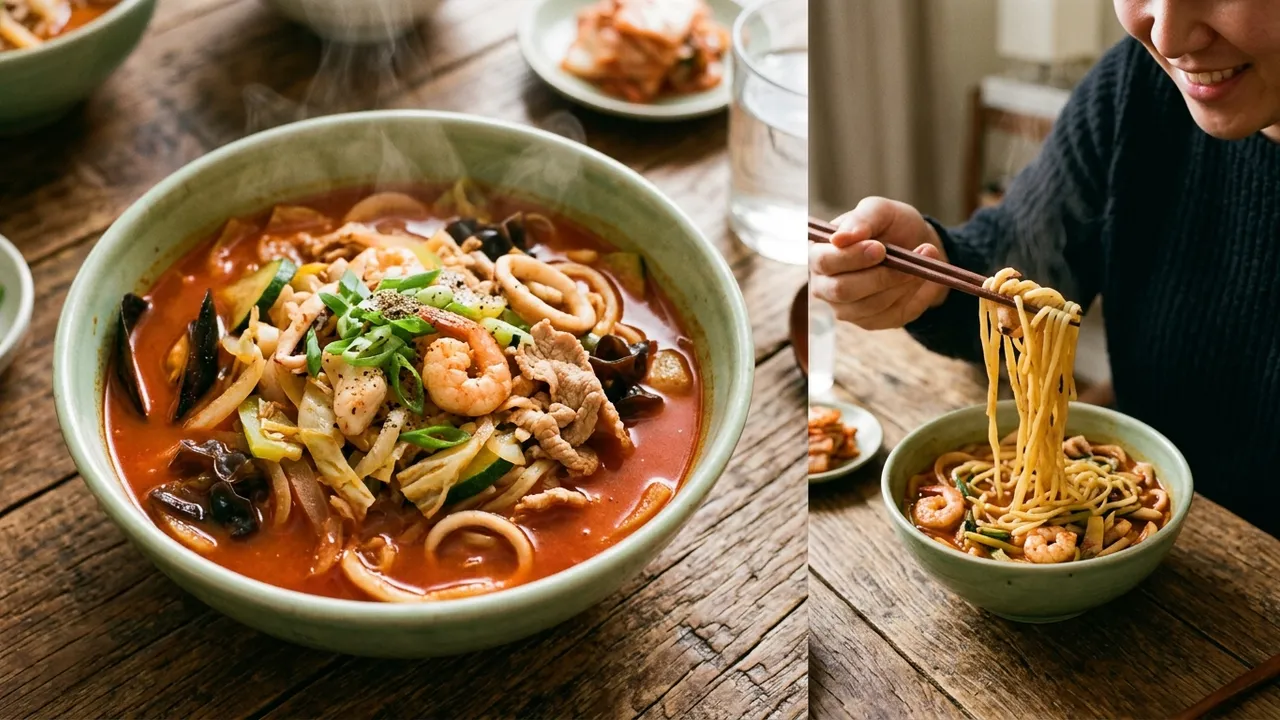
Old-fashioned Jjamppong Recipe
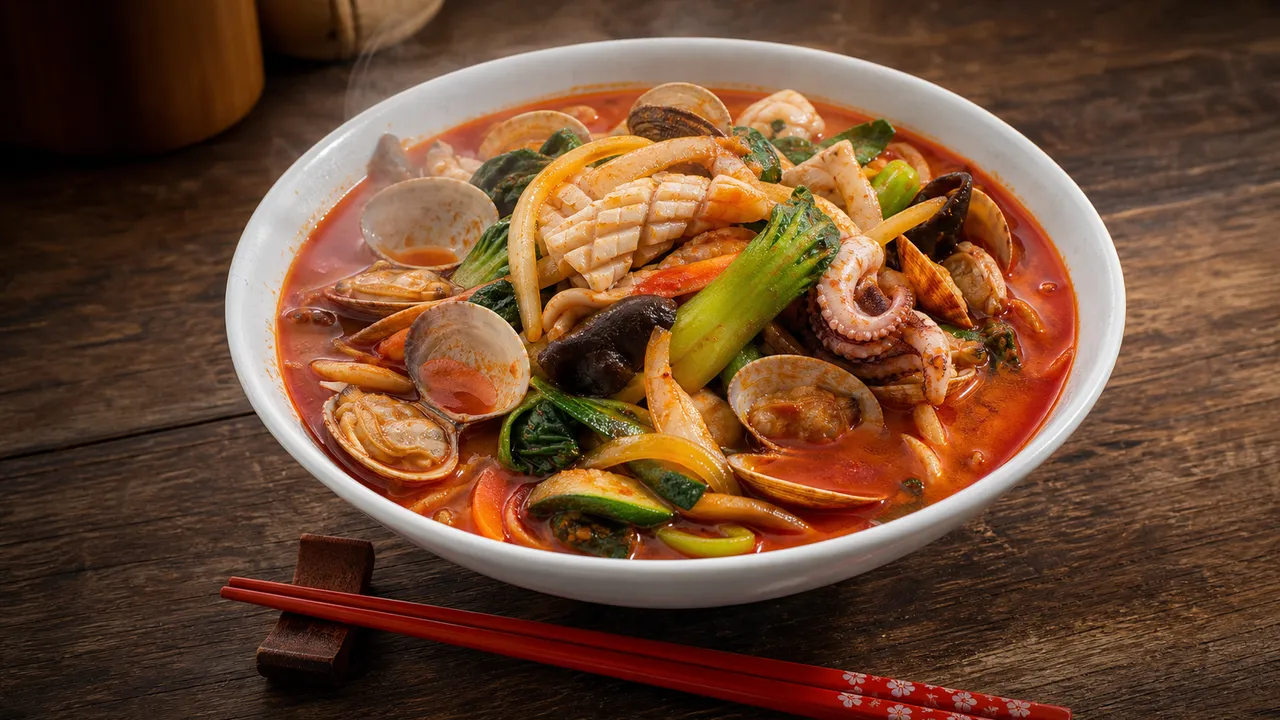
* 이미지는 AI가 생성한 참고 이미지로, 실제 조리 결과물과 다를 수 있습니다.
This is a basic jjamppong recipe that features a refreshing and spicy broth, made by stir-frying pork, various vegetables, and seafood in a traditional way. You can enjoy restaurant-style flavors right at home.
📝 Editor's Notes
This old-fashioned jjamppong recipe is characterized by its refreshing and spicy broth, achieved by stir-frying generous amounts of pork, fresh seafood, and various vegetables.
It allows you to enjoy restaurant-quality flavors at home.
By cutting the ingredients into large pieces, you can enhance the chewing texture, and quickly stir-frying over high heat delivers a proper 'wok hei' (불맛, smoky flavor).
The difficulty level is moderate, requiring the preparation and stir-frying of various ingredients, but the satisfaction of the finished dish is very high.
It's especially recommended as a hearty meal for the whole family on chilly or rainy days, or whenever you crave a spicy broth.
🛒 Ingredient Tips
The key ingredients for this jjamppong are fresh pork, seafood, and crunchy vegetables.
For pork, using pork neck or pork belly cuts will allow you to enjoy both savory flavor and tender texture.
Choose cuts that are reddish-pink with a good balance of fat and lean meat.
For seafood, prepare fresh seasonal ingredients like squid, shrimp, and Manila clams to achieve a much deeper broth flavor.
For squid, choose ones with plump and firm bodies, and for Manila clams, select those that have been well-purged and tightly closed.
For vegetables, it's good to prepare crunchy ones like napa cabbage, onion, zucchini, and bok choy.
🔄 Substitution Guide
While pork is an important ingredient that adds depth to this recipe, it can be substituted according to preference.
Using chicken breast or chicken thighs instead of pork can yield a lighter and milder flavor.
If you have seafood allergies or specific seafood is difficult to find, mussels (홍합) or Manila clams alone can provide a sufficiently refreshing broth instead of squid or shrimp.
In this case, the natural flavors of the seafood will be emphasized.
If you prefer a more natural umami flavor instead of chicken powder or MSG (미원), you can use anchovy-kelp broth or add a small amount of beef stock powder (소고기 다시다).
However, using store-bought gomtang (곰탕, beef bone broth) is the easiest and most reliable method.
🥘 Ingredients
👨🍳 Cooking Points
There are three main cooking points that determine the taste of this old-fashioned jjamppong.
First, creating 'wok hei' (불맛): The key is to stir-fry green onion and minced garlic in oil to create an aroma, then quickly stir-fry pork and Cheongyang chili pepper (청양고추) over high heat.
Maintaining high heat at this stage allows the moisture from the ingredients to evaporate, infusing them with a delicious smoky flavor.
Second, after adding gochugaru (고춧가루), immediately add 1/2 cup of water to prevent it from burning and to fully extract the chili oil.
This step is crucial for determining the depth of the spicy flavor.
Third, the noodles should be cooked separately, rinsed in cold water, and then briefly blanched in the hot broth before serving to maintain their chewy texture.
Be careful to prevent the noodles from sticking to the bottom of the pot.
👨🍳 Directions
Chop 1/4 onion, 3 leaves of napa cabbage, 1/4 zucchini, 2 bok choy, 1 stalk of green onion, and 1 Cheongyang chili pepper (청양고추).
Cut the octopus and 50g of pork into large pieces.
Heat 3 tbsp of oil in a frying pan, add the green onion and 1/2 tbsp of minced garlic, and stir-fry over medium heat.
Add the pork and Cheongyang chili pepper (청양고추) to the pan and stir-fry over high heat.
Add 1/2 tbsp of soy sauce and the remaining vegetables (onion, zucchini, napa cabbage, bamboo shoots, button mushrooms, wood ear mushrooms), excluding the bok choy, and stir-fry gradually with enough room.
Once the vegetables are somewhat cooked, add 2 tbsp of gochugaru (고춧가루). Before the gochugaru (고춧가루) burns, add 1/2 cup of water and stir-fry a little more.
Add an additional 600 ml of water to the frying pan. Add 1/2 tbsp of chicken powder, 1/3 tbsp of salt, and 1.5 tbsp of oyster sauce. Once the broth starts to boil, add 7-8 Manila clams, the prepared shrimp, and octopus to create the broth.
Boil water in a new pot, cook the jjamppong noodles, rinse them once in cold water, then blanch them again in boiling water. (Noodles should be added to boiling water to prevent them from sticking to the bottom, and cooking them quickly helps maintain their elasticity.)
Lightly blanch the bok choy in the boiling broth from step 7.
Pour the broth over the cooked jjamppong noodles to complete the dish.
💡 Tips
Meat is an essential ingredient for old-fashioned jjamppong.
Manila clams and short-necked clams (모시조개) are excellent choices for jjamppong. While hard clams (백합) and mussels (홍합) are also good, consider their price and quantity and add them appropriately.
Adding too many ingredients to jjamppong can make it taste like maeuntang (매운탕, spicy fish stew), so it's important to balance the flavors with appropriate amounts.
If you want to achieve restaurant-style jjamppong at home, use store-bought gomtang (곰탕, beef bone broth) or, if using plain water, add a pinch of MSG (미원) per serving to significantly enhance the umami flavor.
Restaurants don't make jjamppong one serving at a time; they stir-fry ingredients for multiple servings simultaneously. When additional orders come in, freshly stir-fried ingredients are combined with the existing broth to maintain flavor and texture.
To ensure the jjamppong noodles are chewy and delicious, cook them in boiling water, rinse them once in cold water, and then blanch them again in boiling water.
📦 Storage & Reuse
Finished jjamppong is best eaten immediately as the noodles can become soggy.
If you have leftovers, it's best to store the noodles and broth separately.
The broth can be stored in an airtight container in the refrigerator for 2-3 days, or frozen for up to 1 month.
When reheating, bring the thawed broth to a boil in a pot, then prepare fresh noodles separately and blanch them in the hot broth to enjoy the original taste.
Leftover vegetable ingredients can be used in fried rice or other stir-fried dishes.
Similarly, leftover seafood can be incorporated into seafood stir-fries or pasta dishes for varied enjoyment.
🥢 Who This Is For
This jjamppong is highly recommended for those who love spicy and refreshing noodle soups.
It's an excellent recipe for those who want to enjoy both seafood and meat, or for anyone looking to recreate restaurant-quality jjamppong at home.
It's perfect for chilly weather when you crave a warm soup, or as a special weekend meal for the whole family.
Recommended side dishes include crispy gunmandu (군만두, fried dumplings) or sweet and sour tangsuyuk (탕수육, sweet and sour pork).
Serving it with danmuji (단무지, pickled radish) and chunjang (춘장, black bean paste) with onions will complete a perfect Chinese-Korean meal.
🔥 Nutrition Info
One serving of this old-fashioned jjamppong is estimated to be approximately 950-1100 kcal.
The calorie content is relatively high due to the jjamppong noodles, oil, and pork.
Protein intake is abundant at about 45-55g, mainly from pork and seafood (shrimp, squid, Manila clams), which aids in muscle maintenance and growth.
Fat content is about 60-75g, primarily from oil and pork, while carbohydrates are supplied at about 90-110g from noodles and vegetables.
Additionally, various vegetables (napa cabbage, zucchini, onion, bok choy, etc.) provide vitamin C and dietary fiber, and seafood and pork are rich in minerals such as iron, zinc, and selenium.
However, due to oyster sauce, chicken powder, and salt, the sodium content may be somewhat high, so it's advisable to moderate your broth intake.
💬 Frequently Asked Questions
- Q. What ingredients do I need for Old-fashioned Jjamppong?
- Main ingredients include Shrimp, Pork, Zucchini, Napa cabbage, Squid (or octopus). The key ingredients for this jjamppong are fresh pork, seafood, and crunchy vegetables. For pork, using pork neck or pork belly cuts will allow you to enjoy both savory flavor and tender texture. Choose cuts that are reddish-pink with a good balance of fat and lean meat. For seafood, prepare fresh seasonal ingredients like squid, shrimp, and Manila clams to achieve a much deeper broth flavor. For squid, choose ones with plump and firm bodies, and for Manila clams, select those that have been well-purged and tightly closed. For vegetables, it's good to prepare crunchy ones like napa cabbage, onion, zucchini, and bok choy.
- Q. What are the key tips for making Old-fashioned Jjamppong?
- There are three main cooking points that determine the taste of this old-fashioned jjamppong. First, creating 'wok hei' (불맛): The key is to stir-fry green onion and minced garlic in oil to create an aroma, then quickly stir-fry pork and Cheongyang chili pepper (청양고추) over high heat. Maintaining high heat at this stage allows the moisture from the ingredients to evaporate, infusing them with a delicious smoky flavor. Second, after adding gochugaru (고춧가루), immediately add 1/2 cup of water to prevent it from burning and to fully extract the chili oil. This step is crucial for determining the depth of the spicy flavor. Third, the noodles should be cooked separately, rinsed in cold water, and then briefly blanched in the hot broth before serving to maintain their chewy texture. Be careful to prevent the noodles from sticking to the bottom of the pot.
- Q. How should I store leftover Old-fashioned Jjamppong?
- Finished jjamppong is best eaten immediately as the noodles can become soggy. If you have leftovers, it's best to store the noodles and broth separately. The broth can be stored in an airtight container in the refrigerator for 2-3 days, or frozen for up to 1 month. When reheating, bring the thawed broth to a boil in a pot, then prepare fresh noodles separately and blanch them in the hot broth to enjoy the original taste. Leftover vegetable ingredients can be used in fried rice or other stir-fried dishes. Similarly, leftover seafood can be incorporated into seafood stir-fries or pasta dishes for varied enjoyment.
- Q. How many calories are in Old-fashioned Jjamppong?
- One serving of this old-fashioned jjamppong is estimated to be approximately 950-1100 kcal. The calorie content is relatively high due to the jjamppong noodles, oil, and pork. Protein intake is abundant at about 45-55g, mainly from pork and seafood (shrimp, squid, Manila clams), which aids in muscle maintenance and growth. Fat content is about 60-75g, primarily from oil and pork, while carbohydrates are supplied at about 90-110g from noodles and vegetables. Additionally, various vegetables (napa cabbage, zucchini, onion, bok choy, etc.) provide vitamin C and dietary fiber, and seafood and pork are rich in minerals such as iron, zinc, and selenium. However, due to oyster sauce, chicken powder, and salt, the sodium content may be somewhat high, so it's advisable to moderate your broth intake.
- Q. Can I substitute ingredients in Old-fashioned Jjamppong?
- While pork is an important ingredient that adds depth to this recipe, it can be substituted according to preference. Using chicken breast or chicken thighs instead of pork can yield a lighter and milder flavor. If you have seafood allergies or specific seafood is difficult to find, mussels (홍합) or Manila clams alone can provide a sufficiently refreshing broth instead of squid or shrimp. In this case, the natural flavors of the seafood will be emphasized. If you prefer a more natural umami flavor instead of chicken powder or MSG (미원), you can use anchovy-kelp broth or add a small amount of beef stock powder (소고기 다시다). However, using store-bought gomtang (곰탕, beef bone broth) is the easiest and most reliable method.
💬 Comments
No comments yet. Be the first to comment!