
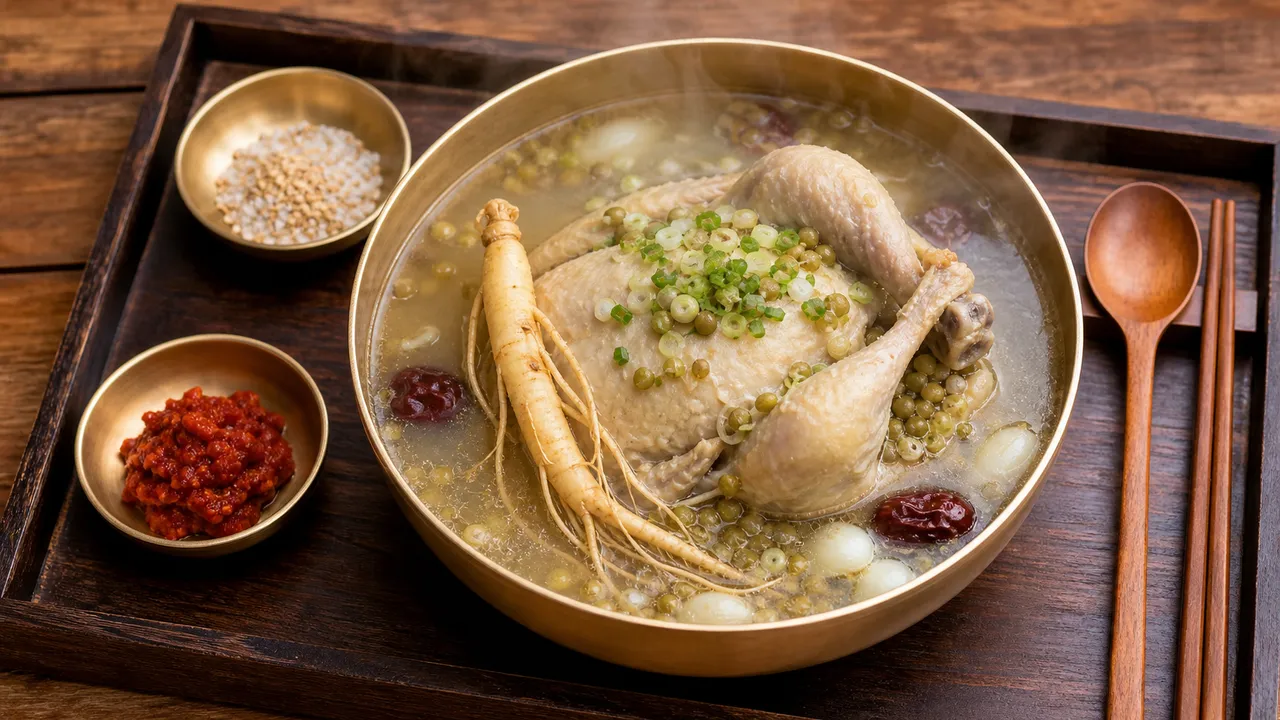
Korean Ginseng Chicken Soup with Mung Beans Recipe
* 이미지는 AI가 생성한 참고 이미지로, 실제 조리 결과물과 다를 수 있습니다.
A rich summer restorative chicken soup made with mung beans, fresh ginseng, chestnuts, and jujubes, ready in about 50 minutes.
📝 Editor's Notes
This summer restorative soup is made with 2 small chickens stuffed with mung beans, sweet rice, fresh ginseng, chestnuts, and jujubes, and it cooks in about 50 minutes.
The prep takes a little care, but the cooking itself is not difficult, making it a solid intermediate-level recipe.
The broth is first infused with astragalus root, then strained through damp cheesecloth for a clear, clean finish.
Mashed mung beans make the soup soft, nutty, and comforting, which is especially welcome when hot weather dulls the appetite.
It is a satisfying bowl for the hottest days of summer or anytime you need something nourishing.
🛒 Ingredient Tips
Choose small young chickens around 1 lb each, the kind typically used for samgyetang (삼계탕).
Look for pale, resilient skin and plump meat.
For fresh ginseng (수삼), choose firm roots with fine rootlets still attached and a strong aroma.
Good astragalus root (황기) has a yellowish cut surface and a gentle sweet scent without any musty smell.
Peeled mung beans (녹두) soften easily and are convenient for making porridge.
For jujubes (대추), look for fruit with fewer wrinkles and a clear reddish color.
🔄 Substitution Guide
If fresh ginseng (수삼) is too expensive or hard to find, you can substitute 1 or 2 roots of dried ginseng or red ginseng.
The aroma will be deeper with a subtle sweetness.
If you do not have astragalus root (황기), you can make the broth with castor aralia or oriental raisin tree, though the herbal aroma will be milder.
If mung beans are hard to find or you are allergic, you can use adzuki beans or whole barley instead; adzuki beans will make the color and flavor stronger, while barley adds a more pronounced chewy texture.
Sweet rice can be replaced with soaked short-grain rice, but the porridge will be less sticky and slightly lighter.
🥘 Ingredients
👨🍳 Cooking Points
Remember two things.
First, do not overfill the chicken cavities with mung beans and sweet rice; fill them only about two-thirds full, or the center may not cook through.
Soak the sweet rice for at least 3 hours, and soak the mung beans well so they become tender within 50 minutes.
Second, start over high heat with the lid off and skim away the foam and fat as they rise.
This is what keeps the broth clear and clean.
After skimming, lower the heat to medium-low and simmer gently for 50 minutes so the broth becomes rich and the meat stays moist.
👨🍳 Directions
Trim the wing tips and tail ends from the 2 small chickens with kitchen shears, and remove any excess fat. To prevent cross-contamination, do not rinse the chickens directly in the sink; fill a large bowl with water and wash them there instead. Scrape out any blood clots inside the cavity to remove off odors. Rinse again in fresh water, then make a slit in each thigh so the legs can be crossed and secured.
Stuff the cavities with well-soaked peeled mung beans (녹두) and sweet rice (찹쌀) that has been soaked for at least 3 hours. Block each opening with a chestnut so the filling does not spill out. Cross the chicken legs and tuck them through the slits to secure.
Place 0.9 oz astragalus root (황기) and 8 1/2 cups water in a pot and boil for 20 minutes to make the broth.
Into the boiling astragalus broth, add the prepared chickens, 2 fresh ginseng roots (수삼), 1/2 piece ginger, 4 jujubes (대추), 10 garlic cloves, and 3 tbsp cheongju rice wine (청주). Bring to a boil over high heat with the lid off.
Once the broth comes to a boil, skim off the foam and excess fat that rise to the surface for a cleaner-tasting soup.
Place the remaining 1 cup mung beans (녹두) and 1 cup sweet rice (찹쌀) in a cotton soup bag and add it to the pot.
Reduce the heat to medium-low, cover, and simmer for 50 minutes total.
When the chicken is cooked, remove it from the pot. Strain the broth through a damp cheesecloth to separate out a clear stock. Discard the astragalus root and other medicinal herbs.
Transfer the cooked mung beans and sweet rice from the cloth bag to a bowl and mash until smooth.
Pour the strained broth back into the pot and season with 1 tbsp Korean sea salt (천일염).
Add the mashed sweet rice and mung beans to the broth and simmer to make a light mung bean porridge. Adjust the thickness with the sweet rice porridge to your liking. Return the chickens to the pot, cover, and gently simmer for 5 minutes.
Place a chicken in each serving bowl and ladle the broth over it. Top with thinly sliced green onion, then finish with mashed mung beans, fresh ginseng, and jujubes as garnish.
💡 Tips
When cleaning the chicken, wash it in a large bowl of water instead of directly in the sink to help prevent cross-contamination.
Scrape out the blood clots inside the chicken cavity thoroughly to prevent any gamey smell.
Do not overstuff the chicken with sweet rice and mung beans, or the filling may not cook through properly.
Skim off the foam and fat as the broth boils to make a clean, deeply flavored Korean ginseng chicken soup.
📦 Storage & Reuse
Store the chicken and broth separately in airtight containers.
They will keep for 2 to 3 days in the refrigerator or 2 to 3 weeks in the freezer.
The mung bean porridge broth thickens as it sits, so when reheating, add a little water or broth and warm it over low heat while stirring.
Leftover broth can be simmered with rice to make chicken porridge for breakfast the next day, or the meat can be shredded and tossed with garlic chives for a seasoned chicken salad.
🥢 Who This Is For
This is especially good for family members, older adults, or anyone recovering from fatigue during the summer.
Because the broth is enriched with mung bean porridge, it is also relatively easy to digest.
Crisp white kimchi (백김치) or stuffed cucumber kimchi (오이소박이) makes a refreshing side, and a plate of seasoned garlic chives cuts nicely through the mild richness.
It also pairs well with ginseng liquor or chilled young summer radish kimchi.
🔥 Nutrition Info
Each serving is estimated at about 620 to 720 calories.
If one serving includes one chicken plus the sweet rice and mung beans from the cavity, it provides roughly 45 to 55 g protein, 25 to 30 g fat, and 55 to 65 g carbohydrates.
The chicken offers high-quality protein and essential amino acids, while mung beans provide fiber, potassium, and folate.
Fresh ginseng, astragalus root, and jujubes add saponins and iron-containing components.
Removing the skin and skimming the fat from the broth can further reduce the fat and calories.
💬 Frequently Asked Questions
- Q. What ingredients do I need for Korean Ginseng Chicken Soup with Mung Beans?
- Main ingredients include small whole chickens for samgyetang (삼계탕), fresh ginseng (수삼), astragalus root (황기), about 5 pieces each 10 inches long, chestnuts, jujubes (대추). Choose small young chickens around 1 lb each, the kind typically used for samgyetang (삼계탕). Look for pale, resilient skin and plump meat. For fresh ginseng (수삼), choose firm roots with fine rootlets still attached and a strong aroma. Good astragalus root (황기) has a yellowish cut surface and a gentle sweet scent without any musty smell. Peeled mung beans (녹두) soften easily and are convenient for making porridge. For jujubes (대추), look for fruit with fewer wrinkles and a clear reddish color.
- Q. What are the key tips for making Korean Ginseng Chicken Soup with Mung Beans?
- Remember two things. First, do not overfill the chicken cavities with mung beans and sweet rice; fill them only about two-thirds full, or the center may not cook through. Soak the sweet rice for at least 3 hours, and soak the mung beans well so they become tender within 50 minutes. Second, start over high heat with the lid off and skim away the foam and fat as they rise. This is what keeps the broth clear and clean. After skimming, lower the heat to medium-low and simmer gently for 50 minutes so the broth becomes rich and the meat stays moist.
- Q. How should I store leftover Korean Ginseng Chicken Soup with Mung Beans?
- Store the chicken and broth separately in airtight containers. They will keep for 2 to 3 days in the refrigerator or 2 to 3 weeks in the freezer. The mung bean porridge broth thickens as it sits, so when reheating, add a little water or broth and warm it over low heat while stirring. Leftover broth can be simmered with rice to make chicken porridge for breakfast the next day, or the meat can be shredded and tossed with garlic chives for a seasoned chicken salad.
- Q. How many calories are in Korean Ginseng Chicken Soup with Mung Beans?
- Each serving is estimated at about 620 to 720 calories. If one serving includes one chicken plus the sweet rice and mung beans from the cavity, it provides roughly 45 to 55 g protein, 25 to 30 g fat, and 55 to 65 g carbohydrates. The chicken offers high-quality protein and essential amino acids, while mung beans provide fiber, potassium, and folate. Fresh ginseng, astragalus root, and jujubes add saponins and iron-containing components. Removing the skin and skimming the fat from the broth can further reduce the fat and calories.
- Q. Can I substitute ingredients in Korean Ginseng Chicken Soup with Mung Beans?
- If fresh ginseng (수삼) is too expensive or hard to find, you can substitute 1 or 2 roots of dried ginseng or red ginseng. The aroma will be deeper with a subtle sweetness. If you do not have astragalus root (황기), you can make the broth with castor aralia or oriental raisin tree, though the herbal aroma will be milder. If mung beans are hard to find or you are allergic, you can use adzuki beans or whole barley instead; adzuki beans will make the color and flavor stronger, while barley adds a more pronounced chewy texture. Sweet rice can be replaced with soaked short-grain rice, but the porridge will be less sticky and slightly lighter.
💬 Comments
No comments yet. Be the first to comment!