
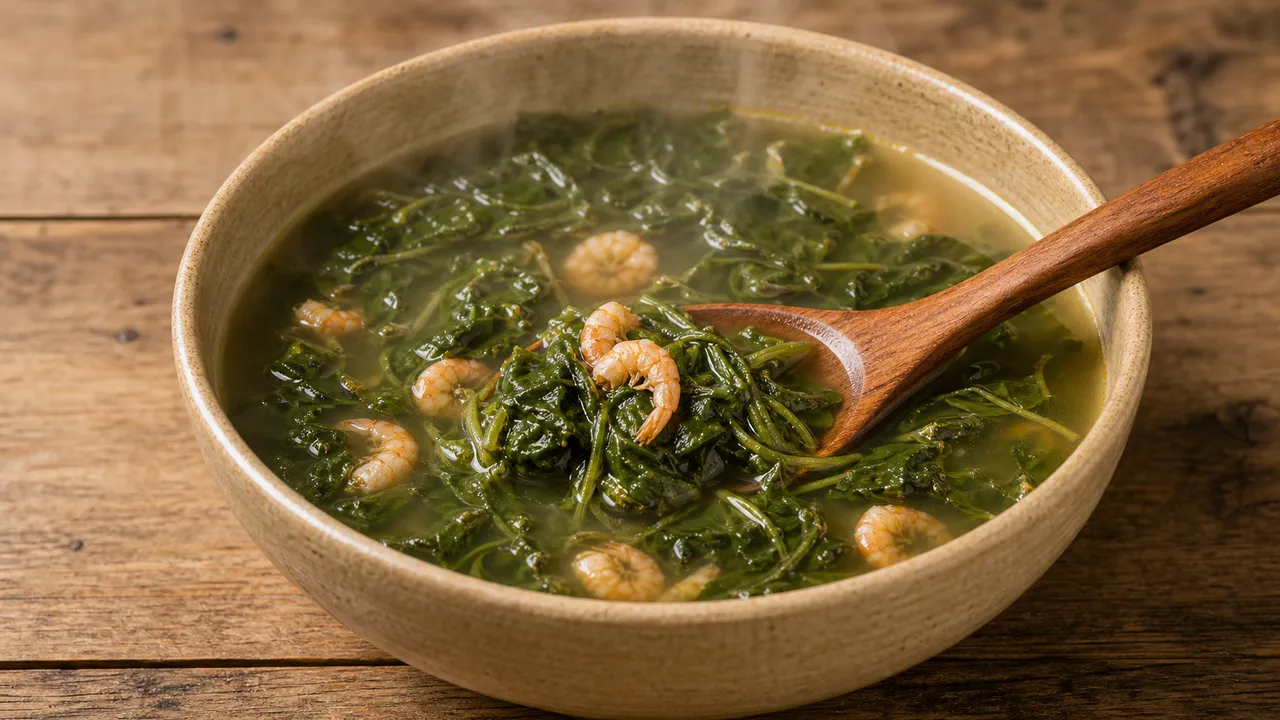
Savory and Refreshing Mallow Soybean Paste Soup (Auk Doenjan
* 이미지는 AI가 생성한 참고 이미지로, 실제 조리 결과물과 다를 수 있습니다.
This recipe for Auk Doenjang-guk (mallow soybean paste soup), a delightful 'rice thief,' is completed in about 15 minutes using mallow, rice water, dried shrimp, and doenjang (된장). It's a savory and refreshing dish with a deep umami flavor, smooth texture, and no grassy taste.
📝 Editor's Notes
This is a savory and refreshing Auk Doenjang-guk (Mallow Soybean Paste Soup) recipe that can be quickly prepared in just 15 minutes with one bunch of mallow and rice water.
The addition of dried shrimp and half a tablespoon of gochujang (고추장) creates a deep umami flavor, making it a perfect 'rice thief' soup for the whole family to enjoy with warm rice on chilly days.
The tender texture of the mallow, free of any grassy taste, is exquisite, and it will provide a healthy and hearty meal even on busy days.
🛒 Ingredient Tips
When choosing mallow, look for leaves that are vibrant green and not wilted, with stems that are not too tough.
If the stems are thick and fibrous, be sure to remove them to reduce the grassy taste and ensure a tender texture.
For dried shrimp, select those with a clear color and that are not broken.
Dried shrimp plays an important role in enhancing umami and providing a refreshing flavor to the broth.
For doenjang (된장), you can use homemade or store-bought varieties, but it's important to choose one that isn't too salty.
🔄 Substitution Guide
If mallow is difficult to find, you can use spinach or Swiss chard as substitutes.
However, spinach does not require as much kneading as mallow; simply blanch it lightly before use.
Swiss chard has a similar texture and taste to mallow but has less of a grassy smell, making it easier to prepare.
If you don't have dried shrimp, you can use an anchovy-kelp broth.
While anchovy broth provides good umami, it may differ from the refreshing and savory flavor unique to dried shrimp.
If you dislike gochujang (고추장) or have an allergy, you can make the soup with only doenjang (된장), but the umami might be slightly less intense.
In that case, try adding minced garlic or Cheongyang chili peppers (청양고추) to balance the flavor.
🥘 Ingredients
👨🍳 Cooking Points
The most crucial point in this recipe is preparing the mallow.
To remove the grassy smell and tenderize the mallow, never skip the step of vigorously kneading it with 1 handful of salt and 1 cup of water, as if hand-washing laundry.
The mallow is properly prepared when enough sticky, slimy liquid is released.
The second important step is sieving the doenjang (된장) and gochujang (고추장) into the broth; this ensures a smooth, clump-free soup.
Finally, it's essential to simmer the mallow thoroughly for at least 15 minutes to draw out its deep flavor, resulting in a richer and more savory doenjang-guk (된장국).
👨🍳 Directions
Cut off the thick stems of the mallow and peel off the fibrous parts. Use only the tender stems.
Roughly chop the prepared mallow into bite-sized pieces.
In a large bowl, combine the chopped mallow, 1 handful of salt, and 1 cup of water. Knead vigorously as if hand-washing laundry until the grassy smell disappears and the mallow becomes soft. A sticky, slimy liquid should be released.
Rinse the kneaded mallow thoroughly with water and set aside.
In a pot, add 1.5 liters of rice water, 1 piece of kelp, and 1 handful of dried shrimp. Bring to a boil to make the broth.
Optionally, add a broth tablet or powdered broth for enhanced flavor.
Sieve 2 tbsp of doenjang (된장) and 0.5 tbsp of gochujang (고추장) into the broth, ensuring no clumps remain.
Add the prepared mallow to the broth and simmer thoroughly for at least 15 minutes to bring out a deep flavor.
Remove the kelp after simmering for about 5-10 minutes. Over-boiling can result in a bitter taste.
Chop a little green onion, a little garlic chives, and 1-2 Cheongyang chili peppers (청양고추) into bite-sized pieces.
Add the chopped green onions, garlic chives, and Cheongyang chili peppers (청양고추) to the boiling doenjang-guk and bring to a boil once more.
Taste the soup and adjust seasoning with Korean soup soy sauce (국간장), doenjang (된장), or tuna extract if it's bland.
Optionally, add a pinch of gochugaru (고춧가루) for extra flavor.
💡 Tips
Thoroughly knead the mallow with salt as if hand-washing laundry. A sticky, slimy liquid must be released for the grassy smell to disappear and for the mallow to become tender.
Adding a little gochujang (고추장) significantly enhances the umami flavor compared to using only doenjang (된장).
To develop a deep flavor, the mallow must be simmered thoroughly for at least 15 minutes.
Using rice water makes the doenjang-guk (된장국) taste even more harmonious. Remove the kelp after 5-10 minutes of boiling, as simmering it for too long can result in a bitter taste.
📦 Storage & Reuse
Store the finished Auk Doenjang-guk (Mallow Soybean Paste Soup) in an airtight container in the refrigerator for 3-4 days to keep it fresh.
For longer storage, we recommend dividing it into single portions and freezing it for up to approximately 1 month.
To thaw, you can either naturally defrost it in the refrigerator or microwave it.
For the best flavor without altering the soup's taste, gently reheat it over low heat in a pot.
The leftover soup is also delicious mixed with rice, or you can add boiled noodles to make Doenjang Guksu (Soybean Paste Noodle Soup).
🥢 Who This Is For
This Auk Doenjang-guk (Mallow Soybean Paste Soup) is excellent as a hearty meal served with warm rice.
It's particularly comforting and warming, perfect for days when you need a soothing bowl of soup, or even as a hangover cure.
Pair it with simple grilled fish or savory egg rolls for an even more abundant meal.
We recommend this dish for the entire family, from children to seniors.
🔥 Nutrition Info
Based on a single serving, this Auk Doenjang-guk (Mallow Soybean Paste Soup) is estimated to contain approximately 150-200 kcal.
It will likely have about 8-12g of protein, 5-8g of fat, and 15-20g of carbohydrates.
Mallow is rich in vitamins A and C, calcium, and iron, contributing to immune system strengthening and bone health.
Its high fiber content is also beneficial for gut health.
Dried shrimp are abundant in calcium and chitin, while doenjang (된장) is a fermented food containing beneficial lactic acid bacteria, promoting digestive health.
Overall, it is a well-balanced and healthy soup dish.
💬 Frequently Asked Questions
- Q. What ingredients do I need for Savory and Refreshing Mallow Soybean Paste Soup (Auk Doenjang-guk) Recipe?
- Main ingredients include Mallow (아욱), Rice water, Kelp, Dried shrimp, Doenjang (된장). When choosing mallow, look for leaves that are vibrant green and not wilted, with stems that are not too tough. If the stems are thick and fibrous, be sure to remove them to reduce the grassy taste and ensure a tender texture. For dried shrimp, select those with a clear color and that are not broken. Dried shrimp plays an important role in enhancing umami and providing a refreshing flavor to the broth. For doenjang (된장), you can use homemade or store-bought varieties, but it's important to choose one that isn't too salty.
- Q. What are the key tips for making Savory and Refreshing Mallow Soybean Paste Soup (Auk Doenjang-guk) Recipe?
- The most crucial point in this recipe is preparing the mallow. To remove the grassy smell and tenderize the mallow, never skip the step of vigorously kneading it with 1 handful of salt and 1 cup of water, as if hand-washing laundry. The mallow is properly prepared when enough sticky, slimy liquid is released. The second important step is sieving the doenjang (된장) and gochujang (고추장) into the broth; this ensures a smooth, clump-free soup. Finally, it's essential to simmer the mallow thoroughly for at least 15 minutes to draw out its deep flavor, resulting in a richer and more savory doenjang-guk (된장국).
- Q. How should I store leftover Savory and Refreshing Mallow Soybean Paste Soup (Auk Doenjang-guk) Recipe?
- Store the finished Auk Doenjang-guk (Mallow Soybean Paste Soup) in an airtight container in the refrigerator for 3-4 days to keep it fresh. For longer storage, we recommend dividing it into single portions and freezing it for up to approximately 1 month. To thaw, you can either naturally defrost it in the refrigerator or microwave it. For the best flavor without altering the soup's taste, gently reheat it over low heat in a pot. The leftover soup is also delicious mixed with rice, or you can add boiled noodles to make Doenjang Guksu (Soybean Paste Noodle Soup).
- Q. How many calories are in Savory and Refreshing Mallow Soybean Paste Soup (Auk Doenjang-guk) Recipe?
- Based on a single serving, this Auk Doenjang-guk (Mallow Soybean Paste Soup) is estimated to contain approximately 150-200 kcal. It will likely have about 8-12g of protein, 5-8g of fat, and 15-20g of carbohydrates. Mallow is rich in vitamins A and C, calcium, and iron, contributing to immune system strengthening and bone health. Its high fiber content is also beneficial for gut health. Dried shrimp are abundant in calcium and chitin, while doenjang (된장) is a fermented food containing beneficial lactic acid bacteria, promoting digestive health. Overall, it is a well-balanced and healthy soup dish.
- Q. Can I substitute ingredients in Savory and Refreshing Mallow Soybean Paste Soup (Auk Doenjang-guk) Recipe?
- If mallow is difficult to find, you can use spinach or Swiss chard as substitutes. However, spinach does not require as much kneading as mallow; simply blanch it lightly before use. Swiss chard has a similar texture and taste to mallow but has less of a grassy smell, making it easier to prepare. If you don't have dried shrimp, you can use an anchovy-kelp broth. While anchovy broth provides good umami, it may differ from the refreshing and savory flavor unique to dried shrimp. If you dislike gochujang (고추장) or have an allergy, you can make the soup with only doenjang (된장), but the umami might be slightly less intense. In that case, try adding minced garlic or Cheongyang chili peppers (청양고추) to balance the flavor.
💬 Comments
No comments yet. Be the first to comment!