
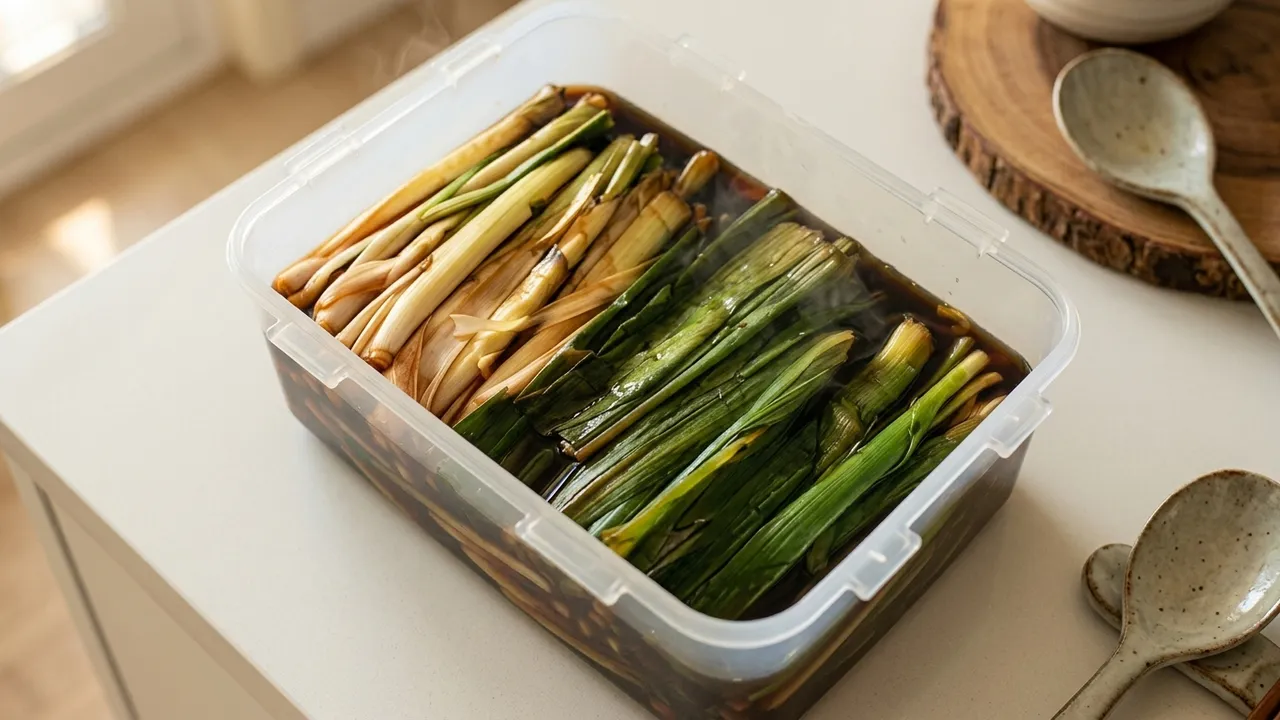
Young Garlic Jangajji (Korean Pickled Young Garlic, similar
* 이미지는 AI가 생성한 참고 이미지로, 실제 조리 결과물과 다를 수 있습니다.
This jangajji (Korean pickled side dish) made with young garlic chives offers a taste similar to Myeong-i Namul (Korean wild garlic leaves) pickle, and is an excellent, affordable, and delicious banchan (everyday side dish).
📝 Editor's Notes
Young Garlic Jangajji is a delightful banchan (side dish) that perfectly captures the fragrant aroma and crisp texture of spring young garlic chives.
It offers a taste similar to Myeong-i Namul (Korean wild garlic leaves) pickle but at a much more affordable price, making it an excellent value.
The sweet, sour, and savory soy sauce seasoning, combined with the unique pungent flavor of young garlic chives, truly stimulates the appetite.
The preparation process is simple, making it easy for even novice cooks to try.
A major advantage is that it can be enjoyed from the very next day, as it's pickled immediately by pouring hot brine over it.
It pairs wonderfully with meat dishes, cutting through their richness, and also serves as a fantastic accompaniment to rice, making it a dish the whole family can enjoy.
🛒 Ingredient Tips
The key to delicious Young Garlic Jangajji lies in selecting fresh young garlic chives.
Look for chives with firm, green stalks and leaves that are not withered or yellowed.
Choose chives of moderate thickness rather than overly thick ones to ensure a tender and crisp texture.
Chives that are relatively clean and free of excessive dirt will also be much easier to prepare.
Young garlic chives are typically in season between March and May, so try to find the freshest and most flavorful ones during this period.
Remember, good ingredients are the first step to making a delicious jangajji!
🔄 Substitution Guide
If young garlic chives are difficult to find or if you'd like to try variations with other ingredients, consider a few substitutes.
Instead of young garlic chives, you can use scallions (jokpa, 쪽파) or chamnamul (참나물, Pimpinella brachycarpa).
Scallions offer a crisp texture and a milder aroma, providing a different charm, while chamnamul's unique fragrance pairs well with the pickling brine.
However, please note that the distinctive flavor of young garlic chives may not be fully replicated.
The brewed vinegar in this recipe can be replaced with apple cider vinegar or brown rice vinegar without significant changes to the taste.
Soju (소주) plays a role in eliminating off-flavors from the brine and enhancing preservation.
If soju is unavailable, you can substitute it with cheongju (청주, Korean rice wine) or mirin (맛술, sweet cooking rice wine).
However, as mirin is sweeter, you might want to slightly adjust the amount of sugar.
🥘 Ingredients
👨🍳 Cooking Points
There are three key points for successfully making this Young Garlic Jangajji.
First, it's crucial to thoroughly remove all dirt when cleaning the young garlic chives.
Especially for the white stalk sections, you should separate them into individual strands and rinse them repeatedly, shaking them well.
Second, make sure to cut the white stalk sections lengthwise in half.
This allows the pickling brine to penetrate deeply into the chives, resulting in a richer flavor and a much tenderer, more satisfying texture when eaten.
Third, the most critical step is to immediately pour the boiling hot pickling brine over the chives.
The hot brine instantly cooks the chives' tissue, helping them maintain their crisp texture for a longer period.
Lastly, stirring and flipping the young garlic chives every hour after pouring the brine ensures that they are evenly seasoned from top to bottom, resulting in a much more delicious jangajji.
👨🍳 Directions
Separate the young garlic chives into white stalk sections and green leafy parts. To remove any dirt caught in the connecting areas, separate the chives into individual strands and rinse them thoroughly multiple times under running water, shaking them well.
Trim off any yellowed tips of the young garlic chive leaves and continue washing until no dirt is visible.
For the white stalk sections, cut them lengthwise in half, but not completely through the end, so they can spread out like leaves.
Cut the green leafy parts into 3 equal pieces to fit easily into your container.
Arrange the trimmed and cut young garlic chives neatly into a container.
In a pot, combine 2 cups water, 2 cups soy sauce, 1 cup brewed vinegar, 1⅔ cups sugar, and ⅔ cup soju (소주). Bring the mixture to a rolling boil to create the pickling brine.
Immediately pour the hot, boiling pickling brine over the young garlic chives in the container.
Press down on the young garlic chives to ensure they are fully submerged in the brine, and stir/flip them about once an hour to ensure even saturation.
After about 3 hours, the young garlic chives will have softened sufficiently, and you can start enjoying them from the next day.
💡 Tips
Pouring the pickling brine while it's hot helps the young garlic chives maintain their crisp texture and prevents them from becoming mushy.
After pouring the brine, stirring and flipping the young garlic chives every hour for the first few hours ensures they are evenly steeped in the brine.
Young garlic jangajji can be enjoyed deliciously with meat, wrapped together like ssam (wrap vegetable), similar to how Myeong-i Namul (Korean wild garlic leaves) is eaten.
If you plan to make enough jangajji to last for a year, it's recommended to prepare about 6.6 lb (3 kg) of young garlic chives.
📦 Storage & Reuse
Store the finished Young Garlic Jangajji in an airtight container in the refrigerator.
Ensure there is enough pickling brine to fully cover the young garlic chives to keep them fresh and prevent spoilage for a long time.
While it can be stored for up to a year as mentioned in the recipe tips, it's recommended to consume it within 3 to 6 months after opening, as frequent air exposure can affect its quality.
Jangajji is best enjoyed chilled, so serve it directly from the refrigerator without reheating.
If you have any leftover pickling brine, don't discard it!
This flavorful brine can be used as a seasoning for dubu-jorim (braised tofu), meat marinades, or even in fried rice, adding a wonderful umami boost.
🥢 Who This Is For
This Young Garlic Jangajji pairs exceptionally well with rich, fatty meat dishes.
Serve it alongside samgyeopsal (grilled pork belly), ogyeopsal (grilled five-layered pork belly), or bossam (boiled pork wraps) as a ssam (wrap vegetable) to cut through the richness of the meat, allowing you to enjoy more without feeling overwhelmed.
It's also a fantastic 'rice thief' when simply placed on warm rice.
Those who typically enjoy Myeong-i Namul (Korean wild garlic leaves) pickle will find this particularly satisfying.
We highly recommend this healthy and delicious banchan (side dish) that the whole family can enjoy, enriching your dining table.
🔥 Nutrition Info
Young Garlic Jangajji is a dish that enhances the flavor while allowing you to enjoy the nutritional benefits of young garlic chives.
For a single serving (approximately 50g), the estimated calorie count ranges from about 80-120 kcal.
Most calories come from carbohydrates in sugar, with very low protein and fat content.
Young garlic chives themselves are rich in various vitamins and minerals such as Vitamin A, C, calcium, and iron, which can help boost immunity and relieve fatigue.
The allicin compound, unique to garlic, is particularly known for its excellent effects on improving blood circulation and antimicrobial activity.
However, as it contains soy sauce and sugar, the sodium and sugar content can be high, so it is healthier to enjoy it in moderation rather than excessive consumption.
💬 Frequently Asked Questions
- Q. What ingredients do I need for Young Garlic Jangajji (Korean Pickled Young Garlic, similar to Wild Garlic Leaves Pickle)?
- Main ingredients include Young garlic chives (trimmed), Soy sauce, Water, Sugar, Brewed vinegar. The key to delicious Young Garlic Jangajji lies in selecting fresh young garlic chives. Look for chives with firm, green stalks and leaves that are not withered or yellowed. Choose chives of moderate thickness rather than overly thick ones to ensure a tender and crisp texture. Chives that are relatively clean and free of excessive dirt will also be much easier to prepare. Young garlic chives are typically in season between March and May, so try to find the freshest and most flavorful ones during this period. Remember, good ingredients are the first step to making a delicious jangajji!
- Q. What are the key tips for making Young Garlic Jangajji (Korean Pickled Young Garlic, similar to Wild Garlic Leaves Pickle)?
- There are three key points for successfully making this Young Garlic Jangajji. First, it's crucial to thoroughly remove all dirt when cleaning the young garlic chives. Especially for the white stalk sections, you should separate them into individual strands and rinse them repeatedly, shaking them well. Second, make sure to cut the white stalk sections lengthwise in half. This allows the pickling brine to penetrate deeply into the chives, resulting in a richer flavor and a much tenderer, more satisfying texture when eaten. Third, the most critical step is to immediately pour the boiling hot pickling brine over the chives. The hot brine instantly cooks the chives' tissue, helping them maintain their crisp texture for a longer period. Lastly, stirring and flipping the young garlic chives every hour after pouring the brine ensures that they are evenly seasoned from top to bottom, resulting in a much more delicious jangajji.
- Q. How should I store leftover Young Garlic Jangajji (Korean Pickled Young Garlic, similar to Wild Garlic Leaves Pickle)?
- Store the finished Young Garlic Jangajji in an airtight container in the refrigerator. Ensure there is enough pickling brine to fully cover the young garlic chives to keep them fresh and prevent spoilage for a long time. While it can be stored for up to a year as mentioned in the recipe tips, it's recommended to consume it within 3 to 6 months after opening, as frequent air exposure can affect its quality. Jangajji is best enjoyed chilled, so serve it directly from the refrigerator without reheating. If you have any leftover pickling brine, don't discard it! This flavorful brine can be used as a seasoning for dubu-jorim (braised tofu), meat marinades, or even in fried rice, adding a wonderful umami boost.
- Q. How many calories are in Young Garlic Jangajji (Korean Pickled Young Garlic, similar to Wild Garlic Leaves Pickle)?
- Young Garlic Jangajji is a dish that enhances the flavor while allowing you to enjoy the nutritional benefits of young garlic chives. For a single serving (approximately 50g), the estimated calorie count ranges from about 80-120 kcal. Most calories come from carbohydrates in sugar, with very low protein and fat content. Young garlic chives themselves are rich in various vitamins and minerals such as Vitamin A, C, calcium, and iron, which can help boost immunity and relieve fatigue. The allicin compound, unique to garlic, is particularly known for its excellent effects on improving blood circulation and antimicrobial activity. However, as it contains soy sauce and sugar, the sodium and sugar content can be high, so it is healthier to enjoy it in moderation rather than excessive consumption.
- Q. Can I substitute ingredients in Young Garlic Jangajji (Korean Pickled Young Garlic, similar to Wild Garlic Leaves Pickle)?
- If young garlic chives are difficult to find or if you'd like to try variations with other ingredients, consider a few substitutes. Instead of young garlic chives, you can use scallions (jokpa, 쪽파) or chamnamul (참나물, Pimpinella brachycarpa). Scallions offer a crisp texture and a milder aroma, providing a different charm, while chamnamul's unique fragrance pairs well with the pickling brine. However, please note that the distinctive flavor of young garlic chives may not be fully replicated. The brewed vinegar in this recipe can be replaced with apple cider vinegar or brown rice vinegar without significant changes to the taste. Soju (소주) plays a role in eliminating off-flavors from the brine and enhancing preservation. If soju is unavailable, you can substitute it with cheongju (청주, Korean rice wine) or mirin (맛술, sweet cooking rice wine). However, as mirin is sweeter, you might want to slightly adjust the amount of sugar.
💬 Comments
No comments yet. Be the first to comment!