
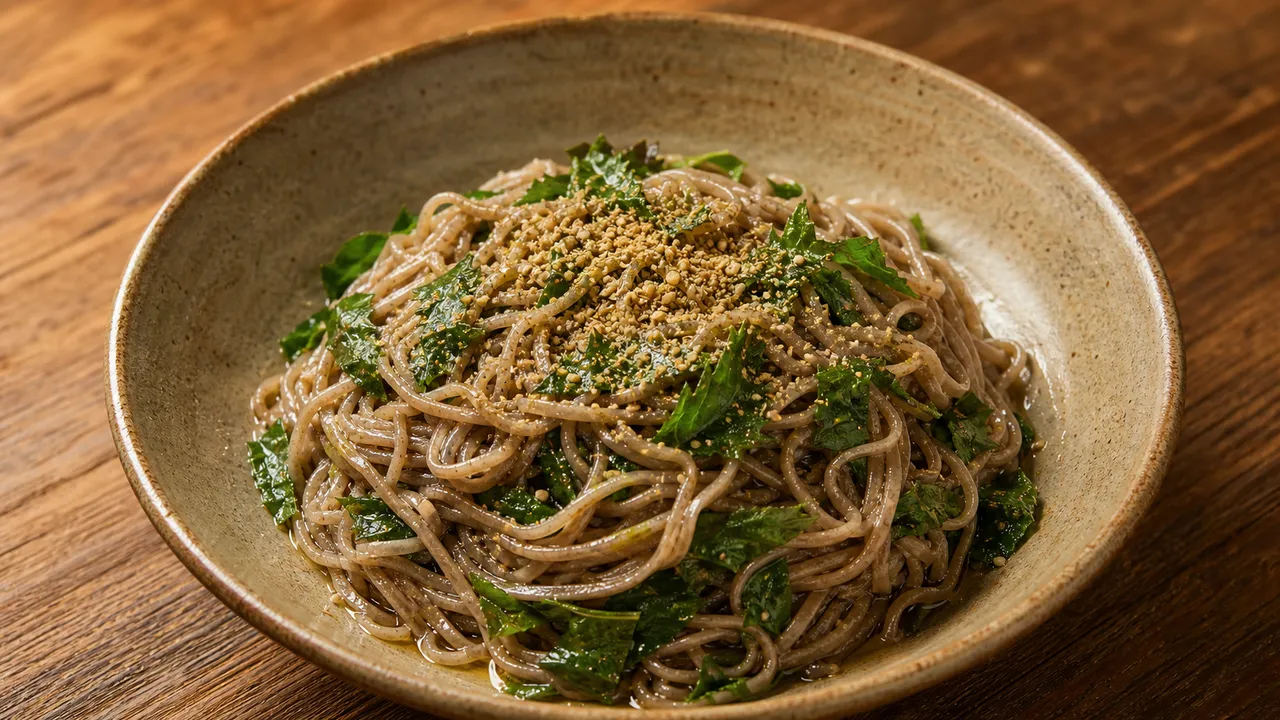
Perilla Oil Makguksu (Buckwheat Noodles) with a Golden Ratio
* 이미지는 AI가 생성한 참고 이미지로, 실제 조리 결과물과 다를 수 있습니다.
A refreshing and aromatic Perilla Oil Makguksu (Buckwheat Noodles), perfected with homemade umami-rich fish soy sauce (eogan-jang) and savory perilla oil (deul-gireum).
📋 2 recipes — Select to view
A refreshing and fragrant Perilla Oil Makguksu, perfected with savory perilla oil (들기름) and umami-rich eoganjang (어간장).
📝 Editor's Notes
Today's Perilla Oil Makguksu is a super simple recipe that can be prepared in just 5 minutes with only buckwheat noodles, perilla leaves (깻잎), eoganjang (어간장), and perilla oil (들기름).
The harmony of nutty perilla oil and fragrant perilla leaves is exceptional, and the deep umami flavor from the homemade eoganjang (어간장) will leave you wanting more than just one bowl.
It's a perfect refreshing delicacy to stimulate your appetite on hot summer days, or a wonderful light meal or late-night snack.
With simple ingredients and an uncomplicated cooking process, even beginner cooks can enjoy this dish successfully.
🛒 Ingredient Tips
For buckwheat noodles, store-bought dried noodles are fine, but it's recommended to choose products with a high buckwheat content for a richer flavor and chewier texture.
For perilla leaves (깻잎), it's important to choose fresh, vibrant green ones.
Select clean leaves without any wilting or yellowing.
Since their unique aroma is strong, use a moderate amount to avoid overpowering other ingredients.
For perilla oil (들기름), make sure to use roasted perilla oil, not raw, to bring out its nutty fragrance.
While sesame oil is also good, perilla oil is the key to this dish, so prepare a good quality one.
If you use homemade eoganjang (어간장), the umami will be much deeper, but store-bought eoganjang or gukganjang (국간장) can also be used.
🔄 Substitution Guide
If you don't have eoganjang (어간장), you can mix 2 tbsp of gukganjang (국간장, Korean soup soy sauce) with 1 tbsp of aekjeot (액젓, fish sauce) to achieve a similar umami flavor.
Using gukganjang alone might lack a bit of depth, so adding a small amount of aekjeot is recommended.
Instead of perilla leaves (깻잎), you can use shredded seaweed (김가루) for a nutty flavor, but you'll miss the unique fragrance of perilla leaves.
If you don't have perilla leaves or dislike them, finely chopped chives or green onions (쪽파) also work well.
Perilla powder (들깨가루) and sesame powder (참깨가루) are key to the nutty flavor of this dish, so it's best not to substitute them.
However, if you don't have them, chopped roasted peanuts or other nut powders can be used, though the taste and aroma may differ slightly.
🥘 Ingredients
👨🍳 Cooking Points
There are two crucial cooking points in this recipe.
First, stir-frying the perilla leaves (깻잎).
To preserve their aroma and maintain a crisp texture, they must be stir-fried quickly over high heat.
In a generously oiled pan, stir-fry them rapidly within 1 minute.
Once they release their absorbed oil, immediately turn off the heat and spread them out on parchment paper to cool.
This will result in a crispy and nutty topping.
Second, boiling the buckwheat noodles.
After boiling for about 5 minutes, vigorously rub and rinse them in cold water to achieve a chewy texture and prevent them from getting soggy.
By following these two tips, you can make delicious Perilla Oil Makguksu without fail.
👨🍳 Directions
Julienne the perilla leaves (깻잎). In a generously oiled pan, quickly stir-fry the julienned perilla leaves over high heat.
Stir-fry continuously to prevent burning. Once the perilla leaves (깻잎) release the oil they absorbed, turn off the heat and spread them out on parchment paper to cool.
Boil the buckwheat noodles for about 5 minutes. Then, rinse them vigorously under cold water, rubbing them well, and drain thoroughly.
Place the buckwheat noodles in a bowl and drizzle with 3 tbsp of eoganjang (어간장) and 2 tbsp of perilla oil (들기름).
Sprinkle generously with roasted perilla powder (볶은 들깨가루) and roasted sesame powder (볶은 참깨가루) to finish.
💡 Tips
Stir-frying perilla leaves (깻잎) in oil allows you to enjoy them as an even nuttier garnish instead of shredded seaweed.
After boiling, rinsing buckwheat noodles vigorously in cold water makes them chewier and less likely to get soggy.
📦 Storage & Reuse
This Perilla Oil Makguksu is best made and eaten immediately.
This is because the noodles can get soggy easily, and the perilla leaf (깻잎) topping might become damp.
If you have any leftover ingredients, store uncooked noodles sealed in the refrigerator.
The stir-fried perilla leaves can be stored in an airtight container in the refrigerator for about 2-3 days.
It's recommended to prepare the sauce in advance and mix it with the noodles and topping right before serving.
Leftover stir-fried perilla leaves can also be enjoyed as a side dish for rice or added to rice balls for a delightful twist.
🥢 Who This Is For
This Perilla Oil Makguksu is perfect when you crave a light and refreshing meal, or as a special treat on a hot summer day when your appetite is low.
It makes an excellent accompaniment to a cold beer or a glass of makgeolli (막걸리).
It also pairs well with meat dishes, or can be served with simple fried dishes or jeon (전) to complete a hearty spread.
If you enjoy spicy flavors, finely chopped cheongyang pepper (청양고추) makes a great addition.
🔥 Nutrition Info
One serving of this Perilla Oil Makguksu (based on 100g of buckwheat noodles) is estimated to be approximately 450-500 kcal.
It will contain about 15g of protein, 30g of fat, and 40g of carbohydrates.
Buckwheat noodles are rich in rutin, which can help support vascular health.
Perilla leaves (깻잎) are abundant in vitamins A and C, as well as iron, benefiting immune system enhancement and anemia prevention.
Perilla oil (들기름) is rich in omega-3 fatty acids, positively impacting cardiovascular health.
Overall, it's a meal balanced with carbohydrates, fats, and proteins.
💬 Frequently Asked Questions
- Q. What ingredients do I need for Perilla Oil Makguksu (Buckwheat Noodles) with a Golden Ratio Fish Soy Sauce (Eogan-jang)?
- Main ingredients include Buckwheat noodles, Perilla leaves, Fish soy sauce (eogan-jang), Perilla oil (deul-gireum), Roasted perilla seed powder. The key ingredients that determine the taste of Perilla Oil Makguksu are perilla oil (deul-gireum), fish soy sauce (eogan-jang), and buckwheat noodles. It's best to use fresh, domestically produced cold-pressed perilla oil. Its unique savory and aromatic flavor will greatly enhance the taste of the makguksu. For fish soy sauce (eogan-jang), store-bought products are fine, but homemade fish soy sauce will yield an even deeper flavor. For buckwheat noodles, check the buckwheat content on the packaging. While noodles with a higher buckwheat content tend to break more easily, you can truly enjoy buckwheat's unique aroma and texture. For perilla leaves, it's important to choose fresh ones with vibrant color and no wilting.
- Q. What are the key tips for making Perilla Oil Makguksu (Buckwheat Noodles) with a Golden Ratio Fish Soy Sauce (Eogan-jang)?
- There are two main cooking points in this recipe. First, it's important to stir-fry the perilla leaves quickly over high heat. Stir-frying them over high heat in a generously oiled pan helps maintain their crispness and maximizes their savory aroma. Keep stirring to prevent burning; once the perilla leaves release their oil, immediately turn off the heat and let them cool. Second is the process of vigorously rinsing the buckwheat noodles in cold water after boiling them. This process removes starch from the noodles, resulting in much chewier makguksu that doesn't get soggy easily. After boiling for about 5 minutes, immediately rinse them in cold water and drain thoroughly. If you remember just these two points, you'll be able to make delicious Perilla Oil Makguksu without fail.
- Q. How should I store leftover Perilla Oil Makguksu (Buckwheat Noodles) with a Golden Ratio Fish Soy Sauce (Eogan-jang)?
- Finished Perilla Oil Makguksu is best enjoyed immediately as the noodles can easily get soggy. If there are leftovers, it's recommended to store the noodles and sauce separately. Buckwheat noodles, thoroughly drained and stored in an airtight container in the refrigerator, can last for about a day, but their texture may change significantly. The stir-fried perilla leaf garnish can be stored in an airtight container in the refrigerator for about 2-3 days. Leftover perilla leaf garnish can be used in bibimbap or other noodle dishes, or simply mixed with warm rice for a delicious meal.
- Q. How many calories are in Perilla Oil Makguksu (Buckwheat Noodles) with a Golden Ratio Fish Soy Sauce (Eogan-jang)?
- This Perilla Oil Makguksu is estimated to be approximately 450-550 kcal per serving. This may vary depending on the amount of buckwheat noodles, perilla oil (deul-gireum), and fish soy sauce (eogan-jang) used. It is estimated to contain approximately 60-70g of carbohydrates, 10-15g of protein, and 20-30g of fat. Buckwheat is rich in a compound called rutin, which can help with vascular health, and perilla leaves are rich in vitamins A and C, iron, and other nutrients, which are good for boosting immunity and skin health. Perilla oil (deul-gireum) is rich in omega-3 fatty acids, which can help prevent cardiovascular diseases, but it has a high fat content, so it's best to consume it in moderation.
- Q. Can I substitute ingredients in Perilla Oil Makguksu (Buckwheat Noodles) with a Golden Ratio Fish Soy Sauce (Eogan-jang)?
- If you need to use other noodles instead of buckwheat noodles, thin wheat noodles or medium wheat noodles are acceptable. However, the unique nutty aroma and chewiness of buckwheat noodles may be diminished. If you have a perilla leaf allergy or find them difficult to obtain, you can use roasted seaweed flakes or finely chopped stir-fried chives as a garnish. The taste will be slightly different, but you can still add a savory flavor. If you don't have fish soy sauce (eogan-jang), you can mix 2 tbsp of regular soy sauce with 1 tbsp of fish sauce to achieve a similar umami flavor. You can omit both perilla seed powder and sesame seed powder, or use only one, but be aware that the savory flavor may be reduced.
💬 Comments
No comments yet. Be the first to comment!