
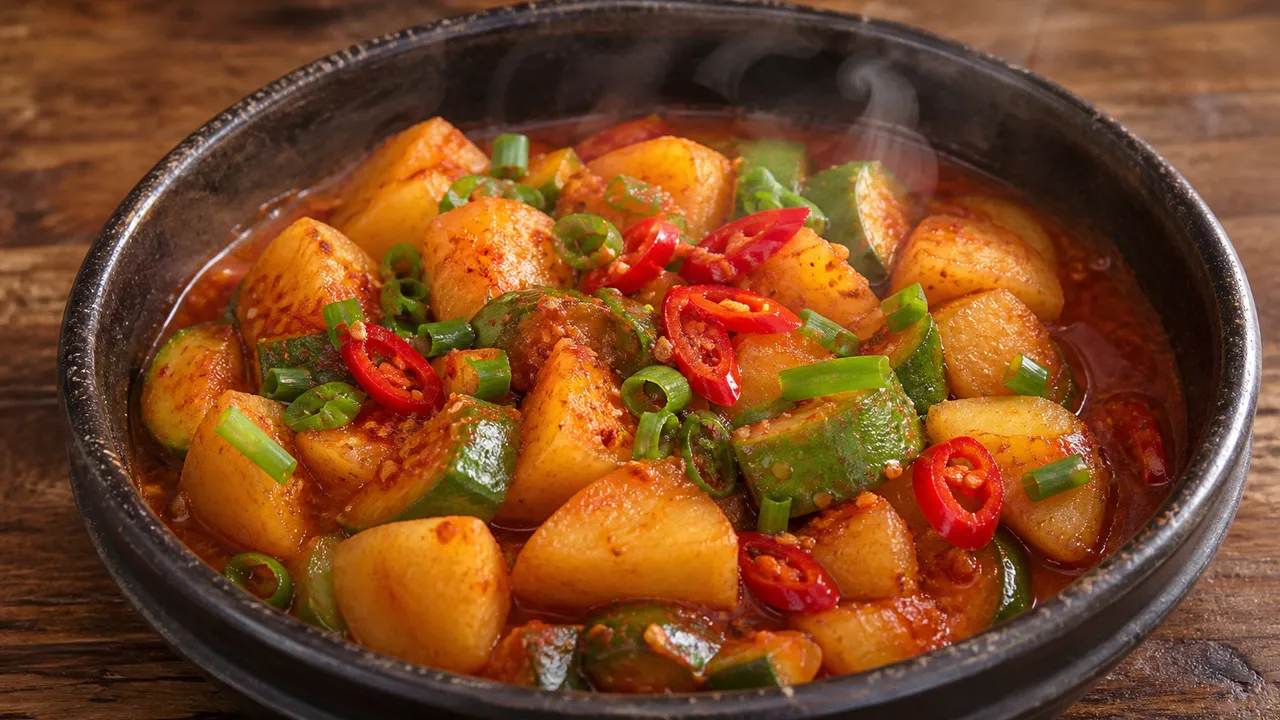
Hearty Potato and Joseon Hobak Gochujang Stew: Golden Ratio
* 이미지는 AI가 생성한 참고 이미지로, 실제 조리 결과물과 다를 수 있습니다.
This Korean gochujang stew offers a deep, savory flavor, combining tender potatoes and sweet Joseon hobak (조선호박) (Korean zucchini). Cooked with anchovy and kelp broth, it makes for a hearty and spicy meal.
📝 Editor's Notes
This Potato and Joseon Hobak Gochujang Stew, with its tender potatoes and sweet Joseon hobak (조선호박), offers a rich flavor that can be whipped up in just 18 minutes.
Cooked with anchovy and kelp broth, it boasts an excellent savory and spicy taste.
It's especially perfect when you crave a warm soup dish on a chilly day or a hearty and satisfying home-cooked meal.
With its spicy yet harmoniously sweet vegetable flavors, it's a Korean soul food that everyone, regardless of age, will love.
🛒 Ingredient Tips
For the key ingredient, potatoes, choose starchy varieties like Sumi (수미) or Dubaek (두백) potatoes for a fluffy texture.
Look for smooth, unblemished skins.
Joseon hobak (조선호박) (Korean zucchini) is sweeter and softer than regular zucchini, making it ideal for stew.
Choose ones that are not too large and have a glossy skin.
They are best in season from summer to autumn.
For a spicy kick, select Cheongyang chili peppers (청양고추) with fresh stems and deep colors.
The anchovy and kelp broth determines the depth of the stew, so make sure to use high-quality dried anchovies for broth and kelp without any fishy smell.
🔄 Substitution Guide
You can use aehobak (애호박) (regular zucchini) instead of Joseon hobak (조선호박) without a significant difference in taste.
Aehobak has a slightly softer texture than Joseon hobak and might be slightly less sweet.
If you don't have potatoes or are allergic to them, you can cube and add Korean radish (mu).
Radish adds a refreshing and spicy-cool flavor, but you won't get the same fluffy texture as with potatoes.
If saeujeot (새우젓) is unavailable, you can add a little more guk-ganjang (국간장) or season with salt, but keep in mind that the unique refreshing and umami flavor of saeujeot might be diminished.
Feel free to substitute based on the characteristics of each ingredient.
🥘 Ingredients
👨🍳 Cooking Points
There are three key points to cooking this delicious Potato and Joseon Hobak Gochujang Stew.
First, make sure to soak the potatoes in cold water for 10 minutes to remove starch.
This ensures a clear and clean broth.
Second, stir-frying the gochujang (고추장) in oil first is crucial.
Gently stir-fry over medium heat for 1 minute to enhance its vibrant color and bring out its savory flavor.
Be careful not to burn it on high heat.
Third, after adding the potatoes and broth, add the Joseon hobak (조선호박) when the potatoes are halfway cooked.
Adding zucchini too early can make it soft and mushy, but this timing helps retain its sweet flavor and good texture.
👨🍳 Directions
Cut 4 potatoes (approx. 400g) in half, then slice them into slightly thick pieces.
Immediately soak the sliced potatoes in cold water for 10 minutes to remove starch. (Removing starch prevents the stew broth from becoming cloudy.)
Cut off the ends of 300g Joseon hobak (조선호박) (Korean zucchini), slice it in half lengthwise, then cube it into bite-sized pieces. (Aehobak/regular zucchini also works well. Slicing the zucchini thickly helps it maintain its shape even after cooking.)
Cut 1 onion (approx. 100g) in half, then chop it finely.
Slice 2 Cheongyang chili peppers (청양고추) and 1 red chili pepper diagonally or chop them finely. (Removing the seeds from Cheongyang chili peppers keeps the spicy kick but reduces the overall heat.)
Slice 1/2 stalk of green onion diagonally.
Prepare 700ml anchovy and kelp broth by boiling a handful of dried anchovies and 1 piece of kelp for 10 minutes.
Heat 1 tbsp cooking oil in a pan (or wok) and add 1 tbsp minced garlic. Sauté until the garlic aroma develops. (Sautéing the garlic thoroughly removes its raw smell and infuses a savory fragrance throughout the broth.)
Add 2 tbsp gochujang (고추장) and gently stir-fry over medium heat for 1 minute. (Stir-frying gochujang in oil first enhances its color and deepens its savory flavor. Maintain medium heat as high heat can burn it quickly.)
Drain the soaked potatoes and add them to the stir-fried gochujang. Continue to stir-fry over medium heat. (Stir-frying the potatoes this way makes the broth much richer and more savory.)
Pour in 700ml anchovy and kelp broth and bring the potatoes to a rolling boil.
Add 1 tbsp guk-ganjang (국간장), 1 tbsp mirin (맛술), and 1 tbsp gochugaru (고춧가루). Stir well. (Adjust seasoning at this stage, being careful not to make it too salty.)
Close the lid and simmer for about 10 minutes.
After 10 minutes, open the lid and give it a gentle stir.
Once the potatoes are halfway cooked, add the sliced Joseon hobak (조선호박) and onion. Simmer for another 5 minutes over medium heat. (Adding the zucchini too early can make it mushy and lose its shape. It's best to add it when the potatoes are partially cooked to maintain its texture and flavor. As the zucchini softens, the broth will start to become sweeter and more savory.)
Close the lid and simmer for an additional 5 minutes.
Open the lid, add the green onion, Cheongyang chili peppers (청양고추), and red chili pepper, then simmer for just 2 more minutes. (Adding green onion at the end helps preserve its fresh aroma.)
Taste and adjust the seasoning. If it's bland, add a little saeujeot (새우젓). If it's too salty, add a little water to balance the flavor. (Seasoning with saeujeot results in a much more refreshing and cleaner broth compared to using salt.)
Serve the potato and Joseon hobak gochujang stew with warm rice and mix thoroughly before eating.
💡 Tips
Soaking potatoes in cold water for 10 minutes to remove starch keeps the stew broth clear and clean.
Stir-frying gochujang (고추장) in oil first enhances its vibrant color and savory flavor. It's crucial to maintain medium heat, as high heat can burn it quickly.
Add zucchini when the potatoes are halfway cooked to prevent it from becoming mushy and to allow its sweetness to infuse deliciously into the broth.
Using saeujeot (새우젓) for seasoning results in a much more refreshing and cleaner broth compared to using salt.
📦 Storage & Reuse
Once prepared, store the Potato and Joseon Hobak Gochujang Stew in an airtight container in the refrigerator for 2-3 days.
For longer storage, portion it out and freeze.
It can be kept frozen for up to about 1 month.
To thaw, either let it naturally defrost in the refrigerator or microwave it before transferring to a pot and reheating over low heat.
Adding a little water or broth at this stage can help maintain its original delicious flavor.
It's also delicious when mixed with rice or served with ramen noodles added to the leftover stew.
🥢 Who This Is For
This Potato and Joseon Hobak Gochujang Stew is a warm and hearty dish perfect for the whole family.
Especially when served with a bowl of rice, it makes a complete and satisfying meal without the need for other side dishes.
It's particularly well-suited for rainy days or cold weather when you're craving a spicy and savory soup.
For complementary dishes, consider serving it with pan-fried fish, mild steamed egg, or crunchy bean sprout salad for a more abundant table setting.
🔥 Nutrition Info
This Potato and Joseon Hobak Gochujang Stew is estimated to be approximately 250-300 kcal per serving.
It can be estimated to contain about 40-50g of carbohydrates, 10-15g of protein, and 5-10g of fat.
Potatoes are rich in Vitamin C and potassium, while zucchini provides Vitamin A and fiber.
Gochujang (고추장) contains capsaicin, which aids metabolism, and anchovy broth supplements calcium and protein, making this a nutritionally balanced meal.
Its spicy flavor also helps stimulate appetite.
💬 Frequently Asked Questions
- Q. What ingredients do I need for Hearty Potato and Joseon Hobak Gochujang Stew: Golden Ratio for a Tender Texture?
- Main ingredients include Potato, Joseon hobak (조선호박) (Korean zucchini, aehobak/regular zucchini also works), Onion, Cheongyang chili peppers (청양고추), Red chili pepper. For the key ingredient, potatoes, choose starchy varieties like Sumi (수미) or Dubaek (두백) potatoes for a fluffy texture. Look for smooth, unblemished skins. Joseon hobak (조선호박) (Korean zucchini) is sweeter and softer than regular zucchini, making it ideal for stew. Choose ones that are not too large and have a glossy skin. They are best in season from summer to autumn. For a spicy kick, select Cheongyang chili peppers (청양고추) with fresh stems and deep colors. The anchovy and kelp broth determines the depth of the stew, so make sure to use high-quality dried anchovies for broth and kelp without any fishy smell.
- Q. What are the key tips for making Hearty Potato and Joseon Hobak Gochujang Stew: Golden Ratio for a Tender Texture?
- There are three key points to cooking this delicious Potato and Joseon Hobak Gochujang Stew. First, make sure to soak the potatoes in cold water for 10 minutes to remove starch. This ensures a clear and clean broth. Second, stir-frying the gochujang (고추장) in oil first is crucial. Gently stir-fry over medium heat for 1 minute to enhance its vibrant color and bring out its savory flavor. Be careful not to burn it on high heat. Third, after adding the potatoes and broth, add the Joseon hobak (조선호박) when the potatoes are halfway cooked. Adding zucchini too early can make it soft and mushy, but this timing helps retain its sweet flavor and good texture.
- Q. How should I store leftover Hearty Potato and Joseon Hobak Gochujang Stew: Golden Ratio for a Tender Texture?
- Once prepared, store the Potato and Joseon Hobak Gochujang Stew in an airtight container in the refrigerator for 2-3 days. For longer storage, portion it out and freeze. It can be kept frozen for up to about 1 month. To thaw, either let it naturally defrost in the refrigerator or microwave it before transferring to a pot and reheating over low heat. Adding a little water or broth at this stage can help maintain its original delicious flavor. It's also delicious when mixed with rice or served with ramen noodles added to the leftover stew.
- Q. How many calories are in Hearty Potato and Joseon Hobak Gochujang Stew: Golden Ratio for a Tender Texture?
- This Potato and Joseon Hobak Gochujang Stew is estimated to be approximately 250-300 kcal per serving. It can be estimated to contain about 40-50g of carbohydrates, 10-15g of protein, and 5-10g of fat. Potatoes are rich in Vitamin C and potassium, while zucchini provides Vitamin A and fiber. Gochujang (고추장) contains capsaicin, which aids metabolism, and anchovy broth supplements calcium and protein, making this a nutritionally balanced meal. Its spicy flavor also helps stimulate appetite.
- Q. Can I substitute ingredients in Hearty Potato and Joseon Hobak Gochujang Stew: Golden Ratio for a Tender Texture?
- You can use aehobak (애호박) (regular zucchini) instead of Joseon hobak (조선호박) without a significant difference in taste. Aehobak has a slightly softer texture than Joseon hobak and might be slightly less sweet. If you don't have potatoes or are allergic to them, you can cube and add Korean radish (mu). Radish adds a refreshing and spicy-cool flavor, but you won't get the same fluffy texture as with potatoes. If saeujeot (새우젓) is unavailable, you can add a little more guk-ganjang (국간장) or season with salt, but keep in mind that the unique refreshing and umami flavor of saeujeot might be diminished. Feel free to substitute based on the characteristics of each ingredient.
💬 Comments
No comments yet. Be the first to comment!