
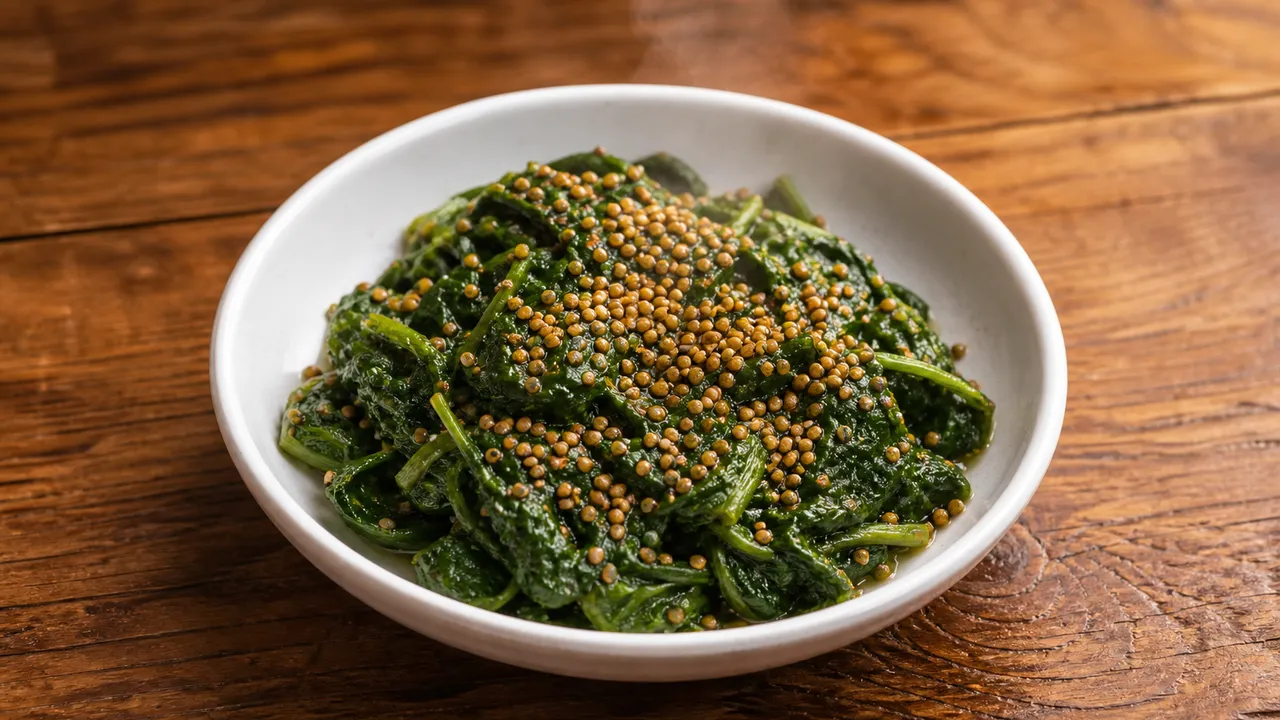
Fragrant Kkaennipsun Namul: Soft with a Popping Perilla Seed
* 이미지는 AI가 생성한 참고 이미지로, 실제 조리 결과물과 다를 수 있습니다.
This kkaennipsun namul (seasoned young perilla leaves) features soft young perilla leaves seasoned with perilla oil and roasted whole perilla seeds, creating a superb fragrant flavor and a delightful popping texture. Seasoned with guk-ganjang (국간장) for rich umami, this easy-to-make dish is a perfect 'rice thief' (bap-doduk) banchan (반찬).
📝 Editor's Notes
Introducing 'Fragrant Kkaennipsun Namul with Popping Perilla Seeds,' a delightful recipe ready in just 20 minutes, combining freshly picked kkaennipsun (깻잎순) with nutty whole roasted perilla seeds.
This namul (나물) dish, rich in fiber from the kkaennipsun, is seasoned with guk-ganjang (국간장) for deep umami.
A generous addition of whole perilla seeds provides a fantastic popping texture and nutty aroma with every bite.
It's an excellent spring delicacy that pairs perfectly with warm rice, stimulating your appetite.
Ideal for days when you crave fragrant vegetables and a healthy meal.
🛒 Ingredient Tips
Choose kkaennipsun (깻잎순) with stems that are not too thick or tough, and leaves that are fresh and vibrant green.
Avoid wilted or yellowing leaves.
While its peak season is from spring to early summer, fresh kkaennipsun is available year-round due to greenhouse cultivation.
To prepare whole perilla seeds, wash and dry them thoroughly, then lightly toast them in a dry pan to bring out their nutty aroma and ensure a delightful popping texture.
Be careful not to over-roast, as they can burn and become bitter.
For guk-ganjang (국간장), choose a product that is not overly salty but rich in umami flavor.
🔄 Substitution Guide
If kkaennipsun (깻잎순) is unavailable, you can substitute it with other fragrant greens.
For example, chamnamul (참나물) or chwinamul (취나물) offer a similar fragrance and make good alternatives.
However, chamnamul is softer than kkaennipsun, so blanching time should be reduced to about 1 minute.
Chwinamul, like kkaennipsun, is fibrous, so similar blanching times are acceptable.
You can use perilla seed powder instead of whole roasted perilla seeds, but the unique popping texture and nuttiness might be reduced.
If using perilla seed powder, use a slightly smaller amount and add it at the very end when seasoning.
If guk-ganjang (국간장) is not available, you can use regular soy sauce with a pinch of salt to season, but it may lack the distinct deep flavor of guk-ganjang.
🥘 Ingredients
👨🍳 Cooking Points
The key to this namul (나물) is properly blanching the kkaennipsun (깻잎순) and evenly coating it with seasoning.
First, kkaennipsun has more fiber than spinach, so it needs to be blanched for a full 1-2 minutes to achieve a soft, non-fibrous texture.
Add salt to boiling water, then add kkaennipsun and blanch, stirring to ensure even cooking.
Second, after blanching, rinse the kkaennipsun thoroughly in cold water a couple of times and squeeze out as much water as possible.
Too much water will dilute the seasoning and result in a bland taste.
Third, when seasoning, vigorously mix and massage the kkaennipsun with your hands, fluffing it to prevent clumping, which ensures the seasoning is evenly absorbed for a balanced flavor.
It's best to season it slightly on the salty side initially, as the flavor will mellow to perfection by the time it's served.
👨🍳 Directions
Rinse the kkaennipsun (깻잎순) once with water and set aside. Bring water to a boil for blanching the namul. (Since kkaennipsun namul is blanched and then washed again, a quick initial rinse is sufficient.)
Once the water boils, add salt and the kkaennipsun (깻잎순). Kkaennipsun has a lot of fiber, so it doesn't need to be removed as quickly as spinach. Stir to ensure even cooking, then cover for about 15 seconds, and continue to boil for 1-2 minutes. (It's better to slightly undercook than overcook. Perilla leaves can be surprisingly tough, so don't remove them too quickly. They are done when the stems are no longer overly tough when pressed.)
Place the blanched kkaennipsun (깻잎순) in cold water and rinse a couple of times. Squeeze out all excess water thoroughly with your hands.
Place the squeezed kkaennipsun (깻잎순) in a wide bowl and fluff it well to prevent the leaves from sticking together.
Add 2-3 tablespoons of guk-ganjang (국간장) to the kkaennipsun (깻잎순). Vigorously mix and massage it, then fluff it again, repeating this process. Taste and adjust the seasoning until it's slightly on the salty side.
Once seasoned with soy sauce, drizzle 1-2 rounds of perilla oil and mix. Finally, add a generous amount of whole roasted perilla seeds and mix to finish. (To prepare whole roasted perilla seeds, wash and dry them, then lightly toast them in a dry pan.)
💡 Tips
Kkaennipsun (깻잎순) has a lot of fiber, so it doesn't need to be removed from boiling water as quickly as spinach. Blanch it for 1-2 minutes, depending on the toughness of the stems.
When seasoning namul (나물), fluff the vegetables well to prevent them from clumping, ensuring the seasoning is evenly distributed.
Initially, season the dish to be slightly on the salty side; this will ensure the flavor is perfectly balanced when served.
Adding a generous amount of roasted whole perilla seeds enhances the popping texture and fragrant aroma.
📦 Storage & Reuse
Store the finished kkaennipsun namul (깻잎순나물) in an airtight container in the refrigerator for 2-3 days.
It tastes best when consumed as fresh as possible.
Freezing is not recommended as it can make the namul mushy, but if you have a large quantity, you can portion it out, freeze it, thaw, and then lightly stir-fry before eating.
Leftover kkaennipsun namul can be used in bibimbap (비빔밥) with warm rice, kimchi (김치), and gochujang (고추장), or as a filling for rice balls.
To reheat, microwave briefly or lightly stir-fry in a pan.
🥢 Who This Is For
This kkaennipsun namul (깻잎순나물) is highly recommended for anyone looking for a fragrant and healthy side dish.
Even children who are not usually fond of vegetables may enjoy it thanks to the nutty whole perilla seeds.
Enjoy it as part of bibimbap (비빔밥) by adding it to warm rice with a fried egg, or serve it alongside meat dishes to cut through the richness.
It also makes a wholesome and hearty meal when paired with a clear doenjang-guk (된장국) or sundubu-jjigae (순두부찌개).
🔥 Nutrition Info
This kkaennipsun namul (깻잎순나물) is estimated to be approximately 120-150 kcal per serving.
You can expect to consume about 3-5g of protein, 8-10g of fat (thanks to the perilla oil and whole perilla seeds), and 5-7g of carbohydrates.
Kkaennipsun is rich in vitamins A, C, and K, with high beta-carotene content, which benefits eye health and boosts immunity.
Whole perilla seeds are abundant in omega-3 fatty acids, good for cardiovascular health, and high in dietary fiber, contributing to gut health.
Overall, it is a healthy side dish rich in a balanced blend of vitamins, minerals, and healthy fats.
💬 Frequently Asked Questions
- Q. What ingredients do I need for Fragrant Kkaennipsun Namul: Soft with a Popping Perilla Seed Texture?
- Main ingredients include Kkaennipsun (깻잎순), Water, Salt, Guk-ganjang (국간장), Perilla Oil. Choose kkaennipsun (깻잎순) with stems that are not too thick or tough, and leaves that are fresh and vibrant green. Avoid wilted or yellowing leaves. While its peak season is from spring to early summer, fresh kkaennipsun is available year-round due to greenhouse cultivation. To prepare whole perilla seeds, wash and dry them thoroughly, then lightly toast them in a dry pan to bring out their nutty aroma and ensure a delightful popping texture. Be careful not to over-roast, as they can burn and become bitter. For guk-ganjang (국간장), choose a product that is not overly salty but rich in umami flavor.
- Q. What are the key tips for making Fragrant Kkaennipsun Namul: Soft with a Popping Perilla Seed Texture?
- The key to this namul (나물) is properly blanching the kkaennipsun (깻잎순) and evenly coating it with seasoning. First, kkaennipsun has more fiber than spinach, so it needs to be blanched for a full 1-2 minutes to achieve a soft, non-fibrous texture. Add salt to boiling water, then add kkaennipsun and blanch, stirring to ensure even cooking. Second, after blanching, rinse the kkaennipsun thoroughly in cold water a couple of times and squeeze out as much water as possible. Too much water will dilute the seasoning and result in a bland taste. Third, when seasoning, vigorously mix and massage the kkaennipsun with your hands, fluffing it to prevent clumping, which ensures the seasoning is evenly absorbed for a balanced flavor. It's best to season it slightly on the salty side initially, as the flavor will mellow to perfection by the time it's served.
- Q. How should I store leftover Fragrant Kkaennipsun Namul: Soft with a Popping Perilla Seed Texture?
- Store the finished kkaennipsun namul (깻잎순나물) in an airtight container in the refrigerator for 2-3 days. It tastes best when consumed as fresh as possible. Freezing is not recommended as it can make the namul mushy, but if you have a large quantity, you can portion it out, freeze it, thaw, and then lightly stir-fry before eating. Leftover kkaennipsun namul can be used in bibimbap (비빔밥) with warm rice, kimchi (김치), and gochujang (고추장), or as a filling for rice balls. To reheat, microwave briefly or lightly stir-fry in a pan.
- Q. How many calories are in Fragrant Kkaennipsun Namul: Soft with a Popping Perilla Seed Texture?
- This kkaennipsun namul (깻잎순나물) is estimated to be approximately 120-150 kcal per serving. You can expect to consume about 3-5g of protein, 8-10g of fat (thanks to the perilla oil and whole perilla seeds), and 5-7g of carbohydrates. Kkaennipsun is rich in vitamins A, C, and K, with high beta-carotene content, which benefits eye health and boosts immunity. Whole perilla seeds are abundant in omega-3 fatty acids, good for cardiovascular health, and high in dietary fiber, contributing to gut health. Overall, it is a healthy side dish rich in a balanced blend of vitamins, minerals, and healthy fats.
- Q. Can I substitute ingredients in Fragrant Kkaennipsun Namul: Soft with a Popping Perilla Seed Texture?
- If kkaennipsun (깻잎순) is unavailable, you can substitute it with other fragrant greens. For example, chamnamul (참나물) or chwinamul (취나물) offer a similar fragrance and make good alternatives. However, chamnamul is softer than kkaennipsun, so blanching time should be reduced to about 1 minute. Chwinamul, like kkaennipsun, is fibrous, so similar blanching times are acceptable. You can use perilla seed powder instead of whole roasted perilla seeds, but the unique popping texture and nuttiness might be reduced. If using perilla seed powder, use a slightly smaller amount and add it at the very end when seasoning. If guk-ganjang (국간장) is not available, you can use regular soy sauce with a pinch of salt to season, but it may lack the distinct deep flavor of guk-ganjang.
💬 Comments
No comments yet. Be the first to comment!