
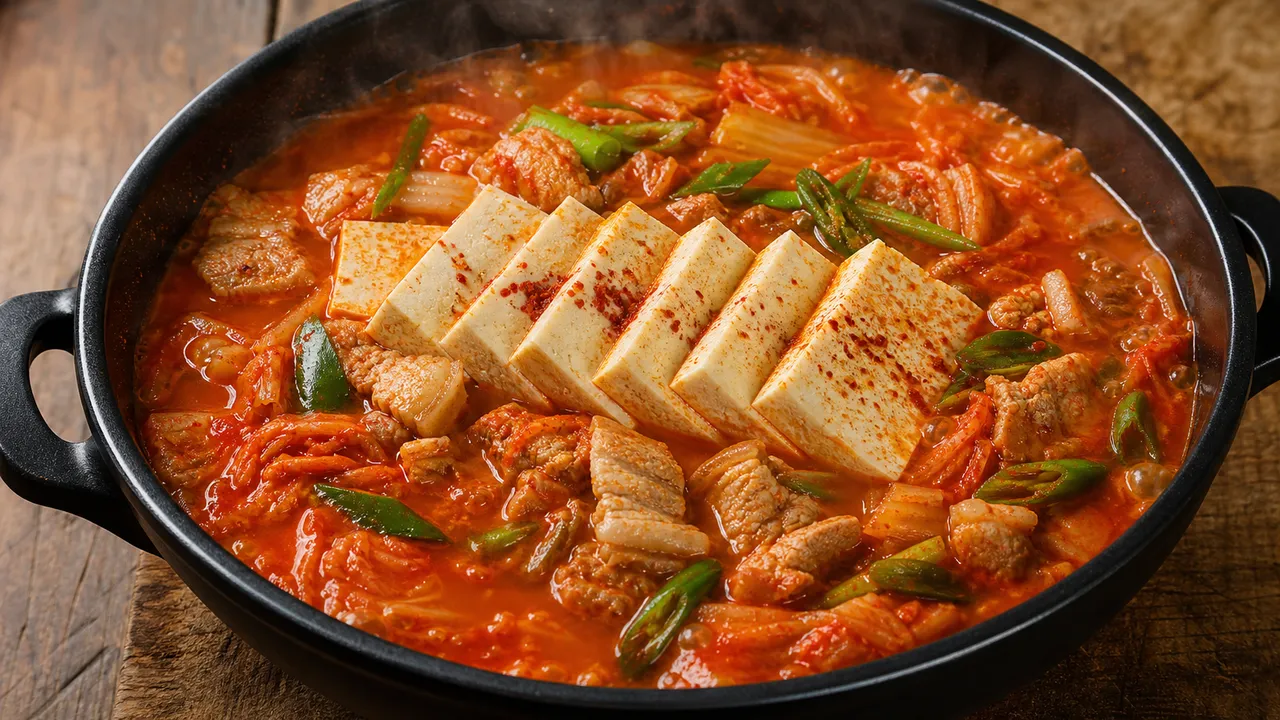
Baek Jong-won's Pork Fatback Kimchi Jjigae: A Secret Recipe
* 이미지는 AI가 생성한 참고 이미지로, 실제 조리 결과물과 다를 수 있습니다.
A deeply flavorful kimchi jjigae (김치찌개) made with pork fatback and well-fermented kimchi. This is Baek Jong-won's special recipe, ready in just 23 minutes for 4 servings.
📝 Editor's Notes
Baek Jong-won's Pork Fatback Kimchi Jjigae (김치찌개) is a special recipe that combines the deep umami flavor of pork fatback with well-fermented kimchi, ready in just 23 minutes.
The longer it simmers, the richer the broth becomes, making it a perfect hearty meal with a warm bowl of rice on a chilly day.
The savory fat rendered from the pork fatback gently mellows the kimchi's sourness, creating a beloved Korean comfort food that the whole family can enjoy.
🛒 Ingredient Tips
Pork fatback and napa cabbage kimchi (배추김치) are the core ingredients for the flavor of this kimchi jjigae.
It's beneficial to cut the pork fatback into small pieces, not too large, as this helps the fat render out better, creating a deeper flavor.
Use fresh fatback to avoid any gamey smell; when purchasing, choose pieces that are white and firm.
It's crucial to use well-fermented, sour kimchi.
If the kimchi is not sour enough, add a little vinegar to enhance the tartness, and if it's too sour, add a bit of sugar to balance the flavors.
For tofu, use firm or extra-firm tofu (부침용 두부) as it holds its shape better in the stew and won't easily crumble.
🔄 Substitution Guide
Instead of pork fatback, you can use pork belly (삼겹살) or pork neck (목살).
Using pork belly with fat attached will allow you to enjoy both the savory fat and the chewy lean meat.
In this case, stir-fry the meat first to render out enough fat before adding the kimchi and simmering.
If the kimchi is too sour or its distinct aroma is too strong for your liking, you can reduce the amount of kimchi and add king oyster mushrooms (새송이버섯) or enoki mushrooms (팽이버섯) to enhance texture and umami.
If you don't have fish sauce (액젓), you can substitute it with guk-ganjang (국간장, Korean soup soy sauce), but note that it may not provide the same deep umami flavor as fish sauce.
🥘 Ingredients
👨🍳 Cooking Points
The most crucial cooking points are: First, sufficiently rendering the fat from the pork fatback.
Add water, pork fatback, and onion to a pot and simmer over medium heat for 15 minutes to allow the fatback's savory flavor to infuse into the broth.
It's important to stir occasionally to help the fat render evenly.
Second, when adding kimchi, season with gochugaru (고춧가루), minced garlic, and fish sauce (액젓), and simmer until the flavors are well combined.
Kimchi jjigae deepens in flavor the longer it cooks, so if you have time, simmering for an additional 30 minutes to an hour will result in a much richer taste.
Third, add the tofu last and simmer for only about 1 minute.
Cooking it for too long can make the tofu tough or cause it to break apart.
👨🍳 Directions
Cut the pork fatback into small pieces.
In a pot, add water, pork fatback, and thinly sliced onion. Bring to a boil over medium heat and simmer for about 15 minutes. Stir occasionally to ensure the fat melts evenly.
Remove the pork fatback from the pot. Add kimchi (김치), coarse gochugaru (고춧가루), minced garlic, and fish sauce (액젓), then bring to a boil.
While it's boiling, slice the green onions and Cheongyang chili peppers (청양고추) about 0.7 cm (approx. 0.3 inches) thick.
Add the sliced green onions and Cheongyang chili peppers, and simmer for another 7 minutes.
Slice the tofu about 1 cm (approx. 0.4 inches) thick, add to the pot, and simmer for 1 more minute. Finish by sprinkling some gochugaru (고춧가루) on top.
💡 Tips
Cutting pork fatback into small pieces and storing it in advance makes it convenient to use. If stored pork fatback has an odor, thinly slice an onion and simmer it together with the fatback to neutralize the smell.
If the kimchi is not sour enough, add 1-2 tablespoons of regular vinegar. Conversely, if the kimchi is too sour, add ½ tablespoon of sugar to balance the tartness and enhance the umami flavor.
For a richer, deeper flavor, simmer the jjigae (찌개) for 30 minutes to 1 hour to allow the fat to render sufficiently. You can also add more water during this extended simmering time.
📦 Storage & Reuse
The completed kimchi jjigae can be stored in an airtight container in the refrigerator for 3-4 days.
Since jjigae tends to deepen in flavor as it sits, allowing it to rest for a day can make it even more delicious.
For longer storage, divide it into single servings and freeze.
It can be frozen for up to about a month; when ready to eat, thaw and gently reheat over low heat.
Leftover jjigae is also delicious with ramen or udon noodles, or you can mix it with rice to make kimchi fried rice.
🥢 Who This Is For
This pork fatback kimchi jjigae (김치찌개) is highly recommended for those who love a spicy and rich flavor.
It's especially wonderful for the whole family to gather around and enjoy on a rainy day or a chilly evening when you crave a warm, comforting soup.
A simple spread of freshly cooked warm rice, a fried egg, and roasted seaweed (김) makes for an excellent meal.
It also pairs wonderfully with a glass of makgeolli (막걸리).
🔥 Nutrition Info
This kimchi jjigae, based on 4 servings, is estimated to contain approximately 350-400 kcal per serving.
It will likely have about 15-20g of protein, 25-30g of fat, and 15-20g of carbohydrates.
The fat from the pork fatback provides a good source of energy, and kimchi is rich in Vitamin C and dietary fiber, which aids in gut health.
Tofu is a good source of plant-based protein, while green onions and Cheongyang chili peppers (청양고추) add vitamins and minerals.
Fish sauce (액젓) contains sodium, so it's advisable to be mindful of your intake.
💬 Frequently Asked Questions
- Q. What ingredients do I need for Baek Jong-won's Pork Fatback Kimchi Jjigae: A Secret Recipe for Deep Umami Flavor?
- Main ingredients include Pork fatback, Napa cabbage kimchi, Water, Onion, Firm tofu. Pork fatback and napa cabbage kimchi (배추김치) are the core ingredients for the flavor of this kimchi jjigae. It's beneficial to cut the pork fatback into small pieces, not too large, as this helps the fat render out better, creating a deeper flavor. Use fresh fatback to avoid any gamey smell; when purchasing, choose pieces that are white and firm. It's crucial to use well-fermented, sour kimchi. If the kimchi is not sour enough, add a little vinegar to enhance the tartness, and if it's too sour, add a bit of sugar to balance the flavors. For tofu, use firm or extra-firm tofu (부침용 두부) as it holds its shape better in the stew and won't easily crumble.
- Q. What are the key tips for making Baek Jong-won's Pork Fatback Kimchi Jjigae: A Secret Recipe for Deep Umami Flavor?
- The most crucial cooking points are: First, sufficiently rendering the fat from the pork fatback. Add water, pork fatback, and onion to a pot and simmer over medium heat for 15 minutes to allow the fatback's savory flavor to infuse into the broth. It's important to stir occasionally to help the fat render evenly. Second, when adding kimchi, season with gochugaru (고춧가루), minced garlic, and fish sauce (액젓), and simmer until the flavors are well combined. Kimchi jjigae deepens in flavor the longer it cooks, so if you have time, simmering for an additional 30 minutes to an hour will result in a much richer taste. Third, add the tofu last and simmer for only about 1 minute. Cooking it for too long can make the tofu tough or cause it to break apart.
- Q. How should I store leftover Baek Jong-won's Pork Fatback Kimchi Jjigae: A Secret Recipe for Deep Umami Flavor?
- The completed kimchi jjigae can be stored in an airtight container in the refrigerator for 3-4 days. Since jjigae tends to deepen in flavor as it sits, allowing it to rest for a day can make it even more delicious. For longer storage, divide it into single servings and freeze. It can be frozen for up to about a month; when ready to eat, thaw and gently reheat over low heat. Leftover jjigae is also delicious with ramen or udon noodles, or you can mix it with rice to make kimchi fried rice.
- Q. How many calories are in Baek Jong-won's Pork Fatback Kimchi Jjigae: A Secret Recipe for Deep Umami Flavor?
- This kimchi jjigae, based on 4 servings, is estimated to contain approximately 350-400 kcal per serving. It will likely have about 15-20g of protein, 25-30g of fat, and 15-20g of carbohydrates. The fat from the pork fatback provides a good source of energy, and kimchi is rich in Vitamin C and dietary fiber, which aids in gut health. Tofu is a good source of plant-based protein, while green onions and Cheongyang chili peppers (청양고추) add vitamins and minerals. Fish sauce (액젓) contains sodium, so it's advisable to be mindful of your intake.
- Q. Can I substitute ingredients in Baek Jong-won's Pork Fatback Kimchi Jjigae: A Secret Recipe for Deep Umami Flavor?
- Instead of pork fatback, you can use pork belly (삼겹살) or pork neck (목살). Using pork belly with fat attached will allow you to enjoy both the savory fat and the chewy lean meat. In this case, stir-fry the meat first to render out enough fat before adding the kimchi and simmering. If the kimchi is too sour or its distinct aroma is too strong for your liking, you can reduce the amount of kimchi and add king oyster mushrooms (새송이버섯) or enoki mushrooms (팽이버섯) to enhance texture and umami. If you don't have fish sauce (액젓), you can substitute it with guk-ganjang (국간장, Korean soup soy sauce), but note that it may not provide the same deep umami flavor as fish sauce.
💬 Comments
No comments yet. Be the first to comment!