
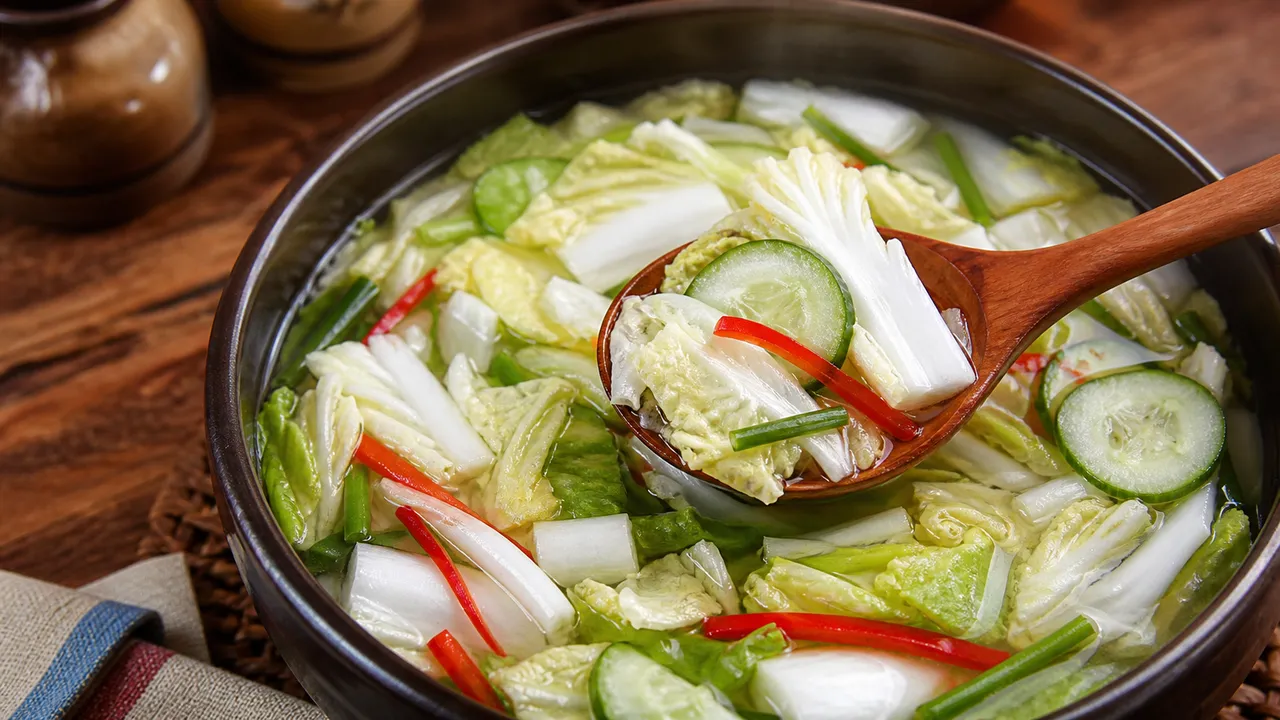
Refreshing and Crispy Cabbage Mul-kimchi (물김치): An Easy Summ
* 이미지는 AI가 생성한 참고 이미지로, 실제 조리 결과물과 다를 수 있습니다.
A recipe for Mul-kimchi (물김치) that's perfect for summer, featuring crispy cabbage and cucumber in a refreshing broth.
📝 Editor's Notes
This is a recipe for Cabbage Mul-kimchi (물김치) that will instantly beat the summer heat, with crispy cabbage and cucumber immersed in a refreshing broth.
While it takes about 1 hour and 50 minutes in total, most of that time is for preparing ingredients and pickling, so the actual cooking difficulty is medium-low.
Korean plum extract (매실 액) and anchovy sauce (멸치 액젓) add a deep umami (감칠맛) flavor, and the clean spiciness of Cheongyang chili peppers (청양고추) will surely whet your appetite.
On a sweaty summer day, when you crave a refreshing soup dish, a bowl of this Cabbage Mul-kimchi (물김치) can bring back your lost appetite.
It's excellent as a side dish with rice, and sipping the cool broth is also the best way to quench your thirst.
🛒 Ingredient Tips
Choose cabbage with vibrant green outer leaves that are firm and heavy.
A head that is tightly packed and has less prominent veins indicates freshness and a crispy texture.
For cucumbers, look for ones with a deep green color, firm to the touch, and with intact spines.
Straight cucumbers that aren't bent are freshest.
Select green onions with clean roots and vibrant, un-wilted green tops.
Good ginger has thin skin, isn't too bumpy, and has a strong aroma.
For garlic, mincing whole cloves yourself will yield a much better fragrance.
Using seasonal ingredients will result in even fresher and more delicious Mul-kimchi (물김치).
🔄 Substitution Guide
You can use baby napa cabbage (알배추) or napa cabbage (배추) instead of cabbage.
However, baby napa cabbage (알배추) is softer than regular cabbage, so it's best to reduce the pickling time by about 10 minutes.
If you don't have cucumber, thinly sliced radish can also provide a refreshing taste, but it might not have the unique crispiness of cucumber.
Using regular green chili peppers instead of Cheongyang chili peppers (청양고추) will result in less spice, making it suitable for children.
If anchovy sauce (멸치 액젓) is unavailable, you can substitute it with sand lance sauce (까나리 액젓), but anchovy sauce (멸치 액젓) generally offers a cleaner flavor.
Feel free to adjust ingredients based on personal preference or allergies.
🥘 Ingredients
👨🍳 Cooking Points
The most important cooking point is the pickling time for the cabbage and cucumbers.
Pickling them sufficiently for 50 minutes ensures a crispy texture and well-seasoned vegetables, leading to delicious Mul-kimchi (물김치).
Don't forget to flip them once between 20 and 30 minutes.
The second point is straining the broth finely.
The blended vegetable broth must be strained through a sieve to completely remove solids, ensuring a clear and refreshing soup.
Finally, when cooking the flour paste, stir it well to prevent lumps and create a smooth paste.
By following these three key points, you can make delicious Mul-kimchi (물김치) without fail.
👨🍳 Directions
Pour 700 ml of hot water over 10 g of kelp (다시마) to make broth, and set aside.
Remove the core from half a head of cabbage, then cut it into large, bite-sized pieces.
Rinse the sliced cabbage thoroughly three times, separating any clumped leaves.
Add 3 tbsp of sea salt and 200 ml of water to the washed cabbage, mix well, and pickle for 50 minutes. Flip it once between 20 and 30 minutes.
Trim the ends of 3 cucumbers and slice them 0.5 cm (approx. 0.2 inches) thick.
Add 1 tbsp of sea salt and 50 ml of water to the sliced cucumbers, mix well, and pickle for 50 minutes. Flip them once between 20 and 30 minutes, along with the pickling cabbage.
Remove the kelp (다시마) from the 700 ml kelp broth. Add 2 tbsp of all-purpose flour to the broth. Stir well to dissolve all the flour while the water is not too hot.
Stir continuously until the flour paste boils, then turn off the heat and let it cool.
Prepare the vegetables for the Mul-kimchi (물김치): Finely chop half an apple, half an onion, 4 Cheongyang chili peppers (청양고추), 20 g of ginger, and 65 g of garlic.
Halve 2 red chili peppers, remove the seeds, and thinly julienne them.
Trim the root ends of 100 g of green onions and cut them into 3 cm (approx. 1.2 inches) lengths.
In a blender, combine the finely chopped apple, onion, Cheongyang chili peppers (청양고추), ginger, and garlic, along with 3 tbsp of Korean plum extract (매실 액), 5 tbsp of anchovy sauce (멸치 액젓), and 200 ml of water. Blend until very smooth.
Strain the finely blended vegetable broth through a fine-mesh sieve, stirring with your fingers to extract only the liquid. Discard the remaining pulp.
Pour the cooled flour paste and 2 L of water into the strained broth. Mix well and strain again through a fine-mesh sieve. Press firmly to extract all remaining liquid.
First, place the well-pickled cabbage and cucumbers into a kimchi container (김치통). Use the pickling liquid (vegetable brine) as well.
Sprinkle the sliced green onions and julienned red chili peppers evenly over them.
Finally, pour the prepared broth into the kimchi container (김치통). Stir once from the bottom with a spoon to ensure all ingredients are well mixed.
If the weather is warm, let it ferment at room temperature for about 6 hours, then refrigerate and serve chilled.
💡 Tips
When washing cabbage, separating any clumped leaves one by one allows for a cleaner wash.
Adding a little water when pickling cabbage and cucumbers helps them pickle faster and more evenly.
Since the pickled cabbage and cucumbers are sufficiently seasoned, use the vegetable brine produced during pickling to enhance the umami (감칠맛) of the Mul-kimchi (물김치).
The blended vegetable broth must be finely strained through a sieve to achieve a clear and refreshing soup base.
📦 Storage & Reuse
Store the finished Cabbage Mul-kimchi (물김치) in an airtight container in the refrigerator to maintain its refreshing and crispy taste for about 3-5 days.
The broth develops a deeper flavor as it ferments deliciously, so it's best to enjoy it while it's fresh and chilled rather than keeping it too long.
Freezing is not recommended, as the crisp texture of the cabbage and cucumber can be significantly lost upon thawing.
Leftover cabbage can be used in salads or stir-fries, and leftover cucumbers can be made into oi-muchim (오이무침, spicy cucumber salad) or naeng-guk (냉국, cold soup).
🥢 Who This Is For
This refreshing and crispy Cabbage Mul-kimchi (물김치) is the best side dish to regain your appetite on a hot summer day.
It pairs exceptionally well with rich meat dishes or spicy foods, adding a clean and refreshing balance.
Try serving this chilled Mul-kimchi (물김치) alongside main dishes like samgyeopsal (삼겹살, grilled pork belly) or galbi-jjim (갈비찜, braised short ribs).
It will be a delightful treat not only for family meals but also for guests.
It's also delicious as a topping for noodles or naengmyeon (냉면, cold noodles).
🔥 Nutrition Info
One serving of this Cabbage Mul-kimchi (물김치) (approximately 200g) is estimated to be around 80-100 kcal.
It contains about 15-20g of carbohydrates, 3-5g of protein, and very little fat (less than 1g).
Thanks to cabbage and cucumber, it's rich in Vitamin C, Vitamin K, and dietary fiber, which aids gut health and boosts immunity.
Allicin in garlic and ginger has antibacterial properties, while Korean plum extract (매실 액) helps with digestion and fatigue recovery.
Overall, it's a low-calorie, nutrient-rich summer tonic that can be enjoyed healthily.
💬 Frequently Asked Questions
- Q. What ingredients do I need for Refreshing and Crispy Cabbage Mul-kimchi (물김치): An Easy Summer Delicacy?
- Main ingredients include Cabbage, Cucumber, Green onions, Apple, Onion. Choose cabbage with vibrant green outer leaves that are firm and heavy. A head that is tightly packed and has less prominent veins indicates freshness and a crispy texture. For cucumbers, look for ones with a deep green color, firm to the touch, and with intact spines. Straight cucumbers that aren't bent are freshest. Select green onions with clean roots and vibrant, un-wilted green tops. Good ginger has thin skin, isn't too bumpy, and has a strong aroma. For garlic, mincing whole cloves yourself will yield a much better fragrance. Using seasonal ingredients will result in even fresher and more delicious Mul-kimchi (물김치).
- Q. What are the key tips for making Refreshing and Crispy Cabbage Mul-kimchi (물김치): An Easy Summer Delicacy?
- The most important cooking point is the pickling time for the cabbage and cucumbers. Pickling them sufficiently for 50 minutes ensures a crispy texture and well-seasoned vegetables, leading to delicious Mul-kimchi (물김치). Don't forget to flip them once between 20 and 30 minutes. The second point is straining the broth finely. The blended vegetable broth must be strained through a sieve to completely remove solids, ensuring a clear and refreshing soup. Finally, when cooking the flour paste, stir it well to prevent lumps and create a smooth paste. By following these three key points, you can make delicious Mul-kimchi (물김치) without fail.
- Q. How should I store leftover Refreshing and Crispy Cabbage Mul-kimchi (물김치): An Easy Summer Delicacy?
- Store the finished Cabbage Mul-kimchi (물김치) in an airtight container in the refrigerator to maintain its refreshing and crispy taste for about 3-5 days. The broth develops a deeper flavor as it ferments deliciously, so it's best to enjoy it while it's fresh and chilled rather than keeping it too long. Freezing is not recommended, as the crisp texture of the cabbage and cucumber can be significantly lost upon thawing. Leftover cabbage can be used in salads or stir-fries, and leftover cucumbers can be made into oi-muchim (오이무침, spicy cucumber salad) or naeng-guk (냉국, cold soup).
- Q. How many calories are in Refreshing and Crispy Cabbage Mul-kimchi (물김치): An Easy Summer Delicacy?
- One serving of this Cabbage Mul-kimchi (물김치) (approximately 200g) is estimated to be around 80-100 kcal. It contains about 15-20g of carbohydrates, 3-5g of protein, and very little fat (less than 1g). Thanks to cabbage and cucumber, it's rich in Vitamin C, Vitamin K, and dietary fiber, which aids gut health and boosts immunity. Allicin in garlic and ginger has antibacterial properties, while Korean plum extract (매실 액) helps with digestion and fatigue recovery. Overall, it's a low-calorie, nutrient-rich summer tonic that can be enjoyed healthily.
- Q. Can I substitute ingredients in Refreshing and Crispy Cabbage Mul-kimchi (물김치): An Easy Summer Delicacy?
- You can use baby napa cabbage (알배추) or napa cabbage (배추) instead of cabbage. However, baby napa cabbage (알배추) is softer than regular cabbage, so it's best to reduce the pickling time by about 10 minutes. If you don't have cucumber, thinly sliced radish can also provide a refreshing taste, but it might not have the unique crispiness of cucumber. Using regular green chili peppers instead of Cheongyang chili peppers (청양고추) will result in less spice, making it suitable for children. If anchovy sauce (멸치 액젓) is unavailable, you can substitute it with sand lance sauce (까나리 액젓), but anchovy sauce (멸치 액젓) generally offers a cleaner flavor. Feel free to adjust ingredients based on personal preference or allergies.
💬 Comments
No comments yet. Be the first to comment!