
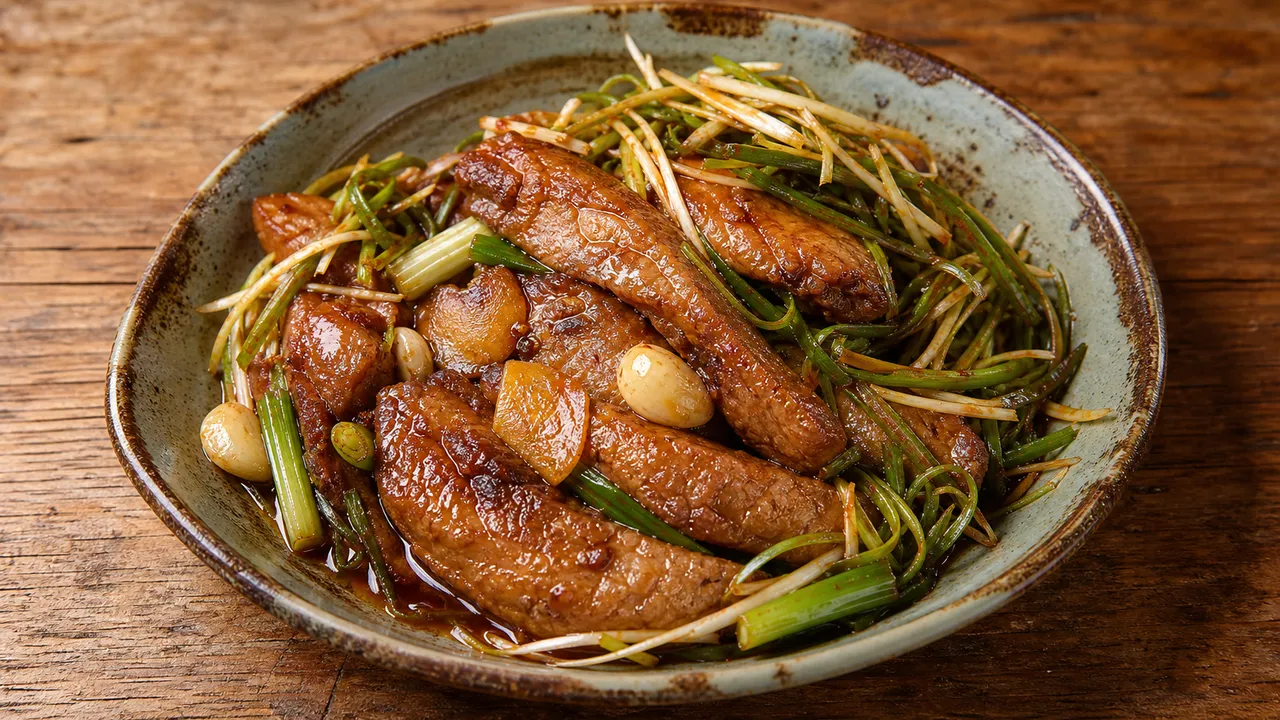
Braised Pork Jowl (Tong Hangjeongsal Jorim) & Cucumber Cold
* 이미지는 AI가 생성한 참고 이미지로, 실제 조리 결과물과 다를 수 있습니다.
This recipe is a perfect summer 'rice thief' (bap-doduk (밥도둑)) that will bring back your lost appetite with its savory and slightly sweet braised whole pork jowl, paired with a cool and refreshing cucumber cold soup (o-i naengguk (오이냉국)).
📋 2 recipes — Select to view
Golden-brown seared whole pork jowl, simmered in a special teriyaki-style soy sauce, resulting in a springy and savory braised pork jowl, served with a sweet and sour seasoned shredded scallion salad.
📝 Editor's Notes
Braised Pork Jowl and Scallion Salad is a dish that boasts an exquisite harmony between savory pork jowl and sweet-and-sour scallions.
It can be completed in about 15 minutes, making it possible to prepare a special meal even on busy days.
The golden-brown seared pork jowl, simmered in a special teriyaki-style soy sauce, offers a moist and springy texture.
The addition of crispy shredded scallions cuts through the richness and adds a refreshing zest.
It's great any time of year, but particularly suitable for summer when appetites might wane, or as a special dish for entertaining guests.
We highly recommend it to those who appreciate a hearty yet clean-tasting meal.
🛒 Ingredient Tips
For the star of this dish, pork jowl (hangjeongsal), it's important to choose pieces that are reddish-pink with evenly distributed fat layers.
Selecting a moderate thickness, neither too thin nor too thick, will help preserve the juices during cooking.
For shredded scallions, choose fresh, vibrant green ones that are not wilted.
Buying pre-shredded scallions can save cooking time and be convenient.
For ginger and garlic cloves, select those that are firm and fragrant to further enhance the dish's flavor.
Ginger, in particular, should have smooth skin and a strong aroma.
Remember that choosing good ingredients is the first step to a delicious meal.
🔄 Substitution Guide
If you wish to use a different cut of pork instead of pork jowl (hangjeongsal), consider using pork neck (moksal) or pork belly (samgyeopsal).
Pork neck has less fat than pork jowl, offering a leaner taste, while pork belly, with its higher fat content, provides a richer and more tender flavor.
However, pork neck may not have the same springy texture as pork jowl, and pork belly may render more fat, so pay extra attention to removing excess oil during cooking.
If you don't have oyster sauce, you can add about 0.5 tbsp more soy sauce or a little chicken stock to enhance umami.
However, keep in mind that the unique flavor of oyster sauce may not be fully replicated.
Instead of shredded scallions, you can use thinly sliced regular scallions or shredded onions.
Onions can add sweetness and a crisp texture.
🥘 Ingredients
👨🍳 Cooking Points
The first crucial point in this dish is searing the pork jowl.
The key is to sear the surface over high heat until golden brown to lock in the juices.
A significant amount of fat will render from the pork jowl during this process, and regularly blotting it with a paper towel is essential for a clean, non-greasy taste.
The second point is the simmering time for the braising sauce.
The mixture of soy sauce, mirin, water, sugar, and oyster sauce needs to simmer over medium heat for 15-20 minutes until slightly sticky.
This allows the flavors to penetrate the meat well and gives it a glossy finish.
If the sauce is too thin, it will taste bland, and if it's over-reduced, it can become too salty or burn, so monitor the consistency carefully.
Finally, for the scallion salad, it's best to lightly toss it with the dressing just before serving to maintain its crisp texture.
The sweet and sour flavor from the hot mustard paste (yeongyeoja) and vinegar will further enhance the richness of the pork jowl.
👨🍳 Directions
Place 2 chunks of pork jowl (hangjeongsal) in a deep pan and sear over high heat until golden brown on all sides. Flip occasionally to cook evenly, and frequently blot excess oil with a paper towel as it renders from the pork jowl.
Pour 3 tbsp + 1 tsp of soy sauce and 3 tbsp + 1 tsp of mirin into the pan with the seared pork jowl. Bring to a vigorous boil over high heat to cook off the alcohol.
Next, add approx. 3/4 cup water, thinly sliced ginger (to taste), roughly smashed garlic cloves (to taste), scallions (or shredded scallions) (to taste), 1 tbsp sugar, and 1/2 tbsp oyster sauce. Simmer over medium heat for 15-20 minutes until the sauce has thickened slightly.
In a bowl for the scallion salad, squeeze a small amount of hot mustard paste (yeongyeoja) and add a splash of water to dissolve it. Then add 1 tbsp soy sauce and 1 tbsp vinegar, and mix well. Add shredded scallions (to taste) and lightly toss to coat.
Arrange the seasoned shredded scallions on a serving plate. Remove the well-braised pork jowl, slice it into slightly thin pieces, and place them on top of the scallions. Drizzle the remaining braising sauce lightly over the pork to finish.
💡 Tips
Regularly blotting excess oil rendered from the pork jowl with a paper towel during searing helps achieve a cleaner flavor.
Simmer the braising sauce with the meat over medium heat for 15-20 minutes until the sauce sufficiently thickens.
Adding hot mustard paste (yeongyeoja) and vinegar to the scallion salad dressing creates a delightful sweet and sour flavor.
For the braising, you can use regular scallions instead of shredded scallions, or omit them entirely.
📦 Storage & Reuse
The finished braised pork jowl can be stored in an airtight container in the refrigerator for 2-3 days.
To reheat, microwave for about 2 minutes or gently warm in a pan over low heat.
The leftover braising sauce is excellent for mixing with rice or as a marinade for other meat dishes.
The scallion salad is best enjoyed as soon as possible, as the dressing can cause the scallions to wilt.
Store any remaining plain shredded scallions in an airtight container in the refrigerator, and use them to make a fresh salad with new dressing, or add them to ramen.
Uncooked pork jowl can be frozen for about a month; thaw before use.
🥢 Who This Is For
This Braised Pork Jowl and Scallion Salad is a wonderful meal for the whole family to enjoy.
It will surely earn you compliments when served as a special main dish, especially for weekend dinners or when entertaining guests.
It's not only a great side dish for rice but also an excellent accompaniment to alcoholic beverages.
It pairs particularly well with a cold beer or soju.
Recommended side dishes include warm steamed rice, seaweed soup (miyeokguk), or refreshing bean sprout soup.
Serving it with crunchy geotjeori (fresh kimchi) or white kimchi will make the meal even more refreshing.
🔥 Nutrition Info
One serving of Braised Pork Jowl and Scallion Salad (based on approx.
100g pork jowl) is estimated to be around 450-550 kcal.
It is expected to contain approximately 25-30g protein, 35-45g fat, and 10-15g carbohydrates.
Pork jowl is a special cut of pork, rich in protein and essential amino acids, which aids in muscle formation and fatigue recovery.
It is also abundant in B vitamins (especially B1), contributing to active energy metabolism.
Shredded scallions are rich in Vitamin C and dietary fiber, which help digestion and strengthen immunity.
Garlic and ginger are rich in antioxidants, promoting overall health.
However, due to the sugar and soy sauce in the braising sauce, it's advisable to be mindful of sodium and sugar intake.
We recommend enjoying this dish in moderation as part of a balanced diet.
💬 Frequently Asked Questions
- Q. What ingredients do I need for Braised Pork Jowl (Tong Hangjeongsal Jorim) & Cucumber Cold Soup (O-i Naengguk): The Perfect Summer Pair?
- Main ingredients include Whole pork jowl (hangjeongsal (항정살)), Sliced green onions (pa-chae (파채)), Ginger, Whole garlic, Green onions (or sliced green onions (pa-chae (파채))). When choosing whole pork jowl (hangjeongsal (항정살)), look for pieces that are bright pink, with an evenly distributed fat layer that isn't excessively thick. Pork jowl is a special cut of pork, known for its rich fat content and chewy yet tender texture. Fresh hangjeongsal boasts a distinct savory flavor that makes it especially delicious when braised. For ginger, select firm, not-too-large pieces with a strong aroma. For sliced green onions (pa-chae (파채)), choose fresh ones with plenty of vibrant green parts.
- Q. What are the key tips for making Braised Pork Jowl (Tong Hangjeongsal Jorim) & Cucumber Cold Soup (O-i Naengguk): The Perfect Summer Pair?
- The most crucial point in this recipe is searing the pork jowl (hangjeongsal (항정살)) until golden brown on the surface to lock in its juices. Sear it quickly over high heat on all sides. Thoroughly removing the rendered fat from the pork jowl with a paper towel is essential for a clean, non-greasy taste. When braising the sauce, simmer over medium heat for 15-20 minutes until it thickens sufficiently and fully infuses the pork jowl with rich flavor. Lastly, dissolving a small amount of prepared mustard (yeon-gyeojja (연겨자)) into the sliced green onion (pa-chae (파채)) dressing will add a pungent kick that enhances the pork jowl's aroma. Remember these tips, and you'll successfully prepare a delicious pork jowl jorim.
- Q. How should I store leftover Braised Pork Jowl (Tong Hangjeongsal Jorim) & Cucumber Cold Soup (O-i Naengguk): The Perfect Summer Pair?
- Once prepared, the braised whole pork jowl (hangjeongsal (항정살)) can be stored in an airtight container in the refrigerator for 2-3 days. To reheat, microwave for 2-3 minutes or sauté lightly in a pan to enjoy it warm with its original flavor. Any leftover braising sauce can be mixed with rice or used as a seasoning for other meat dishes. Sliced green onions (pa-chae (파채)) should ideally be dressed just before serving, as they can wilt and release water if stored dressed. If you have any leftover dressed pa-chae, store it in an airtight container in the refrigerator and consume it quickly the next day.
- Q. How many calories are in Braised Pork Jowl (Tong Hangjeongsal Jorim) & Cucumber Cold Soup (O-i Naengguk): The Perfect Summer Pair?
- For one serving of this braised whole pork jowl (hangjeongsal (항정살)) (based on one piece of pork jowl), the estimated calorie count is approximately 450-500 kcal. It may contain about 30-35g of protein, 35-40g of fat, and 10-15g of carbohydrates. Pork jowl is rich in B vitamins like B1, B2, and niacin, which help with fatigue recovery, and also contains minerals such as iron and zinc. Due to the soy sauce and sugar in the braising sauce, there may be a moderate amount of sodium and sugar. The accompanying cucumber cold soup (o-i naengguk (오이냉국)) can help with sodium excretion and provide Vitamin C. We recommend serving with vegetable side dishes for a balanced meal.
- Q. Can I substitute ingredients in Braised Pork Jowl (Tong Hangjeongsal Jorim) & Cucumber Cold Soup (O-i Naengguk): The Perfect Summer Pair?
- Instead of whole pork jowl (hangjeongsal (항정살)), you can use pork shoulder or pork belly. Pork shoulder has less fat than pork jowl, offering a leaner flavor, while pork belly provides a similar rich, savory taste. Note that pork shoulder can become tough if overcooked, so adjust the braising time accordingly. If oyster sauce is unavailable, you can adjust the ratio of soy sauce and sugar to achieve a sweet and salty flavor, or add a small amount of doenjang (된장) for a savory depth. For prepared mustard (yeon-gyeojja (연겨자)), you can substitute with whole grain mustard for a pungent kick and textural variety.
💬 Comments
No comments yet. Be the first to comment!