
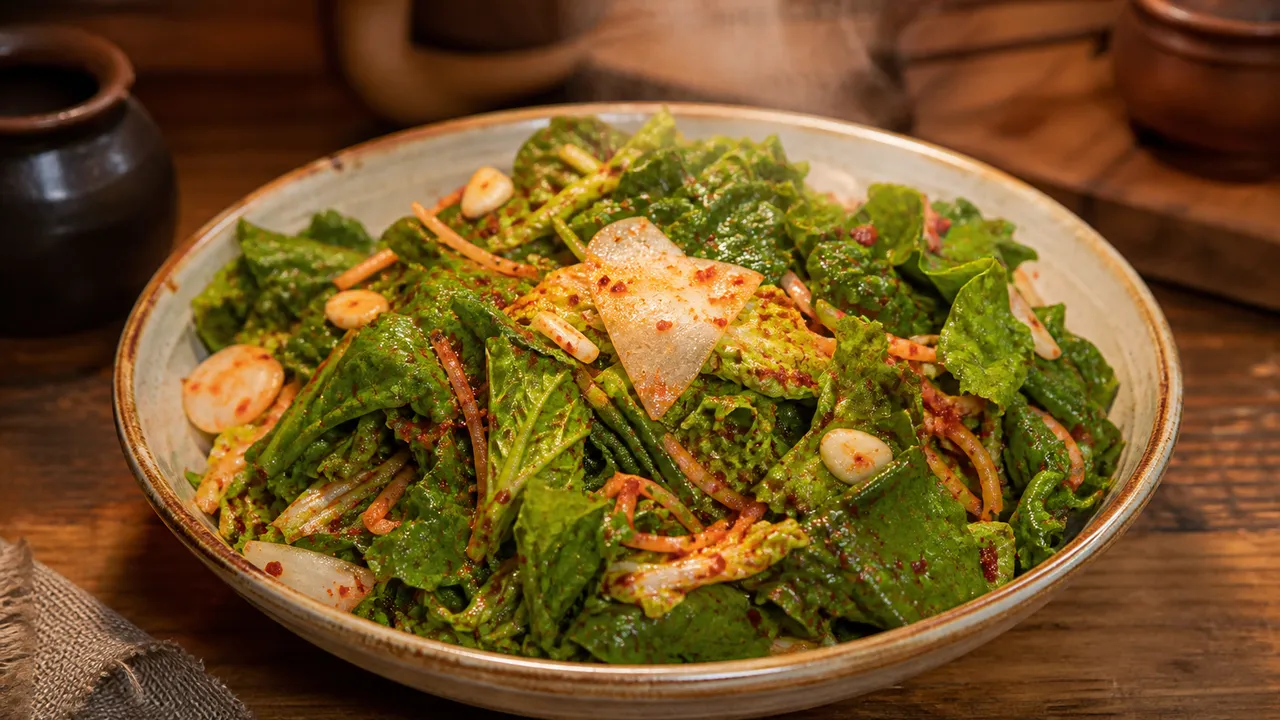
Chef Kim Dae-seok's Lettuce Geotjeori Recipe
* 이미지는 AI가 생성한 참고 이미지로, 실제 조리 결과물과 다를 수 있습니다.
This is a recipe for Lettuce Geotjeori, bursting with a sweet, sour, and savory flavor that stimulates your appetite. It's even more delicious when served with meat dishes.
📝 Editor's Notes
Chef Kim Dae-seok's Lettuce Geotjeori is an attractive recipe that explodes with sweet, sour, and savory flavors.
It boasts a fantastic pairing with meat dishes, making your dining table much richer when served with main courses like samgyeopsal (삼겹살) or galbijjim (갈비찜).
Its characteristic is bringing out the fresh crispness of lettuce while delivering a deep flavor without complicated steps.
It will be a lifesaver side dish to rekindle your lost appetite during hot summer days.
While easy for anyone to follow, handling the lettuce delicately is the secret to its deliciousness.
🛒 Ingredient Tips
The star of this Lettuce Geotjeori is, of course, the lettuce!
Baby lettuce, with its small, tender leaves, is especially well-suited for geotjeori.
Choose leaves that are not wilted, have a vibrant green color, and whose stems are not too thick.
Even if there's some dirt, freshness is key.
For onions, a medium-sized one, not too large, is appropriate.
Look for firm onions with shiny skins and no mold on the root end.
For green onions, choose ones with clearly defined green leaves and white stalks, and good elasticity.
Cheongyang chili peppers (청양고추) that are straight rather than overly bent will deliver the best spicy flavor.
🔄 Substitution Guide
You can use other types of wrapping vegetables instead of baby lettuce.
For example, romaine lettuce or red leaf lettuce can provide a similar crispness and fresh taste.
However, if the leaves are too thick, tearing them by hand will improve the texture.
If you don't have Korean anchovy fish sauce (멸치액젓) or are sensitive to its fishy aroma, you can substitute it with kkanari-aekjeot (까나리액젓) (sand lance fish sauce), but note that kkanari-aekjeot can be saltier, so use a slightly smaller amount.
If maesil-cheong (매실청) is unavailable, you can adjust the sweet and sour taste by adding about 1/2 tbsp of oligosaccharide or corn syrup and an additional 1/2 tbsp of vinegar.
While it might lack the unique fragrance of maesil-cheong, it will help balance the flavors.
🥘 Ingredients
👨🍳 Cooking Points
There are three crucial cooking points in this recipe.
First, the lettuce washing method: soaking the lettuce in lukewarm water with a splash of vinegar for 5 minutes effectively removes dirt, and then rinsing it in cold water helps revive its crisp texture. This is the secret.
Second, for the seasoning sauce, it's essential to mix all the ingredients thoroughly beforehand.
This ensures the gochugaru (고춧가루) dissolves evenly and the sauce coats all the vegetables well. Third, the tossing method!
Lettuce is a very delicate vegetable; if tossed too vigorously, it can develop a raw, grassy smell and wilt.
You must toss it gently and lightly with your hands, as if handling a baby, to maintain its fresh taste and crispness.
Mixing delicately to prevent bruising is key.
👨🍳 Directions
Pour lukewarm water into a washing bowl. This helps remove dirt and dust easily.
Add a splash of vinegar to the water. Break off the tough ends of the lettuce by hand, tear larger leaves, then submerge all 250g of baby lettuce in the water for 5 minutes.
After 5 minutes, drain the water. Rinse the lettuce under cold water, shaking each leaf to ensure crispness, then drain thoroughly.
Finely julienne 1/2 small onion.
Halve 1 Cheongyang chili pepper (청양고추) lengthwise, then finely mince it.
Halve 1 stalk of green onion lengthwise, then julienne it into long strips.
In a large bowl, combine 2 tbsp gochugaru (고춧가루), 2.5 tbsp soy sauce, 1.5 tbsp Korean anchovy fish sauce (멸치액젓), 1 tbsp maesil-cheong (매실청), 1 tbsp minced garlic, and 2 pinches raw sugar. Mix well to create the seasoning sauce. Mixing thoroughly beforehand prevents the sauce from clumping.
Add the julienned onion and minced Cheongyang chili pepper to the seasoning sauce and mix again.
Lightly grind 1 tbsp of toasted sesame seeds in a mortar and pestle. Do not grind too finely; a gentle grind will preserve the nutty aroma.
Place the drained lettuce into the bowl with the seasoning sauce. Tear any overly large lettuce leaves by hand; small leaves can be added whole.
Place the julienned green onion on top of the lettuce.
Gently toss lightly with your hands. Mix delicately to prevent the lettuce from bruising.
Once the lettuce is about halfway tossed, sprinkle 1 tbsp of the lightly ground toasted sesame seeds over it.
Finally, drizzle 1 tbsp of sesame oil over the top and gently toss once more until glossy, then serve.
💡 Tips
When washing lettuce for the first time, soak it in lukewarm water with a splash of vinegar for 5 minutes to remove dirt, then rinse in cold water to preserve its crisp texture.
Mix the seasoning ingredients well first before adding the vegetables. This ensures the seasoning doesn't clump and coats everything evenly for better flavor.
If you toss the lettuce too vigorously, it can develop a raw grassy smell and lose its crispness, detracting from the flavor. Toss gently and softly.
At home, it's best to prepare only about 200-250g of Lettuce Geotjeori and eat it immediately. This amount is perfect to accompany about 1.3 lbs (600g) of pork belly.
📦 Storage & Reuse
Lettuce Geotjeori is best enjoyed immediately after preparation, allowing you to fully savor its crisp texture and fresh taste.
While leftover geotjeori can be stored in an airtight container in the refrigerator for about a day, the lettuce will wilt and release water, making it difficult to maintain its initial flavor.
It's highly recommended to make small portions and consume them fresh.
If you have leftover lettuce, wash it thoroughly, pat it dry with a paper towel, wrap it, and store it in an airtight container in the refrigerator for 2-3 days to keep it fresh.
You can use the leftover lettuce for bibimbap (비빔밥) or in sandwiches the next day.
🥢 Who This Is For
This Lettuce Geotjeori is highly recommended for those who especially enjoy meat.
When served alongside oily meat dishes like samgyeopsal (삼겹살), moksal gui (목살 구이 - grilled pork neck), or galbijjim (갈비찜 - braised short ribs), it effectively cuts through the richness and refreshes your palate.
It's particularly well-suited for spring and summer when lettuce is abundant, and it's an excellent side dish to rekindle a lost appetite during hot weather.
It's sure to earn you compliments when served at family dinners or when entertaining guests.
🔥 Nutrition Info
One serving of this Lettuce Geotjeori (approximately 200-250g) is estimated to be around 80-120 kcal.
It is relatively low in calories, consisting mainly of vegetables and a small amount of seasoning.
Protein is estimated at about 3-5g, fat at about 5-8g (including sesame oil), and carbohydrates at about 10-15g.
Lettuce is rich in vitamins A and C, as well as potassium, which contribute to eye health, skin beauty, and sodium excretion.
It's also high in dietary fiber, benefiting gut health.
Onions and green onions contain antioxidants and nutrients that boost immunity, while the capsaicin in Cheongyang chili peppers (청양고추) can help stimulate metabolism.
It's a delicious way to enjoy healthy and fresh vegetables.
💬 Frequently Asked Questions
- Q. What ingredients do I need for Chef Kim Dae-seok's Lettuce Geotjeori Recipe?
- Main ingredients include Baby lettuce, Small onion, Green onion, Cheongyang chili pepper (청양고추), Gochugaru (고춧가루). The star of this Lettuce Geotjeori is, of course, the lettuce! Baby lettuce, with its small, tender leaves, is especially well-suited for geotjeori. Choose leaves that are not wilted, have a vibrant green color, and whose stems are not too thick. Even if there's some dirt, freshness is key. For onions, a medium-sized one, not too large, is appropriate. Look for firm onions with shiny skins and no mold on the root end. For green onions, choose ones with clearly defined green leaves and white stalks, and good elasticity. Cheongyang chili peppers (청양고추) that are straight rather than overly bent will deliver the best spicy flavor.
- Q. What are the key tips for making Chef Kim Dae-seok's Lettuce Geotjeori Recipe?
- There are three crucial cooking points in this recipe. First, the lettuce washing method: soaking the lettuce in lukewarm water with a splash of vinegar for 5 minutes effectively removes dirt, and then rinsing it in cold water helps revive its crisp texture. This is the secret. Second, for the seasoning sauce, it's essential to mix all the ingredients thoroughly beforehand. This ensures the gochugaru (고춧가루) dissolves evenly and the sauce coats all the vegetables well. Third, the tossing method! Lettuce is a very delicate vegetable; if tossed too vigorously, it can develop a raw, grassy smell and wilt. You must toss it gently and lightly with your hands, as if handling a baby, to maintain its fresh taste and crispness. Mixing delicately to prevent bruising is key.
- Q. How should I store leftover Chef Kim Dae-seok's Lettuce Geotjeori Recipe?
- Lettuce Geotjeori is best enjoyed immediately after preparation, allowing you to fully savor its crisp texture and fresh taste. While leftover geotjeori can be stored in an airtight container in the refrigerator for about a day, the lettuce will wilt and release water, making it difficult to maintain its initial flavor. It's highly recommended to make small portions and consume them fresh. If you have leftover lettuce, wash it thoroughly, pat it dry with a paper towel, wrap it, and store it in an airtight container in the refrigerator for 2-3 days to keep it fresh. You can use the leftover lettuce for bibimbap (비빔밥) or in sandwiches the next day.
- Q. How many calories are in Chef Kim Dae-seok's Lettuce Geotjeori Recipe?
- One serving of this Lettuce Geotjeori (approximately 200-250g) is estimated to be around 80-120 kcal. It is relatively low in calories, consisting mainly of vegetables and a small amount of seasoning. Protein is estimated at about 3-5g, fat at about 5-8g (including sesame oil), and carbohydrates at about 10-15g. Lettuce is rich in vitamins A and C, as well as potassium, which contribute to eye health, skin beauty, and sodium excretion. It's also high in dietary fiber, benefiting gut health. Onions and green onions contain antioxidants and nutrients that boost immunity, while the capsaicin in Cheongyang chili peppers (청양고추) can help stimulate metabolism. It's a delicious way to enjoy healthy and fresh vegetables.
- Q. Can I substitute ingredients in Chef Kim Dae-seok's Lettuce Geotjeori Recipe?
- You can use other types of wrapping vegetables instead of baby lettuce. For example, romaine lettuce or red leaf lettuce can provide a similar crispness and fresh taste. However, if the leaves are too thick, tearing them by hand will improve the texture. If you don't have Korean anchovy fish sauce (멸치액젓) or are sensitive to its fishy aroma, you can substitute it with kkanari-aekjeot (까나리액젓) (sand lance fish sauce), but note that kkanari-aekjeot can be saltier, so use a slightly smaller amount. If maesil-cheong (매실청) is unavailable, you can adjust the sweet and sour taste by adding about 1/2 tbsp of oligosaccharide or corn syrup and an additional 1/2 tbsp of vinegar. While it might lack the unique fragrance of maesil-cheong, it will help balance the flavors.
💬 Comments
No comments yet. Be the first to comment!