
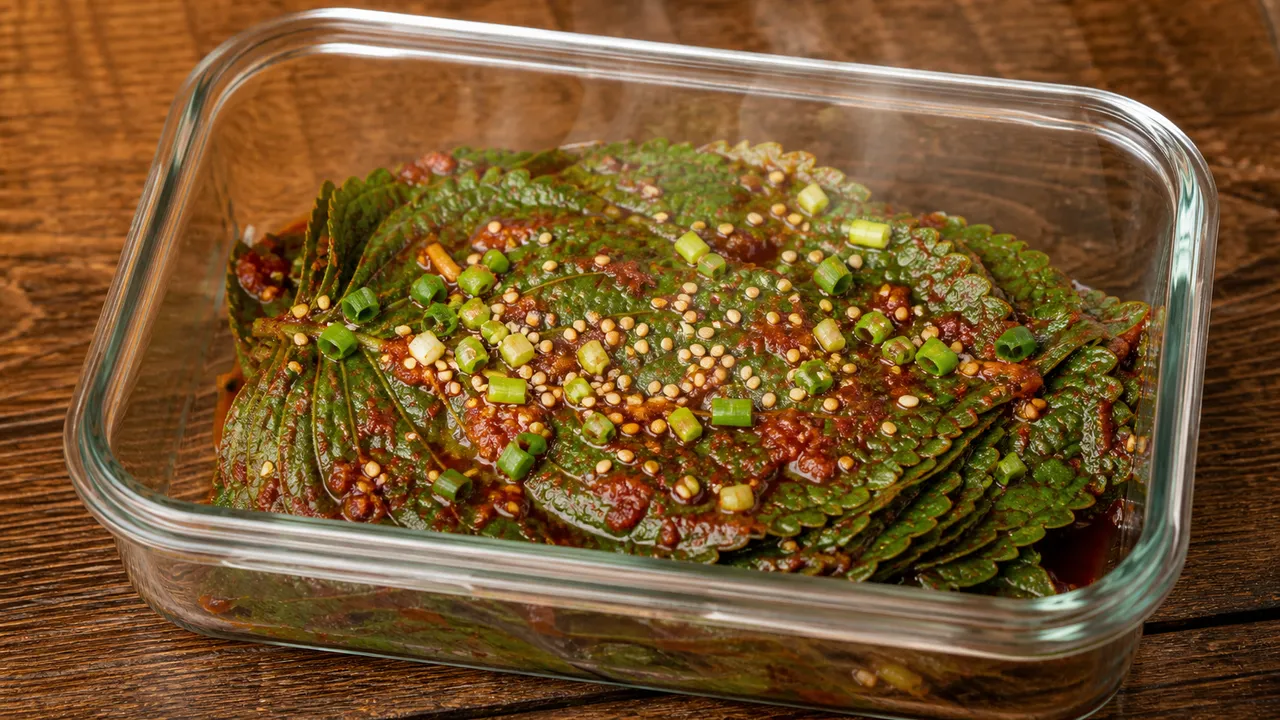
Delicious Perilla Leaf Kimchi (Kkaennip Kimchi): A Secret Re
* 이미지는 AI가 생성한 참고 이미지로, 실제 조리 결과물과 다를 수 있습니다.
This Perilla Leaf Kimchi (Kkaennip Kimchi) recipe is perfect for stimulating your appetite during the hot summer months. With a unique steaming method for the perilla leaves, the seasoning adheres perfectly, the color stays vibrant for longer storage, and you can enjoy this delicious side dish for an extended period.
📝 Editor's Notes
The Perilla Leaf Kimchi (Kkaennip Kimchi) we're introducing today is a summer 'rice thief' that can be enjoyed fragrantly all month long, thanks to a special cooking method.
The biggest charm of this recipe is steaming the perilla leaves so the seasoning adheres perfectly, maintaining a delicious state for a long time without color change.
The spicy-sweet seasoning combined with crunchy vegetables will bring back your lost appetite in the summer heat.
Often, Kkaennip Kimchi can have a raw, grassy smell or the seasoning doesn't absorb well, but this recipe helps you make it perfectly without such worries.
It's the best side dish, so be sure to try it!
🛒 Ingredient Tips
To make delicious Perilla Leaf Kimchi (Kkaennip Kimchi), choosing fresh perilla leaves is crucial.
Look for leaves that are not too large, have a deep green color, and are fresh with no wilting edges.
They should have a strong distinctive aroma and visible fine hairs on the underside.
For garlic chives (buchu), choose straight, fresh leaves with no dried ends.
For green onion (daepa), look for firm stalks with a lot of white.
For Cheongyang chili peppers (cheongyang-gochu), select firm, glossy ones.
Remember that good ingredients are the foundation of delicious kimchi.
🔄 Substitution Guide
If perilla leaves are hard to find or if you prefer other aromatic vegetables, you can try substituting with lettuce or kale.
Lettuce is softer than perilla leaves, so the steaming time should be reduced to about 3 minutes.
Kale can be steamed for about 5 minutes, similar to perilla leaves.
However, lettuce lacks the unique fragrance of perilla, resulting in a lighter flavor, and kale might have a stronger bitter taste.
If you want to reduce the spiciness, you can use Korean shishito peppers (kkari-gochu) or Korean long green peppers (asagi-gochu) instead of Cheongyang chili peppers (cheongyang-gochu).
If you don't have molasses, you can substitute with oligosaccharide or rice syrup (jocheong), but the unique deep sweetness of molasses might be slightly reduced.
🥘 Ingredients
👨🍳 Cooking Points
The core of this Perilla Leaf Kimchi (Kkaennip Kimchi) lies in 'steaming the perilla leaves' and 'resting the seasoning.' First, it's crucial to steam the perilla leaves in a steamer over high heat for exactly 5 minutes.
3 minutes is too short and can result in a raw, grassy smell, while 7 minutes or more will make the leaves too soft with an undesirable texture.
Adhering to the 5-minute rule ensures the perilla leaves retain their color, absorb the seasoning well, and have a chewy texture.
Second, for the seasoning, it's important to mix the liquid ingredients first, then add minced garlic, Korean chili flakes (gochugaru), and sesame seeds, and let it rest for 10 minutes.
During this process, the gochugaru absorbs the liquid, causing the seasoning to thicken and adhere perfectly to the perilla leaves.
Remember these two key points, and you'll be able to make delicious Kkaennip Kimchi without fail.
👨🍳 Directions
Trim the tough ends of the perilla leaves evenly with scissors or a knife.
Place the perilla leaves in a steamer and steam over high heat for 5 minutes.
Remove the steamed perilla leaves, let them cool completely, then squeeze out the water thoroughly by hand.
Cut the garlic chives (buchu) into 1.2 to 1.6-inch (3-4 cm) lengths. Halve the green onion (daepa) lengthwise, then thinly julienne it and cut into short pieces.
Halve the Cheongyang chili peppers (cheongyang-gochu), remove the seeds, and thinly julienne. Also, thinly julienne the carrot.
Combine 7 tbsp of soy sauce (ganjang), 12 tbsp of fish sauce (myeolchi aekjeot), 10 tbsp of soju (소주), and 6 tbsp of molasses, and stir well.
After thoroughly mixing the liquid ingredients, add 2 tbsp of minced garlic and mix.
Add 10 tbsp of Korean chili flakes (gochugaru) and stir lightly, then add sesame seeds and mix once more.
Let the prepared seasoning mixture rest for 10 minutes to thicken.
Take 3-4 perilla leaves stacked together, carefully spread the seasoning on the underside of the leaves, then spread it evenly on the top side as well.
Between the seasoned perilla leaves, place small amounts of the prepared garlic chives, green onion, Cheongyang chili peppers, and carrot.
After seasoning all the perilla leaves, layer them tightly into a kimchi container.
💡 Tips
It is crucial to steam the perilla leaves for exactly 5 minutes. This prevents color change, helps the seasoning adhere well, and ensures a good texture. Steaming for 3 minutes is not enough, and 7 minutes or more will make them too soft.
For the seasoning, it's important to mix the liquid ingredients first, then add the minced garlic, Korean chili flakes (gochugaru), and sesame seeds, and let it rest for 10 minutes. This allows the gochugaru to absorb the liquid and thicken the seasoning. Skipping this step will result in a runny seasoning that won't adhere well to the perilla leaves.
If you plan to eat it immediately, let it ferment at room temperature for one day, then refrigerate. For longer storage, refrigerate it immediately after making, allowing the flavors to slowly develop in the refrigerator; the taste will deepen further after a week.
If you are sensitive to saltiness, reduce the amount of fish sauce (myeolchi aekjeot) to 10 tbsp and adjust to your preference. If you don't have soju (소주), you can substitute it with cheongju (청주, rice wine) or makgeolli (막걸리, rice wine). For molasses, you can use oligosaccharide or pear juice. Omitting soju may result in a harsher flavor for the seasoning.
If you use the leftover seasoning to make a new batch with fresh perilla leaves, you can enjoy an even deeper flavor from the already matured sauce.
📦 Storage & Reuse
Store the finished Perilla Leaf Kimchi by layering it tightly into a kimchi container.
If you plan to eat it immediately, ferment it at room temperature for about a day, then refrigerate; this allows the seasoning to penetrate deeper, making it more delicious.
For longer storage, refrigerate it immediately after making, allowing the flavors to slowly develop in the refrigerator.
This way, the taste deepens after a week, and you can enjoy it fresh for about a month.
Freezing is not recommended as it can make the perilla leaves mushy.
Leftover Kkaennip Kimchi is great for adding to kimchi stew or bibimbap.
🥢 Who This Is For
This Perilla Leaf Kimchi (Kkaennip Kimchi), with its savory and fragrant flavor, is so good that you won't need any other side dishes when enjoyed with warm rice.
It's highly recommended for those who enjoy meat dishes.
It pairs wonderfully with samgyeopsal (grilled pork belly) or suyuk (boiled pork slices), cutting through the richness and adding a refreshing touch.
It's also a delightful addition to bibimbap or as a topping for noodles.
For solo diners or those living alone, it will be a reliable and satisfying side dish.
🔥 Nutrition Info
This Perilla Leaf Kimchi (Kkaennip Kimchi) recipe, based on 500g of perilla leaves, is expected to yield approximately 4-6 servings. Per serving (approx.
100g), the estimated calories are about 150-200 kcal.
Protein is estimated at about 5-7g, fat at about 5-8g, and carbohydrates at about 15-20g.
Perilla leaves are rich in various vitamins and minerals such as Vitamins A and C, calcium, and iron, which help strengthen immunity and prevent anemia.
In particular, their high iron content makes them an excellent source of iron despite being a vegetable.
Garlic chives (buchu), green onion (daepa), and Cheongyang chili peppers (cheongyang-gochu) also contribute vitamins and dietary fiber, helping to maintain nutritional balance.
💬 Frequently Asked Questions
- Q. What ingredients do I need for Delicious Perilla Leaf Kimchi (Kkaennip Kimchi): A Secret Recipe for Lasting Fragrance?
- Main ingredients include Perilla leaves (kkaennip), Garlic chives (buchu), Green onion (daepa), Cheongyang chili peppers (cheongyang-gochu), Carrot. To make delicious Perilla Leaf Kimchi (Kkaennip Kimchi), choosing fresh perilla leaves is crucial. Look for leaves that are not too large, have a deep green color, and are fresh with no wilting edges. They should have a strong distinctive aroma and visible fine hairs on the underside. For garlic chives (buchu), choose straight, fresh leaves with no dried ends. For green onion (daepa), look for firm stalks with a lot of white. For Cheongyang chili peppers (cheongyang-gochu), select firm, glossy ones. Remember that good ingredients are the foundation of delicious kimchi.
- Q. What are the key tips for making Delicious Perilla Leaf Kimchi (Kkaennip Kimchi): A Secret Recipe for Lasting Fragrance?
- The core of this Perilla Leaf Kimchi (Kkaennip Kimchi) lies in 'steaming the perilla leaves' and 'resting the seasoning.' First, it's crucial to steam the perilla leaves in a steamer over high heat for exactly 5 minutes. 3 minutes is too short and can result in a raw, grassy smell, while 7 minutes or more will make the leaves too soft with an undesirable texture. Adhering to the 5-minute rule ensures the perilla leaves retain their color, absorb the seasoning well, and have a chewy texture. Second, for the seasoning, it's important to mix the liquid ingredients first, then add minced garlic, Korean chili flakes (gochugaru), and sesame seeds, and let it rest for 10 minutes. During this process, the gochugaru absorbs the liquid, causing the seasoning to thicken and adhere perfectly to the perilla leaves. Remember these two key points, and you'll be able to make delicious Kkaennip Kimchi without fail.
- Q. How should I store leftover Delicious Perilla Leaf Kimchi (Kkaennip Kimchi): A Secret Recipe for Lasting Fragrance?
- Store the finished Perilla Leaf Kimchi by layering it tightly into a kimchi container. If you plan to eat it immediately, ferment it at room temperature for about a day, then refrigerate; this allows the seasoning to penetrate deeper, making it more delicious. For longer storage, refrigerate it immediately after making, allowing the flavors to slowly develop in the refrigerator. This way, the taste deepens after a week, and you can enjoy it fresh for about a month. Freezing is not recommended as it can make the perilla leaves mushy. Leftover Kkaennip Kimchi is great for adding to kimchi stew or bibimbap.
- Q. How many calories are in Delicious Perilla Leaf Kimchi (Kkaennip Kimchi): A Secret Recipe for Lasting Fragrance?
- This Perilla Leaf Kimchi (Kkaennip Kimchi) recipe, based on 500g of perilla leaves, is expected to yield approximately 4-6 servings. Per serving (approx. 100g), the estimated calories are about 150-200 kcal. Protein is estimated at about 5-7g, fat at about 5-8g, and carbohydrates at about 15-20g. Perilla leaves are rich in various vitamins and minerals such as Vitamins A and C, calcium, and iron, which help strengthen immunity and prevent anemia. In particular, their high iron content makes them an excellent source of iron despite being a vegetable. Garlic chives (buchu), green onion (daepa), and Cheongyang chili peppers (cheongyang-gochu) also contribute vitamins and dietary fiber, helping to maintain nutritional balance.
- Q. Can I substitute ingredients in Delicious Perilla Leaf Kimchi (Kkaennip Kimchi): A Secret Recipe for Lasting Fragrance?
- If perilla leaves are hard to find or if you prefer other aromatic vegetables, you can try substituting with lettuce or kale. Lettuce is softer than perilla leaves, so the steaming time should be reduced to about 3 minutes. Kale can be steamed for about 5 minutes, similar to perilla leaves. However, lettuce lacks the unique fragrance of perilla, resulting in a lighter flavor, and kale might have a stronger bitter taste. If you want to reduce the spiciness, you can use Korean shishito peppers (kkari-gochu) or Korean long green peppers (asagi-gochu) instead of Cheongyang chili peppers (cheongyang-gochu). If you don't have molasses, you can substitute with oligosaccharide or rice syrup (jocheong), but the unique deep sweetness of molasses might be slightly reduced.
💬 Comments
No comments yet. Be the first to comment!