
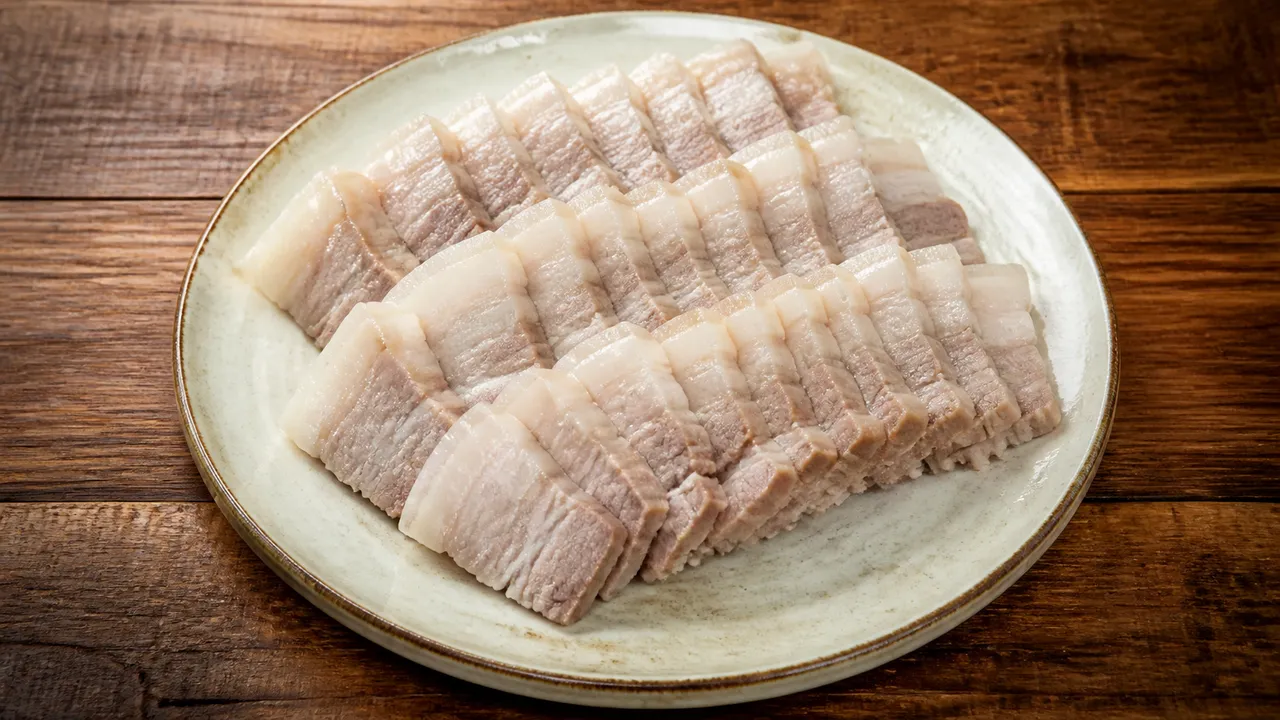
Sung Si-kyung's Super Easy Suyuuk (Boiled Pork Belly) and Do
* 이미지는 AI가 생성한 참고 이미지로, 실제 조리 결과물과 다를 수 있습니다.
This recipe features Sung Si-kyung's easy-to-make suyuuk (boiled pork belly) and a doenjang-jjigae (soybean paste stew) that uses ingredients from your refrigerator, perfect for even the busiest days.
📋 2 recipes — Select to view
This is a super simple suyuk (boiled pork slices) recipe that only requires a few ingredients and boiling. It turns out much more moist and delicious than you might expect.
📝 Editor's Notes
Sung Si Kyung's Suyuk recipe demonstrates an astonishing way to achieve maximum flavor with minimal ingredients.
Its key characteristic is maximizing the inherent moistness and tenderness of the whole pork belly without any special ingredients or complex techniques.
The unexpected combination of salt, sugar, and Miwon (미원) elevates the meat's umami, delivering a profound flavor reminiscent of a high-end restaurant dish.
The difficulty level is low, ensuring even beginner cooks can succeed without fail.
This versatile recipe is perfect for a warm meal on a chilly day, an impressive dish for entertaining guests, or an excellent accompaniment to makgeolli (막걸리) or soju (소주).
It's truly a 'classic home-cooked meal' that can be enjoyed with ease, free from complicated steps.
🛒 Ingredient Tips
The freshness of the whole pork belly, the star of this suyuk, is incredibly important.
When selecting meat, choose pieces with a vibrant reddish-pink color, white and firm fat layers, and an elastic texture.
A good ratio of fat to lean meat will result in a more moist and savory flavor when boiled.
While there's no specific season for pork belly, fresh pork is always best.
For salt, using refined salt rather than coarse sea salt (cheonil-yeom (천일염)) will allow the seasoning to penetrate more cleanly.
Whole black peppercorns are preferred over ground pepper, as they more effectively remove any gamey odors and provide a richer aroma.
If you can obtain bay leaves from your butcher, adding them is also an excellent choice.
🔄 Substitution Guide
Instead of whole pork belly, you can use pork shoulder (moksal (목살)) or pork front leg (apdarissal (앞다리살)).
Pork shoulder has less fat than pork belly, making it suitable for those who prefer a leaner taste, while pork front leg is affordable and rich in lean meat, perfect for a healthier option.
However, using pork shoulder or front leg may result in a less moist texture compared to pork belly.
For a natural umami flavor, you can substitute Miwon (미원) or Beef Dashida (다시다) with kelp (dashima (다시마)) or shiitake mushrooms.
While this might slightly alter the depth of umami, it offers a healthier and more natural taste.
If whole black peppercorns are unavailable, ground pepper can be used, but it may offer less of the distinctive aroma and odor-removing effect of whole peppercorns.
Seasoning with soy sauce instead of salt will result in a darker color and add the unique flavor of soy sauce, offering a different culinary experience.
🥘 Ingredients
👨🍳 Cooking Points
The most crucial cooking points are the 'amount of water' and the 'resting period.' It's vital to pour 1.5 L of water, enough to fully submerge the meat.
This ensures the pork cooks evenly on all sides and absorbs the seasoning well.
The second point is to 'add the pork to boiling water and simmer over medium-low heat for 50 minutes.' Once the water starts boiling, immediately add the pork and maintain medium-low heat to prevent the meat from becoming tough, allowing it to cook tenderly.
Finally, never forget to 'turn off the heat and let it rest with the lid closed for 10 minutes.' This process is the secret to locking in the meat's juices, maximizing its moistness, and ensuring it's perfectly cooked through to the center.
Remember these three tips, and you'll be able to make delicious suyuk without fail.
👨🍳 Directions
Pour 1.5 L of water into a pot (enough to submerge the meat). Add 3-4 tbsp of salt, 1 tbsp of sugar, 0.5 tbsp of Miwon (미원) (or Beef Dashida (다시다)), and 1 tbsp of whole black peppercorns. Bring to a boil.
Once the water comes to a rolling boil, add 400g of whole pork belly and close the lid.
Simmer for 50 minutes over medium-low heat.
Turn off the heat and let it rest with the lid closed for 10 minutes.
Once rested, slice the pork into serving pieces and serve.
💡 Tips
Taste and add more salt to your preference as needed.
Bay leaves are not included in this recipe, but if you can get them from the butcher, adding them while boiling can help eliminate any gamey odor.
📦 Storage & Reuse
For refrigerated storage, it's best to keep cooked suyuk in an airtight container for 2-3 days.
If you wish to store it longer, cut it into single-serving portions, wrap them in plastic wrap, or place them in an airtight container, then freeze.
Frozen suyuk can be stored for up to about one month.
To reheat frozen suyuk, warm it slightly in the microwave or pan-fry it over low heat for a crispy exterior and a moist interior.
Leftover suyuk can be finely chopped and added to kimchi-bokkeum-bap (김치볶음밥) (kimchi fried rice), used as a topping for bibim-guksu (비빔국수) (spicy mixed noodles), or incorporated into sandwiches or salads for a unique twist.
Don't discard the cooking liquid; it can be used as a broth or added to kimchi-jjigae (김치찌개) or doenjang-jjigae (된장찌개) (soybean paste stew) to enhance their depth of flavor.
🥢 Who This Is For
This Sung Si Kyung Suyuk is simple yet delicious, making it an excellent choice for a special weekend family meal or for entertaining guests.
Especially for those who are new to cooking, its ease of success will boost their confidence.
It's wonderful as a hearty meal with warm rice, and pairing it with sweet and spicy bibim-guksu (비빔국수) or refreshing makguksu (막국수) creates an even richer spread.
Served with a glass of makgeolli (막걸리) or soju (소주), it becomes a perfect accompaniment for drinks.
And during kimchi-making season, enjoying it with freshly made kimchi is truly a match made in heaven.
🔥 Nutrition Info
Based on 400g of whole pork belly, this recipe can be estimated to provide approximately 300-350 kcal per serving (about 100g).
It contains roughly 15-20g of protein, 25-30g of fat, and a small amount of carbohydrates (1-2g).
Pork belly is a high-protein food that supports muscle maintenance and growth.
It's rich in B vitamins (B1, B2, B6), which positively influence fatigue recovery and energy metabolism.
Notably, it contains significantly more Vitamin B1 than beef, also benefiting immune system enhancement.
However, due to its high fat content, portion control is necessary if you are on a diet.
The broth contains salt, sugar, and Miwon (미원), so the sodium content may be somewhat high; it is advisable to moderate broth consumption.
💬 Frequently Asked Questions
- Q. What ingredients do I need for Sung Si-kyung's Super Easy Suyuuk (Boiled Pork Belly) and Doenjang-jjigae (Soybean Paste Stew) Meal?
- Main ingredients include Whole Pork Belly, Water, Salt, Sugar, MSG (Miwon (미원)) or Beef Dashida (소고기 다시다). For suyuuk, fresh whole pork belly, the key ingredient, is of utmost importance. Choose a cut with a good balance of lean meat and fat, and pork belly with skin on (ohgyeopsal (오겹살)) for a chewier and more savory taste. The meat should be bright pink and glossy. For the doenjang-jjigae, homemade doenjang (된장) or commercial doenjang are both fine, but if you want a deeper flavor, try mixing a little homemade doenjang with commercial doenjang. For Korean zucchini, choose one with a smooth, glossy surface that is plump and not too large. Firm, savory-tasting pan-frying tofu (buchim-yong dubu) goes well with the stew.
- Q. What are the key tips for making Sung Si-kyung's Super Easy Suyuuk (Boiled Pork Belly) and Doenjang-jjigae (Soybean Paste Stew) Meal?
- The most crucial cooking point of this recipe is the process of boiling the suyuuk. First, adding salt, sugar, MSG (Miwon (미원)) (or Beef Dashida (소고기 다시다)), and whole peppercorns to the water and boiling it thoroughly to season the broth is key. During this process, ample flavor permeates the water, infusing the meat. Second, once the water boils, add the whole pork belly and boil it on medium-low heat for 50 minutes. Cooking on too high heat can make the meat tough, so controlling the flame is important. Third, absolutely do not skip the step of turning off the heat and letting it rest with the lid closed for 10 minutes. This resting time ensures the meat cooks through gently and the juices spread evenly, resulting in even more tender suyuuk.
- Q. How should I store leftover Sung Si-kyung's Super Easy Suyuuk (Boiled Pork Belly) and Doenjang-jjigae (Soybean Paste Stew) Meal?
- Boiled suyuuk can be stored in an airtight container in the refrigerator for 2-3 days, keeping it fresh. Leftover suyuuk can also be frozen, but the texture might become slightly tougher upon thawing, so it's recommended to consume it as soon as possible. When reheating refrigerated suyuuk, it's good to warm it slightly in the microwave, steam it, or pan-fry it until golden brown. Leftover suyuuk is also a delicious addition when thinly sliced and topped on bibim guksu (비빔국수) or added to kimchi bokkeumbap (김치 볶음밥). Doenjang-jjigae (soybean paste stew) can be stored in an airtight container in the refrigerator for 3-4 days after being cooked, but it's best to consume it as soon as possible as tofu and vegetables can spoil easily.
- Q. How many calories are in Sung Si-kyung's Super Easy Suyuuk (Boiled Pork Belly) and Doenjang-jjigae (Soybean Paste Stew) Meal?
- Based on 400g of whole pork belly, the estimated calories per serving (approx. 100g) are about 300-400 kcal. Protein can be estimated at about 20-25g, fat at about 25-30g, and carbohydrates at about 5-10g. Pork belly is high in protein and fat, providing a satisfying feeling of fullness, and rich in B vitamins, which aid in fatigue recovery and energy production. Doenjang-jjigae contributes to nutritional balance with beneficial bacteria from the fermentation process of doenjang, and dietary fiber, vitamins, and minerals from Korean zucchini and tofu. However, the sodium content can be somewhat high, so it's advisable to adjust the salt seasoning during the suyuuk boiling process.
- Q. Can I substitute ingredients in Sung Si-kyung's Super Easy Suyuuk (Boiled Pork Belly) and Doenjang-jjigae (Soybean Paste Stew) Meal?
- You can use pork neck or front leg instead of whole pork belly. Pork neck offers a leaner taste with less fat than pork belly, while front leg is budget-friendly and can still yield a tender texture. However, note that the unique savory flavor and tenderness of pork belly may be somewhat reduced. Instead of MSG (Miwon (미원)) or Beef Dashida (소고기 다시다), you can boil the meat with ingredients like onion, green onion, garlic, and ginger to create a deep flavor. This can add a more natural sweetness and umami, but the depth of flavor might be less intense than when using artificial seasonings. Korean zucchini in doenjang-jjigae can be replaced with potatoes or radishes, and tofu can be swapped for soft tofu or silken tofu for a smoother texture.
💬 Comments
No comments yet. Be the first to comment!