
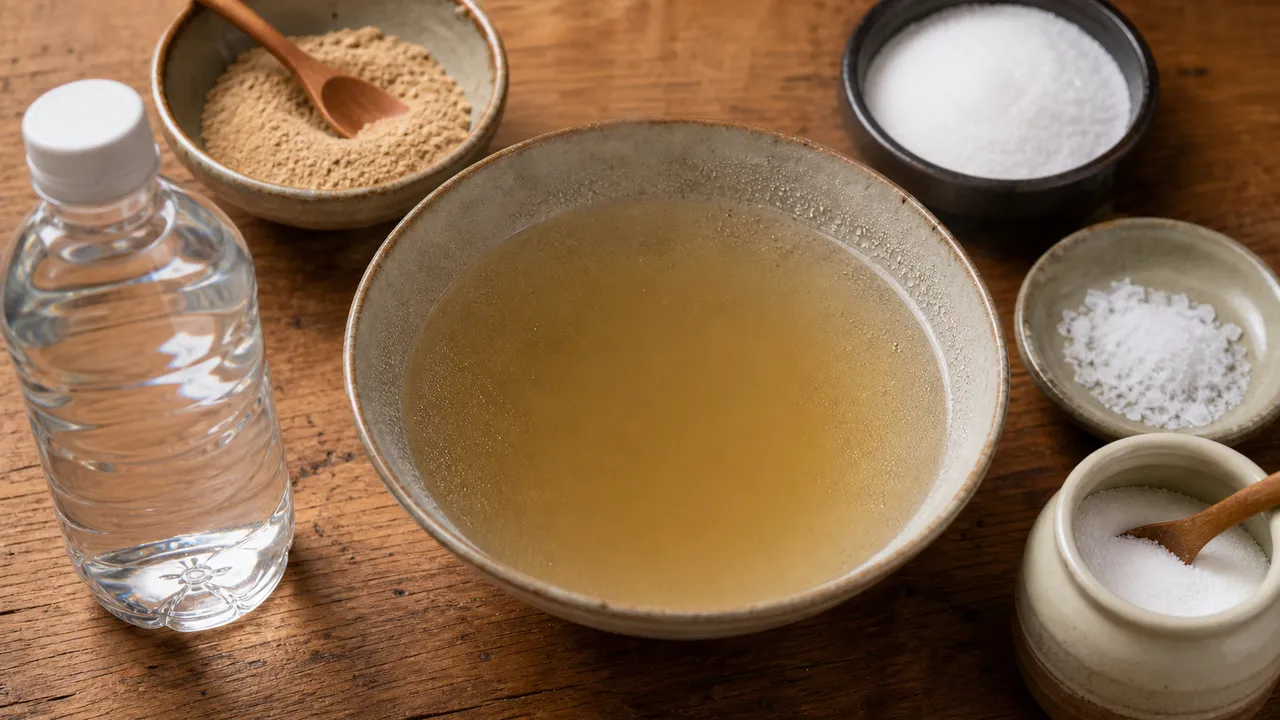
Super Simple Umami Naengmyeon Broth Recipe
* 이미지는 AI가 생성한 참고 이미지로, 실제 조리 결과물과 다를 수 있습니다.
This recipe allows you to easily make restaurant-style naengmyeon broth at home.
📝 Editor's Notes
This super simple umami naengmyeon broth recipe helps you enjoy a refreshing and deeply flavored naengmyeon at home, comparable to what you'd find in a specialty restaurant.
It offers both the convenience of store-bought products and the sincerity of homemade broth.
The perfect harmony of sweet, salty, and sour flavors makes it excellent for stimulating your appetite during hot summer months.
The cooking process is not complicated, so even beginner cooks can easily try it.
Freezing for 3-4 hours to create a slushy broth enhances its refreshing and clean taste.
It's a great recipe for the whole family to enjoy a cool meal together.
🛒 Ingredient Tips
The key to this recipe lies in the harmony of various seasonings.
'Miwon Jinguk Dashi Beef (미원 진국 다시 소고기)' plays an important role in creating a deep umami flavor for the broth.
You can achieve a similar effect by choosing a beef-based dashi or seasoning among store-bought products.
White sugar provides a refreshing sweetness, while fine grain salt seasons the broth and enhances the sweetness.
Both brewed vinegar and apple cider vinegar work well, but apple cider vinegar will yield a slightly milder and more refreshing sourness.
Note that adding Dongchimi Naengmyeon broth (동치미 냉면육수) can further enhance the clean and refreshing umami flavor.
🔄 Substitution Guide
If 'Miwon Jinguk Dashi Beef (미원 진국 다시 소고기)' is unavailable, you can substitute it with a similar amount of store-bought beef dashi (beef stock powder) or a beef-based liquid seasoning like 'Yeondu Cheongyangcho (연두 청양초)'.
However, since the saltiness and umami intensity vary by product, it's best to start with a small amount and adjust to taste.
Instead of 'Yori Plus MSG (요리플러스 MSG 미원)', you can use a small amount of seasoned salt or add a bit more dashi to enhance the umami.
If you don't have Dongchimi Naengmyeon broth (동치미 냉면육수), you can omit it, but the broth might be less clean and refreshing than if it were included.
Alternatively, you can thinly slice radish, marinate it in salt, sugar, and vinegar, and add it as a topping for a similar refreshing touch.
🥘 Ingredients
👨🍳 Cooking Points
There are three key cooking points for this recipe.
First, when boiling the seasoning base, cook it only until the powders are completely dissolved and no grittiness remains at the bottom.
Be careful not to boil it for too long, as the flavor might change.
Second, vinegar must be added only after the broth has completely cooled.
If added when hot, the sourness of the vinegar will dissipate, and you won't be able to enjoy the authentic tangy flavor of naengmyeon broth, so please remember this point.
Third, the process of making the slushy broth is crucial for the taste of naengmyeon.
Freezing it for about 3-4 hours and then lightly breaking it up before serving will double its refreshing quality.
If you need to make slushy ice quickly, blend ice cubes and the prepared broth in a 1:1 ratio.
👨🍳 Directions
Take out 1 cup (about 200ml) from the 1 liter of purified water into a pot. Add 1.5 tbsp of Miwon Jinguk Dashi Beef (미원 진국 다시 소고기), 4 tbsp white sugar, 0.5 tbsp fine grain salt, 0.5 tsp Yori Plus MSG (요리플러스 MSG 미원), and 0.5 tbsp soy sauce. Turn on the heat and boil the seasoning base.
Stir just enough for the powders to dissolve completely, until no grittiness remains at the bottom of the pot.
Pour the freshly boiled and dissolved seasoning broth into the remaining 800ml of cold purified water that was set aside, and mix well.
Once the broth has completely cooled, add 5-6 tbsp of brewed vinegar (or apple cider vinegar) and stir.
Pour the finished broth into a zip-top bag or a stainless steel container and freeze for about 3-4 hours to create slushy ice crystals.
Just before serving, lightly break up the slushy ice and pour it over boiled noodles to complete a refreshing naengmyeon broth.
💡 Tips
To achieve a store-bought naengmyeon taste, it's important to add plenty of sugar.
Vinegar should be added only after the broth has completely cooled, so its sourness doesn't dissipate.
If you want a cleaner finish, try mixing 1 pouch (about 300ml / 1.25 cups) of store-bought Dongchimi Naengmyeon broth (동치미 냉면육수) into the finished broth.
If you want a quick and cold naengmyeon broth, put 1 cup of ice cubes and the prepared naengmyeon broth in a 1:1 ratio into a blender and blend.
📦 Storage & Reuse
The finished naengmyeon broth can be stored in an airtight container or zip-top bag in the refrigerator for 2-3 days.
If you wish to store it longer, freezing is recommended.
Frozen broth can last for about 1-2 weeks.
Thaw it in the refrigerator the night before serving, or use it directly in its slushy state.
Leftover broth can also be used to make cold kongguksu (soy milk noodles) or muk-saball (chilled acorn jelly soup).
Feel free to adapt it for various dishes that require a refreshing broth.
🥢 Who This Is For
This naengmyeon broth is excellent for a refreshing meal on a hot summer day or as a special weekend dish.
Its mild flavor makes it particularly enjoyable for children or the elderly who may not prefer spicy bibim naengmyeon.
Good accompaniments include thinly sliced boiled beef (suyuk), boiled eggs, julienned cucumber, and pickled radish.
Enjoying it with crispy dumplings or tteokgalbi (grilled short rib patties) will make for an even more satisfying meal.
🔥 Nutrition Info
Since the main ingredients for this naengmyeon broth recipe are water and seasonings, the estimated calorie count per serving (approx.
300ml) is around 100-150 kcal.
With 4 tablespoons of sugar, the carbohydrate content is high, likely in the form of sugars, approximately 20-30g.
Protein and fat may contribute in small amounts from ingredients like Miwon Jinguk Dashi Beef, but their overall proportion is very low, estimated at less than 1-2g each.
There are almost no notable vitamins or minerals.
The sodium content can be somewhat high, so it's advisable to adjust the seasoning of other side dishes when consuming.
The primary purpose of this recipe is to quench thirst and provide a refreshing experience.
💬 Frequently Asked Questions
- Q. What ingredients do I need for Super Simple Umami Naengmyeon Broth?
- Main ingredients include Purified water, Miwon Jinguk Dashi Beef (미원 진국 다시 소고기), White sugar, Fine grain salt, Yori Plus MSG (요리플러스 MSG 미원). The key to this recipe lies in the harmony of various seasonings. 'Miwon Jinguk Dashi Beef (미원 진국 다시 소고기)' plays an important role in creating a deep umami flavor for the broth. You can achieve a similar effect by choosing a beef-based dashi or seasoning among store-bought products. White sugar provides a refreshing sweetness, while fine grain salt seasons the broth and enhances the sweetness. Both brewed vinegar and apple cider vinegar work well, but apple cider vinegar will yield a slightly milder and more refreshing sourness. Note that adding Dongchimi Naengmyeon broth (동치미 냉면육수) can further enhance the clean and refreshing umami flavor.
- Q. What are the key tips for making Super Simple Umami Naengmyeon Broth?
- There are three key cooking points for this recipe. First, when boiling the seasoning base, cook it only until the powders are completely dissolved and no grittiness remains at the bottom. Be careful not to boil it for too long, as the flavor might change. Second, vinegar must be added only after the broth has completely cooled. If added when hot, the sourness of the vinegar will dissipate, and you won't be able to enjoy the authentic tangy flavor of naengmyeon broth, so please remember this point. Third, the process of making the slushy broth is crucial for the taste of naengmyeon. Freezing it for about 3-4 hours and then lightly breaking it up before serving will double its refreshing quality. If you need to make slushy ice quickly, blend ice cubes and the prepared broth in a 1:1 ratio.
- Q. How should I store leftover Super Simple Umami Naengmyeon Broth?
- The finished naengmyeon broth can be stored in an airtight container or zip-top bag in the refrigerator for 2-3 days. If you wish to store it longer, freezing is recommended. Frozen broth can last for about 1-2 weeks. Thaw it in the refrigerator the night before serving, or use it directly in its slushy state. Leftover broth can also be used to make cold kongguksu (soy milk noodles) or muk-saball (chilled acorn jelly soup). Feel free to adapt it for various dishes that require a refreshing broth.
- Q. How many calories are in Super Simple Umami Naengmyeon Broth?
- Since the main ingredients for this naengmyeon broth recipe are water and seasonings, the estimated calorie count per serving (approx. 300ml) is around 100-150 kcal. With 4 tablespoons of sugar, the carbohydrate content is high, likely in the form of sugars, approximately 20-30g. Protein and fat may contribute in small amounts from ingredients like Miwon Jinguk Dashi Beef, but their overall proportion is very low, estimated at less than 1-2g each. There are almost no notable vitamins or minerals. The sodium content can be somewhat high, so it's advisable to adjust the seasoning of other side dishes when consuming. The primary purpose of this recipe is to quench thirst and provide a refreshing experience.
- Q. Can I substitute ingredients in Super Simple Umami Naengmyeon Broth?
- If 'Miwon Jinguk Dashi Beef (미원 진국 다시 소고기)' is unavailable, you can substitute it with a similar amount of store-bought beef dashi (beef stock powder) or a beef-based liquid seasoning like 'Yeondu Cheongyangcho (연두 청양초)'. However, since the saltiness and umami intensity vary by product, it's best to start with a small amount and adjust to taste. Instead of 'Yori Plus MSG (요리플러스 MSG 미원)', you can use a small amount of seasoned salt or add a bit more dashi to enhance the umami. If you don't have Dongchimi Naengmyeon broth (동치미 냉면육수), you can omit it, but the broth might be less clean and refreshing than if it were included. Alternatively, you can thinly slice radish, marinate it in salt, sugar, and vinegar, and add it as a topping for a similar refreshing touch.
💬 Comments
No comments yet. Be the first to comment!