
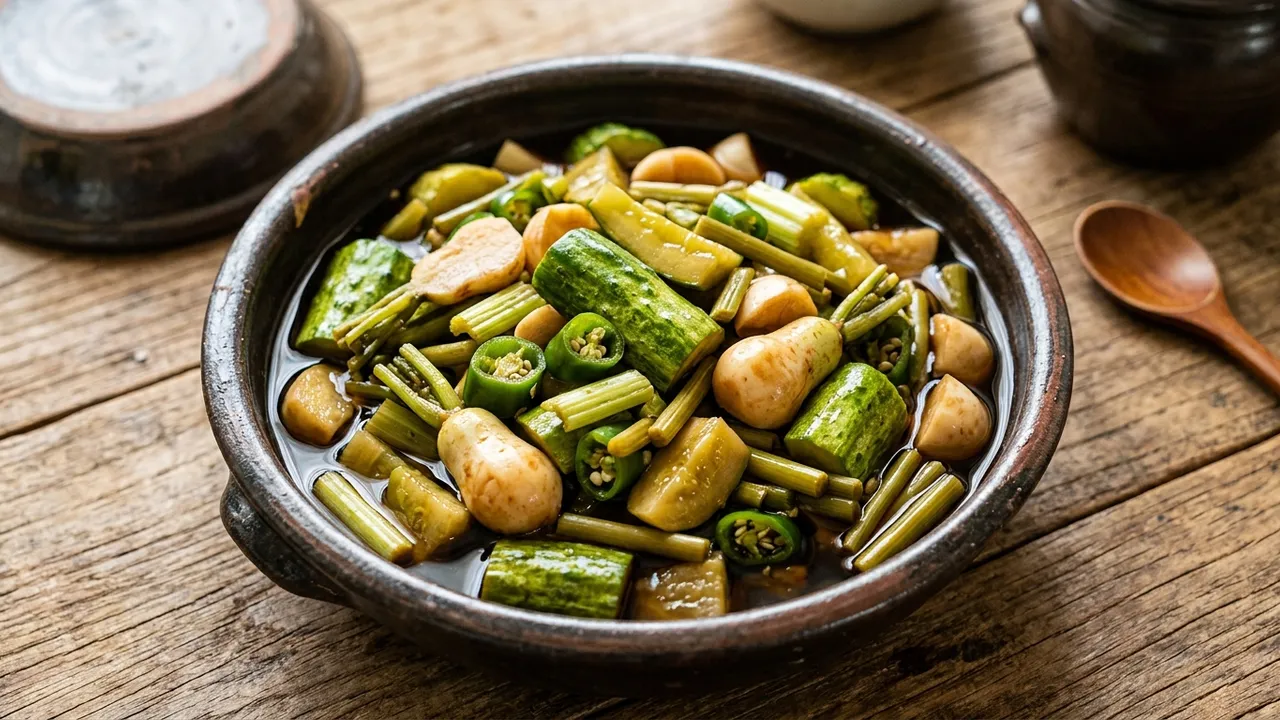
Spicy and Tangy Assorted Jangajji (Korean Pickled Vegetables
* 이미지는 AI가 생성한 참고 이미지로, 실제 조리 결과물과 다를 수 있습니다.
As summer approaches, prepare these Korean-style jangajji (pickled vegetables) and Western-style pickles to whet your appetite. We'll share a simple pickling brine secret and Debbie's Kitchen's special cucumber pickle recipe.
📋 2 recipes — Select to view
A soy sauce-based pickle recipe using various seasonal vegetables that can be enjoyed throughout the summer.
📝 Editor's Notes
Tangy and Sweet Assorted Pickles are the perfect side dish to boost your appetite in summer.
Made with various seasonal vegetables, they boast an excellent harmony of crisp texture and sweet-and-sour flavor.
The soy sauce-based brine enhances the natural taste of the vegetables while adding a deep umami flavor.
The preparation might take some effort, but you'll find it rewarding to have a steady supply of these delicious pickles for a long time.
They're especially ideal as a 'rice thief' (밥도둑, mulmari-bap) on hot summer days when cooking over a stove is difficult.
The difficulty level is low-to-medium, so anyone can follow the steps to make them successfully.
🛒 Ingredient Tips
For cucumbers, choose those with clear bumps, a firm and heavy feel, a dark green peel, and a glossy finish for freshness.
Cheongyang chili peppers (청양고추) should have a fresh stem, vibrant color, and firm texture; avoid any that are soft or discolored.
For chonggakmu (총각무) radishes, it's best to select ones with fresh greens, firm radish bulbs, and minimal fine roots.
For lotus root, look for ones with soil still on them and no blemishes.
A good lotus root will have a white cut surface and distinct, open holes.
Using seasonal vegetables will result in fresher and more delicious pickles, so we recommend selecting them yourself at the market.
🔄 Substitution Guide
Instead of cucumbers, you can use Korean zucchini (애호박) for pickles with a softer texture.
Korean zucchini has more moisture than cucumbers, so lightly salting it and squeezing out the excess water before pickling will result in a crisper texture.
If Cheongyang chili peppers (청양고추) are too spicy for you, you can substitute them with kkwari-gochu (꽈리고추, shishito peppers) or asagi-gochu (아삭이고추, mild green peppers).
Kkwari-gochu offers a gentle spiciness, while asagi-gochu adds a refreshing and crisp taste.
If garlic stems are unavailable, whole garlic cloves can be used.
Whole garlic can be blanched or pickled raw, but its flavor might be stronger and texture firmer than garlic stems.
Since the taste and texture will vary slightly depending on the characteristics of each ingredient, choose according to your preference.
🥘 Ingredients
👨🍳 Cooking Points
The most crucial cooking point lies in preparing the brine.
The key is to first boil only the water, salt, and sugar until completely dissolved, then cool it sufficiently.
Boiling soy sauce and vinegar together can create a strong, peculiar odor and alter the taste, so always mix them in separately.
The second point is preparing the lotus root.
After peeling, the lotus root should be immediately blanched in vinegar water to prevent browning and remove stickiness.
It's important not to rinse it with water afterwards, but rather to drain it in a colander and let it cool to maintain its crisp texture.
Finally, when layering the vegetables in the container, start with the harder vegetables and pack them tightly without leaving gaps.
When pouring the brine, fill the container completely to minimize air exposure, which is essential for long-term storage without spoilage.
Keeping these points in mind will help you make delicious pickles successfully.
👨🍳 Directions
In a pot, combine 1 L of water, 15 g of salt, and 500 g of sugar. Bring to a boil until the sugar and salt are completely dissolved, then let it cool down slightly.
Once the brine has cooled to lukewarm or completely, mix in 800 ml of soy sauce and 800 ml of vinegar. (Mixing all ingredients together and boiling can create a strong odor, so it's best to boil only the water, then cool it before adding soy sauce and vinegar.)
Peel 1 lotus root and slice it into 3-4 mm thick rounds. Immediately submerge them in water to prevent browning. Briefly add a splash of vinegar to boiling water, then blanch the lotus root slices for about 2-3 minutes. Do not rinse with water; instead, drain them in a colander and let them cool.
Cut off both ends of 2 onions, then slice them into pieces roughly half the size of a thumb (about 2.5 cm or 1 inch) and separate the layers.
Slice 300 g of celery into pieces about 2.5 cm (1 inch) long, slightly smaller than the onion pieces.
Cut 300 g of garlic stems into 5 cm (2 inch) lengths.
Slice 6 chonggakmu (총각무) radishes into rounds about 4-5 mm thick. If any part is too thick, halve it before slicing.
Remove the bumps from 4 cucumbers and scrape out the seeds with a small spoon. Blot the cucumbers dry with a paper towel, then slice them into pieces similar in size to the onions (about 2.5 cm or 1 inch).
Take half of the 300 g Cheongyang chili peppers (청양고추) and poke 6-7 holes into each with a toothpick. For the other half, finely chop them into pieces no longer than 1 cm (about 7-8 mm or 0.3 inch), remove the seeds, and place them in a bowl.
In a sterilized container, layer the vegetables tightly, starting with the harder ones, in the following order: chonggakmu (총각무) radishes, garlic stems, lotus root, celery, onions, cucumbers, and Cheongyang chili peppers (청양고추).
Pour the lukewarm or completely cooled brine into the container until it's full. Make sure to fill it completely to minimize air exposure and prevent the vegetables from floating, then close the lid and store it in the refrigerator.
The pickles can be enjoyed starting two days after preparation.
💡 Tips
Prepare the brine in advance by boiling and cooling it. Boiling soy sauce and vinegar together can result in a strong, unpleasant odor.
To remove the sticky mucilage from the lotus root and prevent browning, it's best to blanch it and then cool it immediately without rinsing with water.
You can adjust the spiciness of the Cheongyang chili peppers (청양고추) according to your preference by either poking holes in them whole with a toothpick or by finely chopping them and removing the seeds.
To prevent air exposure, fill a tall jar tightly with the ingredients. For longer storage, after about a week, you can drain the brine, re-boil it, let it cool completely, and then pour it back over the pickles. This will help preserve them for a longer period.
📦 Storage & Reuse
The finished assorted pickles must be stored in the refrigerator.
Transfer them to a sterilized, airtight container and refrigerate; they will stay fresh for about a month.
If you wish to store them longer, after about a week, drain the brine, re-boil it once more, let it cool completely, and then pour it back over the pickles.
This can extend their preservation period to over two months.
Don't discard the leftover brine; you can use it to pickle other vegetables or as a salad dressing.
Pickles are best served chilled, so it's recommended to take them directly from the refrigerator just before serving.
🥢 Who This Is For
These assorted pickles are excellent as a summer side dish.
They are especially good for stimulating the appetite when you're feeling tired and low on energy from sweating a lot.
If you like spicy food, feel free to add more Cheongyang chili peppers (청양고추).
Eating them with a bowl of warm rice and cold water (물말이 밥, mulmari-bap) makes them so satisfying that you won't need any other side dishes.
They also pair wonderfully with greasy foods like samgyeopsal (삼겹살, grilled pork belly) or bossam (보쌈, boiled pork wraps), cutting through the richness and adding a clean flavor.
They're also perfect as a lunchbox side dish for camping or picnics.
🔥 Nutrition Info
This recipe features a variety of vegetables, making it rich in dietary fiber, and is characterized by its soy sauce and vinegar-based brine.
Based on the ingredient quantities provided, one serving is estimated to be approximately 150-200 kcal.
Carbohydrates, from sugar and vegetable sugars, are estimated at about 30-40 g, while protein and fat are present in small amounts, around 2-5 g.
Lotus root, in particular, is rich in iron and Vitamin C, which can help with fatigue recovery and immune system enhancement.
Cucumbers and celery, with their high water content, are excellent for quenching thirst during summer.
However, as it contains a significant amount of soy sauce, the sodium content can be high, so it's important to consume it in moderation.
💬 Frequently Asked Questions
- Q. What ingredients do I need for Spicy and Tangy Assorted Jangajji (Korean Pickled Vegetables) and Super Easy Cucumber Pickles for Summer?
- Main ingredients include Cucumbers, Cheongyang chili peppers, Ponytail radishes, Celery, Garlic scapes. Choosing fresh vegetables is key to the flavor of these jangajji (장아찌) and pickles. For cucumbers, look for glossy, firm skin with distinct bumps. Selecting straight ones also makes them easier to prepare. For Cheongyang chili peppers (청양고추), choose those with vibrant color and fresh stems. If you enjoy a stronger spicy kick, slightly reddish ones are also good. For ponytail radishes (총각무), look for firm roots and fresh leaves, and choose ones that are not too large to ensure a crisp texture. For garlic scapes, select straight, plump stalks with un-wilted ends to make fresh and delicious jangajji.
- Q. What are the key tips for making Spicy and Tangy Assorted Jangajji (Korean Pickled Vegetables) and Super Easy Cucumber Pickles for Summer?
- There are two crucial cooking points in this recipe. First, when making the pickling liquid, it's important to first boil only the water, salt, and sugar until completely dissolved, then let it cool. Be careful not to boil the soy sauce and vinegar together, as this can create a strong odor throughout the house and cause the vinegar's sourness to dissipate. The soy sauce and vinegar should be mixed in when the pickling liquid is lukewarm or completely cooled. Second, when blanching the lotus root, add a splash of vinegar to boiling water and blanch for only 2-3 minutes. Blanching for too long will make it mushy, and rinsing it will re-develop its sticky mucilage. Therefore, the secret to maintaining its crisp texture is to drain it in a colander and let it cool without rinsing after blanching.
- Q. How should I store leftover Spicy and Tangy Assorted Jangajji (Korean Pickled Vegetables) and Super Easy Cucumber Pickles for Summer?
- Store the finished jangajji (장아찌) and pickles in sterilized containers, ensuring the pickling liquid fully submerges the vegetables. Close the lid tightly to prevent air exposure and refrigerate. They can be stored for about 2 weeks in a cool place, or over a month if refrigerated. For longer storage, after about a week, re-boil the pickling liquid, cool it, and pour it back over the vegetables to keep them fresh for an extended period. Don't discard the leftover vegetable pickling liquid; you can dilute it with water to use as a sweet-and-sour gochujang sauce (초고추장) or salad dressing, or add a touch to soup dishes for an extra tangy flavor.
- Q. How many calories are in Spicy and Tangy Assorted Jangajji (Korean Pickled Vegetables) and Super Easy Cucumber Pickles for Summer?
- This assorted jangajji (장아찌) and cucumber pickle, packed with various vegetables, is a healthy side dish rich in vitamins and minerals. The estimated calorie count per serving is about 80-120 kcal, which is relatively low due to vegetables being the main ingredients. Protein is very low, approximately 1-3g, fat is about 0-1g, and carbohydrates are estimated at 15-25g. Cucumbers, in particular, have high water content, which is good for quenching thirst, and are rich in potassium, aiding in sodium excretion. The capsaicin in Cheongyang chili peppers (청양고추) boosts metabolism, and lotus root, rich in dietary fiber, benefits gut health. However, as sugar and soy sauce are included, the sodium content can be somewhat high, so it's best to consume in moderation.
- Q. Can I substitute ingredients in Spicy and Tangy Assorted Jangajji (Korean Pickled Vegetables) and Super Easy Cucumber Pickles for Summer?
- For this recipe, you can use Korean radish (무, mu) instead of ponytail radish (총각무, chonggakmu). While Korean radish has a softer texture and is less crisp than ponytail radish, it offers a refreshing and subtly sweet flavor. If you use burdock root instead of lotus root, you'll experience a different crisp texture and unique aroma. Like lotus root, burdock root should be blanched before use. If celery is unavailable or its aroma is too strong for your preference, you can increase the amount of cucumber or onion, or add bell peppers. Bell peppers will add beautiful color and a crisp texture. If the spiciness of Cheongyang chili peppers (청양고추) is too much, you can substitute them with Kkari-gochu (꽈리고추, Korean shishito peppers) or regular green peppers for a milder taste.
💬 Comments
No comments yet. Be the first to comment!