
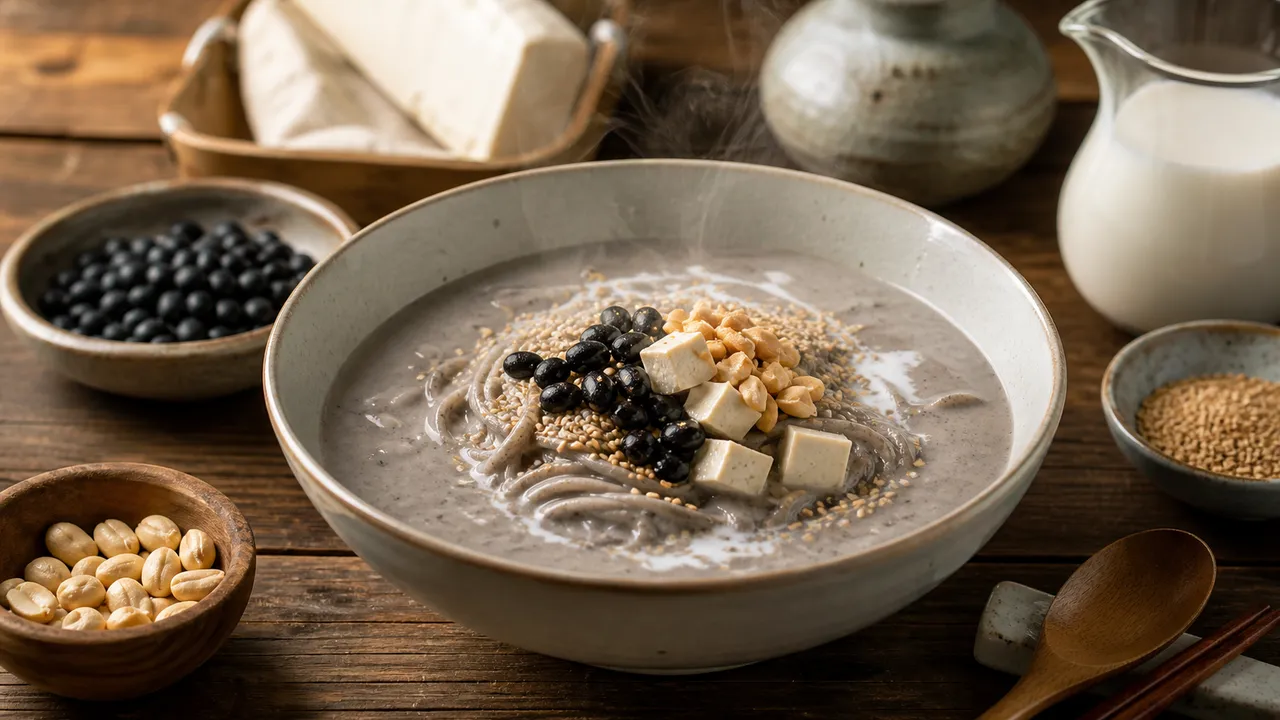
Omonyi's Black Soybean Kongguksu (Cold Soybean Noodle Soup)
* 이미지는 AI가 생성한 참고 이미지로, 실제 조리 결과물과 다를 수 있습니다.
This is actress Oh Yeon-seo's mother's (Omonyi's) recipe for a savory and healthy black soybean kongguksu (cold soybean noodle soup).
📝 Editor's Notes
Omonyi's Black Soybean Kongguksu (Cold Soybean Noodle Soup) is a healthy and delicious dish, boasting a rich and savory flavor.
Black soybeans, peanuts, tofu, and sesame seeds create a profound taste, while milk adds a creamy smoothness.
Unique garnishes like mango watermelon add an interesting twist, and the use of spinach noodles enhances both color and nutrition.
This recipe is a perfect cool delicacy for hot summer days and is highly recommended for anyone needing a nutritious boost.
The difficulty level is low, as it only involves simple steps like blending ingredients and cooking noodles, making it easy for beginners to follow.
It's a healthy and delicious meal that the whole family can enjoy together.
🛒 Ingredient Tips
Black soybeans are the core ingredient for kongguksu, so it's important to choose fresh, glossy domestic black soybeans.
Look for plump beans with unwrinkled skins.
The freshness of peanuts significantly affects the taste, so select those that are not soggy and have a savory aroma.
If possible, roasting raw peanuts with their skins on will yield a much richer, savory flavor, but if that's inconvenient, roasted peanuts are fine too.
For tofu, organic tofu made from domestic soybeans is best.
Using soft silken tofu (sundubu) or soft tofu (yeon-dubu) rather than firm tofu will make the kongguksu soup even smoother.
If you slightly roast and grind whole sesame seeds instead of using them whole, the nutty aroma will be much stronger.
You can often find fresher ingredients by selecting them directly at a traditional market.
🔄 Substitution Guide
You can use white soybeans (baektae, 백태) instead of black soybeans to make savory kongguksu.
However, white soybeans have a lighter color and a slightly milder flavor than black soybeans.
If you have a peanut allergy or dislike peanuts, try adding about a handful of other nuts like cashews or almonds.
Cashews will add a creamy, savory taste, while almonds can provide a richer flavor.
Tofu can be omitted if unavailable, but it significantly enhances the soup's thickness, smoothness, and savory depth, so it's highly recommended if possible.
You can also use soy milk or almond milk instead of cow's milk.
Note that soy milk can be sweet, so opt for unsweetened varieties, and almond milk will result in a much lighter taste.
Regular somyeon (소면, wheat noodles) or buckwheat noodles can be used in place of spinach noodles.
🥘 Ingredients
👨🍳 Cooking Points
The most crucial point of this recipe is to blend the soybean soup "finely." Add all ingredients to the blender with about one cup of water, and blend thoroughly until completely smooth, with no lumps.
This ensures a silky-smooth soybean soup that's pleasant to swallow.
The second key point is cooking the noodles.
When boiling noodles, periodically add a small amount of cold water to prevent them from getting mushy and to maintain their chewy texture.
The chewiness of the noodles is a vital factor for the taste of kongguksu, so remember this tip.
Lastly, instead of adding all the salt at once, add it gradually and taste as you go to adjust to your preference.
Adjust the soup's consistency by adding water as desired to make the most delicious kongguksu.
👨🍳 Directions
Add two handfuls of black soybeans, one handful of peeled peanuts, one block of tofu, a generous handful of sesame seeds, and 500 ml of milk to a blender. Add about one cup of water and blend until smooth.
Add 3 tbsp of salt to the blended soybean soup. Adjust the seasoning by adding more water to achieve your desired consistency.
Cook the noodles. Rinse them thoroughly under cold water to remove starch and make them chewy.
Place the cooked noodles in a bowl and pour the soybean soup over them.
Slice the cucumber thinly and place it on top. Hard-boil an egg, cut it in half, and add it to the bowl. Garnish with cherry tomatoes and mango watermelon to finish.
If you want to add more savory flavor, sprinkle with additional sesame seeds.
💡 Tips
Adding tofu to kongguksu makes the texture smoother and doubles the savory flavor.
While eating peanuts with their skin can be beneficial for dementia prevention, it's recommended to peel them for a smoother taste.
When boiling noodles, adding a little cold water periodically prevents them from getting mushy and helps maintain their chewy texture.
Use a hard-boiled egg to prevent the soup from becoming cloudy.
Adjust the consistency and saltiness of the kongguksu soup with water and salt according to your preference.
It's best to purchase ingredients from local specialty stores or traditional markets for freshness.
📦 Storage & Reuse
The prepared soybean soup can be stored in an airtight container in the refrigerator for 2-3 days.
As time passes, the soup may thicken, so adjust its consistency by adding a little more water or milk before serving.
Cooked noodles, rinsed in cold water and drained, can be refrigerated separately for 1-2 days.
While kongguksu soup can be frozen, its taste and texture may change upon thawing, so it's best to consume it as soon as possible.
Leftover soybean soup can be used to make kongbiji-jjigae (콩비지찌개, soybean pulp stew) or soybean milk pasta.
Use leftover cucumber in cold soup or salads.
Hard-boiled eggs are great in salads or sandwiches.
🥢 Who This Is For
This kongguksu is excellent as a nutritious pick-me-up during hot summer days when you feel low on energy.
It can also be a wonderful meal for growing children and the elderly.
Recommended side dishes include crunchy geotjeori (겉절이, fresh kimchi) or refreshing yeolmu-kimchi (열무김치, young radish kimchi).
The sweet and sour kimchi will enhance the savory flavor of the kongguksu.
You can also pair it with spicy gochujang (고추장) anchovy stir-fry or simple jeon (Korean pancakes).
Finishing the meal with warm tea or sikhye (식혜, sweet rice punch) will make it even more perfect.
🔥 Nutrition Info
This black soybean kongguksu, based on 4 servings, is estimated to provide approximately 450-550 kcal per serving.
Each serving is expected to provide about 25-35g of protein, 20-25g of fat, and 40-50g of carbohydrates.
Black soybeans are rich in anthocyanins, beneficial for antioxidant activity, and peanuts contain abundant unsaturated fatty acids, aiding cardiovascular health.
Tofu is a high-quality source of plant-based protein, and sesame seeds are rich in calcium and iron.
With milk and spinach noodles, this dish becomes a healthy meal providing a balanced intake of various nutrients, including B vitamins, potassium, and dietary fiber.
Its rich plant-based protein content also makes it an excellent option for vegetarians.
Overall, it's a hearty and nutritionally balanced meal.
💬 Frequently Asked Questions
- Q. What ingredients do I need for Omonyi's Black Soybean Kongguksu (Cold Soybean Noodle Soup)?
- Main ingredients include Black soybeans, Peanuts, Tofu, Sesame seeds, Milk. Black soybeans are the core ingredient for kongguksu, so it's important to choose fresh, glossy domestic black soybeans. Look for plump beans with unwrinkled skins. The freshness of peanuts significantly affects the taste, so select those that are not soggy and have a savory aroma. If possible, roasting raw peanuts with their skins on will yield a much richer, savory flavor, but if that's inconvenient, roasted peanuts are fine too. For tofu, organic tofu made from domestic soybeans is best. Using soft silken tofu (sundubu) or soft tofu (yeon-dubu) rather than firm tofu will make the kongguksu soup even smoother. If you slightly roast and grind whole sesame seeds instead of using them whole, the nutty aroma will be much stronger. You can often find fresher ingredients by selecting them directly at a traditional market.
- Q. What are the key tips for making Omonyi's Black Soybean Kongguksu (Cold Soybean Noodle Soup)?
- The most crucial point of this recipe is to blend the soybean soup "finely." Add all ingredients to the blender with about one cup of water, and blend thoroughly until completely smooth, with no lumps. This ensures a silky-smooth soybean soup that's pleasant to swallow. The second key point is cooking the noodles. When boiling noodles, periodically add a small amount of cold water to prevent them from getting mushy and to maintain their chewy texture. The chewiness of the noodles is a vital factor for the taste of kongguksu, so remember this tip. Lastly, instead of adding all the salt at once, add it gradually and taste as you go to adjust to your preference. Adjust the soup's consistency by adding water as desired to make the most delicious kongguksu.
- Q. How should I store leftover Omonyi's Black Soybean Kongguksu (Cold Soybean Noodle Soup)?
- The prepared soybean soup can be stored in an airtight container in the refrigerator for 2-3 days. As time passes, the soup may thicken, so adjust its consistency by adding a little more water or milk before serving. Cooked noodles, rinsed in cold water and drained, can be refrigerated separately for 1-2 days. While kongguksu soup can be frozen, its taste and texture may change upon thawing, so it's best to consume it as soon as possible. Leftover soybean soup can be used to make kongbiji-jjigae (콩비지찌개, soybean pulp stew) or soybean milk pasta. Use leftover cucumber in cold soup or salads. Hard-boiled eggs are great in salads or sandwiches.
- Q. How many calories are in Omonyi's Black Soybean Kongguksu (Cold Soybean Noodle Soup)?
- This black soybean kongguksu, based on 4 servings, is estimated to provide approximately 450-550 kcal per serving. Each serving is expected to provide about 25-35g of protein, 20-25g of fat, and 40-50g of carbohydrates. Black soybeans are rich in anthocyanins, beneficial for antioxidant activity, and peanuts contain abundant unsaturated fatty acids, aiding cardiovascular health. Tofu is a high-quality source of plant-based protein, and sesame seeds are rich in calcium and iron. With milk and spinach noodles, this dish becomes a healthy meal providing a balanced intake of various nutrients, including B vitamins, potassium, and dietary fiber. Its rich plant-based protein content also makes it an excellent option for vegetarians. Overall, it's a hearty and nutritionally balanced meal.
- Q. Can I substitute ingredients in Omonyi's Black Soybean Kongguksu (Cold Soybean Noodle Soup)?
- You can use white soybeans (baektae, 백태) instead of black soybeans to make savory kongguksu. However, white soybeans have a lighter color and a slightly milder flavor than black soybeans. If you have a peanut allergy or dislike peanuts, try adding about a handful of other nuts like cashews or almonds. Cashews will add a creamy, savory taste, while almonds can provide a richer flavor. Tofu can be omitted if unavailable, but it significantly enhances the soup's thickness, smoothness, and savory depth, so it's highly recommended if possible. You can also use soy milk or almond milk instead of cow's milk. Note that soy milk can be sweet, so opt for unsweetened varieties, and almond milk will result in a much lighter taste. Regular somyeon (소면, wheat noodles) or buckwheat noodles can be used in place of spinach noodles.
💬 Comments
No comments yet. Be the first to comment!