
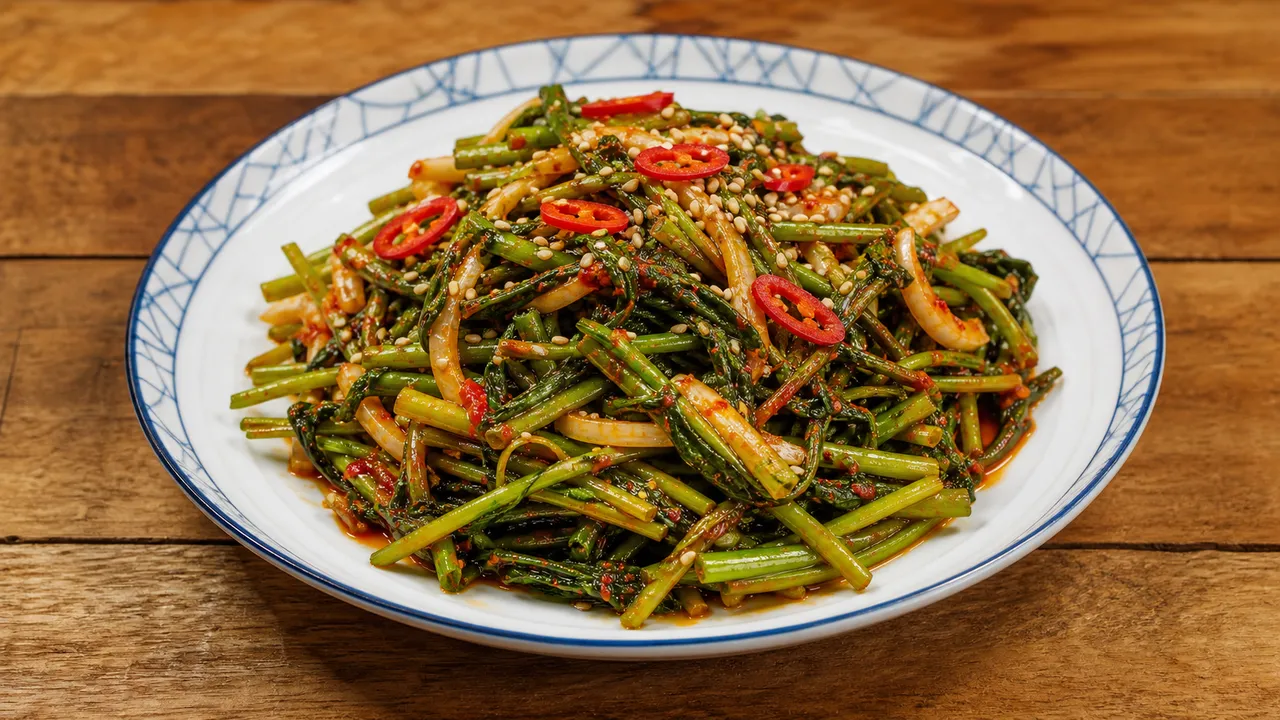
Super Easy Gochujang (고추장) Minaeri (미나리) Salad Recipe
* 이미지는 AI가 생성한 참고 이미지로, 실제 조리 결과물과 다를 수 있습니다.
A spicy and tangy minaeri (미나리) salad ready in just 10 minutes, made by tossing fragrant minaeri (미나리) and crisp vegetables with a gochujang (고추장) dressing. This is an easy-to-make Korean home-style side dish for everyone.
📝 Editor's Notes
Gochujang (고추장) Minaeri (미나리) Salad, made by tossing fragrant minaeri (미나리) and crisp vegetables with a gochujang (고추장) dressing, is a super easy Korean home-style side dish that can be prepared in just 10 minutes.
This spicy and tangy dish is a great appetizer, especially when minaeri (미나리) is in season during spring, offering peak freshness and flavor.
Its simple preparation makes it accessible for anyone, helping you prepare a healthy and delicious meal even on busy days.
The exquisite harmony of fresh vegetable aroma and gochujang (고추장) dressing makes it an excellent accompaniment to rice or meat dishes.
🛒 Ingredient Tips
When selecting minaeri (미나리), choose stalks that are not too thick and are tender, with vibrant green leaves that are not wilted.
Fresh minaeri (미나리) should have straight and firm stalks.
Minaeri (미나리) in season during spring has the best aroma and texture.
For onions, choose those with firm, shiny skins, clean root ends, and no sprouts.
For Cheongyang chili peppers (청양고추) and red chili peppers (홍고추), select those with vivid colors and fresh, un-withered stems.
Minced fresh whole garlic offers a much richer aroma and fresher taste.
Choosing good quality ingredients is the first step to making a delicious seasoned salad.
🔄 Substitution Guide
If minaeri (미나리) is unavailable or difficult to find, you can substitute it with other fragrant wild greens (namul).
For example, water parsley (dol-minaeri, 돌미나리), bitter greens (sseumbagui, 씀바귀) if you enjoy a slightly bitter taste, or even fragrant chamnamul (참나물) can be good alternatives.
However, chamnamul (참나물) is softer than minaeri (미나리), so you should reduce the blanching time to about 10-20 seconds.
If Cheongyang chili peppers (청양고추) or red chili peppers (홍고추) feel too spicy, you can thinly julienne bell peppers or capsicums instead.
This maintains the color while reducing the spiciness.
You can use oligosaccharide or sugar instead of honey to add sweetness, but note that the unique flavor of honey may be slightly diminished.
For soy sauce, you can use regular soy sauce (yangjo ganjang, 양조간장) instead of soup soy sauce (guk ganjang, 국간장); in this case, adjust the amount of soy sauce by using a little less to achieve the desired seasoning.
🥘 Ingredients
👨🍳 Cooking Points
The most important cooking point for this Gochujang (고추장) Minaeri (미나리) Salad is the blanching process of the minaeri (미나리).
Once the water boils in a pot, add a pinch of salt, then add the prepared minaeri (미나리) stems, cover, and blanch briefly for 30 seconds to 1 minute.
Be careful not to blanch it for too long, as this will cause the crisp texture and fragrance of the minaeri (미나리) to disappear.
Immediately rinse the blanched minaeri (미나리) in cold water to stop the cooking process and thoroughly drain it to prevent the seasoning from becoming diluted.
The second key point is the seasoning sauce.
It is important to adjust the seasoning to your personal taste by appropriately combining soy sauce, sesame oil, honey, and vinegar, with gochujang (고추장) and gochugaru (고춧가루) as the base.
If you prefer a more tangy taste, add a little more vinegar; if you prefer sweetness, add more honey.
Finally, when mixing all the ingredients and the seasoning sauce, wear hygienic gloves and gently massage them by hand.
This ensures the seasoning is evenly distributed, enhancing the flavor.
👨🍳 Directions
Bring water to a boil in a pot and add a suitable amount of salt.
Add the prepared minaeri (미나리) stems to the boiling water, sprinkle with a little more salt, cover, and blanch briefly.
Rinse the blanched minaeri (미나리) in cold water, drain thoroughly, and place in a large bowl.
Finely mince the garlic, thinly julienne the onion, diagonally slice the Cheongyang chili peppers (청양고추) and red chili peppers (홍고추), and finely chop the green onion (대파). Add all to the bowl with the minaeri (미나리).
In a small bowl, add 2 tbsp of gochujang (고추장) and 1 heaping tbsp of gochugaru (고춧가루). Add appropriate amounts of soy sauce, sesame oil, honey, and vinegar, then mix well to create the seasoning sauce.
Add all the seasoning sauce to the prepared minaeri (미나리) and vegetables. Using hands with hygienic gloves, gently mix and massage the ingredients together.
Transfer to a serving dish, sprinkle generously with sesame seeds, and serve.
💡 Tips
Adding a pinch of salt when blanching minaeri (미나리) helps to enhance its vibrant green color and pre-season it.
Adjust the amounts of soy sauce, honey, and vinegar in the seasoning sauce to suit your personal preference.
When mixing the vegetables and seasoning sauce, make sure to wear hygienic gloves and mix thoroughly so that the sauce is well absorbed into the ingredients, making it more delicious.
📦 Storage & Reuse
It is best to store the finished Gochujang (고추장) Minaeri (미나리) Salad in an airtight container in the refrigerator.
To fully enjoy the crisp texture and fresh aroma of minaeri (미나리), it is recommended to consume it on the day it is made.
When refrigerated, it is most delicious when eaten within 2-3 days.
Over time, the minaeri (미나리) will lose its crispness and absorb more of the seasoning, which can alter its texture.
Freezing leftover minaeri (미나리) salad is not recommended, as thawing can cause it to become watery and mushy, reducing its flavor.
If you have leftover minaeri (미나리) or other vegetables, you can blanch and freeze minaeri (미나리) for later use in jeon (전, Korean pancakes) or soup, and use leftover chili peppers, onions, etc., in other stir-fries.
🥢 Who This Is For
This Gochujang (고추장) Minaeri (미나리) Salad is highly recommended for those who love fragrant spring greens or wish to stimulate their appetite with a spicy and tangy flavor.
It becomes an unbeatable 'rice thief' side dish, especially when enjoyed with warm rice.
It pairs wonderfully with meat dishes like samgyeopsal (삼겹살, grilled pork belly) or bulgogi (불고기, marinated grilled beef), cutting through their richness and adding a refreshing touch.
It also makes a perfect healthy side dish for guests.
Serving it alongside other Korean staples like kimchi jjigae (김치찌개, kimchi stew) or doenjang jjigae (된장찌개, soybean paste stew) will complete a richer Korean meal.
🔥 Nutrition Info
This Gochujang (고추장) Minaeri (미나리) Salad is estimated to contain approximately 80-120 kcal per serving.
It is expected to provide about 2-4g of protein, 3-5g of fat, and 10-15g of carbohydrates.
Minaeri (미나리) is rich in various vitamins and minerals such as Vitamin K, Vitamin C, calcium, and iron, which contribute to blood clotting, bone health, and immune system strengthening.
It is also high in dietary fiber, beneficial for gut health.
Gochujang (고추장) and gochugaru (고춧가루) contain capsaicin, which boosts metabolism, while garlic and onion contain antioxidants, offering many health benefits.
Honey, used in small amounts as a natural sweetener, adds a sweet note, and vinegar contributes a tangy flavor while aiding digestion.
Overall, this side dish is packed with fresh vegetables, making it a healthy and light, nutritious accompaniment to any meal.
💬 Frequently Asked Questions
- Q. What ingredients do I need for Super Easy Gochujang (고추장) Minaeri (미나리) Salad Recipe?
- Main ingredients include Minaeri (미나리), Salt, Garlic, Onion, Cheongyang chili pepper (청양고추). When selecting minaeri (미나리), choose stalks that are not too thick and are tender, with vibrant green leaves that are not wilted. Fresh minaeri (미나리) should have straight and firm stalks. Minaeri (미나리) in season during spring has the best aroma and texture. For onions, choose those with firm, shiny skins, clean root ends, and no sprouts. For Cheongyang chili peppers (청양고추) and red chili peppers (홍고추), select those with vivid colors and fresh, un-withered stems. Minced fresh whole garlic offers a much richer aroma and fresher taste. Choosing good quality ingredients is the first step to making a delicious seasoned salad.
- Q. What are the key tips for making Super Easy Gochujang (고추장) Minaeri (미나리) Salad Recipe?
- The most important cooking point for this Gochujang (고추장) Minaeri (미나리) Salad is the blanching process of the minaeri (미나리). Once the water boils in a pot, add a pinch of salt, then add the prepared minaeri (미나리) stems, cover, and blanch briefly for 30 seconds to 1 minute. Be careful not to blanch it for too long, as this will cause the crisp texture and fragrance of the minaeri (미나리) to disappear. Immediately rinse the blanched minaeri (미나리) in cold water to stop the cooking process and thoroughly drain it to prevent the seasoning from becoming diluted. The second key point is the seasoning sauce. It is important to adjust the seasoning to your personal taste by appropriately combining soy sauce, sesame oil, honey, and vinegar, with gochujang (고추장) and gochugaru (고춧가루) as the base. If you prefer a more tangy taste, add a little more vinegar; if you prefer sweetness, add more honey. Finally, when mixing all the ingredients and the seasoning sauce, wear hygienic gloves and gently massage them by hand. This ensures the seasoning is evenly distributed, enhancing the flavor.
- Q. How should I store leftover Super Easy Gochujang (고추장) Minaeri (미나리) Salad Recipe?
- It is best to store the finished Gochujang (고추장) Minaeri (미나리) Salad in an airtight container in the refrigerator. To fully enjoy the crisp texture and fresh aroma of minaeri (미나리), it is recommended to consume it on the day it is made. When refrigerated, it is most delicious when eaten within 2-3 days. Over time, the minaeri (미나리) will lose its crispness and absorb more of the seasoning, which can alter its texture. Freezing leftover minaeri (미나리) salad is not recommended, as thawing can cause it to become watery and mushy, reducing its flavor. If you have leftover minaeri (미나리) or other vegetables, you can blanch and freeze minaeri (미나리) for later use in jeon (전, Korean pancakes) or soup, and use leftover chili peppers, onions, etc., in other stir-fries.
- Q. How many calories are in Super Easy Gochujang (고추장) Minaeri (미나리) Salad Recipe?
- This Gochujang (고추장) Minaeri (미나리) Salad is estimated to contain approximately 80-120 kcal per serving. It is expected to provide about 2-4g of protein, 3-5g of fat, and 10-15g of carbohydrates. Minaeri (미나리) is rich in various vitamins and minerals such as Vitamin K, Vitamin C, calcium, and iron, which contribute to blood clotting, bone health, and immune system strengthening. It is also high in dietary fiber, beneficial for gut health. Gochujang (고추장) and gochugaru (고춧가루) contain capsaicin, which boosts metabolism, while garlic and onion contain antioxidants, offering many health benefits. Honey, used in small amounts as a natural sweetener, adds a sweet note, and vinegar contributes a tangy flavor while aiding digestion. Overall, this side dish is packed with fresh vegetables, making it a healthy and light, nutritious accompaniment to any meal.
- Q. Can I substitute ingredients in Super Easy Gochujang (고추장) Minaeri (미나리) Salad Recipe?
- If minaeri (미나리) is unavailable or difficult to find, you can substitute it with other fragrant wild greens (namul). For example, water parsley (dol-minaeri, 돌미나리), bitter greens (sseumbagui, 씀바귀) if you enjoy a slightly bitter taste, or even fragrant chamnamul (참나물) can be good alternatives. However, chamnamul (참나물) is softer than minaeri (미나리), so you should reduce the blanching time to about 10-20 seconds. If Cheongyang chili peppers (청양고추) or red chili peppers (홍고추) feel too spicy, you can thinly julienne bell peppers or capsicums instead. This maintains the color while reducing the spiciness. You can use oligosaccharide or sugar instead of honey to add sweetness, but note that the unique flavor of honey may be slightly diminished. For soy sauce, you can use regular soy sauce (yangjo ganjang, 양조간장) instead of soup soy sauce (guk ganjang, 국간장); in this case, adjust the amount of soy sauce by using a little less to achieve the desired seasoning.
💬 Comments
No comments yet. Be the first to comment!