
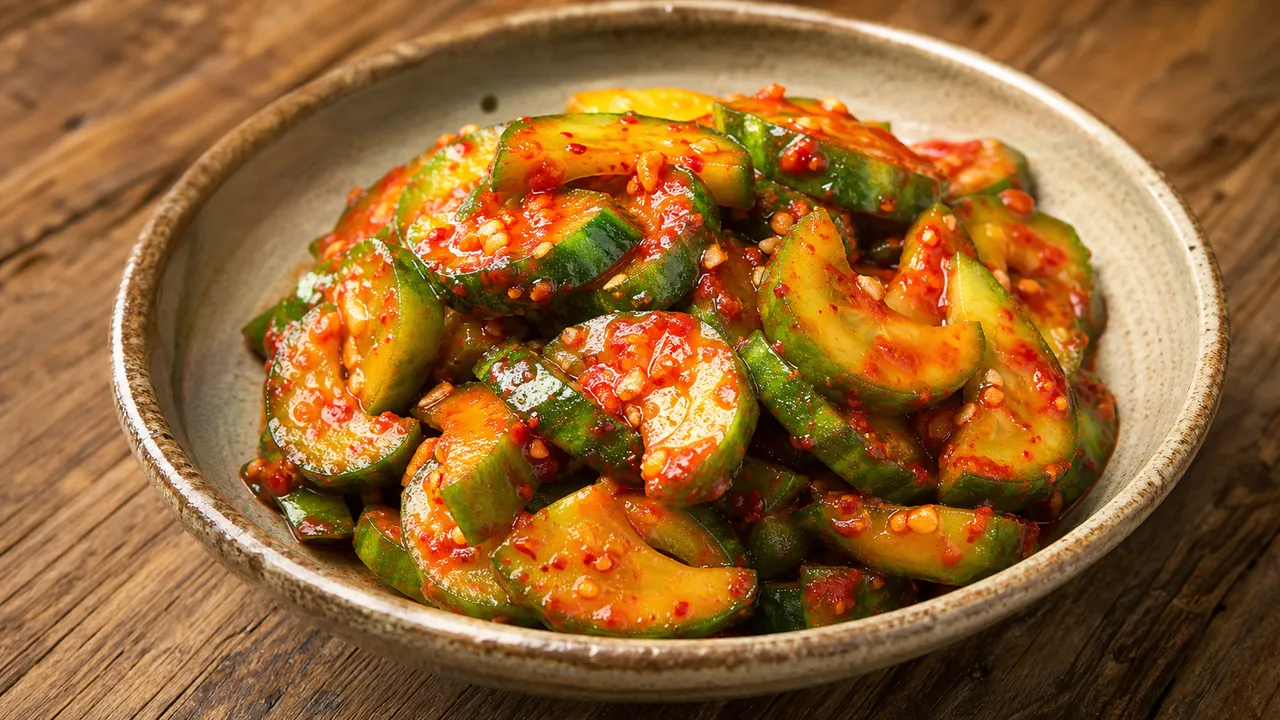
Crisp and Crunchy Cucumber Salad (Oi-muchim) and Spicy Radis
* 이미지는 AI가 생성한 참고 이미지로, 실제 조리 결과물과 다를 수 있습니다.
Discover the secret to making crisp and crunchy cucumber salad (oi-muchim) and spicy radish salad (mu-saengchae) just like at bossam restaurants, without any excess moisture. Learn how to properly remove water from cucumbers and radishes to keep them firm and crunchy, even after time passes.
📋 2 recipes — Select to view
A recipe for Oi Muchim (Korean Spicy Cucumber Salad) where the seeds are removed, and the cucumbers are marinated in salt and corn syrup, then seasoned to achieve a firm and crunchy texture.
📝 Editor's Notes
This _mu-saengchae_ (spicy radish salad) recipe helps you perfectly recreate the firm and crunchy texture you'd find at a _bossam_ (boiled pork wraps) restaurant right at home.
It contains a secret for effectively removing moisture from the radish, ensuring you can enjoy delicious _mu-saengchae_ that doesn't get watery over time.
With its sweet and spicy flavor complemented by the deep umami of _myeolchi aekjeot_ (anchovy fish sauce), it's excellent as a side dish for rice, meat dishes, or _bibimbap_.
The difficulty is not high, making it a challenging yet approachable recipe for beginner cooks.
It will be a staple side dish that enriches your dining table all year round.
🛒 Ingredient Tips
Selecting good ingredients is crucial for delicious _mu-saengchae_ (spicy radish salad).
First, radish is sweetest and most flavorful from autumn to winter.
Choose radishes with shiny, firm skin and fresh green tops.
A medium size is ideal, neither too large nor too small.
For Korean chili powder (gochugaru), it's best to mix fine powder for beautiful color with coarse powder for a slight texture.
_Taeyangcho gochugaru_ (sun-dried chili powder) gives a fine color and deep flavor.
For _myeolchi aekjeot_ (anchovy fish sauce), choose a clear, transparent Korean product with a distinct umami flavor to enhance the taste of your _mu-saengchae_.
🔄 Substitution Guide
If core ingredients are hard to find or if you have allergies to specific ingredients, you can consider some substitutions.
For radish (_mu_), you can use napa cabbage or cucumber to make a _geotjeori_ (fresh kimchi) or _oi muchim_ (cucumber salad) with a different crisp texture.
However, napa cabbage is less firm than radish, and cucumbers have high water content, so the marinating time needs to be adjusted.
If _myeolchi aekjeot_ (anchovy fish sauce) is unavailable or if you are sensitive to its fishy taste, a small amount of _kkaenari aekjeot_ (sand lance fish sauce) or _saeu-jeot_ (salted fermented shrimp) can be used to add umami.
Note that _saeu-jeot_ is saltier, so use about half the amount.
While sugar or oligosaccharide can be used instead of corn syrup (물엿), corn syrup is best for achieving the unique sheen and firm texture.
Therefore, when substituting, be aware of changes in sweetness and texture.
Sugar provides a cleaner sweetness but may not be as effective as corn syrup in drawing out moisture from the radish during marination.
🥘 Ingredients
👨🍳 Cooking Points
There are three key cooking points for this recipe.
First, it's crucial to julienne the radish (_mu_) thickly, about 0.5 cm (0.2 inches).
If sliced too thinly, it can become soft during marination and lose its firm texture, so adhere to this thickness.
Second is the marinating process with salt and corn syrup (물엿) for 20 to 25 minutes.
The corn syrup strongly aids osmosis, effectively drawing out moisture from the radish and firming up its flesh.
After marinating, never rinse the radish with water; instead, place it in a cotton cloth and squeeze out as much water as possible.
Third, add the Korean chili powder (gochugaru) first and rub it vigorously until the radish is uniformly red.
This method ensures a beautiful and appetizing color for your _mu-saengchae_.
👨🍳 Directions
Wash the cucumbers thoroughly, then slice them in half lengthwise.
Using a spoon, scrape out and remove the seeds from the center of the cucumbers.
Slice the deseeded cucumbers diagonally into bite-sized pieces.
For 2 cucumbers, add 2/3 tbsp of salt first and mix well.
Drizzle 3 tbsp of corn syrup (물엿) evenly over the cucumbers and marinate for about 30 minutes.
After 30 minutes, place the shriveled cucumbers into a cotton cloth or a clean kitchen towel and squeeze out the water thoroughly. (Squeeze with all your might!)
To the squeezed cucumbers, add 2 tbsp of Korean chili powder (gochugaru), 1 tbsp of minced garlic, and 1 tbsp of fish sauce (aekjeot).
Place sesame seeds (통깨) on your palm, rub them lightly, and add to the mixture. Drizzle in a drop of sesame oil (참기름) if desired.
Gently mix the ingredients by hand until the seasoning is evenly distributed. (Do not knead too vigorously.)
Transfer to a bowl and refrigerate for 10 to 20 minutes before serving. This allows the seasoning to penetrate deeper, resulting in a richer flavor.
💡 Tips
The cucumber seeds contain the most moisture, so removing them prevents the salad from becoming soggy and helps maintain a crisp texture.
Slicing cucumbers diagonally creates a larger surface area, allowing the seasoning to absorb better and preserving the crisp texture for longer.
Marinating with both salt and corn syrup (물엿) ensures even osmosis, drawing out moisture while firming up the cucumber flesh and retaining its elasticity.
How thoroughly you squeeze out the water from the marinated cucumbers determines their crunchy texture, so it's crucial to squeeze them vigorously with a cotton cloth.
Lightly rubbing sesame seeds (통깨) in your palm before adding them intensifies their aroma twofold.
When mixing the seasoning, avoid kneading too vigorously as this can soften the cucumbers and cause them to release more water. Instead, mix gently as if lightly tossing.
Store Oi Muchim in an airtight container in the refrigerator and consume within one to two days for the best taste.
Served with grilled meat, the cool and crisp taste of the cucumbers cuts through the richness, making the meal much more refreshing.
📦 Storage & Reuse
Once prepared, store the delicious _mu-saengchae_ (spicy radish salad) in an airtight container in the refrigerator, where it will stay fresh for about 3 to 5 days.
While the seasoning will deepen and the flavor will mature over time, the crunchy texture may gradually diminish.
Freezing is not recommended as it can make the radish soggy.
Leftover _mu-saengchae_ is excellent in _bibimbap_ with warm rice, a drizzle of sesame oil, and a fried egg, or stir-fried with pork for a dish similar to _jeyuk-bokkeum_ (spicy stir-fried pork).
Adding it to _kimchi jjigae_ or _doenjang jjigae_ (soybean paste stew) also adds a refreshing kick, so don't throw it away, try various applications.
🥢 Who This Is For
This firm and crunchy _mu-saengchae_ (spicy radish salad) is a versatile side dish that pairs well with various meals.
Especially when served with meat dishes like _bossam_ (boiled pork wraps) or _samgyeopsal_ (grilled pork belly), its refreshing taste cuts through the richness.
It's also delicious simply mixed with warm rice, and it enhances noodle dishes like _kalguksu_ (handmade noodle soup) or _ramyeon_ (instant noodles), making for a more satisfying meal.
Its sweet and spicy flavor is excellent for stimulating the appetite.
We highly recommend this dish for the whole family to enjoy.
🔥 Nutrition Info
This _mu-saengchae_ (spicy radish salad) is a light side dish, with approximately 60-70 kcal per serving.
It's estimated to contain about 15g carbohydrates, 1-2g protein, and less than 1g fat.
The main ingredient, radish, is rich in Vitamin C, which helps boost immunity, and contains enzymes like diastase and amylase that aid digestion and soothe the stomach.
It's also rich in dietary fiber, beneficial for gut health.
Capsaicin in Korean chili powder (gochugaru) boosts metabolism and stimulates appetite.
_Myeolchi aekjeot_ (anchovy fish sauce) adds umami along with a small amount of protein, while sesame seeds (통깨) provide unsaturated fatty acids and Vitamin E, balancing the nutrition.
It's a smart side dish that contributes to a healthy and delicious meal.
💬 Frequently Asked Questions
- Q. What ingredients do I need for Crisp and Crunchy Cucumber Salad (Oi-muchim) and Spicy Radish Salad (Mu-saengchae) Recipe?
- Main ingredients include Cucumber, Salt, Mullyeot (물엿), Gochugaru (고춧가루), Minced garlic. For delicious oi-muchim (cucumber salad), choosing fresh cucumbers is paramount. Select cucumbers that have a dark green color, a glossy surface, and a straight shape. They should feel firm and heavy when touched. Also, check that the stem end is not dry and looks fresh. Seasonal summer cucumbers are particularly juicy and fragrant, making them even more delicious. When choosing cucumbers, it's better to select ones of moderate thickness rather than those that are too large or plump, as they are easier to deseed and result in a better texture for the salad.
- Q. What are the key tips for making Crisp and Crunchy Cucumber Salad (Oi-muchim) and Spicy Radish Salad (Mu-saengchae) Recipe?
- There are three crucial cooking points for this oi-muchim recipe. First, thoroughly remove the cucumber seeds. The seeds contain the most moisture, so removing them is essential to prevent the cucumbers from becoming soggy and to maintain a firm and crunchy texture. Scrape them out cleanly with a spoon. Second, marinate the cucumbers with both salt and mullyeot (물엿). The salt and mullyeot (물엿) work together to create an even osmotic pressure, effectively drawing out moisture from the cucumbers while firming up their flesh, creating an elastic and crisp texture. Third, squeeze out the water from the marinated cucumbers with all your might. You must wring them out vigorously in a cotton cloth or clean kitchen towel to achieve the desired firm and crunchy texture. If not enough water is squeezed out, the seasoning will be diluted, making the taste bland, and the cucumbers will easily become soft. By following these steps carefully, you can make delicious oi-muchim without fail.
- Q. How should I store leftover Crisp and Crunchy Cucumber Salad (Oi-muchim) and Spicy Radish Salad (Mu-saengchae) Recipe?
- Store the finished oi-muchim (cucumber salad) in an airtight container in the refrigerator. Since most of the cucumber's moisture has been removed, it will maintain its crisp texture much longer than regular cucumber salads. It's usually best consumed within 2-3 days, and can be enjoyed fresh for up to 5 days. Freezing is not recommended as it can alter the cucumber's texture. Leftover oi-muchim can be mixed into bibimbap, or used as a topping for naengmyeon (cold noodles) or janchi-guksu (banquet noodles) for a different kind of enjoyment. As time passes, the seasoning will infuse deeper into the cucumbers, offering another appealing flavor.
- Q. How many calories are in Crisp and Crunchy Cucumber Salad (Oi-muchim) and Spicy Radish Salad (Mu-saengchae) Recipe?
- This oi-muchim (cucumber salad) is relatively low in calories, approximately 80-100 kcal per serving (assuming 1 serving from 2 cucumbers for 4 people). Cucumbers are mostly water, making them very low in calories, and they contain various beneficial minerals such as Vitamin K, Vitamin C, and potassium. Carbohydrates primarily come from mullyeot (물엿), estimated to be about 10-15g per serving. A small amount of fat is consumed from a drop of sesame oil and toasted sesame seeds, approximately 3-5g. Protein content is negligible. However, due to the use of salt and aekjeot (액젓), the sodium content can be somewhat high. It can be considered a healthy side dish that provides nutrition from fresh vegetables and spices.
- Q. Can I substitute ingredients in Crisp and Crunchy Cucumber Salad (Oi-muchim) and Spicy Radish Salad (Mu-saengchae) Recipe?
- For this oi-muchim, cucumber is the core ingredient, so replacing it with another vegetable would result in a completely different dish. However, other seasoning ingredients can be substituted. If you don't have mullyeot (물엿), you can use oligosaccharide or sugar. Oligosaccharide is less sweet than mullyeot (물엿) and richer in dietary fiber, making it a healthier option, but its characteristic viscosity might be slightly different. If using sugar, adjust the amount as it's sweeter than mullyeot (물엿) and takes longer to dissolve; ensure it's well mixed to prevent clumping. You can also use soy sauce instead of aekjeot (액젓). While it may lack the unique savory depth of aekjeot (액젓), if you prefer a cleaner and milder taste, substituting with soy sauce can still yield a delicious cucumber salad. This can be a good alternative if you have allergies or find the unique aroma of aekjeot (액젓) overpowering.
💬 Comments
No comments yet. Be the first to comment!