
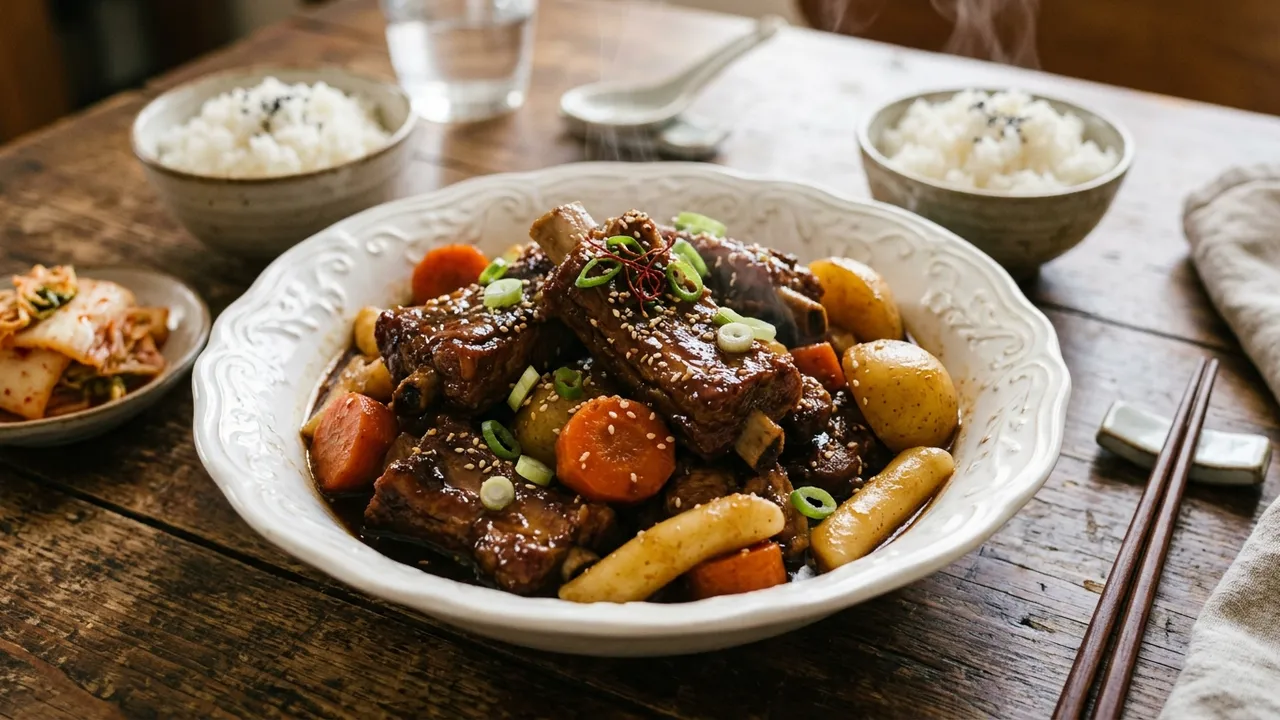
Tender Braised Pork Ribs (Galbi-jjim) Without a Pressure Coo
* 이미지는 AI가 생성한 참고 이미지로, 실제 조리 결과물과 다를 수 있습니다.
This recipe shows you how to make tender and succulent braised pork ribs (Galbi-jjim) without needing a pressure cooker. It's a perfect dish for special occasions, offering a deep flavor through its carefully crafted sauce and step-by-step cooking method.
📝 Editor's Notes
This recipe holds the secret to making soft and tender pork galbi-jjim without a pressure cooker.
Its key features include thoroughly draining the blood from the meat, parboiling it once to perfectly remove any gamey odor, and then using a sauce made from blended fruits and vegetables that has been strained through a sieve, resulting in a clear and clean taste.
The greatest charm of this recipe is that after bringing it to a boil over high heat, it's gently simmered over medium heat for a long time, allowing the sauce to deeply penetrate the meat and tenderizing the texture.
It's a meticulously prepared dish perfect for serving family or guests on special occasions.
While the cooking process is somewhat lengthy, it delivers a deep and rich flavor that is well worth the effort.
🛒 Ingredient Tips
For delicious galbi-jjim, it's crucial to choose fresh pork ribs.
Opt for ribs for braising that have bones, with a good balance of lean meat and fat.
Too much fat can make it greasy, while too little can make it dry, so choose a well-balanced cut.
Korean pear (배) and apple help tenderize the ribs and add a natural sweetness, so using ripe ones is highly recommended.
For Korean radish (무), choose one that is firm and has a smooth surface, and for green chili peppers, fresh and brightly colored ones are best.
Excellent ingredients are essential for enhancing the dish's flavor.
🔄 Substitution Guide
You can substitute beef ribs for pork ribs.
Beef ribs offer a richer meat flavor and a more luxurious taste than pork ribs, but please consider that they may require a longer cooking time and be more expensive.
If Korean pear (배) or apple, which aid in tenderizing, are unavailable, you can add a small amount of kiwi or pineapple.
However, be cautious as kiwi and pineapple have a very strong tenderizing effect, and too much could make the meat mushy.
Also, the unique aroma of these fruits might affect the taste of the galbi-jjim.
You can use light brown sugar or white sugar instead of dark brown sugar, but the distinct deep caramel flavor and color that dark brown sugar provides might be diminished.
If you dislike spicy food, you can omit the green chili peppers or substitute them with shishito peppers (꽈리고추).
Shishito peppers add a subtle aroma without being spicy.
🥘 Ingredients
👨🍳 Cooking Points
There are three key cooking points that determine the success of this recipe.
First, it's crucial to sufficiently drain the blood from the pork ribs for about an hour and then parboil them with bay leaves to perfectly remove impurities and gamey odor.
This process ensures the meat is clean and tender.
Second, the key is to finely blend the sauce ingredients and then strain them through a sieve, using only the liquid.
This prevents the galbi-jjim broth from becoming cloudy, maintaining a clear and clean taste.
Lastly, to make the meat tender without a pressure cooker, the core is to simmer it gently over medium heat for a long time.
After bringing it to a boil over high heat, reduce to medium and simmer for a total of at least 45 minutes to ensure the meat becomes incredibly tender.
Remember these three points, and you'll be able to make delicious galbi-jjim without fail.
👨🍳 Directions
Soak the 3 kg (6.6 lbs) pork ribs in water for about an hour to remove any blood.
Pour enough water to cover the blood-drained pork ribs, add 2 bay leaves, and bring to a boil. Once the water boils, use a ladle to skim off any scum and impurities floating around the meat. There's no need to cook it through completely; rinse the ribs once more with clean water to remove any gamey odor, then set aside.
In a blender, combine 0.5 Korean pear (배), 0.5 apple, 1 onion, 10 garlic cloves, 1 slice of ginger, 5 green chili peppers, and 1 cup of water. Blend until smooth.
Pour the blended mixture into a fine-mesh sieve, strain out the solids, and reserve only the liquid.
To the strained liquid, add 2 cups of soy sauce, 1 cup of Mirin (맛술), 1 cup of dark brown sugar, and 1 pinch of black pepper. Stir until the sugar is well dissolved to complete the sauce.
In a pot, place the parboiled and rinsed pork ribs. Pour in the prepared sauce and add 1 cup of water. Bring to a boil over high heat, then reduce to medium heat and simmer for about 20 minutes.
Add 0.5 Korean radish (무) and 0.5 carrot, both cut with rounded edges, and continue to simmer over medium heat for another 20 minutes. This allows the radish and carrot to absorb the flavor and the liquid to reduce to a thick consistency.
Once the liquid has significantly reduced, add 1 tbsp of sesame oil and 2 stalks of diagonally sliced green onions. Simmer for another 5 minutes to allow the green onion aroma to infuse.
Serve the finished pork galbi-jjim garnished nicely in a serving dish.
💡 Tips
Soaking pork ribs for about an hour is sufficient to remove blood. Parboiling them once also effectively removes any gamey odor.
After blending the sauce ingredients, straining them through a sieve and using only the liquid prevents the galbi-jjim sauce from becoming murky, resulting in a clean and clear taste.
When preparing the galbi sauce, it's important to stir well until all ingredients are dissolved and to dedicate care to making the dish delicious.
Cutting Korean radish (무) and carrots with rounded edges (dol려깎기) prevents them from breaking apart during cooking, maintaining their attractive shape.
Even without a pressure cooker, simmering gently over medium heat for a long time will yield incredibly tender, fall-off-the-bone galbi-jjim.
📦 Storage & Reuse
Leftover pork galbi-jjim can be stored in an airtight container in the refrigerator for 3-4 days.
For longer storage, we recommend dividing it into individual portions and freezing them.
It can be stored in the freezer for up to 1-2 months.
When reheating frozen galbi-jjim, you can microwave it or gently heat it in a pot over low heat.
If the sauce is insufficient, add a little water or broth when reheating to maintain moisture.
Another great way to use leftovers is to stir-fry rice with the remaining sauce or add shredded meat to kimchi jjigae (김치찌개) for a unique flavor.
🥢 Who This Is For
This tender pork galbi-jjim is an excellent dish for family meals, holidays, or special occasions when entertaining guests.
Its meticulous preparation makes anyone feel cherished.
Especially with its sweet and savory flavor that even children love, it's perfect for the whole family to enjoy together.
A generous spoonful of sauce over warm white rice will make a bowl disappear in no time.
For accompanying dishes, we recommend refreshing dongchimi (동치미) or freshly made geotjeori kimchi (겉절이 김치), or simple namul (나물) side dishes.
They pair wonderfully with the rich flavor of galbi-jjim.
🔥 Nutrition Info
Based on 3 kg of pork ribs, and calculated for approximately 8 servings, each serving of this pork galbi-jjim is estimated to be around 950-1100 kcal.
It is expected to contain approximately 55-65g of protein, 60-70g of fat, and 40-50g of carbohydrates.
Pork ribs, the main ingredient, are rich in high-quality protein, iron, and B vitamins, which aid in energy restoration and anemia prevention.
However, due to the high fat content in the rib cut and the significant amounts of sugar and soy sauce in the seasoning, the calorie and sodium content tend to be relatively high.
Fruits and vegetables like Korean pear (배), apple, Korean radish (무), and onion provide dietary fiber and vitamins, but their proportion in the overall nutrient composition is not significant.
It is recommended to consume in moderation for health.
💬 Frequently Asked Questions
- Q. What ingredients do I need for Tender Braised Pork Ribs (Galbi-jjim) Without a Pressure Cooker?
- Main ingredients include Pork Ribs, Korean pear (배), Apple, Onion, Garlic cloves. For delicious galbi-jjim, it's crucial to choose fresh pork ribs. Opt for ribs for braising that have bones, with a good balance of lean meat and fat. Too much fat can make it greasy, while too little can make it dry, so choose a well-balanced cut. Korean pear (배) and apple help tenderize the ribs and add a natural sweetness, so using ripe ones is highly recommended. For Korean radish (무), choose one that is firm and has a smooth surface, and for green chili peppers, fresh and brightly colored ones are best. Excellent ingredients are essential for enhancing the dish's flavor.
- Q. What are the key tips for making Tender Braised Pork Ribs (Galbi-jjim) Without a Pressure Cooker?
- There are three key cooking points that determine the success of this recipe. First, it's crucial to sufficiently drain the blood from the pork ribs for about an hour and then parboil them with bay leaves to perfectly remove impurities and gamey odor. This process ensures the meat is clean and tender. Second, the key is to finely blend the sauce ingredients and then strain them through a sieve, using only the liquid. This prevents the galbi-jjim broth from becoming cloudy, maintaining a clear and clean taste. Lastly, to make the meat tender without a pressure cooker, the core is to simmer it gently over medium heat for a long time. After bringing it to a boil over high heat, reduce to medium and simmer for a total of at least 45 minutes to ensure the meat becomes incredibly tender. Remember these three points, and you'll be able to make delicious galbi-jjim without fail.
- Q. How should I store leftover Tender Braised Pork Ribs (Galbi-jjim) Without a Pressure Cooker?
- Leftover pork galbi-jjim can be stored in an airtight container in the refrigerator for 3-4 days. For longer storage, we recommend dividing it into individual portions and freezing them. It can be stored in the freezer for up to 1-2 months. When reheating frozen galbi-jjim, you can microwave it or gently heat it in a pot over low heat. If the sauce is insufficient, add a little water or broth when reheating to maintain moisture. Another great way to use leftovers is to stir-fry rice with the remaining sauce or add shredded meat to kimchi jjigae (김치찌개) for a unique flavor.
- Q. How many calories are in Tender Braised Pork Ribs (Galbi-jjim) Without a Pressure Cooker?
- Based on 3 kg of pork ribs, and calculated for approximately 8 servings, each serving of this pork galbi-jjim is estimated to be around 950-1100 kcal. It is expected to contain approximately 55-65g of protein, 60-70g of fat, and 40-50g of carbohydrates. Pork ribs, the main ingredient, are rich in high-quality protein, iron, and B vitamins, which aid in energy restoration and anemia prevention. However, due to the high fat content in the rib cut and the significant amounts of sugar and soy sauce in the seasoning, the calorie and sodium content tend to be relatively high. Fruits and vegetables like Korean pear (배), apple, Korean radish (무), and onion provide dietary fiber and vitamins, but their proportion in the overall nutrient composition is not significant. It is recommended to consume in moderation for health.
- Q. Can I substitute ingredients in Tender Braised Pork Ribs (Galbi-jjim) Without a Pressure Cooker?
- You can substitute beef ribs for pork ribs. Beef ribs offer a richer meat flavor and a more luxurious taste than pork ribs, but please consider that they may require a longer cooking time and be more expensive. If Korean pear (배) or apple, which aid in tenderizing, are unavailable, you can add a small amount of kiwi or pineapple. However, be cautious as kiwi and pineapple have a very strong tenderizing effect, and too much could make the meat mushy. Also, the unique aroma of these fruits might affect the taste of the galbi-jjim. You can use light brown sugar or white sugar instead of dark brown sugar, but the distinct deep caramel flavor and color that dark brown sugar provides might be diminished. If you dislike spicy food, you can omit the green chili peppers or substitute them with shishito peppers (꽈리고추). Shishito peppers add a subtle aroma without being spicy.
💬 Comments
No comments yet. Be the first to comment!