
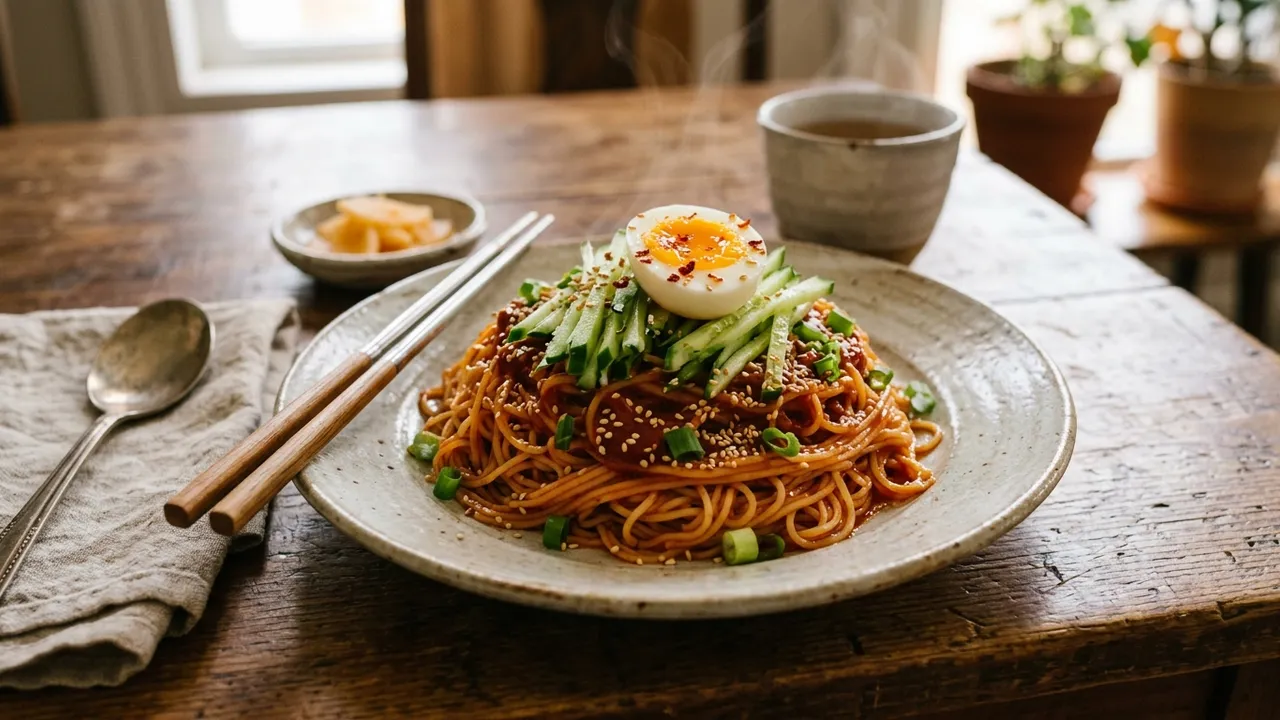
Spicy and Sweet Bibim Guksu (Tomato Cucumber Sauce) Recipe
* 이미지는 AI가 생성한 참고 이미지로, 실제 조리 결과물과 다를 수 있습니다.
This recipe is for spicy and sweet Kalguksu Bibim Guksu, perfect for enjoying chilled in summer. It's characterized by a refreshing and clean taste without fruit, thanks to its unique tomato cucumber sauce.
📝 Editor's Notes
This spicy and sweet Bibim Guksu is perfect for stimulating appetite during the summer heat.
While many Bibim Guksu recipes incorporate blended fruits, this recipe uniquely uses tomatoes and cucumbers to achieve a clean and refreshing taste without fruit.
The harmonious blend of sweet, sour, cool, and spicy flavors is exquisite.
The use of Kalguksu noodles adds a delightful chewiness, making for a satisfying meal.
The cooking process is not complicated, making this a beginner-to-intermediate level recipe that even novice cooks can easily follow.
It's highly recommended, especially when you want a cool and refreshing meal on a hot day.
🛒 Ingredient Tips
The key ingredients that determine the flavor of this recipe are tomatoes and cucumbers.
For the sauce, use ripe large tomatoes or cherry tomatoes to ensure a harmonious blend of sweetness and tartness, which creates a deep flavor in the sauce.
It's best to choose firm, brightly colored tomatoes that are not overly soft.
For cucumbers, select fresh and straight ones for a crisp texture.
Especially for garnish, choose cucumbers with high moisture content and good aroma to add a refreshing touch when eaten with the noodles.
For Kalguksu noodles, using fresh noodles rather than dried ones will yield a chewier and softer texture.
When purchasing, check the manufacturing date and choose fresh noodles.
🔄 Substitution Guide
Instead of Kalguksu noodles, you can use somyeon (소면, thin wheat noodles) or jungmyeon (중면, medium wheat noodles) in this recipe.
Somyeon, being thinner, absorbs the sauce better and offers a softer texture, while jungmyeon provides a chewier yet lighter texture than Kalguksu noodles.
However, the unique chewiness of Kalguksu noodles may be reduced.
If you substitute the tomatoes and cucumbers in the sauce with fruits like apple or pear, you'll add sweetness and coolness, but the distinct 'clean taste without fruit' characteristic of this recipe will be lost.
If you don't have fruit, you can enhance the flavor by adding a bit more onion or garlic and highlighting the nutty aroma of sesame oil.
If maesil-cheong (Korean green plum syrup) is unavailable, you can adjust the ratio of sugar and vinegar to achieve a sweet and sour taste, or substitute with oligo-dang (올리고당, corn syrup).
However, the unique fragrance and deep flavor of maesil-cheong may be somewhat diminished.
🥘 Ingredients
👨🍳 Cooking Points
There are two crucial cooking points for this Bibim Guksu.
First, blending the sauce until very smooth.
Put all ingredients into a blender and process until completely smooth.
This ensures the sauce coats the noodles evenly, and the flavors of the ingredients meld together rather than standing apart.
Adjusting the consistency with the amount of lemon-lime soda is important here.
If it's too thick, it will be hard to mix; if too thin, the sauce flavor will be weak.
Aim for a moderately thick consistency.
Second, thoroughly rinsing the Kalguksu noodles in cold water after cooking.
Removing the starch completely makes the noodles chewy and prevents them from sticking together.
Rinsing and rubbing the noodles several times in cold water until they are firm and springy is a key factor in the taste of Bibim Guksu.
It's best to mix the noodles with the sauce and eat immediately to prevent them from becoming soggy.
👨🍳 Directions
First, bring water to a boil for boiling eggs.
Roughly chop half a cucumber, 6 cherry tomatoes (or 1 large tomato), and half an onion.
Place the chopped onion, cherry tomatoes (or large tomato), and half a cucumber into a blender.
Add 5 tbsp soy sauce, 2 tbsp sugar, 5 tbsp vinegar, 5 tbsp maesil-cheong (Korean green plum syrup), 1 tbsp gochujang (Korean chili paste), and 8 tbsp gochugaru (Korean chili powder) to the blender.
Add 0.5 cup lemon-lime soda to adjust consistency. If you prefer it spicier, add a pinch of spicy gochugaru (Korean chili powder).
Blend all ingredients until smooth to create the sauce.
Transfer the blended sauce to a bowl and set aside.
Thinly julienne the cucumber and onion for garnish.
Boil the eggs and prepare them.
Cook the Kalguksu noodles according to package directions.
Rinse the cooked Kalguksu noodles thoroughly in cold water to remove starch, then add them to the sauce and mix well.
Serve the mixed noodles in a bowl, topped with julienned cucumber, onion, and boiled egg.
Drizzle with fragrant sesame oil and sprinkle with toasted sesame seeds to finish.
💡 Tips
The consistency of the mixed sauce can be adjusted with the amount of lemon-lime soda.
If you prefer a spicier taste, add a pinch more spicy gochugaru (Korean chili powder).
Using Kalguksu noodles instead of somyeon (thin wheat noodles) provides a more satisfying chew, enhancing the flavor.
The sauce develops a deeper flavor when aged, but it is delicious enough to be eaten immediately after preparation.
📦 Storage & Reuse
The prepared Bibim sauce can be stored in an airtight container in the refrigerator for about a week, allowing you to enjoy it fresh.
The sauce deepens in flavor as it ages, so making it in advance is a good idea.
However, finished Bibim Guksu with noodles mixed in is best eaten immediately, as the noodles can become soggy and the flavor may change.
Store leftover garnish vegetables in an airtight container in the refrigerator.
Unpeeled boiled eggs can also be stored in the refrigerator for 2-3 days.
Any remaining sauce can be used to mix with rice or as a dressing for other noodle dishes, making it very versatile.
🥢 Who This Is For
This spicy and sweet Bibim Guksu is highly recommended for anyone looking for a cool and refreshing meal on a hot summer day.
It will likely be popular among adults who enjoy spicy flavors.
It's also suitable as an easy meal for single households or as a main dish for casual gatherings with friends.
Good companion dishes include refreshing soups like kongnamul-guk (콩나물국, soybean sprout soup) or miyeok naengguk (미역냉국, chilled seaweed soup).
Additionally, serving it with crispy kimchijeon (김치전, kimchi pancake) or savory buchu-jeon (부추전, chive pancake) will make for an even richer dining experience.
🔥 Nutrition Info
One serving of this spicy and sweet Bibim Guksu (based on 4-5 servings total) is estimated to be approximately 500-650 kcal.
Carbohydrate content is highest from the Kalguksu noodles, and the proportion of carbohydrates is also high due to sugars like sugar, maesil-cheong (Korean green plum syrup), and lemon-lime soda in the sauce.
About 6g of protein can be obtained from one boiled egg, with a small amount also coming from the noodles.
Fat is primarily consumed from sesame oil and egg yolk, estimated at about 10-15g.
Tomatoes and cucumbers provide minerals such as Vitamin C and potassium, and are rich in dietary fiber, aiding digestion.
However, due to ingredients like soy sauce and gochujang (Korean chili paste), the sodium content may be somewhat high.
For health reasons, it is recommended to adjust the amount of sauce or add plenty of vegetable garnishes.
💬 Frequently Asked Questions
- Q. What ingredients do I need for Spicy and Sweet Bibim Guksu (Tomato Cucumber Sauce)?
- Main ingredients include Cucumber, Cherry tomatoes, Large tomato, Onion, Soy sauce. The key ingredients that determine the flavor of this recipe are tomatoes and cucumbers. For the sauce, use ripe large tomatoes or cherry tomatoes to ensure a harmonious blend of sweetness and tartness, which creates a deep flavor in the sauce. It's best to choose firm, brightly colored tomatoes that are not overly soft. For cucumbers, select fresh and straight ones for a crisp texture. Especially for garnish, choose cucumbers with high moisture content and good aroma to add a refreshing touch when eaten with the noodles. For Kalguksu noodles, using fresh noodles rather than dried ones will yield a chewier and softer texture. When purchasing, check the manufacturing date and choose fresh noodles.
- Q. What are the key tips for making Spicy and Sweet Bibim Guksu (Tomato Cucumber Sauce)?
- There are two crucial cooking points for this Bibim Guksu. First, blending the sauce until very smooth. Put all ingredients into a blender and process until completely smooth. This ensures the sauce coats the noodles evenly, and the flavors of the ingredients meld together rather than standing apart. Adjusting the consistency with the amount of lemon-lime soda is important here. If it's too thick, it will be hard to mix; if too thin, the sauce flavor will be weak. Aim for a moderately thick consistency. Second, thoroughly rinsing the Kalguksu noodles in cold water after cooking. Removing the starch completely makes the noodles chewy and prevents them from sticking together. Rinsing and rubbing the noodles several times in cold water until they are firm and springy is a key factor in the taste of Bibim Guksu. It's best to mix the noodles with the sauce and eat immediately to prevent them from becoming soggy.
- Q. How should I store leftover Spicy and Sweet Bibim Guksu (Tomato Cucumber Sauce)?
- The prepared Bibim sauce can be stored in an airtight container in the refrigerator for about a week, allowing you to enjoy it fresh. The sauce deepens in flavor as it ages, so making it in advance is a good idea. However, finished Bibim Guksu with noodles mixed in is best eaten immediately, as the noodles can become soggy and the flavor may change. Store leftover garnish vegetables in an airtight container in the refrigerator. Unpeeled boiled eggs can also be stored in the refrigerator for 2-3 days. Any remaining sauce can be used to mix with rice or as a dressing for other noodle dishes, making it very versatile.
- Q. How many calories are in Spicy and Sweet Bibim Guksu (Tomato Cucumber Sauce)?
- One serving of this spicy and sweet Bibim Guksu (based on 4-5 servings total) is estimated to be approximately 500-650 kcal. Carbohydrate content is highest from the Kalguksu noodles, and the proportion of carbohydrates is also high due to sugars like sugar, maesil-cheong (Korean green plum syrup), and lemon-lime soda in the sauce. About 6g of protein can be obtained from one boiled egg, with a small amount also coming from the noodles. Fat is primarily consumed from sesame oil and egg yolk, estimated at about 10-15g. Tomatoes and cucumbers provide minerals such as Vitamin C and potassium, and are rich in dietary fiber, aiding digestion. However, due to ingredients like soy sauce and gochujang (Korean chili paste), the sodium content may be somewhat high. For health reasons, it is recommended to adjust the amount of sauce or add plenty of vegetable garnishes.
- Q. Can I substitute ingredients in Spicy and Sweet Bibim Guksu (Tomato Cucumber Sauce)?
- Instead of Kalguksu noodles, you can use somyeon (소면, thin wheat noodles) or jungmyeon (중면, medium wheat noodles) in this recipe. Somyeon, being thinner, absorbs the sauce better and offers a softer texture, while jungmyeon provides a chewier yet lighter texture than Kalguksu noodles. However, the unique chewiness of Kalguksu noodles may be reduced. If you substitute the tomatoes and cucumbers in the sauce with fruits like apple or pear, you'll add sweetness and coolness, but the distinct 'clean taste without fruit' characteristic of this recipe will be lost. If you don't have fruit, you can enhance the flavor by adding a bit more onion or garlic and highlighting the nutty aroma of sesame oil. If maesil-cheong (Korean green plum syrup) is unavailable, you can adjust the ratio of sugar and vinegar to achieve a sweet and sour taste, or substitute with oligo-dang (올리고당, corn syrup). However, the unique fragrance and deep flavor of maesil-cheong may be somewhat diminished.
💬 Comments
No comments yet. Be the first to comment!