
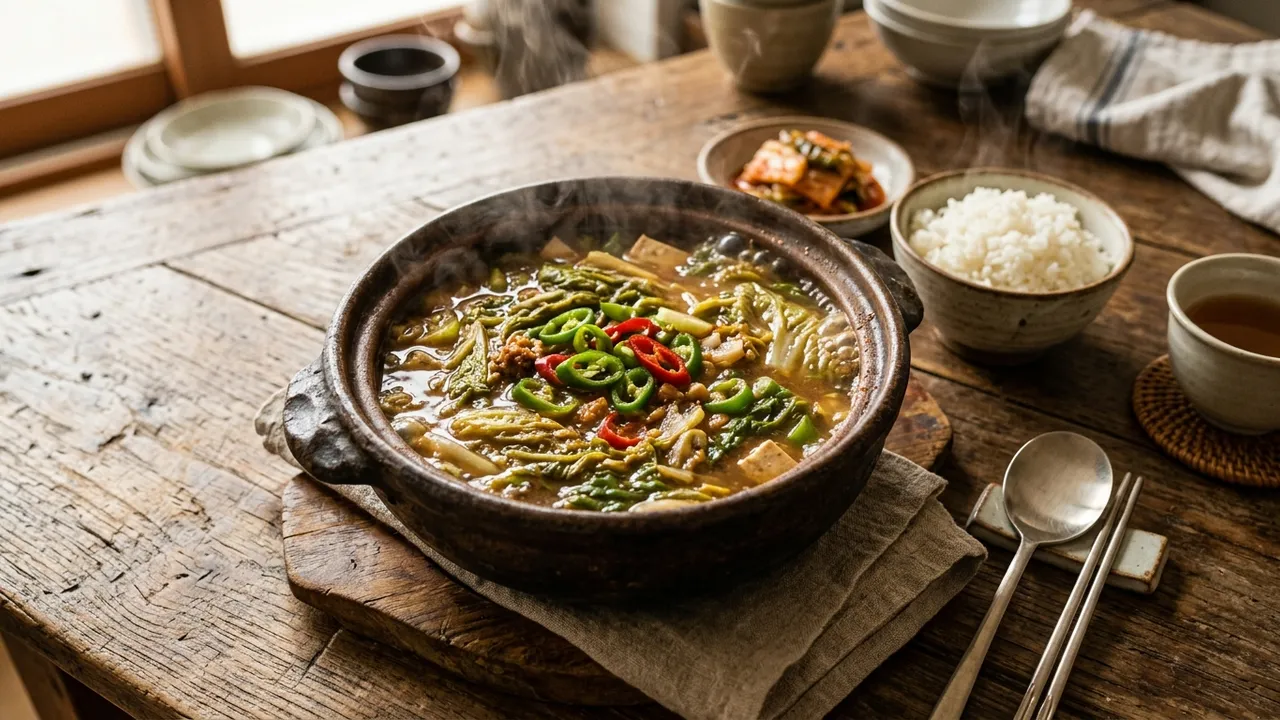
Eolgal-i Doenjang-guk (Korean Cabbage and Soybean Paste Soup
* 이미지는 AI가 생성한 참고 이미지로, 실제 조리 결과물과 다를 수 있습니다.
Eolgal-i Doenjang-guk is a wonderfully soothing soup that will make you feel refreshed with just one spoonful. Its cool, subtly sweet, and deeply savory flavor is so exceptional, you'll want to finish every last drop.
📝 Editor's Notes
This Eolgal-i Doenjang-guk is a quintessential Korean home-style dish, renowned for its incredibly refreshing and soothing qualities that provide comfort with just one spoonful.
The subtly sweet yet deeply savory flavor of doenjang (된장) harmonizes beautifully with the eolgal-i cabbage, creating a rich taste.
The cool, umami-rich broth made with anchovies and dried shrimp, combined with the nutty flavor of raw soybean powder, gives it an irresistible charm that will have you finishing a whole bowl of rice.
While made with relatively simple ingredients, a little care in preparing the broth and blanching the cabbage can yield a taste comparable to a chef's.
It's especially recommended as a comforting and easy-on-the-stomach meal for the whole family, perfect for when you need a hangover cure or a warm soup on a chilly day.
🛒 Ingredient Tips
The key ingredients that determine the flavor of this doenjang-guk are undoubtedly eolgal-i cabbage and homemade doenjang (된장).
Choose eolgal-i cabbage with vibrant green leaves that aren't wilted and firm, non-mushy stalks.
Fresh eolgal-i will have a clean, clear cross-section when the root is trimmed, free of impurities.
While it's in season from spring to autumn, good quality eolgal-i is available year-round these days.
Homemade doenjang offers a deeper, richer savory flavor than commercial varieties, significantly enhancing the soup's taste.
If you don't have homemade doenjang, a mix of commercial doenjang with a bit of traditional doenjang can work well.
For the broth, use large, cleaned dried anchovies with their guts removed to ensure a clean, non-fishy broth.
🔄 Substitution Guide
If eolgal-i cabbage is difficult to find or you prefer other vegetables, you can substitute it with bomdong (봄동, spring cabbage), Swiss chard, mallow, or spinach.
However, note that bomdong will offer a crisper texture, while Swiss chard, mallow, or spinach have softer leaves than eolgal-i, which may subtly alter the soup's texture and taste.
If you don't have homemade doenjang (된장), you can use a mix of commercial doenjang and traditional doenjang in a 2:1 ratio to achieve some of that distinct deep flavor.
Raw soybean powder plays a crucial role in enhancing the savory depth and thickness of this soup.
If you don't have it, you can cook the soup with rice water (the water used to rinse rice) or add a small amount of finely ground perilla seeds for a nutty flavor.
However, be aware that these substitutions may not provide the same deep savory taste or thick consistency as soybean powder.
🥘 Ingredients
👨🍳 Cooking Points
There are a few crucial points for making delicious Eolgal-i Doenjang-guk.
First, when blanching the eolgal-i cabbage, blanch the stems and leaves separately to ensure a tender, non-tough texture.
Blanch the stems until they are slightly pliable, and the leaves just until they wilt, then quickly rinse them in cold water.
After blanching, it's important not to wring out the water too tightly, as this can make the cabbage tough; squeeze just enough to retain some moisture.
Second, first mix the blanched eolgal-i cabbage with the doenjang seasoning to allow it to absorb the flavors thoroughly.
Adding raw soybean powder at this stage mellows the saltiness of the doenjang, adds a deep, savory richness to the broth, and gives it a pleasant body – a triple benefit.
Third, when preparing the broth, dry-roast the anchovies over low heat to evaporate their moisture, which eliminates fishiness and enhances their nutty flavor.
For the dried shrimp, add them after turning off the heat from roasting the anchovies, cooking them with the residual heat to prevent burning and impart a fragrant taste.
Remembering these three points will help you successfully make delicious Eolgal-i Doenjang-guk every time.
👨🍳 Directions
Trim the root ends off 1.5 lb (700g) of eolgal-i cabbage (얼갈이배추), then cut the cabbage into 3 equal pieces.
Fill a large basin with water, gently swish the cut eolgal-i cabbage around, and rinse thoroughly 3-4 times.
Boil a generous amount of water in a pot. Add 1 tbsp of coarse sea salt, then blanch the stem portions of the eolgal-i cabbage until they are slightly pliable but not limp.
In the same boiling water, blanch the leaf portions of the eolgal-i cabbage just until they wilt, then remove them immediately.
Quickly transfer the blanched eolgal-i cabbage to cold water to rinse, then gently squeeze out excess water, being careful not to wring it too dry.
To the blanched eolgal-i cabbage, add 3 tbsp of homemade doenjang (된장), 1.5 tbsp of gochugaru (고춧가루), and 1 tbsp of perilla oil. Mix well to ensure the cabbage is evenly seasoned.
Add 3 tbsp of raw soybean powder and mix again until well combined.
Cut off the green portion of 1 large green onion and chop the remaining white and light green parts finely. Finely chop 3 Cheongyang chili peppers (청양고추) and 1 red chili pepper.
Roughly chop 0.5 onion.
In a pot, add 0.7 oz (20g) of cleaned dried anchovies for broth. Dry-roast them over low heat, stirring frequently, until their moisture evaporates and they become fragrant and crumbly when touched. Turn off the heat, add 1 handful of dried shrimp, and continue to stir with the residual heat.
Let the anchovies cool slightly, then break them into smaller pieces by hand.
To the pot with the roasted anchovies and dried shrimp, add 8.5 cups (2 liters) of water, the roughly chopped green portion of the large green onion, and the roughly chopped onion.
Add the seasoned eolgal-i cabbage and stir everything well.
Once it starts to boil, reduce heat to medium and simmer for 12 minutes.
After 12 minutes, open the lid and stir once. You may remove the green portion of the green onion and the onion pieces (added for broth) if desired, or leave them in.
Add 1 tbsp of minced garlic and 1 tbsp of tuna extract (참치액젓). Then, add all the finely chopped green onion and chili peppers. Bring it to a quick boil once more, and it's done.
💡 Tips
Eolgal-i cabbage may have soil or impurities hidden between its stalks, so fill a basin with water and rinse it thoroughly 3-4 times.
Do not wring out the blanched eolgal-i cabbage too tightly, as it can become tough. Squeeze out just enough water.
Adding raw soybean powder to doenjang (된장) helps mellow its saltiness, doubles its savory flavor, and deepens the soup's overall taste.
When dry-roasting anchovies for broth, cook them over low heat to evaporate their moisture. This removes any fishy odor and enhances their savory, nutty flavor.
Dried shrimp can burn easily, so after roasting the anchovies, turn off the heat and roast the dried shrimp using the residual heat of the pot.
The green part of the green onion and the onion pieces added for the broth can be removed before serving or left in, according to your preference.
📦 Storage & Reuse
Delicious Eolgal-i Doenjang-guk can be stored in an airtight container in the refrigerator for 2-3 days.
For longer storage, divide it into single-serving portions and freeze for up to 2 weeks to a month.
For frozen soup, thaw it naturally in the refrigerator the night before serving, or use the defrost function on your microwave for convenience.
When reheating, simmer gently over low heat.
If the broth has reduced too much, add a little water or anchovy broth to adjust the consistency.
If you have leftover eolgal-i cabbage, you can make geotjeori (겉절이, fresh kimchi) or blanch it lightly and season it as namul (나물, seasoned vegetable side dish).
Leftover anchovies and dried shrimp can be used with kelp to make broth for other soups, or stir-fried to make a delicious side dish.
🥢 Who This Is For
This Eolgal-i Doenjang-guk is highly recommended for days when you crave a warm, comforting meal, especially as a breakfast for a hangover cure after a night of drinking.
The refreshing and savory broth will gently soothe your stomach.
It's also a fantastic dish for the entire family, from children to the elderly.
A bowl of freshly cooked warm rice with Eolgal-i Doenjang-guk is so satisfying, you might not even need other side dishes.
For a more substantial meal, pair it with pan-fried fish or a simple egg roll.
It also goes wonderfully with basic Korean side dishes like kimchi (김치) or kkakdugi (깍두기, cubed radish kimchi).
🔥 Nutrition Info
Eolgal-i Doenjang-guk can be an excellent meal, providing healthy and balanced nutrition.
Based on this recipe for 4 servings, the estimated calories per serving are approximately 110-130 kcal.
Protein is abundantly sourced from anchovies, dried shrimp, doenjang (된장), and raw soybean powder, while healthy fats come from perilla oil and doenjang.
Carbohydrates are primarily supplied by eolgal-i cabbage and raw soybean powder.
Eolgal-i cabbage, in particular, is rich in vitamins A, C, and K, aiding immune system strength and eye health, and its high fiber content benefits gut health.
Anchovies and dried shrimp are excellent sources of calcium, essential for bone health, and doenjang, a fermented food rich in beneficial bacteria, positively impacts gut health.
Vegetables like minced garlic, green onions, onions, and chili peppers further contribute vitamins and antioxidants.
💬 Frequently Asked Questions
- Q. What ingredients do I need for Eolgal-i Doenjang-guk (Korean Cabbage and Soybean Paste Soup)?
- Main ingredients include Eolgal-i Cabbage (얼갈이배추), Coarse sea salt, Homemade doenjang (된장), Gochugaru (고춧가루), Perilla oil. The key ingredients that determine the flavor of this doenjang-guk are undoubtedly eolgal-i cabbage and homemade doenjang (된장). Choose eolgal-i cabbage with vibrant green leaves that aren't wilted and firm, non-mushy stalks. Fresh eolgal-i will have a clean, clear cross-section when the root is trimmed, free of impurities. While it's in season from spring to autumn, good quality eolgal-i is available year-round these days. Homemade doenjang offers a deeper, richer savory flavor than commercial varieties, significantly enhancing the soup's taste. If you don't have homemade doenjang, a mix of commercial doenjang with a bit of traditional doenjang can work well. For the broth, use large, cleaned dried anchovies with their guts removed to ensure a clean, non-fishy broth.
- Q. What are the key tips for making Eolgal-i Doenjang-guk (Korean Cabbage and Soybean Paste Soup)?
- There are a few crucial points for making delicious Eolgal-i Doenjang-guk. First, when blanching the eolgal-i cabbage, blanch the stems and leaves separately to ensure a tender, non-tough texture. Blanch the stems until they are slightly pliable, and the leaves just until they wilt, then quickly rinse them in cold water. After blanching, it's important not to wring out the water too tightly, as this can make the cabbage tough; squeeze just enough to retain some moisture. Second, first mix the blanched eolgal-i cabbage with the doenjang seasoning to allow it to absorb the flavors thoroughly. Adding raw soybean powder at this stage mellows the saltiness of the doenjang, adds a deep, savory richness to the broth, and gives it a pleasant body – a triple benefit. Third, when preparing the broth, dry-roast the anchovies over low heat to evaporate their moisture, which eliminates fishiness and enhances their nutty flavor. For the dried shrimp, add them after turning off the heat from roasting the anchovies, cooking them with the residual heat to prevent burning and impart a fragrant taste. Remembering these three points will help you successfully make delicious Eolgal-i Doenjang-guk every time.
- Q. How should I store leftover Eolgal-i Doenjang-guk (Korean Cabbage and Soybean Paste Soup)?
- Delicious Eolgal-i Doenjang-guk can be stored in an airtight container in the refrigerator for 2-3 days. For longer storage, divide it into single-serving portions and freeze for up to 2 weeks to a month. For frozen soup, thaw it naturally in the refrigerator the night before serving, or use the defrost function on your microwave for convenience. When reheating, simmer gently over low heat. If the broth has reduced too much, add a little water or anchovy broth to adjust the consistency. If you have leftover eolgal-i cabbage, you can make geotjeori (겉절이, fresh kimchi) or blanch it lightly and season it as namul (나물, seasoned vegetable side dish). Leftover anchovies and dried shrimp can be used with kelp to make broth for other soups, or stir-fried to make a delicious side dish.
- Q. How many calories are in Eolgal-i Doenjang-guk (Korean Cabbage and Soybean Paste Soup)?
- Eolgal-i Doenjang-guk can be an excellent meal, providing healthy and balanced nutrition. Based on this recipe for 4 servings, the estimated calories per serving are approximately 110-130 kcal. Protein is abundantly sourced from anchovies, dried shrimp, doenjang (된장), and raw soybean powder, while healthy fats come from perilla oil and doenjang. Carbohydrates are primarily supplied by eolgal-i cabbage and raw soybean powder. Eolgal-i cabbage, in particular, is rich in vitamins A, C, and K, aiding immune system strength and eye health, and its high fiber content benefits gut health. Anchovies and dried shrimp are excellent sources of calcium, essential for bone health, and doenjang, a fermented food rich in beneficial bacteria, positively impacts gut health. Vegetables like minced garlic, green onions, onions, and chili peppers further contribute vitamins and antioxidants.
- Q. Can I substitute ingredients in Eolgal-i Doenjang-guk (Korean Cabbage and Soybean Paste Soup)?
- If eolgal-i cabbage is difficult to find or you prefer other vegetables, you can substitute it with bomdong (봄동, spring cabbage), Swiss chard, mallow, or spinach. However, note that bomdong will offer a crisper texture, while Swiss chard, mallow, or spinach have softer leaves than eolgal-i, which may subtly alter the soup's texture and taste. If you don't have homemade doenjang (된장), you can use a mix of commercial doenjang and traditional doenjang in a 2:1 ratio to achieve some of that distinct deep flavor. Raw soybean powder plays a crucial role in enhancing the savory depth and thickness of this soup. If you don't have it, you can cook the soup with rice water (the water used to rinse rice) or add a small amount of finely ground perilla seeds for a nutty flavor. However, be aware that these substitutions may not provide the same deep savory taste or thick consistency as soybean powder.
💬 Comments
No comments yet. Be the first to comment!