
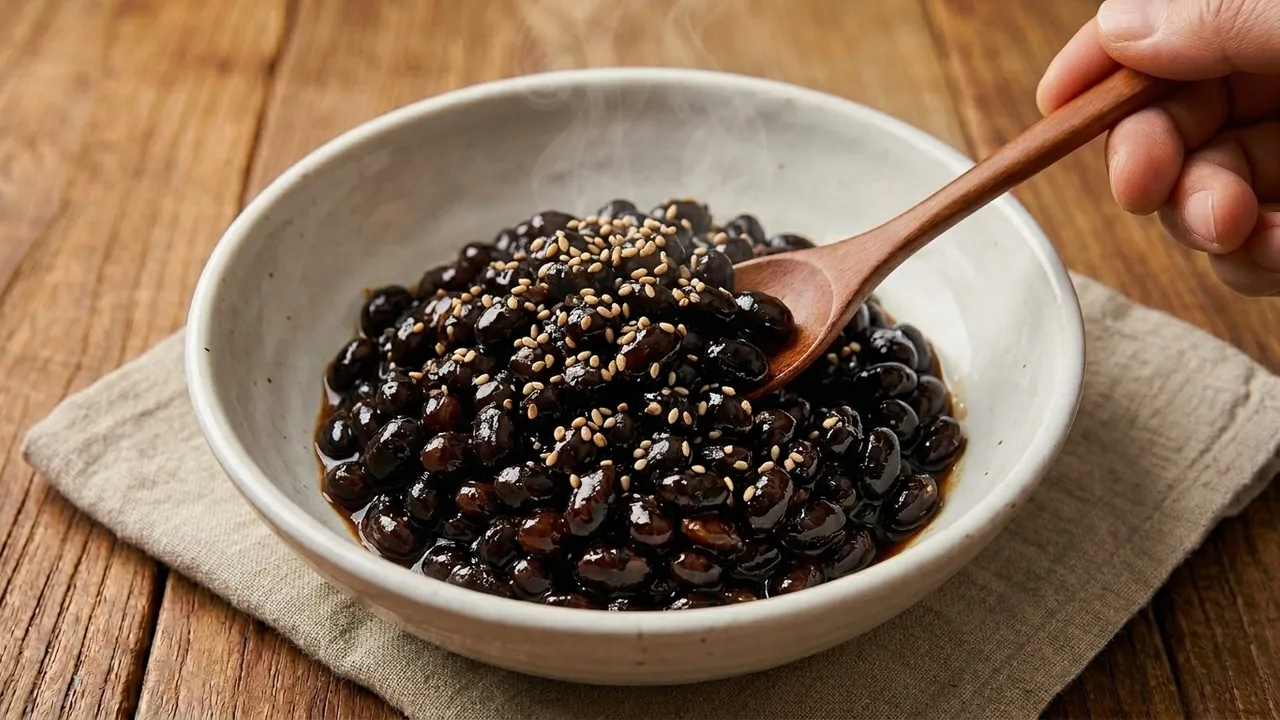
Chewy Kongjaban (콩자반) Recipe
* 이미지는 AI가 생성한 참고 이미지로, 실제 조리 결과물과 다를 수 있습니다.
This secret recipe shows you how to make glossy and chewy Kongjaban (콩자반), a Korean braised black soybean dish, that stays soft even when refrigerated. This is achieved by using olive oil instead of cooking oil, and corn syrup (물엿) and oligosaccharide (올리고당) instead of sugar.
📝 Editor's Notes
This recipe holds a special secret that breaks the stereotype of traditional Kongjaban (콩자반).
Its most distinctive features are its chewy texture and appealing glossiness, which remain even after cooling, preventing it from hardening.
By using olive oil instead of cooking oil, and corn syrup (물엿) and oligosaccharide (올리고당) instead of sugar, it offers a healthy yet deep umami flavor and a gentle sweetness.
This sweet and savory taste will truly be a 'rice thief' (a dish that makes you eat more rice).
The difficulty level is moderate; anyone can make delicious Kongjaban with a little care in preparing ingredients and soaking time.
It's excellent as a year-round side dish, especially perfect for lunchboxes.
🛒 Ingredient Tips
Here are some key ingredient tips that determine the taste of this chewy Kongjaban (콩자반).
First, for the main ingredient, Seoritae (서리태) black soybeans, it's best to choose beans that are large, glossy, have thin skins, and are green inside.
Freshly harvested Seoritae are even nuttier and softer, so it's good to buy them in season.
For olive oil, select an extra virgin olive oil or light olive oil that isn't too strongly flavored, so it doesn't overpower the Kongjaban's taste while adding healthy fats.
Finally, choose dried kelp (dashima (다시마)) that is not too thick and is clean; the white powder on its surface is an umami component, so do not wipe it off and use it as is.
🔄 Substitution Guide
If Seoritae (서리태) black soybeans are unavailable, you can use general black soybeans (such as Jwinunbultae (쥐눈이콩)), but the unique chewy and nutty flavor of Seoritae might be slightly less pronounced.
Substituting with kidney beans will result in a significantly different color and taste, creating a new type of braised bean dish, so keep that in mind.
If you find the aroma of olive oil too strong or have an allergy, you can use a neutral-flavored, clean vegetable oil like grapeseed oil or canola oil.
If you want to add a nutty flavor, you could finish with a small amount of sesame oil, but be cautious as its strong aroma might overpower the authentic taste of Kongjaban.
For the recipe's key secret of 'Kongjaban that doesn't harden,' the use of corn syrup (물엿) and oligosaccharide (올리고당) is highly recommended.
If you substitute with sugar, the Kongjaban may harden as it cools, and you will also need to adjust the sweetness level.
If using honey, its distinct aroma might alter the taste of the Kongjaban, so choose carefully.
🥘 Ingredients
👨🍳 Cooking Points
Remember these three important cooking points for delicious Kongjaban (콩자반).
First, the key is to soak the beans sufficiently in saltwater for 5-8 hours.
The salt seasoning subtly permeates the beans, enhancing their umami flavor and helping them cook softly to achieve a chewy texture.
If the soaking time is too short, the beans will be hard; if too long, their skins might peel off.
Second, do not discard the foam that forms when boiling the beans, as it contains beneficial extracts.
Also, when adding the seasoning and reducing it over medium heat for about 3 minutes, it's crucial to stir continuously to prevent burning.
Third, adding the oligosaccharide (올리고당) and remaining olive oil *after* turning off the heat is the highlight of this recipe.
Oligosaccharide is sensitive to high temperatures and its sweetness can diminish, so adding it last preserves its gentle sweetness and gloss.
The olive oil adds aroma and nuttiness.
If you remember these points, you'll be able to make chewy Kongjaban (콩자반) without fail.
👨🍳 Directions
Place 1 cup of Seoritae (서리태) black soybeans in a bowl and wash vigorously 2-3 times with 1L of water. Discard any beans that float to the surface.
To the washed Seoritae, add 1L of water and 1 tbsp of salt (such as fine sea salt or coarse sea salt), mix well, and soak for 5-8 hours. (The subtle saltiness will infuse into the beans, enhancing their umami flavor.)
Place the soaked beans in a pot. Pour in just enough of the soaking water to barely cover the beans. Add 1 sheet of dried kelp (dashima (다시마)) and 0.5 tbsp of olive oil. Turn on the heat and boil for 10 minutes from the point the water begins to boil. (Do not discard the foam that forms during boiling, as it contains beneficial extracts from the beans.)
After 10 minutes, turn off the heat and remove the dried kelp when about 50ml of the bean liquid remains. Then, add 4 tbsp of soy sauce, 2 tbsp of corn syrup (mulyeot (물엿)), and 2 tbsp of mirin (미림). Stir-fry over medium heat for about 3 minutes until the seasoning has almost completely reduced.
Turn off the heat. Add 2 tbsp of oligosaccharide (올리고당), 0.5 tbsp of olive oil, and toasted sesame seeds. Mix well to finish.
💡 Tips
Using olive oil instead of regular cooking oil adds a subtle aroma, nutty flavor, and a beautiful sheen to the Kongjaban (콩자반).
If you use sugar when cooking Kongjaban (콩자반), it tends to harden when it cools, potentially becoming rock-hard when stored in the refrigerator. It's best to use corn syrup (mulyeot (물엿)) and oligosaccharide (올리고당) to achieve a soft sweetness.
When soaking the beans, adding 1 tbsp of salt will allow the seasoning to subtly permeate the beans, resulting in a deeper umami flavor.
Do not discard the bean soaking water; utilizing it during cooking will result in a more attractive color for the Kongjaban (콩자반) and enhance its beneficial nutrients and umami flavor.
📦 Storage & Reuse
Store the finished Kongjaban (콩자반) in an airtight container in the refrigerator for 3-5 days to keep it fresh.
If you wish to store it longer, it's a good idea to portion it out into single servings and freeze it.
It can be stored in the freezer for about 1-2 weeks.
Thaw it in the refrigerator or gently warm it in the microwave before serving.
When reheating from frozen, be careful not to overheat, as the beans can become tough; only heat until their moisture is retained.
If you have any leftover Kongjaban, you can finely chop it and use it as a filling for rice balls (jumeokbap) or as a topping for bibimbap, which makes for a delightful variation.
🥢 Who This Is For
This chewy Kongjaban (콩자반) is a nutritious side dish, excellent for busy breakfasts or children's lunchboxes.
Thanks to its chewy texture, children will likely enjoy it without resistance.
It's also a great choice for those who are health-conscious or prefer a vegetarian diet.
Served with warm white rice, it makes for a satisfying and delicious meal.
Paired with other seasoned vegetable side dishes (namul) or kimchi, it can complete an even richer Korean set meal (Hansik (한식)) table.
🔥 Nutrition Info
This chewy Kongjaban (콩자반) is an excellent side dish nutritionally.
Seoritae (서리태) black soybeans, the main ingredient, are rich in protein and dietary fiber, often called 'beef from the field,' providing satiety and aiding gut health.
They also contain abundant antioxidants like anthocyanins and isoflavones, beneficial for women's health.
Olive oil, a healthy unsaturated fatty acid, positively impacts cardiovascular health, while dried kelp (dashima (다시마)) supplements minerals and iodine.
The corn syrup (물엿) and oligosaccharide (올리고당) used instead of sugar have a relatively slower impact on blood sugar levels than sugar and can act as beneficial prebiotics for gut health.
Assuming this entire recipe yields about 5 servings, one serving is estimated to be approximately 200-250 kcal, providing about 15g of protein, 5-7g of fat, and 25-30g of carbohydrates (including dietary fiber).
It is also rich in various micronutrients such as iron and B vitamins.
💬 Frequently Asked Questions
- Q. What ingredients do I need for Chewy Kongjaban (콩자반) Recipe?
- Main ingredients include Unsoaked Seoritae (서리태) black soybeans, Salt, Dried kelp (dashima (다시마)), Olive oil, Soy sauce. Here are some key ingredient tips that determine the taste of this chewy Kongjaban (콩자반). First, for the main ingredient, Seoritae (서리태) black soybeans, it's best to choose beans that are large, glossy, have thin skins, and are green inside. Freshly harvested Seoritae are even nuttier and softer, so it's good to buy them in season. For olive oil, select an extra virgin olive oil or light olive oil that isn't too strongly flavored, so it doesn't overpower the Kongjaban's taste while adding healthy fats. Finally, choose dried kelp (dashima (다시마)) that is not too thick and is clean; the white powder on its surface is an umami component, so do not wipe it off and use it as is.
- Q. What are the key tips for making Chewy Kongjaban (콩자반) Recipe?
- Remember these three important cooking points for delicious Kongjaban (콩자반). First, the key is to soak the beans sufficiently in saltwater for 5-8 hours. The salt seasoning subtly permeates the beans, enhancing their umami flavor and helping them cook softly to achieve a chewy texture. If the soaking time is too short, the beans will be hard; if too long, their skins might peel off. Second, do not discard the foam that forms when boiling the beans, as it contains beneficial extracts. Also, when adding the seasoning and reducing it over medium heat for about 3 minutes, it's crucial to stir continuously to prevent burning. Third, adding the oligosaccharide (올리고당) and remaining olive oil *after* turning off the heat is the highlight of this recipe. Oligosaccharide is sensitive to high temperatures and its sweetness can diminish, so adding it last preserves its gentle sweetness and gloss. The olive oil adds aroma and nuttiness. If you remember these points, you'll be able to make chewy Kongjaban (콩자반) without fail.
- Q. How should I store leftover Chewy Kongjaban (콩자반) Recipe?
- Store the finished Kongjaban (콩자반) in an airtight container in the refrigerator for 3-5 days to keep it fresh. If you wish to store it longer, it's a good idea to portion it out into single servings and freeze it. It can be stored in the freezer for about 1-2 weeks. Thaw it in the refrigerator or gently warm it in the microwave before serving. When reheating from frozen, be careful not to overheat, as the beans can become tough; only heat until their moisture is retained. If you have any leftover Kongjaban, you can finely chop it and use it as a filling for rice balls (jumeokbap) or as a topping for bibimbap, which makes for a delightful variation.
- Q. How many calories are in Chewy Kongjaban (콩자반) Recipe?
- This chewy Kongjaban (콩자반) is an excellent side dish nutritionally. Seoritae (서리태) black soybeans, the main ingredient, are rich in protein and dietary fiber, often called 'beef from the field,' providing satiety and aiding gut health. They also contain abundant antioxidants like anthocyanins and isoflavones, beneficial for women's health. Olive oil, a healthy unsaturated fatty acid, positively impacts cardiovascular health, while dried kelp (dashima (다시마)) supplements minerals and iodine. The corn syrup (물엿) and oligosaccharide (올리고당) used instead of sugar have a relatively slower impact on blood sugar levels than sugar and can act as beneficial prebiotics for gut health. Assuming this entire recipe yields about 5 servings, one serving is estimated to be approximately 200-250 kcal, providing about 15g of protein, 5-7g of fat, and 25-30g of carbohydrates (including dietary fiber). It is also rich in various micronutrients such as iron and B vitamins.
- Q. Can I substitute ingredients in Chewy Kongjaban (콩자반) Recipe?
- If Seoritae (서리태) black soybeans are unavailable, you can use general black soybeans (such as Jwinunbultae (쥐눈이콩)), but the unique chewy and nutty flavor of Seoritae might be slightly less pronounced. Substituting with kidney beans will result in a significantly different color and taste, creating a new type of braised bean dish, so keep that in mind. If you find the aroma of olive oil too strong or have an allergy, you can use a neutral-flavored, clean vegetable oil like grapeseed oil or canola oil. If you want to add a nutty flavor, you could finish with a small amount of sesame oil, but be cautious as its strong aroma might overpower the authentic taste of Kongjaban. For the recipe's key secret of 'Kongjaban that doesn't harden,' the use of corn syrup (물엿) and oligosaccharide (올리고당) is highly recommended. If you substitute with sugar, the Kongjaban may harden as it cools, and you will also need to adjust the sweetness level. If using honey, its distinct aroma might alter the taste of the Kongjaban, so choose carefully.
💬 Comments
No comments yet. Be the first to comment!