
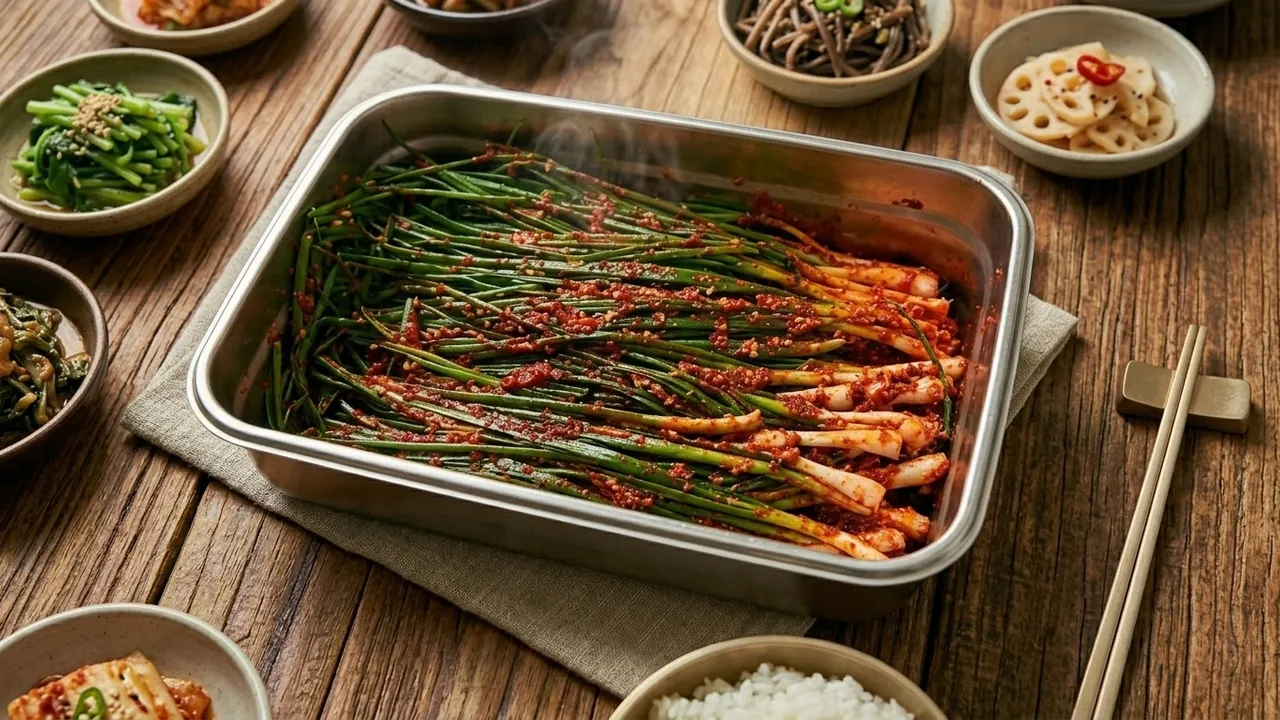
Easy Scallion Kimchi Recipe
* 이미지는 AI가 생성한 참고 이미지로, 실제 조리 결과물과 다를 수 있습니다.
This is a delicious scallion kimchi recipe that can be easily made with just 3 seasonings, without a blender or glutinous rice paste.
📝 Editor's Notes
This super simple scallion kimchi recipe allows you to create a deep and delicious kimchi without a blender or glutinous rice paste, using only three key seasonings.
The unique fragrance of scallions, the umami of fish sauce (myeolchi-aekjeot), and the subtly sweet Korean chili powder (gochugaru) seasoning combine to make an irresistible "rice thief." The simple cooking process makes it easy for beginner cooks to try, and it will enrich your spring dining table.
It's a fantastic pairing with warm rice, grilled meats like samgyeopsal (pork belly), or a steaming bowl of ramyeon.
Its biggest charm is delivering excellent flavor without complex steps.
🛒 Ingredient Tips
Scallions (jokpa) are the key ingredient that determines the taste of this kimchi, so choosing fresh ones is crucial.
Look for stalks that are not too thick, but rather moderately thin and firm, with vibrant green leaves that are not wilted.
Select scallions with clean, white roots and minimal soil for easier trimming.
The peak season is typically late winter to early spring, during which you can enjoy the most fragrant and delicious scallions.
For fish sauce (myeolchi-aekjeot), choose a product that isn't overly salty but offers a deep umami flavor.
Use Korean chili powder (gochugaru) that is brightly colored and finely ground to ensure a beautiful kimchi color.
🔄 Substitution Guide
Instead of fish sauce (myeolchi-aekjeot), a key seasoning in this recipe, you can use sand lance fish sauce (kkanari-aekjeot).
Sand lance fish sauce has less of a distinct fishy odor than anchovy fish sauce, making it a good alternative if you prefer a cleaner taste.
However, anchovy fish sauce may offer a deeper umami flavor.
For oligosaccharide (oligodang), you can use sugar or corn syrup instead.
If using sugar, reduce the amount slightly as it is sweeter.
Corn syrup provides a similar sweetness and sheen to oligosaccharide.
If scallions (jokpa) are hard to find, young green onions (daepa) or chives (buchu) can be used.
Green onions have thicker stalks than scallions, so you may need to increase the marinating time slightly or cut them in half.
Chives are much thinner, so the marinating time should be significantly reduced to prevent them from becoming tough.
Please note that using different ingredients will result in variations in taste and texture.
🥘 Ingredients
👨🍳 Cooking Points
The most crucial cooking points are in the trimming and washing of the scallions.
First, making a small tear or hole at the tip of each scallion leaf is the key to this recipe.
This allows the fish sauce seasoning to quickly penetrate, ensuring even seasoning, and helps maintain a crisp texture by preventing the leaves from swelling too much when the kimchi ferments.
Second, when washing the scallions, avoid running water directly over them.
Instead, let water flow into an empty space in the basin to prevent bruising and maintain freshness.
Gently rub the root ends with your hands to remove soil, and shake the leafy parts to wash them.
Lastly, when marinating, pour the fish sauce primarily onto the white bulb ends and marinate for 20 minutes.
Tilting the basin by placing a plate underneath helps the fish sauce penetrate the bulbs evenly.
Remember, the green leaf parts can easily become tough if over-marinated.
👨🍳 Directions
Prepare 1 kg of scallions (jokpa) and begin trimming them. Lightly trim the root ends and peel off any soil-covered outer layers.
An important tip is to slightly tear or make a small hole at the very tip of each scallion leaf. This allows the seasoning to penetrate faster and prevents the leaves from becoming too swollen when fermented.
When washing the trimmed scallions, carefully transfer them into a large basin, keeping them neatly arranged without scattering. Do not run water directly onto the scallions; instead, let the water flow into an empty space in the basin to prevent bruising the scallions.
Since there may be soil near the roots, submerge the scallions completely in water and gently rub the root ends with your hands to remove the soil. Submerge and gently shake the scallions to wash them thoroughly. Repeat this washing process 3 times. For the second wash, simply shake them in the water without rubbing.
Drain the thoroughly washed scallions in a colander and let them dry completely.
Place the scallions in a large basin and salt only the white bulb ends. Pour 9 tbsp of fish sauce (myeolchi-aekjeot) directly onto the bulb ends. Do not salt the green leaf parts, as they will become tough.
To help the fish sauce penetrate the bulb ends more effectively, place a plate underneath one side of the basin to tilt it.
Marinate for a total of 20 minutes, flipping them once after 10 minutes.
While the scallions are marinating, prepare the seasoning paste. Pour the fish sauce that was used for marinating the scallions into a separate bowl. Add 1 cup of Korean chili powder (gochugaru) and 5 tbsp of oligosaccharide (oligodang), and mix well. Scallion kimchi tastes best with a slight sweetness.
After mixing the chili powder, fish sauce, and oligosaccharide, let it sit for about 5 minutes for the chili powder to bloom and thicken the paste. Then, add 3 tbsp of toasted sesame seeds and mix well to complete the seasoning paste.
Take a handful of scallions and apply the seasoning paste primarily to the white bulb ends. For the green leaf parts, lightly spread the excess paste downwards from the bulbs.
When packing the scallion kimchi into a container, stack them crisscross, alternating the direction of each layer. This helps the seasoning flow down and evenly coat the entire length of the scallions.
After seasoning all the scallions, spread any remaining paste over the top.
For the finished scallion kimchi, let it ferment for about a day in a cool place, such as a balcony, especially in cooler weather (like November). If you prefer it less fermented, you can eat it immediately.
After one day of fermentation, store it in the refrigerator. It's best enjoyed fresh, with a slightly less fermented, 'geotjeori' (fresh kimchi) feel, rather than fully fermenting it.
💡 Tips
When trimming scallions, slightly tear or make a small hole at the tip of each leaf. This allows the seasoning to penetrate faster and prevents the leaves from swelling too much when fermented.
When washing scallions, avoid running water directly over them. Instead, let water flow into an empty space in the basin to prevent bruising. Gently rub the root ends with your hands to remove soil, and submerge and shake the green leafy parts in water to wash.
When marinating scallions, pour the fish sauce primarily onto the white bulb ends. Tilt the basin by placing a plate underneath one side to help the fish sauce penetrate evenly. Do not marinate the green leaf parts, as they will become tough.
The seasoning paste is made simply with fish sauce (myeolchi-aekjeot), Korean chili powder (gochugaru), oligosaccharide (oligodang), and toasted sesame seeds. After mixing the chili powder, fish sauce, and oligosaccharide, let it sit for about 5 minutes for the chili powder to bloom and thicken the paste, making it easier to apply.
After making, store the scallion kimchi in a cool place for one day of fermentation, then refrigerate. It's best enjoyed fresh, similar to 'geotjeori' (fresh kimchi), rather than allowing it to fully ferment. Since it's easy to make, we recommend buying a bunch of scallions and making it often.
📦 Storage & Reuse
Store the finished scallion kimchi in an airtight container in the refrigerator.
Freshly made kimchi can be enjoyed for about 1-2 weeks.
Over time, it will naturally ferment, developing a stronger sour taste.
While sour kimchi is delicious on its own, it's also excellent for dishes like scallion kimchi stew (pa-kimchi jjigae), fried rice with scallion kimchi (pa-kimchi bokkeumbap), or stir-fried with grilled meat.
Freezing kimchi is not recommended as it can alter the texture.
If you have leftover scallions, they can be used for pancakes (jeon) or a fresh scallion salad (pachae muchim).
Taking out only the amount you need will help keep the rest fresh longer.
🥢 Who This Is For
This super simple scallion kimchi is highly recommended for anyone who wants to enjoy freshly made kimchi even in a busy daily life.
It's a recipe that beginners and those living alone can confidently try.
It pairs wonderfully with spicy ramyeon or a comforting hot gukbap (rice soup), and when served with grilled meats like samgyeopsal (pork belly) or moksal (pork neck), it cuts through the richness, making them even more delicious.
It also makes an excellent side dish to quickly prepare if unexpected guests arrive.
🔥 Nutrition Info
This super simple scallion kimchi is estimated to be approximately 160 kcal per serving, with about 29g carbohydrates, 8g protein, and 4.5g fat.
Scallions (jokpa) are rich in vitamins C and K, and iron, which can help boost immunity and prevent anemia.
Korean chili powder (gochugaru) is also high in vitamins A and C, aiding in antioxidant activity.
Toasted sesame seeds are abundant in calcium and unsaturated fatty acids, which can positively impact bone and cardiovascular health.
However, as fish sauce (myeolchi-aekjeot) is used, the sodium content may be somewhat high, so it's advisable to consume in moderation.
Oligosaccharide (oligodang) has fewer calories than sugar and is rich in dietary fiber, which can benefit gut health.
💬 Frequently Asked Questions
- Q. What ingredients do I need for Easy Scallion Kimchi?
- Main ingredients include scallions (jokpa), fish sauce (myeolchi-aekjeot), Korean chili powder (gochugaru), oligosaccharide (oligodang), toasted sesame seeds. Scallions (jokpa) are the key ingredient that determines the taste of this kimchi, so choosing fresh ones is crucial. Look for stalks that are not too thick, but rather moderately thin and firm, with vibrant green leaves that are not wilted. Select scallions with clean, white roots and minimal soil for easier trimming. The peak season is typically late winter to early spring, during which you can enjoy the most fragrant and delicious scallions. For fish sauce (myeolchi-aekjeot), choose a product that isn't overly salty but offers a deep umami flavor. Use Korean chili powder (gochugaru) that is brightly colored and finely ground to ensure a beautiful kimchi color.
- Q. What are the key tips for making Easy Scallion Kimchi?
- The most crucial cooking points are in the trimming and washing of the scallions. First, making a small tear or hole at the tip of each scallion leaf is the key to this recipe. This allows the fish sauce seasoning to quickly penetrate, ensuring even seasoning, and helps maintain a crisp texture by preventing the leaves from swelling too much when the kimchi ferments. Second, when washing the scallions, avoid running water directly over them. Instead, let water flow into an empty space in the basin to prevent bruising and maintain freshness. Gently rub the root ends with your hands to remove soil, and shake the leafy parts to wash them. Lastly, when marinating, pour the fish sauce primarily onto the white bulb ends and marinate for 20 minutes. Tilting the basin by placing a plate underneath helps the fish sauce penetrate the bulbs evenly. Remember, the green leaf parts can easily become tough if over-marinated.
- Q. How should I store leftover Easy Scallion Kimchi?
- Store the finished scallion kimchi in an airtight container in the refrigerator. Freshly made kimchi can be enjoyed for about 1-2 weeks. Over time, it will naturally ferment, developing a stronger sour taste. While sour kimchi is delicious on its own, it's also excellent for dishes like scallion kimchi stew (pa-kimchi jjigae), fried rice with scallion kimchi (pa-kimchi bokkeumbap), or stir-fried with grilled meat. Freezing kimchi is not recommended as it can alter the texture. If you have leftover scallions, they can be used for pancakes (jeon) or a fresh scallion salad (pachae muchim). Taking out only the amount you need will help keep the rest fresh longer.
- Q. How many calories are in Easy Scallion Kimchi?
- This super simple scallion kimchi is estimated to be approximately 160 kcal per serving, with about 29g carbohydrates, 8g protein, and 4.5g fat. Scallions (jokpa) are rich in vitamins C and K, and iron, which can help boost immunity and prevent anemia. Korean chili powder (gochugaru) is also high in vitamins A and C, aiding in antioxidant activity. Toasted sesame seeds are abundant in calcium and unsaturated fatty acids, which can positively impact bone and cardiovascular health. However, as fish sauce (myeolchi-aekjeot) is used, the sodium content may be somewhat high, so it's advisable to consume in moderation. Oligosaccharide (oligodang) has fewer calories than sugar and is rich in dietary fiber, which can benefit gut health.
- Q. Can I substitute ingredients in Easy Scallion Kimchi?
- Instead of fish sauce (myeolchi-aekjeot), a key seasoning in this recipe, you can use sand lance fish sauce (kkanari-aekjeot). Sand lance fish sauce has less of a distinct fishy odor than anchovy fish sauce, making it a good alternative if you prefer a cleaner taste. However, anchovy fish sauce may offer a deeper umami flavor. For oligosaccharide (oligodang), you can use sugar or corn syrup instead. If using sugar, reduce the amount slightly as it is sweeter. Corn syrup provides a similar sweetness and sheen to oligosaccharide. If scallions (jokpa) are hard to find, young green onions (daepa) or chives (buchu) can be used. Green onions have thicker stalks than scallions, so you may need to increase the marinating time slightly or cut them in half. Chives are much thinner, so the marinating time should be significantly reduced to prevent them from becoming tough. Please note that using different ingredients will result in variations in taste and texture.
💬 Comments
No comments yet. Be the first to comment!