
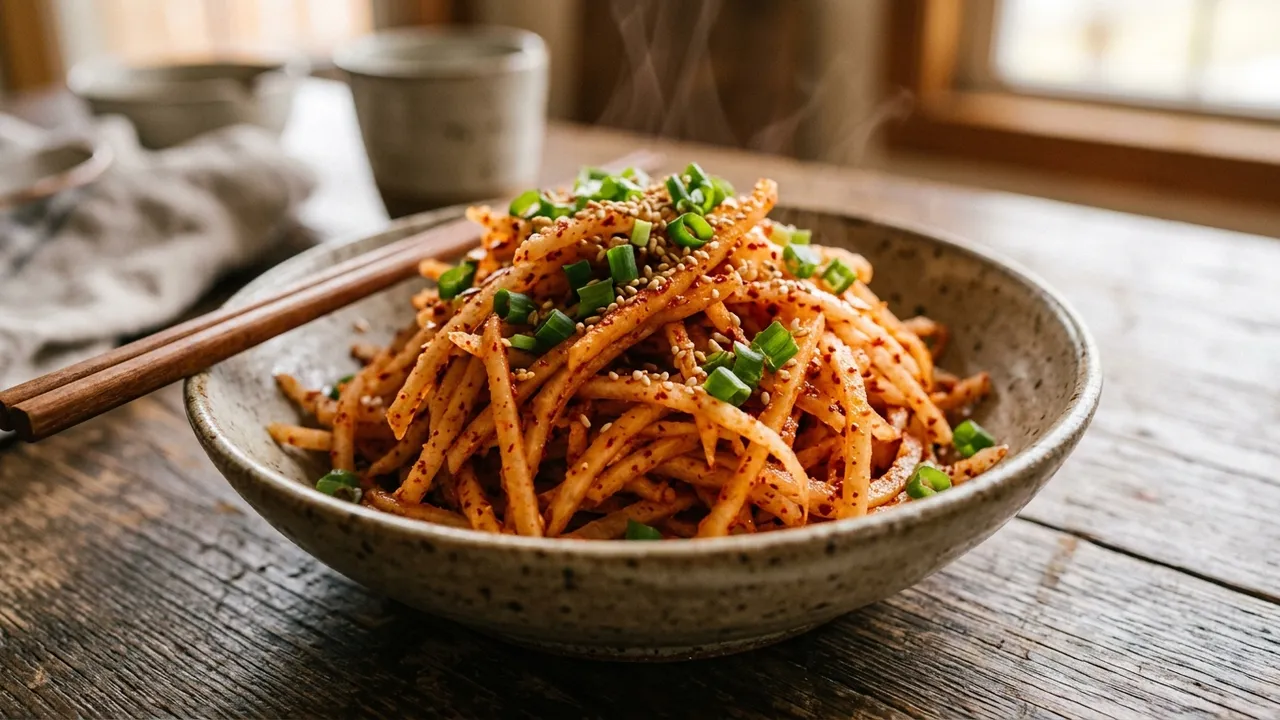
Mu-saengchae (무생채) Recipe
* 이미지는 AI가 생성한 참고 이미지로, 실제 조리 결과물과 다를 수 있습니다.
A delicious winter radish salad (Mu-saengchae) made with a golden ratio of simple ingredients, so good you'll want to eat it every day.
📝 Editor's Notes
This mu-saengchae is a winter delicacy that offers deep flavors through a golden ratio of simple ingredients.
It boasts a delightful balance of crispness, refreshing coolness, and a sweet-and-sour taste.
The preparation is straightforward, making it an accessible dish even for novice cooks.
It's especially delicious when made with seasonal winter radish, and it pairs perfectly with warm rice as a bibimbap or as a side to meat dishes.
This humble yet satisfying dish offers a flavor you won't tire of, even with daily enjoyment.
🛒 Ingredient Tips
As the star of mu-saengchae, choosing fresh radish is crucial.
Winter radishes are particularly sweet and juicy, making them ideal for this dish.
Look for radishes with a smooth, firm surface and fresh-looking greens attached.
A medium size, neither too thin nor too thick, is perfect.
For scallions, choose ones with vibrant color that aren't wilted.
Fresh onions should be firm, shiny, and have tightly adhering skins.
Fresh ingredients are key to the refreshing and crisp taste of mu-saengchae.
🔄 Substitution Guide
If scallions are unavailable, you can use the finely julienned white part of a large green onion (daepa).
While its aroma might be stronger and its crispness less pronounced than scallions, it will serve a similar purpose.
For ginger, while ginger powder is convenient, its flavor can be much more intense than ginger juice, so it's recommended to use only a small amount or, preferably, fresh ginger juice.
It's challenging to replicate the pungent and clean taste that fresh ginger provides.
Gochugaru (고춧가루) is crucial for both the color and flavor of mu-saengchae.
If you prefer less spice, use fine gochugaru (고춧가루) and add only a small amount for color.
Alternatively, finely chopped Cheongyang chili peppers can add a clean heat.
🥘 Ingredients
👨🍳 Cooking Points
The first key point is how you julienne the radish.
If it's too thick, the seasoning won't penetrate well; if too thin, it might become mushy.
It's important to julienne it slightly thinner than the mu-saengchae found at Korean BBQ restaurants, but still thick enough to retain a crisp texture.
The second is the order of seasoning.
The secret to the golden ratio is to first salt the radish to draw out moisture, then mix with sugar to add sweetness.
Finally, after adding gochugaru (고춧가루), waiting for about 3 minutes allows the color to develop beautifully.
Remember to rub the minced garlic into the radish liquid first to prevent clumping and ensure the seasoning is evenly mixed.
👨🍳 Directions
Prepare 1 kg of daikon radish (about 1/2 of a large radish or 2/3 of a medium radish). Julienne the radish slightly thinner than what you'd find at a Korean BBQ restaurant, but thick enough to retain a crisp texture. (If using a knife is difficult, a mandoline slicer can be helpful.)
Slice the 7 stalks of scallions into 2-3 cm (approx. 1 inch) lengths, similar to the radish strips. Halve any thicker white parts. Julienne 30-40g of onion as thinly as possible.
Add 1 tbsp of fine sea salt to the julienned radish and gently mix. Then add 2 tbsp of white sugar and gently mix again to season.
Add 2 tbsp of gochugaru (고춧가루) and let it sit for about 3 minutes for the color to develop.
Rub 1 tbsp of minced garlic into the liquid released from the radish first to dissolve the seasoning. Then add 1 tsp of ginger juice and 2 tbsp of brewed vinegar and mix.
Add the julienned onion and scallions. Gently mix everything by hand, ensuring the seasoning is evenly distributed throughout the radish.
Finally, add 1 tbsp of toasted sesame seeds and gently mix to finish. (Taste and adjust seasoning: add more salt if it's bland, or more vinegar if you prefer it tangier.)
💡 Tips
If scallions are unavailable, you can finely julienne the white part of a large green onion instead.
Slice the onion as thinly as possible to enhance the flavor while keeping the dish clean and crisp.
Be careful not to add too much gochugaru (고춧가루), as it can overpower the refreshing taste of the mu-saengchae and make it gritty. If you want more spiciness, it's better to add finely chopped Cheongyang chili peppers.
Using ginger powder instead of ginger juice is not recommended as its aroma can be too strong.
Mu-saengchae tastes even better as the seasoning has more time to meld and penetrate the radish after mixing.
Winter mu-saengchae is especially delicious when mixed with warm rice, a drizzle of sesame oil, and a fried egg.
📦 Storage & Reuse
Store mu-saengchae in an airtight container in the refrigerator for about 5-7 days.
While the flavor deepens as the seasoning soaks into the radish over time, its crisp texture may gradually diminish.
Freezing is not recommended, as the radish's texture changes significantly, becoming mushy after thawing.
If you have leftover mu-saengchae, try mixing it with warm rice, sesame oil, and a fried egg, or use it as an ingredient in kimchi jjigae (김치찌개) or doenjang jjigae (된장찌개) to add a unique flavor.
🥢 Who This Is For
This mu-saengchae makes a hearty meal when mixed vigorously with warm rice.
It also perfectly complements meat dishes like samgyeopsal (삼겹살) or bossam (보쌈), cutting through the richness for a more enjoyable experience.
It's also an excellent topping for spicy bibim guksu (비빔국수) or naengmyeon (냉면).
This versatile side dish is great for the whole family and is impressive enough to serve to guests.
Try making this 'rice thief' mu-saengchae to revive your appetite this winter season.
🔥 Nutrition Info
A single serving of this mu-saengchae (per person) can be enjoyed guilt-free, with an estimated 70-80 calories.
It is estimated to contain approximately 15g of carbohydrates, 1-2g of protein, and 2-3g of fat.
Radish is rich in Vitamin C and digestive enzymes like amylase, which aid digestion and boost immunity.
Garlic, ginger, and onion contain antioxidants.
It's also a healthy side dish rich in dietary fiber, beneficial for gut health.
However, sodium content can vary depending on the amount of salt used, so it's important to adjust it appropriately for health.
💬 Frequently Asked Questions
- Q. What ingredients do I need for Mu-saengchae (무생채)?
- Main ingredients include Daikon radish, Fine sea salt, White sugar, Gochugaru (고춧가루), Brewed vinegar. As the star of mu-saengchae, choosing fresh radish is crucial. Winter radishes are particularly sweet and juicy, making them ideal for this dish. Look for radishes with a smooth, firm surface and fresh-looking greens attached. A medium size, neither too thin nor too thick, is perfect. For scallions, choose ones with vibrant color that aren't wilted. Fresh onions should be firm, shiny, and have tightly adhering skins. Fresh ingredients are key to the refreshing and crisp taste of mu-saengchae.
- Q. What are the key tips for making Mu-saengchae (무생채)?
- The first key point is how you julienne the radish. If it's too thick, the seasoning won't penetrate well; if too thin, it might become mushy. It's important to julienne it slightly thinner than the mu-saengchae found at Korean BBQ restaurants, but still thick enough to retain a crisp texture. The second is the order of seasoning. The secret to the golden ratio is to first salt the radish to draw out moisture, then mix with sugar to add sweetness. Finally, after adding gochugaru (고춧가루), waiting for about 3 minutes allows the color to develop beautifully. Remember to rub the minced garlic into the radish liquid first to prevent clumping and ensure the seasoning is evenly mixed.
- Q. How should I store leftover Mu-saengchae (무생채)?
- Store mu-saengchae in an airtight container in the refrigerator for about 5-7 days. While the flavor deepens as the seasoning soaks into the radish over time, its crisp texture may gradually diminish. Freezing is not recommended, as the radish's texture changes significantly, becoming mushy after thawing. If you have leftover mu-saengchae, try mixing it with warm rice, sesame oil, and a fried egg, or use it as an ingredient in kimchi jjigae (김치찌개) or doenjang jjigae (된장찌개) to add a unique flavor.
- Q. How many calories are in Mu-saengchae (무생채)?
- A single serving of this mu-saengchae (per person) can be enjoyed guilt-free, with an estimated 70-80 calories. It is estimated to contain approximately 15g of carbohydrates, 1-2g of protein, and 2-3g of fat. Radish is rich in Vitamin C and digestive enzymes like amylase, which aid digestion and boost immunity. Garlic, ginger, and onion contain antioxidants. It's also a healthy side dish rich in dietary fiber, beneficial for gut health. However, sodium content can vary depending on the amount of salt used, so it's important to adjust it appropriately for health.
- Q. Can I substitute ingredients in Mu-saengchae (무생채)?
- If scallions are unavailable, you can use the finely julienned white part of a large green onion (daepa). While its aroma might be stronger and its crispness less pronounced than scallions, it will serve a similar purpose. For ginger, while ginger powder is convenient, its flavor can be much more intense than ginger juice, so it's recommended to use only a small amount or, preferably, fresh ginger juice. It's challenging to replicate the pungent and clean taste that fresh ginger provides. Gochugaru (고춧가루) is crucial for both the color and flavor of mu-saengchae. If you prefer less spice, use fine gochugaru (고춧가루) and add only a small amount for color. Alternatively, finely chopped Cheongyang chili peppers can add a clean heat.
💬 Comments
No comments yet. Be the first to comment!