
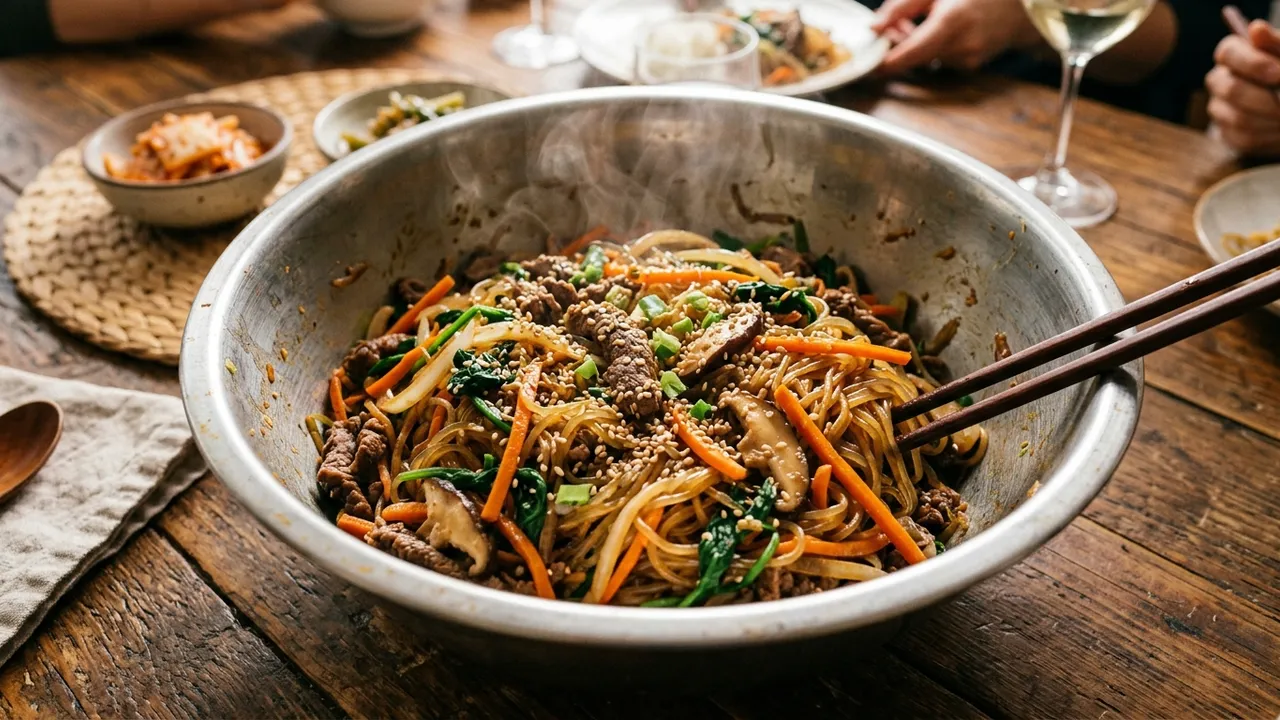
The Easiest and Most Delicious Japchae Recipe
* 이미지는 AI가 생성한 참고 이미지로, 실제 조리 결과물과 다를 수 있습니다.
A recipe for the easiest and most delicious japchae that isn't complicated.
📝 Editor's Notes
True to its title, this japchae recipe is characterized by its deep flavor despite its simplicity.
Unlike traditional japchae, this method reduces hassle by stir-frying vegetables and meat separately, letting them cool, and then cooking the glass noodles directly in a seasoned liquid.
This preserves the texture of the ingredients, and the noodles absorb the seasoning thoroughly, creating a more harmonious taste.
The subtle spiciness from the Cheongyang chili peppers (cheongyang gochu) and chili oil (gochu gireum) cuts through any richness, making it a crowd-pleaser for all ages.
It's perfect for entertaining guests or special occasions, and easy enough to whip up for family meals on busy weekdays.
🛒 Ingredient Tips
Pay a little extra attention to selecting the key ingredients that will define the taste of this japchae.
For spinach, choose leaves that are not wilted, have a glossy sheen, and thick, reddish roots.
Fresh spinach enhances the color and adds a crisp texture to the japchae.
For bell peppers, select ones with vibrant colors, shiny skins, and firm textures; using both red and yellow bell peppers will make your japchae visually more appealing.
For the beef, choose a cut with less fat and more lean meat for a cleaner flavor.
Make sure the meat is fresh and free of excess blood.
🔄 Substitution Guide
If you're missing certain ingredients or have allergies, consider these substitutions: Instead of beef for japchae, you can use thinly sliced pork shoulder or pork leg.
Pork is often more affordable than beef and offers a savory flavor that brings a different charm to the dish.
For vegetarians, simply add plenty of shiitake or king oyster mushrooms instead of meat.
Their chewy texture and deep aroma will fill the void left by the meat.
If you don't have rice syrup (jocheong), you can substitute with corn syrup or oligo syrup, but the unique deep sweetness and glaze of jocheong might be slightly reduced.
If the spiciness of Cheongyang chili peppers (cheongyang gochu) is too much, julienne bell peppers or pimientos instead, or omit them entirely.
While the flavor might be slightly different, the delicious base seasoning ensures it will still be enjoyable.
🥘 Ingredients
👨🍳 Cooking Points
This recipe has three crucial cooking points.
First, when stir-frying vegetables, lightly sauté them over medium heat until the spinach wilts.
Be careful not to overcook, as this can release too much water and make the vegetables soft.
Spreading the stir-fried vegetables on a wide platter to cool is key to preventing the japchae from spoiling quickly and maintaining freshness.
Second, it's important to quickly stir-fry the beef and mushrooms over high heat so that no liquid remains.
Mushrooms, in particular, release a lot of water, so stir-fry them rapidly over high heat to evaporate the moisture.
Third, adding soy sauce, brown sugar, and chili oil (gochu gireum) to the glass noodle boiling water is the core of this japchae.
As the noodles absorb the seasoned liquid while cooking, they develop a deep flavor and an appealing brown color without needing separate seasoning.
Don't overcook the glass noodles; once they become transparent and soft in the boiling water, remove them immediately to prevent them from becoming mushy.
👨🍳 Directions
Combine 8 tbsp soy sauce, 4 tbsp mirin (cooking wine), 4 tbsp rice syrup (jocheong), and 5 dashes of black pepper. Mix well to prepare the seasoning sauce.
Remove the seeds from 1/2 red bell pepper and 1/2 yellow bell pepper, then julienne them. Julienne 3.5 oz (100g) carrot, 4.2 oz (120g) onion, and 3 Cheongyang chili peppers (cheongyang gochu). Clean and separate the leaves of 4.2 oz (120g) spinach. Tear the thick parts of 4.2 oz (120g) oyster mushrooms into strips. Prepare 7 oz (200g) beef for japchae without seasoning.
In a large pot or wok, heat 3 tbsp cooking oil over medium heat. Add 1/2 tbsp garlic and stir-fry briefly to release its fragrance. Add 3.5 oz (100g) carrot and stir-fry lightly. Then add 4.2 oz (120g) onion, 1/2 yellow bell pepper, 1/2 red bell pepper, 4.2 oz (120g) spinach, and 1 level tsp fine salt. Stir-fry over medium heat until the spinach wilts. Spread the stir-fried vegetables onto a large platter to cool.
In the same pan used for the vegetables, heat 1 tbsp cooking oil and 1/2 tbsp garlic. Once the garlic fragrance rises, add 7 oz (200g) beef for japchae. Add 3 tbsp of the prepared seasoning sauce and 3 julienned Cheongyang chili peppers (cheongyang gochu). Stir-fry over high heat until the beef is no longer pink and releases a lot of juice. Add 4.2 oz (120g) oyster mushrooms and quickly stir-fry over high heat until all the liquid evaporates and the mushrooms are thoroughly coated in the juice. Combine the stir-fried beef and mushrooms with the vegetables on the large platter and spread them out to cool.
In a pot, combine 4 cups (800 ml) water, 3 tbsp soy sauce, 3 tbsp brown sugar, and 3 tbsp chili oil (gochu gireum). Bring to a boil over high heat. Once boiling, add the rinsed 10.6 oz (300g) glass noodles, submerging them completely in the boiling water until softened. When the noodles become pliable, reduce the heat to medium-low and simmer for 8-9 minutes. After 8-9 minutes, when all the liquid has evaporated, turn off the heat.
Add the cooked glass noodles to the large platter with the stir-fried vegetables and beef. Pour in the remaining seasoning sauce and 2 tbsp sesame oil. Mix all the ingredients thoroughly. Taste and adjust seasoning as desired. Drizzle with 2 tbsp perilla oil and a generous amount of toasted sesame seeds. Serve warm and enjoy!
💡 Tips
When preparing spinach, don't trim it in large clumps; separate the leaves individually.
Finely julienning Cheongyang chili peppers (cheongyang gochu) and adding them to japchae makes it deliciously spicy.
Spreading the stir-fried vegetables thinly to cool prevents the japchae from spoiling quickly.
When stir-frying mushrooms, quickly stir-fry them over high heat until all the liquid evaporates, as mushrooms release a lot of water.
Adding brown sugar to the glass noodle boiling water gives the japchae an appetizing brown color, and adding chili oil (gochu gireum) infuses it with spicy flavor and aroma, making it much more delicious.
Using a mix of sesame oil and perilla oil for japchae makes it much more savory and flavorful.
📦 Storage & Reuse
Store leftover japchae in an airtight container in the refrigerator for 2-3 days.
It's best to consume it quickly, as the noodles can become soggy and vegetables lose moisture over time.
Freezing is generally not recommended as it can alter the texture of the glass noodles, but if necessary, freeze in small portions and reheat in a microwave or frying pan.
To maintain moisture when reheating, add a splash of water or broth and stir-fry gently.
Leftover japchae also makes a delicious japchae-bap (japchae fried rice) when stir-fried with rice, or japchae-jeon (japchae pancake) when mixed with a little pancake mix and pan-fried.
🥢 Who This Is For
This japchae is highly recommended for novice cooks or busy dual-income couples, as it allows you to create a wonderful dish without complex steps.
If you've found making japchae challenging in the past, this recipe will boost your confidence.
It's perfect for family weekend meals, birthday celebrations, or entertaining guests.
It works well as a hearty standalone meal or as a harmonious side dish.
Serving it with a refreshing bean sprout soup (kongnamul-guk), seaweed soup (miyeok-guk), or simple kimchi will make your meal even more enjoyable.
🔥 Nutrition Info
Based on approximately 4-5 servings, this japchae recipe is estimated to provide about 650-750 kcal per serving.
It's projected to offer roughly 80-90g of carbohydrates from glass noodles, rice syrup (jocheong), and brown sugar; about 20-25g of protein from beef for japchae and vegetables; and approximately 35-40g of fat from cooking oil, chili oil (gochu gireum), sesame oil, and perilla oil.
The abundant variety of vegetables like spinach, bell peppers, and carrots contributes to the intake of vitamins A, C, and dietary fiber, while beef replenishes essential minerals like iron and zinc.
Chili oil (gochu gireum) and Cheongyang chili peppers (cheongyang gochu) contain capsaicin, which can boost metabolism, making this a healthy and delicious meal.
💬 Frequently Asked Questions
- Q. What ingredients do I need for The Easiest and Most Delicious Japchae?
- Main ingredients include Glass noodles, Spinach, Red bell pepper, Yellow bell pepper, Carrot. Pay a little extra attention to selecting the key ingredients that will define the taste of this japchae. For spinach, choose leaves that are not wilted, have a glossy sheen, and thick, reddish roots. Fresh spinach enhances the color and adds a crisp texture to the japchae. For bell peppers, select ones with vibrant colors, shiny skins, and firm textures; using both red and yellow bell peppers will make your japchae visually more appealing. For the beef, choose a cut with less fat and more lean meat for a cleaner flavor. Make sure the meat is fresh and free of excess blood.
- Q. What are the key tips for making The Easiest and Most Delicious Japchae?
- This recipe has three crucial cooking points. First, when stir-frying vegetables, lightly sauté them over medium heat until the spinach wilts. Be careful not to overcook, as this can release too much water and make the vegetables soft. Spreading the stir-fried vegetables on a wide platter to cool is key to preventing the japchae from spoiling quickly and maintaining freshness. Second, it's important to quickly stir-fry the beef and mushrooms over high heat so that no liquid remains. Mushrooms, in particular, release a lot of water, so stir-fry them rapidly over high heat to evaporate the moisture. Third, adding soy sauce, brown sugar, and chili oil (gochu gireum) to the glass noodle boiling water is the core of this japchae. As the noodles absorb the seasoned liquid while cooking, they develop a deep flavor and an appealing brown color without needing separate seasoning. Don't overcook the glass noodles; once they become transparent and soft in the boiling water, remove them immediately to prevent them from becoming mushy.
- Q. How should I store leftover The Easiest and Most Delicious Japchae?
- Store leftover japchae in an airtight container in the refrigerator for 2-3 days. It's best to consume it quickly, as the noodles can become soggy and vegetables lose moisture over time. Freezing is generally not recommended as it can alter the texture of the glass noodles, but if necessary, freeze in small portions and reheat in a microwave or frying pan. To maintain moisture when reheating, add a splash of water or broth and stir-fry gently. Leftover japchae also makes a delicious japchae-bap (japchae fried rice) when stir-fried with rice, or japchae-jeon (japchae pancake) when mixed with a little pancake mix and pan-fried.
- Q. How many calories are in The Easiest and Most Delicious Japchae?
- Based on approximately 4-5 servings, this japchae recipe is estimated to provide about 650-750 kcal per serving. It's projected to offer roughly 80-90g of carbohydrates from glass noodles, rice syrup (jocheong), and brown sugar; about 20-25g of protein from beef for japchae and vegetables; and approximately 35-40g of fat from cooking oil, chili oil (gochu gireum), sesame oil, and perilla oil. The abundant variety of vegetables like spinach, bell peppers, and carrots contributes to the intake of vitamins A, C, and dietary fiber, while beef replenishes essential minerals like iron and zinc. Chili oil (gochu gireum) and Cheongyang chili peppers (cheongyang gochu) contain capsaicin, which can boost metabolism, making this a healthy and delicious meal.
- Q. Can I substitute ingredients in The Easiest and Most Delicious Japchae?
- If you're missing certain ingredients or have allergies, consider these substitutions: Instead of beef for japchae, you can use thinly sliced pork shoulder or pork leg. Pork is often more affordable than beef and offers a savory flavor that brings a different charm to the dish. For vegetarians, simply add plenty of shiitake or king oyster mushrooms instead of meat. Their chewy texture and deep aroma will fill the void left by the meat. If you don't have rice syrup (jocheong), you can substitute with corn syrup or oligo syrup, but the unique deep sweetness and glaze of jocheong might be slightly reduced. If the spiciness of Cheongyang chili peppers (cheongyang gochu) is too much, julienne bell peppers or pimientos instead, or omit them entirely. While the flavor might be slightly different, the delicious base seasoning ensures it will still be enjoyable.
💬 Comments
No comments yet. Be the first to comment!