
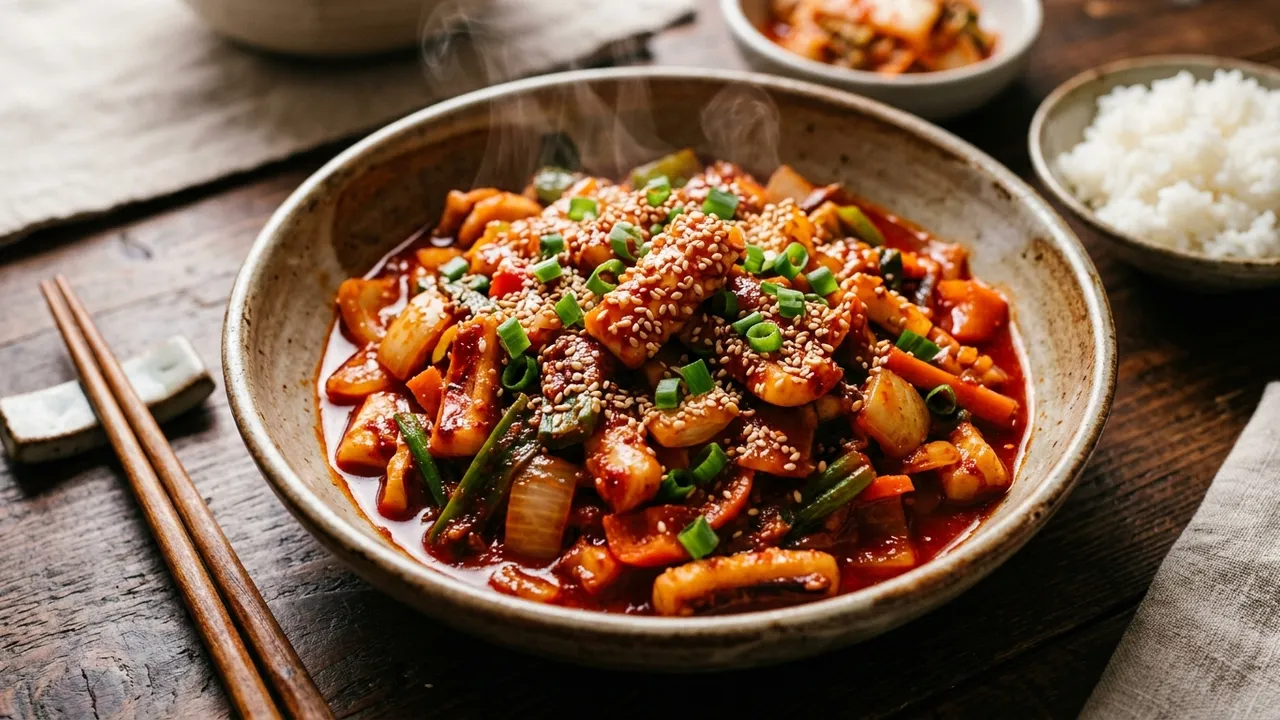
Spicy Stir-fried Squid (Ojing-eo Bokkeum) Recipe
* 이미지는 AI가 생성한 참고 이미지로, 실제 조리 결과물과 다를 수 있습니다.
This is a recipe for Spicy Stir-fried Squid (Ojing-eo Bokkeum) that boasts a tender, non-chewy texture and a delightful sweet and spicy flavor.
📝 Editor's Notes
This recipe contains delicate know-how for making tender, non-chewy stir-fried squid.
From preparing the squid to making the sauce and the cooking process, the secret to the flavor is hidden in every step.
The perfect harmony of sweet and spicy sauce with bouncy squid is exquisite, and the meticulous process of simmering the sauce beforehand and stir-frying the vegetables first adds depth to the taste.
The difficulty level is intermediate, but if you follow a few key points, you can complete a splendid meal.
It's excellent as a side dish for rice or as a snack with drinks, and while it's a beloved dish all year round, it's especially recommended as a comforting delicacy on days when you need a boost of energy.
🛒 Ingredient Tips
Choosing fresh squid is the beginning of this dish.
Look for squid with a translucent and firm body, clear eyes, and no ruptured ink sac.
It's also good to check if the legs are firmly attached to the body.
For Cheongyang chili peppers (청양고추), choose ones that are vibrant in color, glossy, and firm to the touch.
Avoid those that are too soft or appear to have too many seeds.
For onions and green onions, select firm ones with un-withered skins.
For green onions, check if the root part is fresh, which will enhance the flavor of your dish.
🔄 Substitution Guide
If fresh squid is difficult to find or if you have a seafood allergy, you can substitute with shrimp or chicken breast.
Shrimp offers a similar chewy texture to squid, but adjust cooking time as it cooks faster.
Chicken breast is rich in protein and lean, but you might not get the unique bouncy texture of squid.
If you don't enjoy spicy food or are cooking for children, try replacing Cheongyang chili peppers (청양고추) with regular kkwari-gochu (꽈리고추) or ah-sag-i-gochu (아삭이고추).
This will reduce the spiciness while maintaining a crisp texture.
If you wish to reduce sweetness, adjust the amount of corn syrup or sugar, or substitute with oligosaccharide, pear juice, or apple juice.
However, please note that corn syrup also helps with gloss and consistency, so the sauce might become slightly thinner if substituted.
🥘 Ingredients
👨🍳 Cooking Points
There are three crucial points for the success of this stir-fried squid.
First, thoroughly remove impurities and gamey odors from the squid by vigorously scrubbing it with flour and salt, then washing it clean under running water.
Marinating it for 10 minutes with anchovy sauce (멸치액젓) and plum extract (매실액) is key to adding umami and tenderizing the squid, preventing it from becoming tough.
Second, simmering the sauce in a pan beforehand over low heat helps the ingredients blend well and gives it a more appetizing color.
Third, after stir-frying the vegetables until they are half-cooked, it's important to add the marinated squid and the pre-simmered sauce, and stir-fry them quickly over *high heat* for *less than 5 minutes*.
Remember 'short time, high heat' because squid becomes tough and releases too much moisture if cooked for too long!
👨🍳 Directions
Remove the tentacles from the squid. Add 3 tbsp of all-purpose flour and 1 tbsp of coarse sea salt, then vigorously scrub the squid to remove any impurities and gamey odor. Rinse thoroughly 2-3 times under running water and prepare.
Make shallow cuts between the legs of the cleaned squid to fan them out. Slice the body of the squid horizontally into bite-sized pieces.
Pat dry the cleaned squid with a paper towel. Add 1 tbsp of anchovy sauce (멸치액젓) and 1 tbsp of plum extract (매실액), then marinate for 10 minutes.
Slice 1 onion, 2 green onions, and 3-5 Cheongyang chili peppers (청양고추) into large, thick pieces.
In a pan, combine 1 tbsp of cooking oil, 6 tbsp of gochugaru (고춧가루), 2 tbsp of gochujang (고추장), 2 tbsp of soy sauce, 3 tbsp of corn syrup (물엿), 1 tbsp of sugar, 2 tbsp of minced garlic, 1 tbsp of ginger powder, and 2 tbsp of mirin (맛술). Bring to a simmer over low heat to create the sauce.
In another pan, add 1 tbsp of cooking oil and 2 tbsp of chili oil. Stir-fry the sliced onion, green onions, and Cheongyang chili peppers until they are about half-cooked.
Once the vegetables are half-cooked, add the marinated squid and the pre-simmered sauce. Stir-fry quickly over high heat for about 5 minutes.
When the squid is deliciously cooked, turn off the heat, drizzle with 1 tbsp of sesame oil, and sprinkle generously with toasted sesame seeds to finish.
💡 Tips
It's best to stir-fry the squid directly rather than boiling it first, as boiling can make it tough.
The lower part of the squid tentacles often contains many impurities, so it's advisable to remove and wash them thoroughly before cooking.
Squid muscles run horizontally, so slicing them horizontally helps achieve a bouncy and tender texture.
Simmering the sauce in a pan beforehand enhances its flavor and color.
For delicious Spicy Stir-fried Squid without excess moisture, stir-fry the vegetables first, then add the squid and stir-fry quickly over high heat.
📦 Storage & Reuse
Once completed, store the stir-fried squid in an airtight container in the refrigerator for 2-3 days to keep it fresh.
Freezing squid is not recommended as it can alter its texture and make it tough, but if you only want to utilize the sauce flavor, you can freeze it, then thaw and stir-fry with rice to make fried rice.
When reheating, gently stir-fry over medium heat until warm to prevent the squid from becoming tough.
Leftover stir-fried squid can also be combined with kimchi (김치) and rice to make spicy stir-fried rice, or mixed with boiled somyeon (소면) noodles for a delicious bibim-myeon (비빔면) style dish.
🥢 Who This Is For
This spicy stir-fried squid is a dish that people of all ages will love for its sweet and spicy flavor.
It's especially perfect as a side dish with rice, or as a snack with a refreshing beer for those who enjoy spicy food or need to relieve stress.
Enjoy it as a rice bowl topping or mixed with boiled somyeon (소면) noodles for a delightful twist.
Pairing it with a spicy bean sprout soup or a refreshing cold seaweed soup will complete an even richer and more harmonious meal.
🔥 Nutrition Info
This recipe uses 2 squids, so it can be considered for 2-3 servings.
Based on one serving (approximately 1 squid), it is estimated to be about 380-480 kcal.
Thanks to the squid, protein will be abundant, around 30g.
Carbohydrates from the sauce (sugar, corn syrup), and vegetables will be about 45-55g, and fats from cooking oil, chili oil, and the squid itself will be about 18-25g.
Squid is rich in taurine, which helps relieve fatigue and positively impacts cholesterol levels.
It also contains antioxidant nutrients like vitamin E and selenium, making it a healthy and energizing meal.
💬 Frequently Asked Questions
- Q. What ingredients do I need for Spicy Stir-fried Squid (Ojing-eo Bokkeum)?
- Main ingredients include Squid, Onion, Green onions, Cheongyang chili peppers (청양고추), Cooking oil. Choosing fresh squid is the beginning of this dish. Look for squid with a translucent and firm body, clear eyes, and no ruptured ink sac. It's also good to check if the legs are firmly attached to the body. For Cheongyang chili peppers (청양고추), choose ones that are vibrant in color, glossy, and firm to the touch. Avoid those that are too soft or appear to have too many seeds. For onions and green onions, select firm ones with un-withered skins. For green onions, check if the root part is fresh, which will enhance the flavor of your dish.
- Q. What are the key tips for making Spicy Stir-fried Squid (Ojing-eo Bokkeum)?
- There are three crucial points for the success of this stir-fried squid. First, thoroughly remove impurities and gamey odors from the squid by vigorously scrubbing it with flour and salt, then washing it clean under running water. Marinating it for 10 minutes with anchovy sauce (멸치액젓) and plum extract (매실액) is key to adding umami and tenderizing the squid, preventing it from becoming tough. Second, simmering the sauce in a pan beforehand over low heat helps the ingredients blend well and gives it a more appetizing color. Third, after stir-frying the vegetables until they are half-cooked, it's important to add the marinated squid and the pre-simmered sauce, and stir-fry them quickly over *high heat* for *less than 5 minutes*. Remember 'short time, high heat' because squid becomes tough and releases too much moisture if cooked for too long!
- Q. How should I store leftover Spicy Stir-fried Squid (Ojing-eo Bokkeum)?
- Once completed, store the stir-fried squid in an airtight container in the refrigerator for 2-3 days to keep it fresh. Freezing squid is not recommended as it can alter its texture and make it tough, but if you only want to utilize the sauce flavor, you can freeze it, then thaw and stir-fry with rice to make fried rice. When reheating, gently stir-fry over medium heat until warm to prevent the squid from becoming tough. Leftover stir-fried squid can also be combined with kimchi (김치) and rice to make spicy stir-fried rice, or mixed with boiled somyeon (소면) noodles for a delicious bibim-myeon (비빔면) style dish.
- Q. How many calories are in Spicy Stir-fried Squid (Ojing-eo Bokkeum)?
- This recipe uses 2 squids, so it can be considered for 2-3 servings. Based on one serving (approximately 1 squid), it is estimated to be about 380-480 kcal. Thanks to the squid, protein will be abundant, around 30g. Carbohydrates from the sauce (sugar, corn syrup), and vegetables will be about 45-55g, and fats from cooking oil, chili oil, and the squid itself will be about 18-25g. Squid is rich in taurine, which helps relieve fatigue and positively impacts cholesterol levels. It also contains antioxidant nutrients like vitamin E and selenium, making it a healthy and energizing meal.
- Q. Can I substitute ingredients in Spicy Stir-fried Squid (Ojing-eo Bokkeum)?
- If fresh squid is difficult to find or if you have a seafood allergy, you can substitute with shrimp or chicken breast. Shrimp offers a similar chewy texture to squid, but adjust cooking time as it cooks faster. Chicken breast is rich in protein and lean, but you might not get the unique bouncy texture of squid. If you don't enjoy spicy food or are cooking for children, try replacing Cheongyang chili peppers (청양고추) with regular kkwari-gochu (꽈리고추) or ah-sag-i-gochu (아삭이고추). This will reduce the spiciness while maintaining a crisp texture. If you wish to reduce sweetness, adjust the amount of corn syrup or sugar, or substitute with oligosaccharide, pear juice, or apple juice. However, please note that corn syrup also helps with gloss and consistency, so the sauce might become slightly thinner if substituted.

💬 Comments
No comments yet. Be the first to comment!