
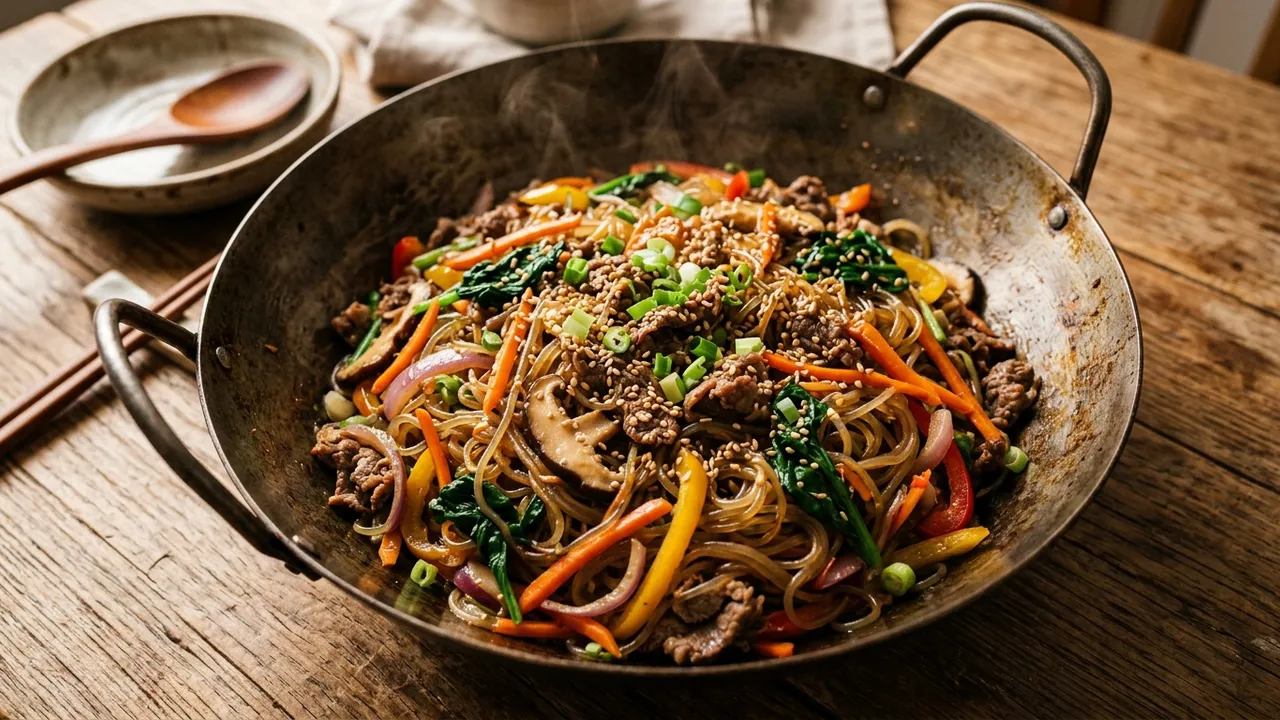
Soggy-Proof Japchae (Glass Noodle Stir-fry) Recipe
* 이미지는 AI가 생성한 참고 이미지로, 실제 조리 결과물과 다를 수 있습니다.
A recipe for springy, chewy japchae that stays firm and doesn't get soggy.
📝 Editor's Notes
The biggest charm of this recipe is that you can enjoy springy, chewy japchae that 'doesn't get soggy'.
The key secret is to cook the glass noodles without pre-soaking, rinse them in cold water to remove starch, and then stir-fry them over high heat to completely evaporate moisture.
This prevents the noodles from clumping or getting soggy over time, maintaining their chewy texture for a long duration.
Various vegetables and pork come together, boasting vibrant colors and rich flavors, while the harmony of soy sauce, sugar, and oyster sauce creates a deep, savory seasoning.
Although it takes a bit of effort, once made, it becomes a hearty main dish, perfect for holidays or entertaining guests.
The difficulty level can be considered intermediate.
🛒 Ingredient Tips
Let's carefully choose the main ingredients that determine the taste and texture of japchae.
For 'glass noodles', choosing a product made with domestic sweet potato starch will give you a chewier and more elastic texture.
Check the ingredients list and manufacturer on the packaging.
'Pork tenderloin' is low in fat and tender, making it well-suited for japchae; it's important to choose fresh meat that has a bright reddish-pink color and a sheen.
Asking for it to be cut into long strips for japchae will make cooking much more convenient.
For 'spinach', it's best to select fresh ones with red roots and vibrant green leaves.
Seasonal spinach has a stronger sweetness, which enhances the flavor of japchae.
🔄 Substitution Guide
If you don't have certain ingredients or want to cater to a specific diet, consider these substitutions.
Instead of 'pork tenderloin', you can use beef bulgogi (불고기) cut or chicken breast.
Beef will offer a richer umami flavor, while chicken breast will provide a lighter, cleaner taste.
For vegetarians, tofu, rehydrated wood ear mushrooms, or king oyster mushrooms can be used instead of pork to supplement protein and texture.
'Shiitake mushrooms' can be replaced with oyster mushrooms or king oyster mushrooms; while the aroma might be milder, the chewy texture will be similar.
If 'spinach' is unavailable, chives, bok choy, or kale can be good alternatives.
Chives add a unique fragrant freshness to japchae, while bok choy or kale can provide a crisp texture.
Please note that the original taste, aroma, and texture of japchae may vary depending on the substitute ingredients used.
🥘 Ingredients
👨🍳 Cooking Points
Remember these three crucial cooking points for japchae that doesn't get soggy!
First, 'stir-frying vegetables and meat separately to evaporate moisture' is key.
Stir-fry vegetables quickly over high heat to maintain their crispness, and stir-fry the meat thoroughly until no moisture remains to eliminate gamey odors and enhance flavor.
Spreading out the stir-fried ingredients to release sufficient moisture is the secret to preventing japchae from becoming soggy.
Second, 'boiling and rinsing glass noodles' is vital.
Cook unsoaked glass noodles in boiling water for 8-9 minutes, then vigorously rinse them twice in cold water to completely remove starch, which results in springy noodles.
Third, 'stir-frying the seasoned glass noodles' is the final step to soggy-proof japchae: use a large wok or pan, start with high heat, and then adjust to medium-low heat, continuing to stir-fry until all moisture has completely evaporated.
If you follow these three points, you can make delicious japchae without failure.
👨🍳 Directions
Prepare 10.6 oz of glass noodles, 10.6 oz of pork tenderloin (for japchae), 5.3 oz of carrot, 1/2 red bell pepper, 1/2 yellow bell pepper, 5.3 oz of shiitake mushrooms, 7 oz of onion, and 6.3 oz of spinach (half bunch). (You can choose or substitute vegetables according to your preference; for example, oyster mushrooms instead of shiitake, or chives instead of spinach are also good.)
Marinate 10.6 oz of pork tenderloin (for japchae) by mixing it with 1 tbsp of granulated sugar, 2 tbsp of soy sauce, 2 tbsp of cooking rice wine, 0.5 tbsp of minced garlic, 0.5 tbsp of sesame oil, and a dash of ground black pepper.
Lightly coat the largest frying pan with cooking oil (as needed) and preheat over high heat. Add the carrots and stir-fry for about 1 minute. Once the carrots are slightly cooked, add the onions, separating them, and continue to stir-fry over high heat. When the onions are slightly tender, add the bell peppers and stir-fry, then season lightly with 1 pinch of salt. Finally, add the washed spinach (without blanching) and stir-fry over high heat until it wilts. Transfer the stir-fried vegetables to a large bowl and spread them out to release moisture.
Turn on high heat in the same pan used for vegetables. Add the marinated pork and stir-fry thoroughly. You don't need to add extra oil. When the pork is about 80% cooked, add the shiitake mushrooms and stir-fry together. Continue to stir-fry until most of the moisture has evaporated and the pan feels almost dry. Then, transfer the stir-fried pork and mushrooms next to the vegetables and spread them out to release moisture.
Boil 2 L of water in a pot or wok. Add 10.6 oz of unsoaked dry glass noodles to the rapidly boiling water and cook. (About 8 minutes for high heat, 9 minutes for low heat is appropriate.)
Rinse the cooked glass noodles thoroughly twice in cold water to remove starch, then drain them well in a colander. Since japchae can become soggy if stir-fried in a small pan, it's best to use a large wok or frying pan (about 11-12 inches / 28-30 cm in diameter).
Place the drained glass noodles in a wok heated over high heat. Add 5 tbsp of soy sauce, 1 tbsp of granulated sugar, 1 tbsp of oyster sauce, 5 tbsp of corn syrup, and 3 tbsp of cooking oil, then mix well. Once the seasoning is thoroughly combined, maintain high heat and let the sauce reduce without stirring until it thickens. Once it has reduced somewhat, taste the noodles to check their doneness. (If you prefer them softer, adjust by stir-frying longer over medium heat.)
Continue to stir-fry the glass noodles until they feel like they are sticking to the pan and all moisture has completely evaporated. (Heat control is crucial here: start with high heat, then gradually reduce to medium-low heat.) Turn off the heat when the noodles feel cohesive like a 'tteok' (떡 - Korean rice cake).
Add the well-stir-fried glass noodles to the prepared stir-fried vegetables and pork (use sanitary gloves as it will be hot). Add 2 tbsp of sesame oil and a generous amount of ground black pepper, then mix everything thoroughly. Finally, sprinkle with sesame seeds for a delicious, soggy-proof japchae.
💡 Tips
You can freely choose or substitute vegetables according to your preference; for example, you can use oyster mushrooms instead of shiitake, or chives instead of spinach.
When stir-frying pork and shiitake mushrooms together, the mushrooms absorb the seasoning well, and the pork doesn't release excess water, resulting in a cleaner-tasting japchae.
When stir-frying glass noodles, be sure to use a large wok or pan (about 11-12 inches / 28-30 cm in diameter). Start with high heat, then adjust to medium-low heat, continuing to stir-fry until all moisture has completely evaporated. This ensures the noodles remain springy and firm, preventing them from becoming soggy.
Once the japchae is fully cooled, store it in the refrigerator. It will remain delicious and not get soggy even the next day.
📦 Storage & Reuse
Once your delicious japchae has cooled sufficiently, store it in an airtight container in the refrigerator, where it will stay fresh for about 2-3 days.
Since this recipe prevents the glass noodles from getting soggy, they tend to retain their chewy texture even after refrigeration.
If you want to store it longer, it's a good idea to portion it out and freeze it.
It can be frozen for about 2 weeks, but please note that the texture of the glass noodles may degrade slightly.
To reheat, warm it gently in the microwave or stir-fry it lightly in a pan with a tiny bit of cooking oil over low heat to restore its original flavor.
Adding 1-2 tbsp of water or broth at this point can make it even more moist.
Leftover japchae is also excellent stir-fried with rice to make japchae-bap, or used as a filling for dumplings.
🥢 Who This Is For
This japchae is perfect for holiday feasts with the whole family or as a special dish for guests.
Making a generous batch is highly recommended for home parties or housewarmings, as it can be enjoyed deliciously even the next day.
You can enjoy it with rice as japchae-bap (잡채밥), or pair it with warm soup dishes (e.g., miyeok-guk (미역국 - seaweed soup), seogogi muguk (소고기 뭇국 - beef and radish soup)) for a more satisfying meal.
Serving it alongside main dishes like galbi-jjim (갈비찜 - braised short ribs) or bulgogi (불고기 - marinated grilled beef) will complete a rich Korean traditional table setting.
🔥 Nutrition Info
This japchae recipe, based on 6 servings, is expected to provide approximately 500-550 kcal per serving.
Carbohydrates, derived from glass noodles, vegetables, sugar, and corn syrup, will be around 60-70g.
Protein, supplied by pork tenderloin and shiitake mushrooms, will be approximately 15-20g.
Fat, from cooking oil, sesame oil, and pork, is estimated to be around 25-30g.
In particular, beta-carotene in carrots converts to vitamin A, aiding eye health, while bell peppers and spinach are rich in vitamin C, beneficial for boosting immunity.
Pork provides high-quality protein, B vitamins, and iron, and various vegetables supplement dietary fiber, making this a nutritionally balanced meal.
However, the sodium content might be relatively high, so adjusting the seasoning can make it healthier.
💬 Frequently Asked Questions
- Q. What ingredients do I need for Soggy-Proof Japchae (Glass Noodle Stir-fry)?
- Main ingredients include Glass noodles, Pork tenderloin (for japchae), Carrot, Red bell pepper, Yellow bell pepper. Let's carefully choose the main ingredients that determine the taste and texture of japchae. For 'glass noodles', choosing a product made with domestic sweet potato starch will give you a chewier and more elastic texture. Check the ingredients list and manufacturer on the packaging. 'Pork tenderloin' is low in fat and tender, making it well-suited for japchae; it's important to choose fresh meat that has a bright reddish-pink color and a sheen. Asking for it to be cut into long strips for japchae will make cooking much more convenient. For 'spinach', it's best to select fresh ones with red roots and vibrant green leaves. Seasonal spinach has a stronger sweetness, which enhances the flavor of japchae.
- Q. What are the key tips for making Soggy-Proof Japchae (Glass Noodle Stir-fry)?
- Remember these three crucial cooking points for japchae that doesn't get soggy! First, 'stir-frying vegetables and meat separately to evaporate moisture' is key. Stir-fry vegetables quickly over high heat to maintain their crispness, and stir-fry the meat thoroughly until no moisture remains to eliminate gamey odors and enhance flavor. Spreading out the stir-fried ingredients to release sufficient moisture is the secret to preventing japchae from becoming soggy. Second, 'boiling and rinsing glass noodles' is vital. Cook unsoaked glass noodles in boiling water for 8-9 minutes, then vigorously rinse them twice in cold water to completely remove starch, which results in springy noodles. Third, 'stir-frying the seasoned glass noodles' is the final step to soggy-proof japchae: use a large wok or pan, start with high heat, and then adjust to medium-low heat, continuing to stir-fry until all moisture has completely evaporated. If you follow these three points, you can make delicious japchae without failure.
- Q. How should I store leftover Soggy-Proof Japchae (Glass Noodle Stir-fry)?
- Once your delicious japchae has cooled sufficiently, store it in an airtight container in the refrigerator, where it will stay fresh for about 2-3 days. Since this recipe prevents the glass noodles from getting soggy, they tend to retain their chewy texture even after refrigeration. If you want to store it longer, it's a good idea to portion it out and freeze it. It can be frozen for about 2 weeks, but please note that the texture of the glass noodles may degrade slightly. To reheat, warm it gently in the microwave or stir-fry it lightly in a pan with a tiny bit of cooking oil over low heat to restore its original flavor. Adding 1-2 tbsp of water or broth at this point can make it even more moist. Leftover japchae is also excellent stir-fried with rice to make japchae-bap, or used as a filling for dumplings.
- Q. How many calories are in Soggy-Proof Japchae (Glass Noodle Stir-fry)?
- This japchae recipe, based on 6 servings, is expected to provide approximately 500-550 kcal per serving. Carbohydrates, derived from glass noodles, vegetables, sugar, and corn syrup, will be around 60-70g. Protein, supplied by pork tenderloin and shiitake mushrooms, will be approximately 15-20g. Fat, from cooking oil, sesame oil, and pork, is estimated to be around 25-30g. In particular, beta-carotene in carrots converts to vitamin A, aiding eye health, while bell peppers and spinach are rich in vitamin C, beneficial for boosting immunity. Pork provides high-quality protein, B vitamins, and iron, and various vegetables supplement dietary fiber, making this a nutritionally balanced meal. However, the sodium content might be relatively high, so adjusting the seasoning can make it healthier.
- Q. Can I substitute ingredients in Soggy-Proof Japchae (Glass Noodle Stir-fry)?
- If you don't have certain ingredients or want to cater to a specific diet, consider these substitutions. Instead of 'pork tenderloin', you can use beef bulgogi (불고기) cut or chicken breast. Beef will offer a richer umami flavor, while chicken breast will provide a lighter, cleaner taste. For vegetarians, tofu, rehydrated wood ear mushrooms, or king oyster mushrooms can be used instead of pork to supplement protein and texture. 'Shiitake mushrooms' can be replaced with oyster mushrooms or king oyster mushrooms; while the aroma might be milder, the chewy texture will be similar. If 'spinach' is unavailable, chives, bok choy, or kale can be good alternatives. Chives add a unique fragrant freshness to japchae, while bok choy or kale can provide a crisp texture. Please note that the original taste, aroma, and texture of japchae may vary depending on the substitute ingredients used.
💬 Comments
No comments yet. Be the first to comment!