
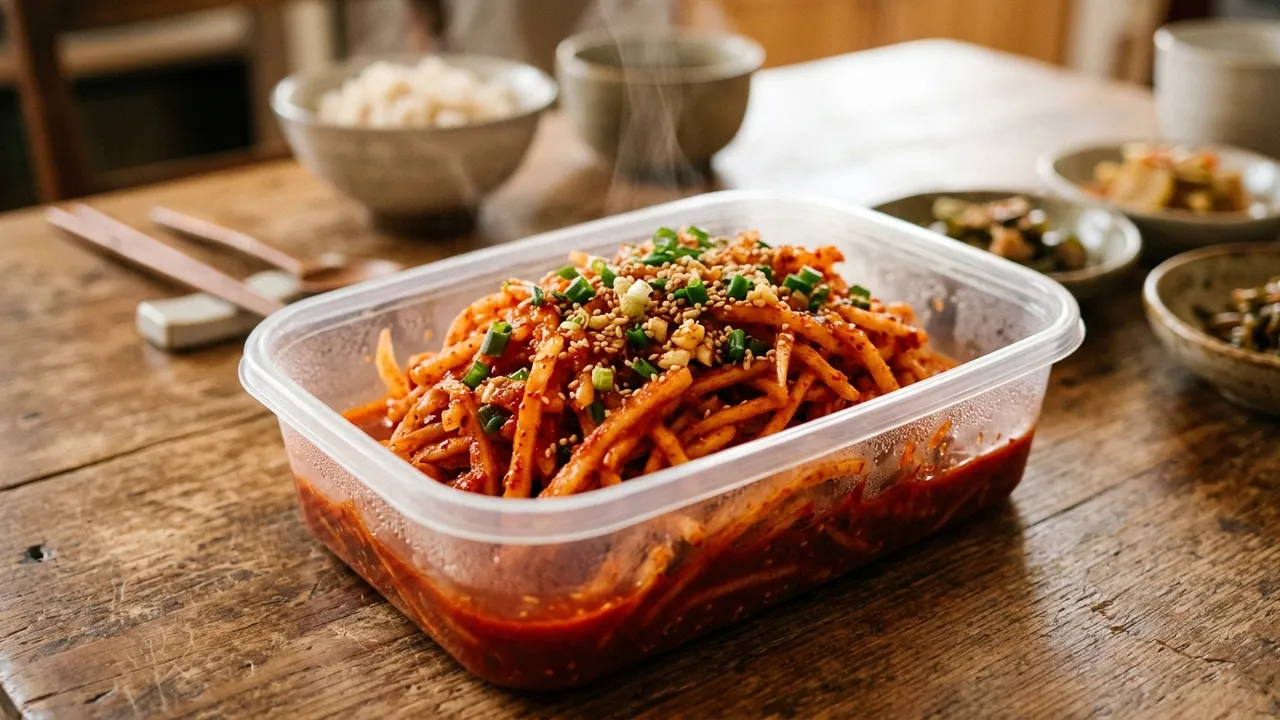
Bo Ssam-Style Mu Saengchae (Spicy Radish Salad) with 5-4-3-2
* 이미지는 AI가 생성한 참고 이미지로, 실제 조리 결과물과 다를 수 있습니다.
This special recipe from trot singer Lee Chan-won recreates the authentic taste of Bo Ssam (braised pork belly) restaurant-style Mu Saengchae using a 5-4-3-2-1 golden ratio seasoning and unique ingredient preparation methods. It features a clean, firm, and crisp texture.
📝 Editor's Notes
This 'Bo Ssam-Style Mu Saengchae (Spicy Radish Salad)', created with trot singer Lee Chan-won's special recipe, stands out with its 5-4-3-2-1 golden seasoning ratio and unique ingredient preparation.
A key feature is slicing the radish with a knife, unpeeled, to achieve a firm and crisp texture.
By using green onions instead of garlic, it gains a clean and refreshing flavor, boasting a delightful balance of sweet, sour, and savory tastes.
The difficulty level is easy, making it suitable for beginner cooks.
It's especially good when made with radishes in season during fall and winter, pairing wonderfully with Bo Ssam (braised pork belly), other meat dishes, or simply over warm rice.
While delicious freshly mixed, letting it mature for a day allows for an even deeper flavor, making it a truly appealing side dish.
🛒 Ingredient Tips
The key ingredient for this mu saengchae is 'Korean radish (mu)'.
Radishes in season during fall and winter are best; choose ones that are firm, glossy, have few fine roots, and feel heavy.
Since you'll be using the skin, it's important to thoroughly brush off any dirt and wash it meticulously.
Next, for 'green onion (daepa)', select fresh ones with vibrant green leaves and firm white parts.
A special feature of this recipe is using a generous amount of green onion instead of garlic for a refreshing and clean taste.
Finally, 'kkanari aekjeot (까나리 액젓)', or Korean sand lance fish sauce, adds a deep umami and refreshing touch to the mu saengchae.
While myeolchi aekjeot (멸치액젓), or anchovy sauce, is also good, kkanari aekjeot offers a cleaner flavor profile, so it's recommended to use it if possible.
Good ingredients make delicious mu saengchae.
🔄 Substitution Guide
In this recipe, you can substitute 'kkanari aekjeot (까나리 액젓)' with 'myeolchi aekjeot (멸치액젓)', or Korean anchovy sauce.
Myeolchi aekjeot has a deeper umami flavor and a stronger fermented aroma than kkanari aekjeot, so it's recommended to start with a slightly smaller amount than the recipe suggests and adjust to taste.
The refreshing flavor might be somewhat reduced.
Also, while using 'green onion (daepa)' instead of garlic is a distinctive feature of this recipe, if you prefer garlic flavor, you can add about 1 tbsp of minced garlic.
However, note that adding garlic will introduce a pungent garlic aroma instead of the clean, refreshing taste achieved with only green onions.
For sweetness, you can also use 'maesil-cheong (매실청)', or Korean green plum syrup, or 'oligosaccharide'.
Maesil-cheong adds a subtle sweetness and a tangy fruitiness, while oligosaccharide provides less sweetness than sugar and adds a glossy finish.
When substituting, the intensity of sweetness may vary, so it's important to taste and adjust the amount accordingly.
🥘 Ingredients
👨🍳 Cooking Points
To make this Bo Ssam-style mu saengchae delicious, you need to remember a few key points.
First, 'julienning the radish'.
Slicing it directly with a knife instead of using a mandoline helps the radish maintain its firm and crisp texture, preventing it from becoming mushy.
Using the skin also preserves nutrients and adds to the crunch, so be sure to use a knife.
Second, 'the order of salting the radish'.
First, mix with sugar to draw out moisture and impart sweetness, then add coarse sea salt to marinate.
This sequence prevents the radish from becoming tough and allows it to absorb the seasoning gently.
This order is crucial for the taste of the mu saengchae.
Third, 'the golden seasoning ratio'.
Be sure to follow the 5-4-3-2-1 ratio: 5 parts gochugaru (고춧가루), 4 parts sugar, 3 parts vinegar, 2 parts soy sauce, and 1 part fish sauce.
A key tip is to pour the vinegar, soy sauce, and fish sauce around the edges of the mu saengchae.
👨🍳 Directions
Wash the Korean radish (mu) thoroughly with a steel scourer, removing only the dirt. (There's no need to peel the skin.)
Slice one side of the round radish flat with a knife to stabilize it and prevent it from rolling.
Thinly slice the stabilized radish, then julienne it. (Slicing with a knife rather than a mandoline helps maintain the radish's firm and crisp texture, preventing it from becoming mushy.)
Add 4 tbsp of sugar to 1 lb 2 oz - 1 lb 5 oz (500-600g) of julienned radish and mix well.
Add 0.5 tbsp of coarse sea salt and mix the radish thoroughly again to salt and marinate it. (You can adjust the saltiness to your preference.)
Add 5 tbsp of gochugaru (고춧가루) to the marinated radish and mix until evenly coated in red. (You can add more for a deeper red color if desired.)
Add 3 tbsp of vinegar, then pour 2 tbsp of soy sauce around the edges of the radish salad.
Add 1 tbsp of kkanari aekjeot (까나리 액젓) and mix the radish again. (Using kkanari aekjeot adds a refreshing flavor.)
Finely chop 1 stalk of green onion (daepa), preparing it as a substitute for garlic.
Add a generous amount of the finely chopped green onion and mix well with the mu saengchae to finish.
💡 Tips
If the mu saengchae tastes bland, adjust the seasoning by adding a little more coarse sea salt to your preference.
Mu saengchae is delicious immediately after mixing, but if you let it age for about a day, it develops a richer, deeper Bo Ssam-style flavor as more liquid forms.
If not consuming immediately, cover the mu saengchae with plastic wrap and store it in a cool place or refrigerate to maintain its refreshing taste.
📦 Storage & Reuse
It's best to store the finished mu saengchae in an airtight container in the refrigerator.
While delicious immediately, refrigerating it for about a day allows the seasoning to penetrate deeper into the radish, enhancing the rich, Bo Ssam-style flavor.
When refrigerated, it's recommended to consume within 3-5 days.
Mu saengchae is a cold side dish, so it's good to take it out in advance before serving.
If you have any leftover mu saengchae, try mixing it with warm rice and sesame oil, or use it as an ingredient in kimchi jjigae (kimchi stew) or fried rice to add a tangy kick.
One batch of mu saengchae can be transformed into various delicious dishes.
🥢 Who This Is For
This Bo Ssam-style mu saengchae is a versatile side dish that complements any meal, thanks to its spicy, sweet, and refreshing flavor.
It's an especially fantastic pairing with meat dishes like Bo Ssam (braised pork belly), suyuk (boiled pork slices), or samgyeopsal (grilled pork belly), as it perfectly cuts through the richness of the meat.
It's also a delightful treat when simply mixed with warm rice, and it makes an excellent ingredient for bibimbap (mixed rice with vegetables and meat).
It's the perfect side dish to whet your appetite when you're not feeling hungry.
It's great for the whole family and impressive enough to serve to guests.
Be sure to try making it when radishes are in season.
🔥 Nutrition Info
This mu saengchae recipe yields approximately 4 servings.
Estimating per serving, you'd consume about 100-120 kcal, with an estimated 23g of carbohydrates, 3g of protein, and less than 1g of fat.
The main ingredient, radish, is rich in dietary fiber and vitamin C, aiding digestive health and boosting immunity.
Specifically, digestive enzymes like diastase and amylase found in radish help digest fatty foods.
Gochugaru (고춧가루) contains vitamin C and capsaicin, which can boost metabolism, and green onions provide vitamins, minerals, and allicin, contributing to immune system enhancement.
However, it's worth noting that the dish contains some sugar and sodium, so it's advisable to consume in moderation for health reasons.
💬 Frequently Asked Questions
- Q. What ingredients do I need for Bo Ssam-Style Mu Saengchae (Spicy Radish Salad) with 5-4-3-2-1 Golden Ratio Seasoning?
- Main ingredients include Korean Radish (mu), Sugar, Coarse Sea Salt, Gochugaru (고춧가루), Vinegar. The key ingredient for this mu saengchae is 'Korean radish (mu)'. Radishes in season during fall and winter are best; choose ones that are firm, glossy, have few fine roots, and feel heavy. Since you'll be using the skin, it's important to thoroughly brush off any dirt and wash it meticulously. Next, for 'green onion (daepa)', select fresh ones with vibrant green leaves and firm white parts. A special feature of this recipe is using a generous amount of green onion instead of garlic for a refreshing and clean taste. Finally, 'kkanari aekjeot (까나리 액젓)', or Korean sand lance fish sauce, adds a deep umami and refreshing touch to the mu saengchae. While myeolchi aekjeot (멸치액젓), or anchovy sauce, is also good, kkanari aekjeot offers a cleaner flavor profile, so it's recommended to use it if possible. Good ingredients make delicious mu saengchae.
- Q. What are the key tips for making Bo Ssam-Style Mu Saengchae (Spicy Radish Salad) with 5-4-3-2-1 Golden Ratio Seasoning?
- To make this Bo Ssam-style mu saengchae delicious, you need to remember a few key points. First, 'julienning the radish'. Slicing it directly with a knife instead of using a mandoline helps the radish maintain its firm and crisp texture, preventing it from becoming mushy. Using the skin also preserves nutrients and adds to the crunch, so be sure to use a knife. Second, 'the order of salting the radish'. First, mix with sugar to draw out moisture and impart sweetness, then add coarse sea salt to marinate. This sequence prevents the radish from becoming tough and allows it to absorb the seasoning gently. This order is crucial for the taste of the mu saengchae. Third, 'the golden seasoning ratio'. Be sure to follow the 5-4-3-2-1 ratio: 5 parts gochugaru (고춧가루), 4 parts sugar, 3 parts vinegar, 2 parts soy sauce, and 1 part fish sauce. A key tip is to pour the vinegar, soy sauce, and fish sauce around the edges of the mu saengchae.
- Q. How should I store leftover Bo Ssam-Style Mu Saengchae (Spicy Radish Salad) with 5-4-3-2-1 Golden Ratio Seasoning?
- It's best to store the finished mu saengchae in an airtight container in the refrigerator. While delicious immediately, refrigerating it for about a day allows the seasoning to penetrate deeper into the radish, enhancing the rich, Bo Ssam-style flavor. When refrigerated, it's recommended to consume within 3-5 days. Mu saengchae is a cold side dish, so it's good to take it out in advance before serving. If you have any leftover mu saengchae, try mixing it with warm rice and sesame oil, or use it as an ingredient in kimchi jjigae (kimchi stew) or fried rice to add a tangy kick. One batch of mu saengchae can be transformed into various delicious dishes.
- Q. How many calories are in Bo Ssam-Style Mu Saengchae (Spicy Radish Salad) with 5-4-3-2-1 Golden Ratio Seasoning?
- This mu saengchae recipe yields approximately 4 servings. Estimating per serving, you'd consume about 100-120 kcal, with an estimated 23g of carbohydrates, 3g of protein, and less than 1g of fat. The main ingredient, radish, is rich in dietary fiber and vitamin C, aiding digestive health and boosting immunity. Specifically, digestive enzymes like diastase and amylase found in radish help digest fatty foods. Gochugaru (고춧가루) contains vitamin C and capsaicin, which can boost metabolism, and green onions provide vitamins, minerals, and allicin, contributing to immune system enhancement. However, it's worth noting that the dish contains some sugar and sodium, so it's advisable to consume in moderation for health reasons.
- Q. Can I substitute ingredients in Bo Ssam-Style Mu Saengchae (Spicy Radish Salad) with 5-4-3-2-1 Golden Ratio Seasoning?
- In this recipe, you can substitute 'kkanari aekjeot (까나리 액젓)' with 'myeolchi aekjeot (멸치액젓)', or Korean anchovy sauce. Myeolchi aekjeot has a deeper umami flavor and a stronger fermented aroma than kkanari aekjeot, so it's recommended to start with a slightly smaller amount than the recipe suggests and adjust to taste. The refreshing flavor might be somewhat reduced. Also, while using 'green onion (daepa)' instead of garlic is a distinctive feature of this recipe, if you prefer garlic flavor, you can add about 1 tbsp of minced garlic. However, note that adding garlic will introduce a pungent garlic aroma instead of the clean, refreshing taste achieved with only green onions. For sweetness, you can also use 'maesil-cheong (매실청)', or Korean green plum syrup, or 'oligosaccharide'. Maesil-cheong adds a subtle sweetness and a tangy fruitiness, while oligosaccharide provides less sweetness than sugar and adds a glossy finish. When substituting, the intensity of sweetness may vary, so it's important to taste and adjust the amount accordingly.
💬 Comments
No comments yet. Be the first to comment!