
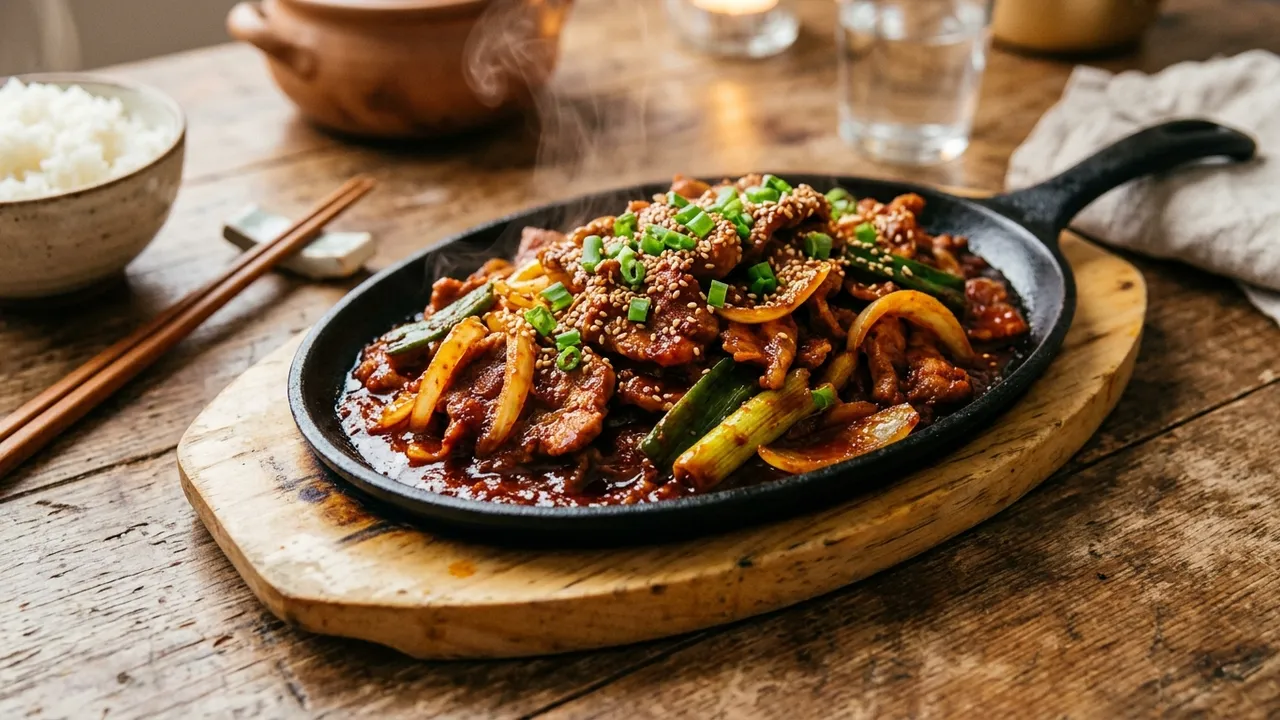
Curry Jeyuk-bokkeum (Spicy Pork Stir-fry) Recipe
* 이미지는 AI가 생성한 참고 이미지로, 실제 조리 결과물과 다를 수 있습니다.
A popular jeyuk-bokkeum (spicy pork stir-fry) recipe with added umami from curry powder.
📝 Editor's Notes
Today's 'Curry Jeyuk-bokkeum' is a unique twist on the popular spicy pork stir-fry, enhanced with the special umami and aroma of curry powder.
The spicy-sweet seasoning harmonizes with the rich curry flavor, offering a deeper and more diverse taste experience.
The cooking process is not overly complex, making it a medium-low difficulty dish suitable for beginner cooks.
It's perfect as a side dish with rice, an appetizer with drinks, or even a meal for guests.
The enticing curry aroma makes it enjoyable all year round.
If you're tired of plain jeyuk-bokkeum, try this recipe for a new culinary delight! 😋
🛒 Ingredient Tips
Pay attention to ingredient selection for delicious Curry Jeyuk-bokkeum!
🥩 First, pork shoulder with a moderate amount of fat is recommended.
Fresh pork shoulder should be bright pink, firm, and odorless.
If you don't prefer fatty cuts, leaner pork leg is also good, but the unique richness of pork shoulder particularly complements this dish.
Using freshly minced whole garlic instead of pre-minced garlic reduces moisture, resulting in a cleaner flavor for the jeyuk-bokkeum.
Finally, curry powder is the key to this dish; choose mild or spicy curry powder according to your preference to create your own unique Curry Jeyuk-bokkeum.
The freshness of spices greatly affects the taste, so it's best to use curry powder that hasn't been opened for too long! 🧅
🔄 Substitution Guide
If you don't have certain ingredients or have allergies, don't worry!
🔄 First, you can use boneless chicken thighs instead of pork shoulder.
Chicken thighs are less fatty and tender, suitable for those who prefer a milder flavor, but they may lack the unique richness of pork.
Adjust cooking time to be slightly shorter than for pork.
Second, if you don't have curry powder or dislike its aroma, you can omit it.
In this case, it will become a regular jeyuk-bokkeum, but you can still enjoy a delicious spicy flavor by adjusting the amounts of gochugaru (고춧가루) and gochujang (고추장).
Please note that the unique umami and aroma of curry may be reduced.
Third, instead of corn syrup or sugar, you can use oligosaccharide or honey.
Oligosaccharide is less sweet and rich in dietary fiber, while honey adds a healthy sweetness with its unique aroma.
However, since honey is quite sweet, it's best to use a slightly smaller amount. 🍯
🥘 Ingredients
👨🍳 Cooking Points
Here are the key points that determine the flavor of Curry Jeyuk-bokkeum.
🍳 First, the pork's initial seasoning and stir-frying order are crucial.
Thoroughly remove excess blood from the pork, then season it first with sugar and curry powder to remove any gamey smell and enhance its flavor.
After seasoning, heat cooking oil in a pan, stir-fry the garlic, then add the pork and continue stir-frying until enough moisture and fat have rendered out.
Second, the 'smoky flavor' (bulmat) is the essence of jeyuk-bokkeum!
Once the pork is fully cooked, add soy sauce over high heat and stir-fry until the soy sauce slightly caramelizes, imparting a charred flavor to the meat.
This process adds a deep umami and smoky aroma.
Third, the seasoning sauce and vegetables should be added later and stir-fried only briefly.
If you mix the sauce in advance, the meat will release too much water, and the vegetables will become mushy, losing their texture.
Add the large green onion at the very end and stir-fry lightly for about 1 minute to preserve its crisp texture and fresh color.
Remember these three tips, and you'll be able to make delicious Curry Jeyuk-bokkeum without fail! 🔥
👨🍳 Directions
Lightly pat dry 600g of pork shoulder with a paper towel to remove excess blood.
Place the patted-dry pork in a bowl, add 1 tbsp sugar and 1 tbsp curry powder, and gently massage and mix well for the first seasoning.
Slice 10 cloves of garlic and then finely mince them. Slice 1 onion into thick slices, not too thin. Cut off the root end of 1 large green onion, split it lengthwise in half, remove the tough core, and chop into large pieces.
In a bowl, combine 2 tbsp gochujang (고추장), 4 tbsp gochugaru (고춧가루), 2 tbsp cooking wine, 2 tbsp corn syrup, 1 tbsp black pepper, and 1 tbsp maesilaek (매실액), and mix well to make the seasoning sauce. (Soy sauce and sesame oil are used separately during cooking, not mixed into the sauce).
Heat 3 tbsp cooking oil in a pan over medium heat. Once the oil is hot, coat the bottom of the pan, then add the minced garlic and stir-fry until golden brown.
When the minced garlic turns golden, add the pre-seasoned pork and stir-fry thoroughly until enough moisture and fat have rendered out.
Once the pork is fully cooked, add 2 tbsp soy sauce over high heat and stir-fry until the soy sauce slightly caramelizes and imparts a smoky, charred flavor to the meat.
Next, add the sliced onion and the prepared seasoning sauce. Stir-fry briefly to coat the pork with the sauce.
Finally, add the coarsely chopped large green onion and stir-fry lightly for just 1 minute more.
Immediately turn off the heat, add 1 tbsp sesame oil, and stir-fry lightly with the residual heat to enhance the flavor.
Sprinkle with sesame seeds and serve.
💡 Tips
Pork shoulder with a moderate amount of fat is recommended for the pork. If you dislike fatty cuts, pork leg can also be used.
Using freshly minced whole garlic instead of pre-minced garlic reduces moisture in the jeyuk-bokkeum, resulting in a more delicious dish.
When making jeyuk-bokkeum, do not marinate the meat with the sauce in advance. Instead, stir-fry the pork first, then add the sauce later and stir-fry briefly for a better taste.
Curry powder, a key ingredient in this dish, simultaneously enhances the spicy flavor, curry aroma, and umami.
Do not stir-fry the large green onion for too long; add it coarsely chopped at the end to preserve its color and texture.
Sesame oil should be added after turning off the heat and lightly tossed with the residual heat to achieve the best aroma.
📦 Storage & Reuse
If you have leftover Curry Jeyuk-bokkeum, store it properly to enjoy it longer!
🧊 The finished jeyuk-bokkeum can be stored in an airtight container in the refrigerator for 2-3 days.
If you wish to store it for a longer period, divide it into single-serving portions and freeze them.
When frozen, it is recommended to consume within 1-2 weeks.
To reheat after thawing, microwave it for a moist texture, or gently stir-fry it in a pan over low heat to evaporate some moisture, which will make it richer and more delicious.
Leftover jeyuk-bokkeum is also delicious as a rice bowl topping with warm rice the next day, or stir-fried with kimchi to make kimchi fried rice. 🍚
🥢 Who This Is For
This Curry Jeyuk-bokkeum is highly recommended for those who enjoy a spicy dish with a subtle curry aroma!
👨👩👧👦 It's perfect when you're tired of regular jeyuk-bokkeum and want a special meal.
For children, adjust the amounts of curry powder and gochugaru (고춧가루) to make it less spicy, creating a delicious treat for the whole family.
Serve it generously over warm white rice as a rice bowl, or wrap it in fresh lettuce for an even more delightful experience.
Pairing it with a refreshing bean sprout soup or soft steamed egg (gyeran-jjim) creates a fantastic combination.
It makes an impressive main dish for camping trips or when entertaining guests! 🏕️
🔥 Nutrition Info
Based on 600g of pork shoulder divided into 4 servings, Curry Jeyuk-bokkeum is estimated to provide approximately 530-580 kcal per serving.
Each serving offers about 30g of protein, 30-35g of fat, and 25-30g of carbohydrates.
Pork, the main ingredient, is rich in high-quality protein, B vitamins (which help with fatigue recovery), and iron, making it excellent for boosting energy.
Vegetables such as onions, garlic, and large green onions provide dietary fiber, vitamin C, and antioxidants.
Particularly, curcumin in the turmeric found in curry powder may offer beneficial anti-inflammatory effects.
However, due to seasonings like gochujang (고추장) and soy sauce, the sodium content can be relatively high.
Individuals with high blood pressure are advised to adjust the amount of seasoning or add more vegetables to maintain balance. 🍎
💬 Frequently Asked Questions
- Q. What ingredients do I need for Curry Jeyuk-bokkeum (Spicy Pork Stir-fry)?
- Main ingredients include Pork shoulder, Onion, Garlic cloves, Large green onion, Sugar. Pay attention to ingredient selection for delicious Curry Jeyuk-bokkeum! 🥩 First, pork shoulder with a moderate amount of fat is recommended. Fresh pork shoulder should be bright pink, firm, and odorless. If you don't prefer fatty cuts, leaner pork leg is also good, but the unique richness of pork shoulder particularly complements this dish. Using freshly minced whole garlic instead of pre-minced garlic reduces moisture, resulting in a cleaner flavor for the jeyuk-bokkeum. Finally, curry powder is the key to this dish; choose mild or spicy curry powder according to your preference to create your own unique Curry Jeyuk-bokkeum. The freshness of spices greatly affects the taste, so it's best to use curry powder that hasn't been opened for too long! 🧅
- Q. What are the key tips for making Curry Jeyuk-bokkeum (Spicy Pork Stir-fry)?
- Here are the key points that determine the flavor of Curry Jeyuk-bokkeum. 🍳 First, the pork's initial seasoning and stir-frying order are crucial. Thoroughly remove excess blood from the pork, then season it first with sugar and curry powder to remove any gamey smell and enhance its flavor. After seasoning, heat cooking oil in a pan, stir-fry the garlic, then add the pork and continue stir-frying until enough moisture and fat have rendered out. Second, the 'smoky flavor' (bulmat) is the essence of jeyuk-bokkeum! Once the pork is fully cooked, add soy sauce over high heat and stir-fry until the soy sauce slightly caramelizes, imparting a charred flavor to the meat. This process adds a deep umami and smoky aroma. Third, the seasoning sauce and vegetables should be added later and stir-fried only briefly. If you mix the sauce in advance, the meat will release too much water, and the vegetables will become mushy, losing their texture. Add the large green onion at the very end and stir-fry lightly for about 1 minute to preserve its crisp texture and fresh color. Remember these three tips, and you'll be able to make delicious Curry Jeyuk-bokkeum without fail! 🔥
- Q. How should I store leftover Curry Jeyuk-bokkeum (Spicy Pork Stir-fry)?
- If you have leftover Curry Jeyuk-bokkeum, store it properly to enjoy it longer! 🧊 The finished jeyuk-bokkeum can be stored in an airtight container in the refrigerator for 2-3 days. If you wish to store it for a longer period, divide it into single-serving portions and freeze them. When frozen, it is recommended to consume within 1-2 weeks. To reheat after thawing, microwave it for a moist texture, or gently stir-fry it in a pan over low heat to evaporate some moisture, which will make it richer and more delicious. Leftover jeyuk-bokkeum is also delicious as a rice bowl topping with warm rice the next day, or stir-fried with kimchi to make kimchi fried rice. 🍚
- Q. How many calories are in Curry Jeyuk-bokkeum (Spicy Pork Stir-fry)?
- Based on 600g of pork shoulder divided into 4 servings, Curry Jeyuk-bokkeum is estimated to provide approximately 530-580 kcal per serving. Each serving offers about 30g of protein, 30-35g of fat, and 25-30g of carbohydrates. Pork, the main ingredient, is rich in high-quality protein, B vitamins (which help with fatigue recovery), and iron, making it excellent for boosting energy. Vegetables such as onions, garlic, and large green onions provide dietary fiber, vitamin C, and antioxidants. Particularly, curcumin in the turmeric found in curry powder may offer beneficial anti-inflammatory effects. However, due to seasonings like gochujang (고추장) and soy sauce, the sodium content can be relatively high. Individuals with high blood pressure are advised to adjust the amount of seasoning or add more vegetables to maintain balance. 🍎
- Q. Can I substitute ingredients in Curry Jeyuk-bokkeum (Spicy Pork Stir-fry)?
- If you don't have certain ingredients or have allergies, don't worry! 🔄 First, you can use boneless chicken thighs instead of pork shoulder. Chicken thighs are less fatty and tender, suitable for those who prefer a milder flavor, but they may lack the unique richness of pork. Adjust cooking time to be slightly shorter than for pork. Second, if you don't have curry powder or dislike its aroma, you can omit it. In this case, it will become a regular jeyuk-bokkeum, but you can still enjoy a delicious spicy flavor by adjusting the amounts of gochugaru (고춧가루) and gochujang (고추장). Please note that the unique umami and aroma of curry may be reduced. Third, instead of corn syrup or sugar, you can use oligosaccharide or honey. Oligosaccharide is less sweet and rich in dietary fiber, while honey adds a healthy sweetness with its unique aroma. However, since honey is quite sweet, it's best to use a slightly smaller amount. 🍯

💬 Comments
No comments yet. Be the first to comment!