
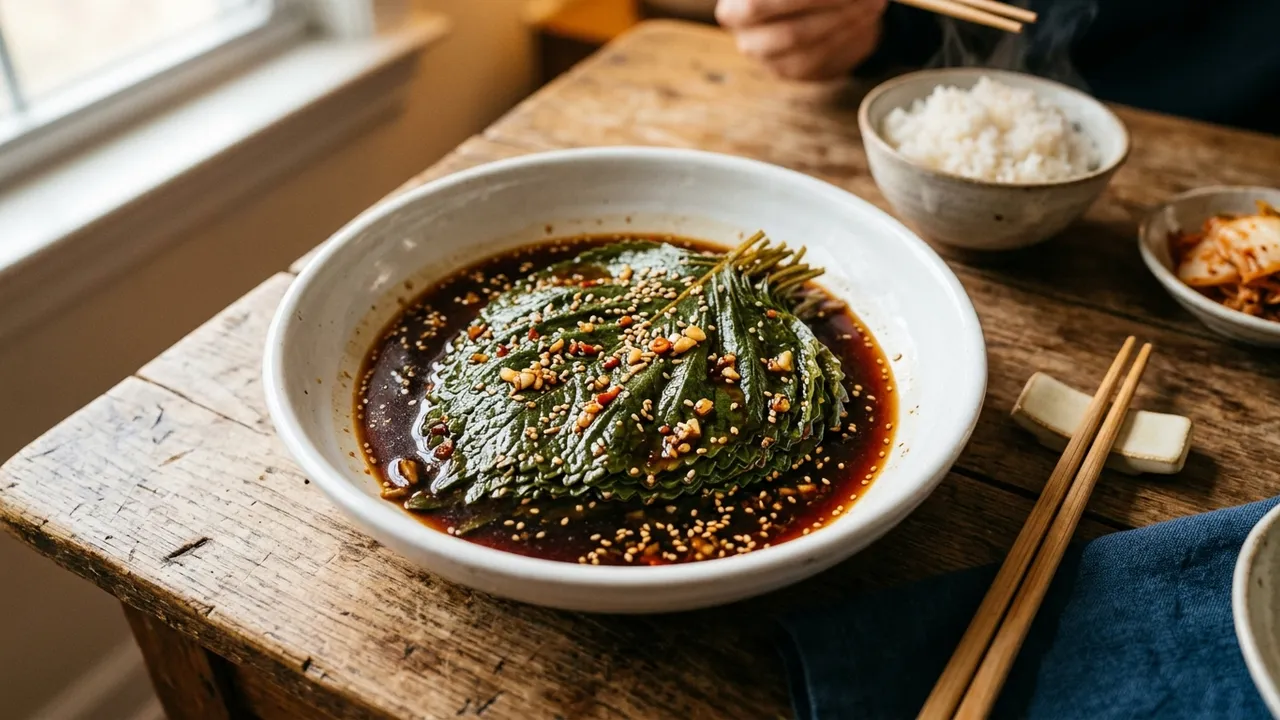
No-Boil Perilla Leaf Pickles (Kkaennip Jangajji) Recipe
* 이미지는 AI가 생성한 참고 이미지로, 실제 조리 결과물과 다를 수 있습니다.
A fragrant and savory perilla leaf pickle (kkaennip jangajji) that stimulates your appetite. This incredibly simple, versatile banchan (side dish) can be made without boiling, tastes delicious, and can be stored for a long time.
📝 Editor's Notes
This perilla leaf pickle (kkaennip jangajji) recipe is notably simple to make, as it requires no boiling.
The fragrant flavor of perilla leaves combined with the savory soy sauce dressing creates a 'rice thief' (bap-doduk) that will surely bring back your lost appetite.
The cooking process is not complicated, making it easy for beginner cooks to try.
It's especially perfect as a refreshing banchan (side dish) when you lack appetite during hot summer days.
Easy to make and long-lasting, it's practical and will be a reliable banchan once prepared.
The difficulty level can be considered 'low'.
🛒 Ingredient Tips
For the star ingredient of this recipe, perilla leaves (kkaennip), it's important to choose those with a strong aroma and clean leaves.
Not too large or tough, tender and soft leaves will have a good texture when pickled.
Stems that are not withered and have a vibrant green color are signs of fresh perilla leaves.
Cheongyang chili peppers (cheongyang-gochu) add a spicy kick to stimulate the appetite, so choose fresh, firm, and glossy ones.
Korean plum extract (maesilaek) adds a deep flavor and aroma, so using a trusted quality product will yield even better results.
🔄 Substitution Guide
If perilla leaves are unavailable, you can make jangajji using lettuce, cabbage, or napa cabbage.
While you won't get the unique fragrance of perilla leaves, you can enjoy a different charm with a crisp texture.
Instead of Korean plum extract (maesilaek), you can use corn syrup, oligosaccharide, or simply increase the amount of sugar.
Korean plum extract adds a deep sweetness and aroma, but if substituting with other sweeteners, adjust the type and concentration of sweetness accordingly.
If Cheongyang chili peppers (cheongyang-gochu) are too spicy for you, feel free to use regular green peppers or crunchy chili peppers.
This will reduce the spiciness but still add a fresh chili aroma.
🥘 Ingredients
👨🍳 Cooking Points
The key to this pickle is to completely remove moisture from the perilla leaves.
Pressing them firmly with paper towels is essential for long-term storage without mold and for the pickling sauce to permeate evenly.
Next, when layering the perilla leaves in the container, it's crucial to alternate the direction of each layer and pack them tightly.
This prevents the leaves from floating and ensures uniform pickling and flavor.
Finally, after pouring in the pickling sauce, remember to press down the perilla leaves with a pressing stone or a small plate.
This step ensures the leaves are not exposed to air and pickle deliciously.
👨🍳 Directions
When you go to the market, a bundle of perilla leaves usually contains about 12 leaves. Prepare 15 bundles (approximately 200 leaves, 470g) and trim about half of the stems. Do not cut off the entire stem.
To thoroughly wash the prepped perilla leaves, pour 5 L of water into a bowl, add 5 tbsp of vinegar, and soak the perilla leaves completely for 10 minutes.
After 10 minutes, do not pick up the perilla leaves one by one. Instead, hold them in bunches, gently rinse them under running water to remove fine hairs, shake off excess water, and drain them in a colander.
In a bowl for making the pickling sauce, add 200 ml (1 cup) of Korean plum extract (maesilaek), 100 ml of soy sauce (jin-ganjang), 100 ml (1/2 cup) of anchovy sauce (myeolchi-aekjeot), 100 ml of brewed vinegar, and 1 tbsp of white sugar. Mix well until the sugar is completely dissolved.
Press the perilla leaves firmly with paper towels to remove all moisture. Then, layer the perilla leaves in a container, alternating the direction of each layer, packing them tightly.
Place the sliced Cheongyang chili peppers (cheongyang-gochu) on top of the perilla leaves, according to your preference. Pour the prepared pickling sauce over the perilla leaves until they are fully submerged. (Even if the sauce seems insufficient, it will become ample as moisture is released from the perilla leaves.)
If you don't have a specialized press container, place a clean small plate on top of the perilla leaves to keep them submerged and ensure even pickling.
For the finished perilla leaf pickles (kkaennip jangajji), leave them at room temperature for half a day to a full day (especially in summer), then store them in the refrigerator. Enjoy them with warm rice once they have sufficiently marinated.
💡 Tips
Cutting the perilla stems too short can make them uncomfortable to eat. It's best to trim only about half of the stem.
Soaking the perilla leaves in vinegar water for 10 minutes during washing helps remove fine hairs and sterilizes them, allowing for a cleaner enjoyment.
Since the pickling sauce doesn't contain water, there's no need to boil it, making it easy to prepare and store for a long time.
Thoroughly removing moisture from the perilla leaves and layering them in alternating directions, then pressing them down, prevents the leaves from floating and allows the pickling sauce to permeate evenly.
📦 Storage & Reuse
After allowing the finished perilla leaf pickles (kkaennip jangajji) to marinate at room temperature for half a day to a full day, they must be stored in the refrigerator.
Since the pickling sauce is uncooked, maintaining freshness is crucial.
When refrigerated, you can enjoy them deliciously for about two weeks to a month.
To prevent spoilage and ensure long-term storage, the perilla leaves must be fully submerged in the pickling sauce; occasionally press them down to prevent them from floating.
They are best enjoyed cold, without reheating.
You can also use any leftover pickling sauce to make other jangajji with ingredients like radish or cucumber.
🥢 Who This Is For
This perilla leaf pickle (kkaennip jangajji) is a versatile banchan (side dish) that's great to serve when you have no appetite or when you're short on side dishes.
It pairs particularly well with Korean meals where a fragrant aroma is desired, and when served with meat dishes like samgyeopsal (grilled pork belly) or suyuk (boiled pork slices), it cuts through the richness, allowing for a more enjoyable flavor.
I recommend it for students living alone or busy professionals, as it's easy to make and can be enjoyed for a long time.
Simply place a piece on warm white rice, and it truly becomes a 'rice thief' (bap-doduk).
🔥 Nutrition Info
This perilla leaf pickle (kkaennip jangajji) is relatively low in calories, consisting mainly of perilla leaves and seasoning.
Based on the total quantity, it is estimated to be approximately 500-600 kcal, and for a single serving (about 10 perilla leaves), it would be around 25-30 kcal.
Carbohydrates primarily come from the Korean plum extract (maesilaek) and sugar, while protein and fat content are very low.
Perilla leaves themselves are rich in vitamins A, C, and K, and also contain significant amounts of iron, calcium, and dietary fiber, making them a very beneficial ingredient for health.
However, due to the use of soy sauce and anchovy sauce (myeolchi-aekjeot), the sodium content may be somewhat high, so it is advisable to consume in moderation.
💬 Frequently Asked Questions
- Q. What ingredients do I need for No-Boil Perilla Leaf Pickles (Kkaennip Jangajji)?
- Main ingredients include Perilla leaves (kkaennip), Cheongyang chili peppers (cheongyang-gochu), Korean plum extract (maesilaek), Soy sauce (jin-ganjang), Anchovy sauce (myeolchi-aekjeot). For the star ingredient of this recipe, perilla leaves (kkaennip), it's important to choose those with a strong aroma and clean leaves. Not too large or tough, tender and soft leaves will have a good texture when pickled. Stems that are not withered and have a vibrant green color are signs of fresh perilla leaves. Cheongyang chili peppers (cheongyang-gochu) add a spicy kick to stimulate the appetite, so choose fresh, firm, and glossy ones. Korean plum extract (maesilaek) adds a deep flavor and aroma, so using a trusted quality product will yield even better results.
- Q. What are the key tips for making No-Boil Perilla Leaf Pickles (Kkaennip Jangajji)?
- The key to this pickle is to completely remove moisture from the perilla leaves. Pressing them firmly with paper towels is essential for long-term storage without mold and for the pickling sauce to permeate evenly. Next, when layering the perilla leaves in the container, it's crucial to alternate the direction of each layer and pack them tightly. This prevents the leaves from floating and ensures uniform pickling and flavor. Finally, after pouring in the pickling sauce, remember to press down the perilla leaves with a pressing stone or a small plate. This step ensures the leaves are not exposed to air and pickle deliciously.
- Q. How should I store leftover No-Boil Perilla Leaf Pickles (Kkaennip Jangajji)?
- After allowing the finished perilla leaf pickles (kkaennip jangajji) to marinate at room temperature for half a day to a full day, they must be stored in the refrigerator. Since the pickling sauce is uncooked, maintaining freshness is crucial. When refrigerated, you can enjoy them deliciously for about two weeks to a month. To prevent spoilage and ensure long-term storage, the perilla leaves must be fully submerged in the pickling sauce; occasionally press them down to prevent them from floating. They are best enjoyed cold, without reheating. You can also use any leftover pickling sauce to make other jangajji with ingredients like radish or cucumber.
- Q. How many calories are in No-Boil Perilla Leaf Pickles (Kkaennip Jangajji)?
- This perilla leaf pickle (kkaennip jangajji) is relatively low in calories, consisting mainly of perilla leaves and seasoning. Based on the total quantity, it is estimated to be approximately 500-600 kcal, and for a single serving (about 10 perilla leaves), it would be around 25-30 kcal. Carbohydrates primarily come from the Korean plum extract (maesilaek) and sugar, while protein and fat content are very low. Perilla leaves themselves are rich in vitamins A, C, and K, and also contain significant amounts of iron, calcium, and dietary fiber, making them a very beneficial ingredient for health. However, due to the use of soy sauce and anchovy sauce (myeolchi-aekjeot), the sodium content may be somewhat high, so it is advisable to consume in moderation.
- Q. Can I substitute ingredients in No-Boil Perilla Leaf Pickles (Kkaennip Jangajji)?
- If perilla leaves are unavailable, you can make jangajji using lettuce, cabbage, or napa cabbage. While you won't get the unique fragrance of perilla leaves, you can enjoy a different charm with a crisp texture. Instead of Korean plum extract (maesilaek), you can use corn syrup, oligosaccharide, or simply increase the amount of sugar. Korean plum extract adds a deep sweetness and aroma, but if substituting with other sweeteners, adjust the type and concentration of sweetness accordingly. If Cheongyang chili peppers (cheongyang-gochu) are too spicy for you, feel free to use regular green peppers or crunchy chili peppers. This will reduce the spiciness but still add a fresh chili aroma.
💬 Comments
No comments yet. Be the first to comment!