
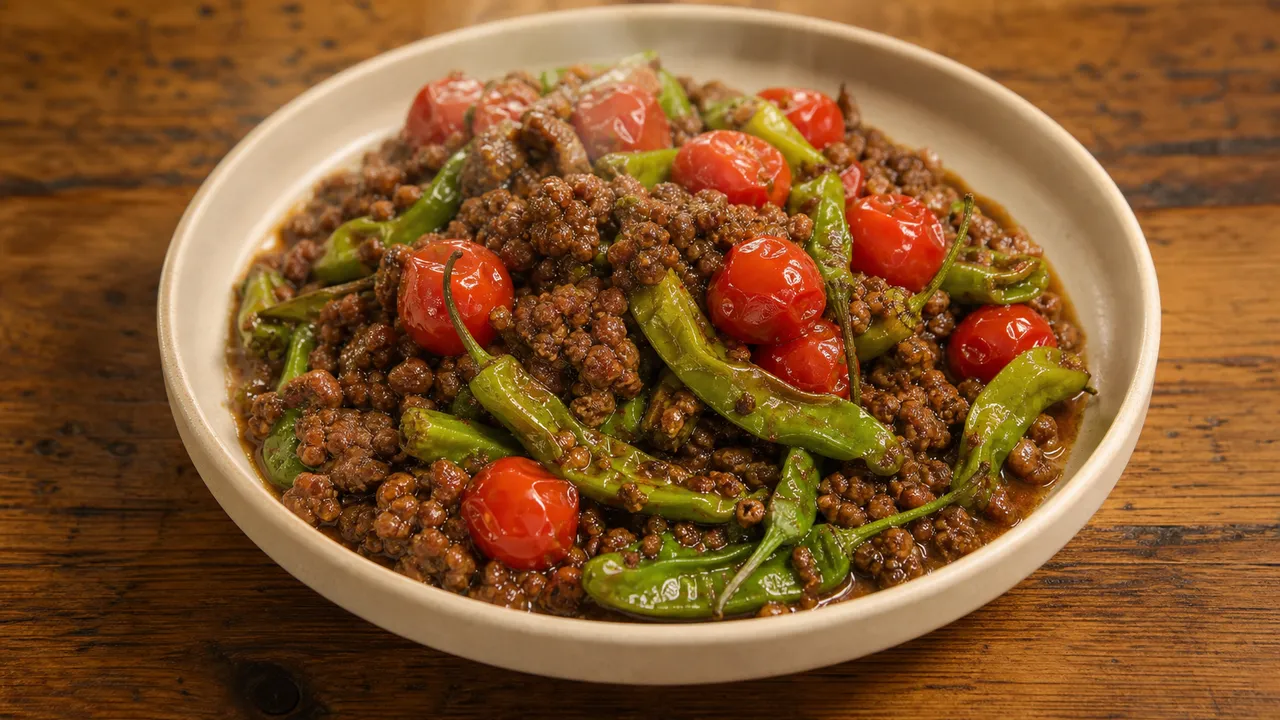
Beef Soboro Jangjorim (장조림): The Ultimate 'Rice Thief' Side
* 이미지는 AI가 생성한 참고 이미지로, 실제 조리 결과물과 다를 수 있습니다.
This recipe for Soboro Jangjorim (장조림) uses ground beef, quail eggs, and shishito peppers to create a versatile side dish so delicious, it's a true 'rice thief.' With steps for draining blood from the beef, pre-seasoning the meat, and a perfect golden ratio for the braising sauce, you'll effortlessly achieve a hearty and satisfying meal.
📝 Editor's Notes
This Beef Soboro Jangjorim (장조림), combining ground beef, quail eggs, and shishito peppers (꽈리고추), creates a 'rice thief' side dish that takes about 40 minutes to complete, making it a medium-difficulty dish.
The savory yet sweet soy sauce marinade deeply permeates the flavorful soboro beef and chewy quail eggs, making it a beloved dish for all ages.
The addition of spicy shishito and Cheongyang chili peppers (청양고추) ensures a clean taste without any greasiness, making it perfect as a hearty home-cooked side dish for crisp autumn days or chilly winters.
Serve generously over warm white rice, and you won't envy any other side dish.
🛒 Ingredient Tips
Freshness is paramount for ground beef.
Choose beef that has a vibrant red color, a glossy sheen, and no off-smell.
Opting for a cut that isn't too fatty will result in a cleaner 'soboro' texture when stir-fried.
For quail eggs, select those with unbroken, smooth shells.
Using pre-boiled and peeled quail eggs can shorten cooking time.
Shishito peppers (꽈리고추) should be young, tender, not too large, and have a vibrant green color without blemishes.
Seasonal shishito peppers have a much superior aroma and flavor, so keep that in mind.
🔄 Substitution Guide
You can substitute ground beef with ground pork.
Pork is often more affordable and readily available than beef, and its rich, savory flavor offers a different appeal.
However, pork can be higher in fat, so you might want to drain off some excess fat while cooking or blot it with a paper towel.
Instead of shishito peppers (꽈리고추), you can use 'Asagigochu (아삭이고추)' (a milder, crunchy Korean pepper) or bell peppers, but you might miss the unique aroma and subtle heat of shishito peppers.
If using boiled eggs instead of quail eggs, they will be more filling, but the cooking time may increase, and it will take longer for the seasoning to fully penetrate the eggs.
🥘 Ingredients
👨🍳 Cooking Points
There are three key cooking points for this recipe.
First, never forget to remove the blood from the ground beef.
Pressing it firmly with paper towels to completely remove the blood is essential for a clean taste without any gamey odor.
Second, stir-frying the ground beef without oil over high heat (medium heat for induction cooktops), breaking it apart with a spatula, is crucial for achieving the fluffy, crumbly 'soboro' texture.
Cook until the liquid has completely evaporated and the meat is light and airy.
Third, braise the quail eggs in the sauce first over high heat.
This ensures the soy sauce evenly penetrates the quail eggs, giving them a beautiful color and a chewy, flavorful texture.
Keep these three points in mind, and you'll be able to make delicious Jangjorim (장조림) without fail.
👨🍳 Directions
First, spread 7 oz (200g) of ground beef on a paper towel, cover with another paper towel, and press firmly to remove blood. Replace with a fresh paper towel if blood seeps out, and let sit for about 10 minutes.
Wash 3.5 oz (100g) of shishito peppers (꽈리고추) thoroughly without removing the stems. After washing, remove the stems and cut them into bite-sized pieces.
Prepare 2 Cheongyang chili peppers (청양고추) to add spiciness. You can adjust the amount or omit them depending on your preference. Slice the Cheongyang chili peppers thinly and remove the seeds.
To the drained ground beef, add all the meat seasoning ingredients (1 tbsp soy sauce, ½ tbsp brown sugar, 2 tbsp mirin (맛술), 1 tbsp minced garlic, ½ tbsp sesame oil, a pinch of black pepper). Mix thoroughly and knead well to ensure the seasoning is fully absorbed.
Without oil, add the seasoned meat to a pan. Stir-fry over high heat (medium heat for induction cooktops), breaking it apart with a spatula until it forms a crumbly, 'soboro' texture. Continue to cook until the liquid has evaporated and the meat is fluffy. Turn off the heat and transfer to a plate.
Without washing the pan used for the meat, immediately add the braising sauce ingredients (3 tbsp soy sauce, 1 tbsp tuna sauce (참치액), 1 tbsp brown sugar, 2 tbsp mirin (맛술)). Turn the heat to high and add 10.5 oz (300g) of quail eggs, then braise. Cook until the soy sauce is deeply absorbed by the quail eggs and they have a dark, glossy color. When the braising liquid has reduced by half, add ¾ cup (200ml) of water and continue to braise over high heat until the water has again reduced by about half. Large bubbles indicate that it's well-braised.
To the braised quail eggs, add the stir-fried ground beef and thinly sliced Cheongyang chili peppers (청양고추). Stir once. Reduce the heat to medium and continue to braise until most of the liquid has evaporated.
Optionally, add 1 tbsp of corn syrup (물엿) to adjust glossiness and sweetness to your preference.
Finally, add the sliced shishito peppers (꽈리고추) and stir once over high heat before turning off the stove. The residual heat will be sufficient to cook the shishito peppers.
💡 Tips
To prevent gamey odors and ensure a clean taste, it's crucial to spread the ground beef on paper towels and press firmly to completely remove all blood.
Wash shishito peppers (꽈리고추) without removing the stems. This prevents water from entering the peppers and altering their flavor.
To achieve a fluffy, crumbly 'soboro' texture for the ground beef, stir-fry it without oil over high heat (medium heat for induction cooktops), breaking it apart with a spatula.
Braising the quail eggs in the sauce first over high heat allows them to absorb the soy sauce deeply, resulting in a beautiful color and a chewy, flavorful texture throughout.
📦 Storage & Reuse
Store the finished Beef Soboro Jangjorim (장조림) in an airtight container in the refrigerator for 3-4 days.
For longer storage, divide it into portions and freeze for up to about 2 weeks.
When ready to eat, thaw in the refrigerator, reheat in the microwave for 2-3 minutes, or gently simmer in a pot over low heat until warm.
Leftover Jangjorim can also be stir-fried into kimchi fried rice or used as a filling for rice balls for another delicious meal.
🥢 Who This Is For
This Beef Soboro Jangjorim (장조림) will be an excellent side dish for growing children or busy professionals who need a hearty meal.
Served over warm rice, it makes a complete and satisfying meal even without other side dishes.
It's especially delicious when wrapped in gim (김) (seaweed sheets) or paired with warm bean sprout soup (kongnamul-guk, 콩나물국) or seaweed soup (miyeok-guk, 미역국) for a more harmonious meal.
With its appealing look and delicious taste, it's a dish worthy of praise, even when served to guests.
🔥 Nutrition Info
Estimated for approximately 4 servings, one serving of this Beef Soboro Jangjorim (장조림) is about 350-400 kcal.
It provides approximately 25-30g of protein, 20-25g of fat, and 15-20g of carbohydrates.
Beef is rich in high-quality protein, iron, and zinc, helping to prevent anemia and boost immunity.
Quail eggs are abundant in vitamins A and B, and choline, while shishito peppers (꽈리고추) are high in vitamin C, all contributing to a balanced diet.
However, the sodium content may be somewhat high, so adjust the amount of soy sauce during cooking or, for those who prefer less salt, use more corn syrup (물엿) to balance the sweetness.
💬 Frequently Asked Questions
- Q. What ingredients do I need for Beef Soboro Jangjorim (장조림): The Ultimate 'Rice Thief' Side Dish Recipe?
- Main ingredients include Ground Beef, Quail Eggs, Shishito Peppers (꽈리고추), Cheongyang Chili Peppers (청양고추), Corn Syrup (물엿) (adjust sweetness to taste). Freshness is paramount for ground beef. Choose beef that has a vibrant red color, a glossy sheen, and no off-smell. Opting for a cut that isn't too fatty will result in a cleaner 'soboro' texture when stir-fried. For quail eggs, select those with unbroken, smooth shells. Using pre-boiled and peeled quail eggs can shorten cooking time. Shishito peppers (꽈리고추) should be young, tender, not too large, and have a vibrant green color without blemishes. Seasonal shishito peppers have a much superior aroma and flavor, so keep that in mind.
- Q. What are the key tips for making Beef Soboro Jangjorim (장조림): The Ultimate 'Rice Thief' Side Dish Recipe?
- There are three key cooking points for this recipe. First, never forget to remove the blood from the ground beef. Pressing it firmly with paper towels to completely remove the blood is essential for a clean taste without any gamey odor. Second, stir-frying the ground beef without oil over high heat (medium heat for induction cooktops), breaking it apart with a spatula, is crucial for achieving the fluffy, crumbly 'soboro' texture. Cook until the liquid has completely evaporated and the meat is light and airy. Third, braise the quail eggs in the sauce first over high heat. This ensures the soy sauce evenly penetrates the quail eggs, giving them a beautiful color and a chewy, flavorful texture. Keep these three points in mind, and you'll be able to make delicious Jangjorim (장조림) without fail.
- Q. How should I store leftover Beef Soboro Jangjorim (장조림): The Ultimate 'Rice Thief' Side Dish Recipe?
- Store the finished Beef Soboro Jangjorim (장조림) in an airtight container in the refrigerator for 3-4 days. For longer storage, divide it into portions and freeze for up to about 2 weeks. When ready to eat, thaw in the refrigerator, reheat in the microwave for 2-3 minutes, or gently simmer in a pot over low heat until warm. Leftover Jangjorim can also be stir-fried into kimchi fried rice or used as a filling for rice balls for another delicious meal.
- Q. How many calories are in Beef Soboro Jangjorim (장조림): The Ultimate 'Rice Thief' Side Dish Recipe?
- Estimated for approximately 4 servings, one serving of this Beef Soboro Jangjorim (장조림) is about 350-400 kcal. It provides approximately 25-30g of protein, 20-25g of fat, and 15-20g of carbohydrates. Beef is rich in high-quality protein, iron, and zinc, helping to prevent anemia and boost immunity. Quail eggs are abundant in vitamins A and B, and choline, while shishito peppers (꽈리고추) are high in vitamin C, all contributing to a balanced diet. However, the sodium content may be somewhat high, so adjust the amount of soy sauce during cooking or, for those who prefer less salt, use more corn syrup (물엿) to balance the sweetness.
- Q. Can I substitute ingredients in Beef Soboro Jangjorim (장조림): The Ultimate 'Rice Thief' Side Dish Recipe?
- You can substitute ground beef with ground pork. Pork is often more affordable and readily available than beef, and its rich, savory flavor offers a different appeal. However, pork can be higher in fat, so you might want to drain off some excess fat while cooking or blot it with a paper towel. Instead of shishito peppers (꽈리고추), you can use 'Asagigochu (아삭이고추)' (a milder, crunchy Korean pepper) or bell peppers, but you might miss the unique aroma and subtle heat of shishito peppers. If using boiled eggs instead of quail eggs, they will be more filling, but the cooking time may increase, and it will take longer for the seasoning to fully penetrate the eggs.
💬 Comments
No comments yet. Be the first to comment!