
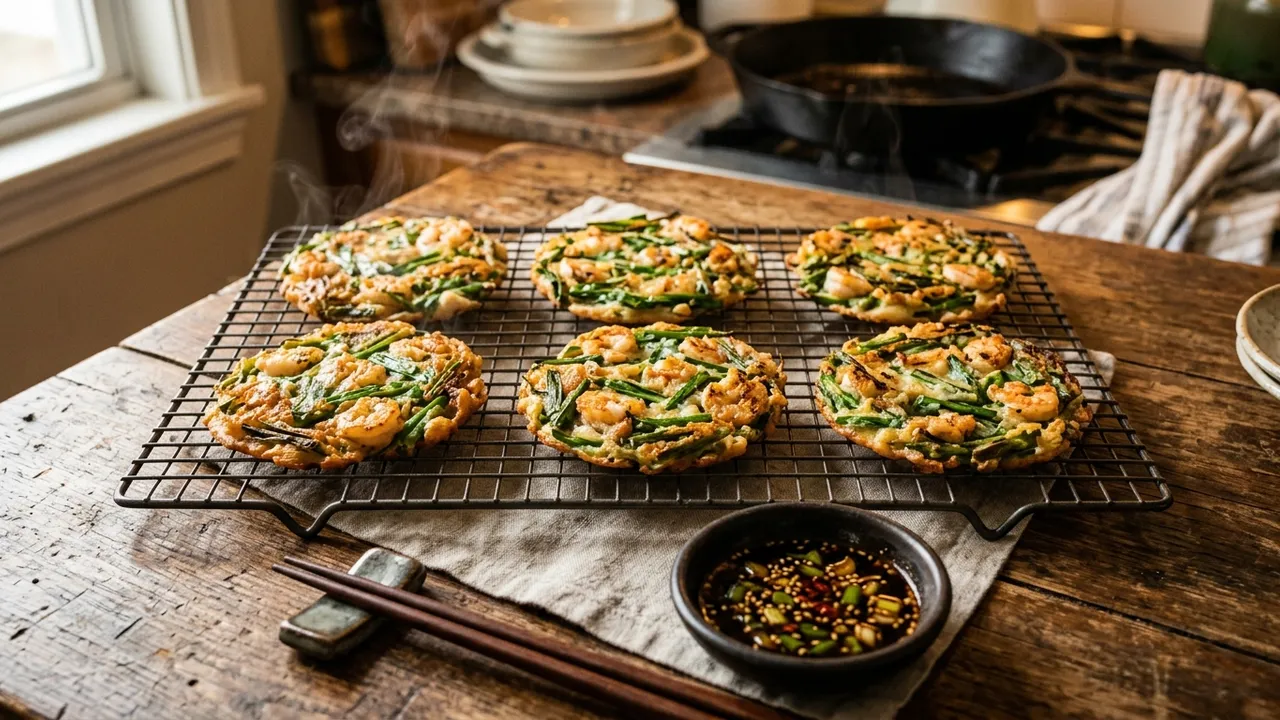
Scallion & Shrimp Pancake Recipe
* 이미지는 AI가 생성한 참고 이미지로, 실제 조리 결과물과 다를 수 있습니다.
This is a recipe for crispy and moist scallion pancakes made with scallions, shrimp, and Cheongyang chili peppers, served with a sweet and sour dipping sauce.
📝 Editor's Notes
This recipe for Shrimp and Scallion Pancake (Saewu Jjokpajeon) boasts a fantastic flavor combination of scallions, plump shrimp, and spicy Cheongyang chili peppers (cheongyang-gochu).
The golden ratio of Korean frying mix (twigim garu) and potato starch ensures a crispy exterior and a tender, moist interior.
Served with a spicy and sour dipping sauce, it's an irresistible jeon that you'll keep reaching for, without any greasiness.
It's perfect as a snack with makgeolli (Korean rice wine) on a rainy day, a weekend family treat, or an an impressive dish for guests.
This versatile dish is sure to become a beloved staple in your home, offering great taste, texture, and nutrition.
🛒 Ingredient Tips
For a delicious Shrimp and Scallion Pancake (Saewu Jjokpajeon), remember these ingredient selection tips!
First, it's important to choose scallions (jjokpa) with crisp, green leaves and firm, clean white parts.
Especially for thick scallions, making a slit in the white part helps them absorb seasoning and cook evenly.
Freshness is key for shrimp; look for those with a glossy sheen and firm flesh.
For small shrimp, you don't necessarily need to devein them, making preparation easier.
Choose Cheongyang chili peppers (cheongyang-gochu) with vibrant color and fresh stems to add a zesty kick.
🔄 Substitution Guide
If scallions (jjokpa) are difficult to find or if you prefer other vegetables, you can substitute them with Korean leeks (daepa) or chives (buchu).
Korean leeks offer a stronger aroma, while chives add a fragrant and crisp texture.
Instead of shrimp, other seafood like squid or clams (bajirak) can also be delicious.
Squid provides a chewy texture, and clams offer a refreshing umami flavor.
If you have a seafood allergy or are vegetarian, finely chopped mushrooms (shiitake, oyster mushrooms, etc.) or Korean zucchini (aehobak) can be used instead of shrimp.
If crab extract (kkotge-aek) is unavailable, you can substitute it with 1 tbsp of tuna extract or anchovy sauce (myeolchi-aekjeot) for a similar umami boost, though the specific seafood flavor may differ slightly.
🥘 Ingredients
👨🍳 Cooking Points
Here are three key cooking points that determine the success of your Shrimp and Scallion Pancake (Saewu Jjokpajeon): First, batter consistency.
Mix the Korean frying mix (twigim garu) and potato starch to achieve a pourable, slightly runny consistency.
If the batter is too thick, the pancake will be tough, and if it's too thin, it won't be crispy enough.
Adjusting the consistency with potato starch is key!
Second, ingredient preparation and mixing.
When adding the appropriately sized chopped scallions and shrimp to the batter, mix lightly without overworking it to preserve the texture of the ingredients. Third, heat control.
When cooking the pancakes, maintain medium-low heat to brown them evenly.
If the heat is too high, the outside will burn while the inside remains uncooked, or it might just burn entirely.
If the heat is too low, the pancake will absorb too much oil and become soggy. Cook slowly and patiently.
👨🍳 Directions
Clean and wash 9.5 oz of scallions. If the white parts are thick, make a slit lengthwise.
Finely chop the white parts of the scallions and cut the green leafy parts into 1-inch (2-3 cm) lengths.
Halve 3 Cheongyang chili peppers (cheongyang-gochu), remove the seeds, and finely mince.
Peel 8.8 oz of shrimp, leaving only the tails intact, and chop into small, bite-sized pieces.
Season the chopped shrimp with 1 tbsp of rice wine and about 5 dashes of black pepper, mixing gently.
In a large bowl, combine 1 cup of Korean frying mix (twigim garu), 3 tbsp of potato starch, and 1 cup of water. Whisk well to make a batter.
Check the consistency of the batter. If it's too thin, add 2 more tbsp of potato starch to reach the desired consistency (total of 5 tbsp potato starch).
Add the chopped scallions, minced Cheongyang chili peppers (cheongyang-gochu), and seasoned shrimp to the prepared batter.
Crack in 2 eggs and mix well.
For umami flavor, add 1 tbsp of crab extract (kkotge-aek) and mix thoroughly again.
Prepare the dipping sauce: In a separate bowl, combine 3 tbsp of soy sauce, 3 tbsp of green plum extract (maesilcheong), 1 tbsp of Korean chili powder (gochugaru), 2 tbsp of minced onion, 1 tbsp of minced red chili pepper, 2 tbsp of minced Cheongyang chili pepper (cheongyang-gochu), 1 tbsp of toasted sesame seeds, and 1 tbsp of vinegar. Mix everything together.
Heat a pan over medium-low heat and add a generous amount of cooking oil.
Spoon individual portions of the batter onto the hot pan and cook until golden brown and crispy on both sides.
Remove the cooked pancakes from the pan, let them cool slightly, then serve with the dipping sauce and enjoy.
💡 Tips
If the white parts of the scallions are thick, make a slit to ensure even cooking.
For small shrimp, you can simply remove the tails without deveining them.
Mixing Korean frying mix (twigim garu) and potato starch helps create a pancake that is crispy on the outside and moist on the inside.
The batter should be pourable; if it's too thick, the pancake won't taste good.
Instead of crab extract (kkotge-aek), you can use 1 tbsp of tuna extract for a similar umami flavor.
You don't need to add extra sugar to the dipping sauce, as the green plum extract (maesilcheong) provides a sweet and sour flavor.
When cooking the pancakes, keep the heat at medium-low to prevent burning and ensure they cook thoroughly.
📦 Storage & Reuse
Once the scallion pancakes are cooked, let them cool completely before storing them in an airtight container in the refrigerator for 2-3 days.
For longer storage, wrap each pancake individually in plastic wrap or place them in a freezer bag and freeze for up to a month.
To reheat frozen pancakes, thaw them first, then gently warm them in a pan over low heat, or air fry at 350°F (180°C) for 5-7 minutes to restore their crispy exterior and moist interior.
While a microwave is convenient, it may reduce the crispiness.
You can also chop any leftover scallions (jjokpa) and use them in ramen or stews!
🥢 Who This Is For
This Shrimp and Scallion Pancake (Saewu Jjokpajeon) is a delightful delicacy perfect for the whole family.
Serve it warm with a glass of makgeolli (Korean rice wine) on a rainy day for a cozy weekend ambiance, or as an excellent hospitality dish for special occasions.
For children, you can adjust the amount of Cheongyang chili peppers (cheongyang-gochu) or omit them entirely.
It's also delicious as a side dish with freshly cooked warm rice, and pairing it with a refreshing bean sprout soup (kongnamul-guk) or fish cake soup (eomuk-tang) will make for an even more satisfying meal.
🔥 Nutrition Info
One serving (approx.
5.3 oz / 150g) of Shrimp and Scallion Pancake (Saewu Jjokpajeon) is estimated to be around 230-280 calories.
Key nutrients include approximately 10-15g of protein, 25-30g of carbohydrates, and 10-15g of fat.
Shrimp is a low-fat, high-protein food rich in essential amino acids, while scallions (jjokpa) are abundant in vitamins A and C, calcium, and iron, aiding in immune system strengthening and fatigue relief.
Capsaicin in Cheongyang chili peppers (cheongyang-gochu) promotes metabolism, and eggs provide protein and B vitamins.
Crab extract (kkotge-aek) adds a small amount of minerals for umami, but since it contains sodium, it's best to consume it in moderation along with the dipping sauce.
💬 Frequently Asked Questions
- Q. What ingredients do I need for Scallion & Shrimp Pancake?
- Main ingredients include Scallions, Cheongyang chili peppers (cheongyang-gochu), Shrimp, Eggs, Rice wine. For a delicious Shrimp and Scallion Pancake (Saewu Jjokpajeon), remember these ingredient selection tips! First, it's important to choose scallions (jjokpa) with crisp, green leaves and firm, clean white parts. Especially for thick scallions, making a slit in the white part helps them absorb seasoning and cook evenly. Freshness is key for shrimp; look for those with a glossy sheen and firm flesh. For small shrimp, you don't necessarily need to devein them, making preparation easier. Choose Cheongyang chili peppers (cheongyang-gochu) with vibrant color and fresh stems to add a zesty kick.
- Q. What are the key tips for making Scallion & Shrimp Pancake?
- Here are three key cooking points that determine the success of your Shrimp and Scallion Pancake (Saewu Jjokpajeon): First, batter consistency. Mix the Korean frying mix (twigim garu) and potato starch to achieve a pourable, slightly runny consistency. If the batter is too thick, the pancake will be tough, and if it's too thin, it won't be crispy enough. Adjusting the consistency with potato starch is key! Second, ingredient preparation and mixing. When adding the appropriately sized chopped scallions and shrimp to the batter, mix lightly without overworking it to preserve the texture of the ingredients. Third, heat control. When cooking the pancakes, maintain medium-low heat to brown them evenly. If the heat is too high, the outside will burn while the inside remains uncooked, or it might just burn entirely. If the heat is too low, the pancake will absorb too much oil and become soggy. Cook slowly and patiently.
- Q. How should I store leftover Scallion & Shrimp Pancake?
- Once the scallion pancakes are cooked, let them cool completely before storing them in an airtight container in the refrigerator for 2-3 days. For longer storage, wrap each pancake individually in plastic wrap or place them in a freezer bag and freeze for up to a month. To reheat frozen pancakes, thaw them first, then gently warm them in a pan over low heat, or air fry at 350°F (180°C) for 5-7 minutes to restore their crispy exterior and moist interior. While a microwave is convenient, it may reduce the crispiness. You can also chop any leftover scallions (jjokpa) and use them in ramen or stews!
- Q. How many calories are in Scallion & Shrimp Pancake?
- One serving (approx. 5.3 oz / 150g) of Shrimp and Scallion Pancake (Saewu Jjokpajeon) is estimated to be around 230-280 calories. Key nutrients include approximately 10-15g of protein, 25-30g of carbohydrates, and 10-15g of fat. Shrimp is a low-fat, high-protein food rich in essential amino acids, while scallions (jjokpa) are abundant in vitamins A and C, calcium, and iron, aiding in immune system strengthening and fatigue relief. Capsaicin in Cheongyang chili peppers (cheongyang-gochu) promotes metabolism, and eggs provide protein and B vitamins. Crab extract (kkotge-aek) adds a small amount of minerals for umami, but since it contains sodium, it's best to consume it in moderation along with the dipping sauce.
- Q. Can I substitute ingredients in Scallion & Shrimp Pancake?
- If scallions (jjokpa) are difficult to find or if you prefer other vegetables, you can substitute them with Korean leeks (daepa) or chives (buchu). Korean leeks offer a stronger aroma, while chives add a fragrant and crisp texture. Instead of shrimp, other seafood like squid or clams (bajirak) can also be delicious. Squid provides a chewy texture, and clams offer a refreshing umami flavor. If you have a seafood allergy or are vegetarian, finely chopped mushrooms (shiitake, oyster mushrooms, etc.) or Korean zucchini (aehobak) can be used instead of shrimp. If crab extract (kkotge-aek) is unavailable, you can substitute it with 1 tbsp of tuna extract or anchovy sauce (myeolchi-aekjeot) for a similar umami boost, though the specific seafood flavor may differ slightly.
💬 Comments
No comments yet. Be the first to comment!