
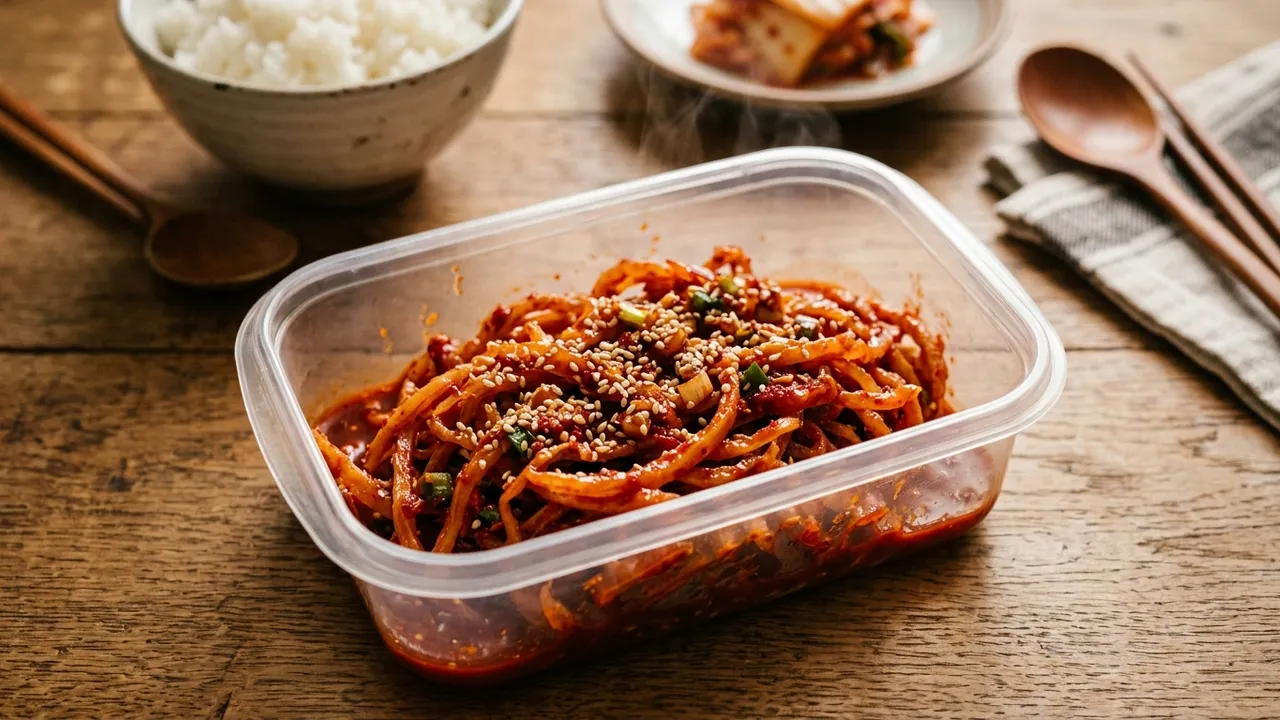
Soft Dried Pollock Stir-fry Recipe
* 이미지는 AI가 생성한 참고 이미지로, 실제 조리 결과물과 다를 수 있습니다.
Here's a soft dried pollock stir-fry recipe that reveals a trade secret. The key is to pre-mix the dried pollock strips with soju (소주) to remove their unique odor and enhance their tenderness. It's crucial not to wash the dried pollock and to mix it with cooled seasoning.
📝 Editor's Notes
The Soft Dried Pollock Stir-fry we're introducing today is a recipe where tenderness is key.
The trade secret of this recipe is to not wash the soft dried pollock strips (백진미채) but to mix them with soju (소주) to remove any unique odor and enhance their soft texture.
This dish offers a delightful balance of sweet, savory, and slightly spicy flavors, making it a beloved banchan (반찬) for all ages.
Especially by carefully following the step of cooling the sauce before mixing, you can consistently achieve a perfectly tender stir-fry.
The difficulty level is 'medium-low,' making it easy for beginners to follow, and it's a versatile side dish suitable for any season.
🛒 Ingredient Tips
When choosing soft dried pollock strips (백진미채), it's important to select ones that are moist and soft.
Avoid those that are too dry or tough, and opt for clear, clean-colored strips.
Good quality soft dried pollock strips have less odor and well-defined fibers.
Tamari soy sauce offers a deeper, richer flavor than regular soy sauce and is slightly lower in sodium, enhancing umami.
If unavailable, regular soy sauce can be used, but adjust the quantity to taste.
Korean plum extract (매실액) helps remove any fishy odor from the pollock and adds a subtle sweetness and tenderness, so be sure to include it.
🔄 Substitution Guide
If soft dried pollock strips (백진미채) are difficult to find, you can substitute them with Hwangtaechae (황태채, dried pollock flakes) or dried squid strips.
Hwangtaechae is generally tougher than the soft dried pollock strips, so it's recommended to soak it in water for about 10 minutes, then squeeze out the excess water before using.
Dried squid strips have a unique flavor and texture different from dried pollock, but can be prepared in the same way by mixing with soju (소주).
If using regular soy sauce instead of tamari soy sauce, note that the saltiness may differ, so start with slightly less than the recipe amount and adjust to taste.
If Korean plum extract (매실액) is unavailable, you can substitute it with oligosaccharide or corn syrup, but be aware that the unique aroma of plum and its tenderizing effect on the pollock strips may be reduced.
🥘 Ingredients
👨🍳 Cooking Points
There are three key points to this recipe.
First, absolutely do not wash the soft dried pollock strips (백진미채) with water; instead, mix them with 2-3 tbsp of soju (소주) to soften them.
This prevents them from becoming tough, maintains their tenderness, and removes any unwanted odor.
Second, after simmering the sauce over low heat, it is crucial to let it cool to a 'lukewarm' temperature before mixing.
Adding the pollock strips to hot sauce can make them tough, and if the sauce is too cold, the seasoning won't absorb well, so slightly warm is best.
Third, once the sauce has cooled, gently mix the pollock strips using two spatulas.
Mixing too vigorously can cause the pollock strips to break.
👨🍳 Directions
Place 200g of soft dried pollock strips in a bowl, add 2-3 tbsp of soju (소주), and mix by hand to soften them. Be careful not to wash them with water.
In a frying pan, add 2 tbsp of sugar and 0.5 tsp of gochugaru (고춧가루).
Next, add 2 tbsp of tamari soy sauce, 2 tbsp of Lotte Mirin (미림), 3 tbsp of Korean plum extract (매실액), 40-50g of gochujang (고추장), and 2 tbsp of corn syrup in sequence.
Heat the sauce over low heat, stirring constantly. When the large bubbles turn into small bubbles and the sauce thickens, turn off the heat and let the sauce cool.
If the sauce cools down too much, the seasoning won't coat the pollock strips well, so cool it until it's slightly warm.
Add the pre-mixed soft dried pollock strips to the cooled sauce and mix well using two spatulas. Be careful, as adding the pollock strips to hot sauce can make them tough.
Gently transfer the finished soft dried pollock stir-fry to a serving container and sprinkle with toasted sesame seeds to finish.
💡 Tips
Never wash soft dried pollock strips with water, as this will cause them to lose moisture, become tough, and prevent the seasoning from absorbing properly.
To remove the unique odor of soft dried pollock strips and make them tender, pre-mix them with soju (소주) to soften them.
It's essential to cool the stir-fry sauce before mixing to prevent the pollock strips from becoming tough and to maintain a soft texture. However, if it cools too much, the seasoning won't coat well, so a slightly warm temperature is ideal.
It's best not to add garlic to the stir-fry sauce to preserve the original flavor of the soft dried pollock strips.
📦 Storage & Reuse
The finished Soft Dried Pollock Stir-fry can be stored in an airtight container in the refrigerator for about 1 to 10 days, maintaining its freshness.
The flavors may even deepen over time as the seasoning permeates further.
While freezing is possible, the texture might become slightly tougher upon thawing, so refrigeration is generally recommended.
If you do freeze it, it's best to thaw it naturally at room temperature before serving.
Leftover stir-fry can be repurposed as gimbap (김밥) filling or chopped finely and added to rice balls for another delicious treat.
🥢 Who This Is For
This Soft Dried Pollock Stir-fry is the perfect banchan (반찬) to ensure a satisfying meal in your busy daily life.
It's excellent as a lunchbox side dish and a nutritious snack for children.
Served with warm white rice, you might not even need other side dishes.
Pair it with a spicy stew or soup for an even more wonderful meal.
Its sweet and spicy flavor also makes it a great accompaniment for drinks.
🔥 Nutrition Info
Based on an estimated 10 servings, each serving of this recipe contains approximately 120-150 kcal.
Protein is very abundant, around 15-18g, thanks to the soft dried pollock strips (백진미채), while fat content is relatively low at about 2-4g.
Carbohydrates, from sugars in ingredients like sugar, corn syrup, and Korean plum extract, can be estimated at around 15-20g.
Soft dried pollock strips are particularly high in protein and rich in essential amino acids, which aid in energy recovery and muscle maintenance.
They also contain various minerals like calcium and phosphorus, making this a nutritionally excellent side dish.
However, the sodium content might be somewhat high, so it's advisable to consume in moderation.
💬 Frequently Asked Questions
- Q. What ingredients do I need for Soft Dried Pollock Stir-fry?
- Main ingredients include Soft Dried Pollock Strips (백진미), Sugar, Gochugaru (고춧가루), Tamari soy sauce, Mirin (미림). When choosing soft dried pollock strips (백진미채), it's important to select ones that are moist and soft. Avoid those that are too dry or tough, and opt for clear, clean-colored strips. Good quality soft dried pollock strips have less odor and well-defined fibers. Tamari soy sauce offers a deeper, richer flavor than regular soy sauce and is slightly lower in sodium, enhancing umami. If unavailable, regular soy sauce can be used, but adjust the quantity to taste. Korean plum extract (매실액) helps remove any fishy odor from the pollock and adds a subtle sweetness and tenderness, so be sure to include it.
- Q. What are the key tips for making Soft Dried Pollock Stir-fry?
- There are three key points to this recipe. First, absolutely do not wash the soft dried pollock strips (백진미채) with water; instead, mix them with 2-3 tbsp of soju (소주) to soften them. This prevents them from becoming tough, maintains their tenderness, and removes any unwanted odor. Second, after simmering the sauce over low heat, it is crucial to let it cool to a 'lukewarm' temperature before mixing. Adding the pollock strips to hot sauce can make them tough, and if the sauce is too cold, the seasoning won't absorb well, so slightly warm is best. Third, once the sauce has cooled, gently mix the pollock strips using two spatulas. Mixing too vigorously can cause the pollock strips to break.
- Q. How should I store leftover Soft Dried Pollock Stir-fry?
- The finished Soft Dried Pollock Stir-fry can be stored in an airtight container in the refrigerator for about 1 to 10 days, maintaining its freshness. The flavors may even deepen over time as the seasoning permeates further. While freezing is possible, the texture might become slightly tougher upon thawing, so refrigeration is generally recommended. If you do freeze it, it's best to thaw it naturally at room temperature before serving. Leftover stir-fry can be repurposed as gimbap (김밥) filling or chopped finely and added to rice balls for another delicious treat.
- Q. How many calories are in Soft Dried Pollock Stir-fry?
- Based on an estimated 10 servings, each serving of this recipe contains approximately 120-150 kcal. Protein is very abundant, around 15-18g, thanks to the soft dried pollock strips (백진미채), while fat content is relatively low at about 2-4g. Carbohydrates, from sugars in ingredients like sugar, corn syrup, and Korean plum extract, can be estimated at around 15-20g. Soft dried pollock strips are particularly high in protein and rich in essential amino acids, which aid in energy recovery and muscle maintenance. They also contain various minerals like calcium and phosphorus, making this a nutritionally excellent side dish. However, the sodium content might be somewhat high, so it's advisable to consume in moderation.
- Q. Can I substitute ingredients in Soft Dried Pollock Stir-fry?
- If soft dried pollock strips (백진미채) are difficult to find, you can substitute them with Hwangtaechae (황태채, dried pollock flakes) or dried squid strips. Hwangtaechae is generally tougher than the soft dried pollock strips, so it's recommended to soak it in water for about 10 minutes, then squeeze out the excess water before using. Dried squid strips have a unique flavor and texture different from dried pollock, but can be prepared in the same way by mixing with soju (소주). If using regular soy sauce instead of tamari soy sauce, note that the saltiness may differ, so start with slightly less than the recipe amount and adjust to taste. If Korean plum extract (매실액) is unavailable, you can substitute it with oligosaccharide or corn syrup, but be aware that the unique aroma of plum and its tenderizing effect on the pollock strips may be reduced.
💬 Comments
No comments yet. Be the first to comment!