
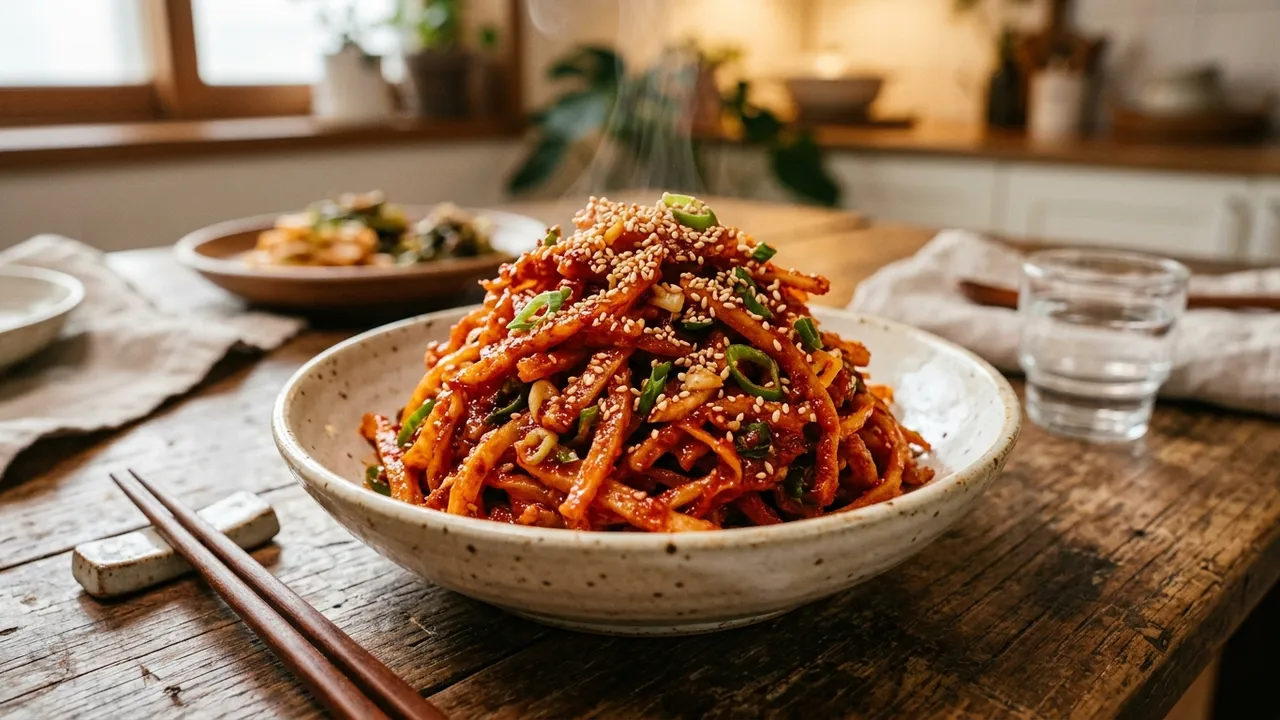
Soft and Chewy Jinmichae Muchim (진미채무침) (Spicy Seasoned Drie
* 이미지는 AI가 생성한 참고 이미지로, 실제 조리 결과물과 다를 수 있습니다.
A recipe for Jinmichae Muchim (진미채무침) that stays soft and tender, even after refrigeration.
📝 Editor's Notes
This recipe is for jinmichae muchim (진미채무침) that boasts a soft texture, even after being stored in the refrigerator.
The umami of the squid combined with the sweet and spicy gochujang (고추장) seasoning creates an exquisite flavor.
The unique steaming method for the dried shredded squid (jinmichae (진미채)) maximizes its tenderness.
With the added depth of flavor from garlic oil and the delicate step of cooling the sauce before mixing, you can make delicious jinmichae muchim (진미채무침) without fail.
It's a versatile side dish perfect for any season, great for lunchboxes, or even for guests.
The difficulty level is low-to-medium, making it easy for anyone to prepare by following a few key points.
🛒 Ingredient Tips
When choosing dried shredded squid (jinmichae (진미채)), it's important to select pieces that have a light ivory color, a glossy sheen, and are not overly dry or crumbly.
Good quality jinmichae (진미채) should feel soft and elastic to the touch and have a savory squid aroma without any musty smell.
If it's too white, it might have been bleached, so it's best to avoid those.
Gochujang (고추장) varies greatly in sweetness and spiciness by brand, so choose a gochujang (고추장) you normally enjoy.
Fine gochugaru (고운 고춧가루) is essential for giving the sauce a vibrant color and a smooth texture, so be sure to have it ready.
Corn syrup (물엿) is an important ingredient that adds a glossy shine and chewy texture that cannot be achieved with sugar alone.
🔄 Substitution Guide
If you wish to use other ingredients instead of dried shredded squid (jinmichae (진미채)), try Hwangtaechae (황태채 - dried pollock strips) or Bukeochae (북어채 - dried pollack strips).
Hwangtaechae (황태채) can be soaked in water or lightly steamed to achieve a soft texture, but it will have a savory and mild flavor different from the distinct umami of squid.
If you don't have corn syrup (물엿), you can substitute it with oligosaccharide or rice syrup.
Oligosaccharide is less sweet and less sticky than corn syrup (물엿), but the chewy texture might be slightly weaker.
Rice syrup provides a similar viscosity to corn syrup (물엿) but may add a subtle grain-specific aroma.
If you have a gochujang (고추장) allergy or want to reduce the spiciness, you can create a base sauce with gochugaru (고춧가루), soy sauce, and sugar, then add a small amount of doenjang (된장 - fermented soybean paste) for a savory flavor.
In this case, note that the unique deep, fermented umami of gochujang (고추장) may be reduced.
🥘 Ingredients
👨🍳 Cooking Points
The most crucial secret to this recipe is the steaming process for the dried shredded squid (jinmichae (진미채)).
Steam for 1 minute and 30 seconds with the lid closed, then for another 1 minute and 30 seconds with the lid open.
Steaming with the lid open allows unpleasant odors to escape and helps achieve a soft texture without excessive moisture absorption.
Be sure to stick to the timing, as steaming for too long can make it tough or mushy.
The second point is to thoroughly create garlic oil and reduce the sauce, ensuring the sauce reaches the right consistency to coat the dried shredded squid (jinmichae (진미채)) well.
Finally, the key is to let the sauce cool down slightly before adding and mixing the dried shredded squid (jinmichae (진미채)).
Adding it directly to hot sauce can cause the dried shredded squid (jinmichae (진미채)) to instantly lose moisture and become tough again.
Remember these three points, and you'll be able to make delicious jinmichae muchim (진미채무침) successfully.
👨🍳 Directions
Prepare 300g of dried shredded squid (jinmichae (진미채)) and cut it into 2-3 pieces with scissors, according to your preference.
Add water to a pot and bring it to a boil. Once steam rises, place a steamer basket on top and line it with a hemp cloth (or parchment paper). Spread the prepared dried shredded squid (jinmichae (진미채)) evenly on the steamer basket.
Cover with a lid and steam for 1 minute and 30 seconds.
Remove the lid and steam again for 1 minute and 30 seconds.
Turn off the heat and let the dried shredded squid (jinmichae (진미채)) cool completely with the lid open.
Prepare the seasoning sauce. Combine 1.5 tbsp soy sauce, 1 tbsp white sugar, 3 tbsp mirin (맛술), 3 tbsp corn syrup (물엿), 3 tbsp gochujang (고추장), 1 tbsp fine gochugaru (고운 고춧가루), and 2 tbsp water in a bowl and mix well.
In a cold frying pan, add 2 tbsp cooking oil and ⅔ tbsp minced garlic. Heat over medium heat and sauté until the garlic sizzles and infuses the oil, creating garlic oil.
Once enough garlic oil has formed, add the prepared seasoning sauce and mix well.
Increase the heat to high and bring the sauce to a rolling boil. Then reduce the heat to medium and simmer until the moisture evaporates and the sauce thickens.
Stir the sauce to prevent it from sticking and let it cool down slightly.
With the heat off, add the cooled dried shredded squid (jinmichae (진미채)) to the sauce and mix well until it is evenly coated.
Add 1 tbsp sesame oil and mix thoroughly again.
Sprinkle generously with 2 tbsp toasted sesame seeds and serve.
💡 Tips
When steaming dried shredded squid (jinmichae (진미채)), steaming with the lid open helps release any unwanted odors and prevents excessive moisture absorption, keeping it from becoming mushy.
Corn syrup (물엿) plays a different role than sugar; it's used to achieve a glossy and chewy texture.
If you don't have fine gochugaru (고운 고춧가루), you can sift regular gochugaru (고춧가루) through a sieve to separate the fine powder.
Adding cooking oil helps the dried shredded squid (jinmichae (진미채)) maintain a glossy and chewy texture and prevents it from clumping together.
If you add dried shredded squid (jinmichae (진미채)) directly to hot sauce, it can become tough. Make sure to let the sauce cool down slightly before mixing.
📦 Storage & Reuse
It is best to store the finished jinmichae muchim (진미채무침) in an airtight container in the refrigerator.
It can be enjoyed fresh for about 5-7 days when refrigerated.
It tastes best when consumed as soon as possible.
While it's typically eaten cold without reheating, if you prefer it warm, briefly microwave it for 10-20 seconds.
Be careful not to overheat it, as the dried shredded squid (jinmichae (진미채)) can become tough again.
Leftover dried shredded squid (jinmichae (진미채)) can be sealed and stored in a cool, dry place or frozen for longer shelf life before cooking.
🥢 Who This Is For
This soft jinmichae muchim (진미채무침) is an excellent dish for children or the elderly who may find tough side dishes difficult.
Its harmonious blend of sweet, spicy, and savory flavors will make it a family-favorite side dish for rice.
Served over warm white rice, it's truly a 'rice thief' (a dish so good it makes you eat a lot of rice).
It's also perfect for lunchboxes and makes a respectable banchan (반찬 - side dish) to serve to unexpected guests.
Pair it with main Korean dishes like Kimchi Jjigae (김치찌개) or Doenjang Jjigae (된장찌개) to complete a more abundant dining table.
🔥 Nutrition Info
This jinmichae muchim (진미채무침), based on 300g of dried shredded squid, can yield approximately 4-6 servings.
Estimating one serving (about 50g of dried shredded squid (jinmichae (진미채)) with sauce), it provides approximately 250-300 kcal of energy.
Protein is abundant, about 30-35g, thanks to the dried shredded squid (jinmichae (진미채)).
Carbohydrates from sugar, corn syrup (물엿), and gochujang (고추장) are estimated at about 15-20g, and fats from cooking oil and sesame oil at about 8-12g.
Squid contains various minerals and vitamins such as selenium, copper, phosphorus, and vitamin B12, providing essential nutrients for our body.
However, as the sauce contains soy sauce and gochujang (고추장), the sodium content may be somewhat high, so it is advisable to consume in moderation.
💬 Frequently Asked Questions
- Q. What ingredients do I need for Soft and Chewy Jinmichae Muchim (진미채무침) (Spicy Seasoned Dried Shredded Squid)?
- Main ingredients include Dried Shredded Squid (jinmichae (진미채)), Sesame Oil, Toasted Sesame Seeds, Cooking Oil, Minced Garlic. When choosing dried shredded squid (jinmichae (진미채)), it's important to select pieces that have a light ivory color, a glossy sheen, and are not overly dry or crumbly. Good quality jinmichae (진미채) should feel soft and elastic to the touch and have a savory squid aroma without any musty smell. If it's too white, it might have been bleached, so it's best to avoid those. Gochujang (고추장) varies greatly in sweetness and spiciness by brand, so choose a gochujang (고추장) you normally enjoy. Fine gochugaru (고운 고춧가루) is essential for giving the sauce a vibrant color and a smooth texture, so be sure to have it ready. Corn syrup (물엿) is an important ingredient that adds a glossy shine and chewy texture that cannot be achieved with sugar alone.
- Q. What are the key tips for making Soft and Chewy Jinmichae Muchim (진미채무침) (Spicy Seasoned Dried Shredded Squid)?
- The most crucial secret to this recipe is the steaming process for the dried shredded squid (jinmichae (진미채)). Steam for 1 minute and 30 seconds with the lid closed, then for another 1 minute and 30 seconds with the lid open. Steaming with the lid open allows unpleasant odors to escape and helps achieve a soft texture without excessive moisture absorption. Be sure to stick to the timing, as steaming for too long can make it tough or mushy. The second point is to thoroughly create garlic oil and reduce the sauce, ensuring the sauce reaches the right consistency to coat the dried shredded squid (jinmichae (진미채)) well. Finally, the key is to let the sauce cool down slightly before adding and mixing the dried shredded squid (jinmichae (진미채)). Adding it directly to hot sauce can cause the dried shredded squid (jinmichae (진미채)) to instantly lose moisture and become tough again. Remember these three points, and you'll be able to make delicious jinmichae muchim (진미채무침) successfully.
- Q. How should I store leftover Soft and Chewy Jinmichae Muchim (진미채무침) (Spicy Seasoned Dried Shredded Squid)?
- It is best to store the finished jinmichae muchim (진미채무침) in an airtight container in the refrigerator. It can be enjoyed fresh for about 5-7 days when refrigerated. It tastes best when consumed as soon as possible. While it's typically eaten cold without reheating, if you prefer it warm, briefly microwave it for 10-20 seconds. Be careful not to overheat it, as the dried shredded squid (jinmichae (진미채)) can become tough again. Leftover dried shredded squid (jinmichae (진미채)) can be sealed and stored in a cool, dry place or frozen for longer shelf life before cooking.
- Q. How many calories are in Soft and Chewy Jinmichae Muchim (진미채무침) (Spicy Seasoned Dried Shredded Squid)?
- This jinmichae muchim (진미채무침), based on 300g of dried shredded squid, can yield approximately 4-6 servings. Estimating one serving (about 50g of dried shredded squid (jinmichae (진미채)) with sauce), it provides approximately 250-300 kcal of energy. Protein is abundant, about 30-35g, thanks to the dried shredded squid (jinmichae (진미채)). Carbohydrates from sugar, corn syrup (물엿), and gochujang (고추장) are estimated at about 15-20g, and fats from cooking oil and sesame oil at about 8-12g. Squid contains various minerals and vitamins such as selenium, copper, phosphorus, and vitamin B12, providing essential nutrients for our body. However, as the sauce contains soy sauce and gochujang (고추장), the sodium content may be somewhat high, so it is advisable to consume in moderation.
- Q. Can I substitute ingredients in Soft and Chewy Jinmichae Muchim (진미채무침) (Spicy Seasoned Dried Shredded Squid)?
- If you wish to use other ingredients instead of dried shredded squid (jinmichae (진미채)), try Hwangtaechae (황태채 - dried pollock strips) or Bukeochae (북어채 - dried pollack strips). Hwangtaechae (황태채) can be soaked in water or lightly steamed to achieve a soft texture, but it will have a savory and mild flavor different from the distinct umami of squid. If you don't have corn syrup (물엿), you can substitute it with oligosaccharide or rice syrup. Oligosaccharide is less sweet and less sticky than corn syrup (물엿), but the chewy texture might be slightly weaker. Rice syrup provides a similar viscosity to corn syrup (물엿) but may add a subtle grain-specific aroma. If you have a gochujang (고추장) allergy or want to reduce the spiciness, you can create a base sauce with gochugaru (고춧가루), soy sauce, and sugar, then add a small amount of doenjang (된장 - fermented soybean paste) for a savory flavor. In this case, note that the unique deep, fermented umami of gochujang (고추장) may be reduced.
💬 Comments
No comments yet. Be the first to comment!