
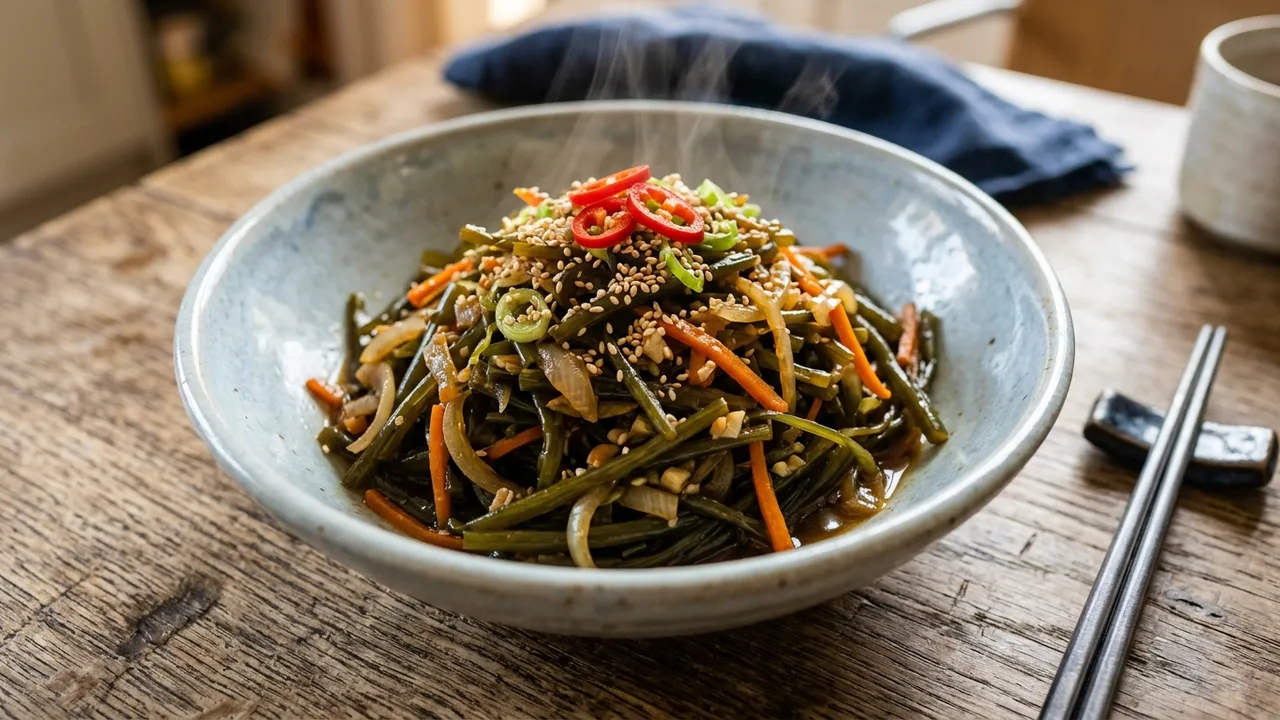
Crunchy and Delicious Stir-fried Seaweed Stems Recipe
* 이미지는 AI가 생성한 참고 이미지로, 실제 조리 결과물과 다를 수 있습니다.
A simple and delicious recipe for making chewy and flavorful stir-fried seaweed stems.
📝 Editor's Notes
This recipe introduces a very easy and delicious way to make stir-fried seaweed stems with an excellent crunchy texture.
The savory, nutty garlic aroma combined with the umami of tuna sauce makes it an irresistible side dish that's perfect with rice.
With just a little attention to ingredient preparation and heat control, anyone can make this wonderful banchan, making it highly recommended for beginner cooks.
It's a versatile recipe, perfect as a healthy homemade side dish year-round or for lunchboxes.
Enrich your dining table with crunchy stir-fried seaweed stems.
🛒 Ingredient Tips
The key to delicious stir-fried seaweed stems lies in choosing fresh and properly salted seaweed stems.
Select salted seaweed stems (염장미역줄기) that are not too dark or yellowish, but rather have a vibrant green color and firm texture.
They should have a subtle oceanic aroma rather than a strong fishy smell.
Avoid any that feel soft or mushy.
For onions and carrots, choose those that are firm and have glossy skins.
Carrots, in particular, should have a bright color and few fine roots for freshness.
Remember that good ingredients are the foundation of a delicious dish!
🔄 Substitution Guide
If you want to use dried seaweed instead of salted seaweed stems (염장미역줄기), soak them sufficiently in water before blanching.
However, please note that dried seaweed may result in a slightly softer texture compared to salted seaweed stems.
If tuna sauce (참치액) is unavailable, you can substitute it with guk-ganjang (국간장, Korean soup soy sauce) or anchovy fish sauce.
Guk-ganjang is saltier, so adjust the amount accordingly.
Anchovy fish sauce offers a deeper umami but has a distinct aroma that might not appeal to everyone.
Instead of onion and carrot, you can also julienne zucchini, oyster mushrooms, or shiitake mushrooms.
Using different vegetables allows you to enjoy various flavors and aromas, so feel free to experiment based on what you have in your refrigerator.
🥘 Ingredients
👨🍳 Cooking Points
There are three key points in this recipe.
First, 'adjusting the saltiness' of the salted seaweed stems.
Soaking them for too long will make them mushy and tasteless.
The ideal saltiness after blanching should be 'slightly salty but palatable.' Second, 'blanching the seaweed stems.' Add them immediately when the water boils and remove them as soon as the water boils again, then rinse in cold water to maintain their chewy texture.
Lastly, 'heat control' is crucial: make garlic oil over medium-low heat to prevent burning, stir-fry the seaweed stems quickly over high heat to evaporate moisture, and reduce to medium heat when adding seasonings to ensure they are well absorbed.
By following these three tips, you're guaranteed to make perfect stir-fried seaweed stems.
👨🍳 Directions
Rinse 300g of salted seaweed stems (염장미역줄기) thoroughly 3-4 times under cold water to remove excess salt.
Once the water comes to a boil, immediately add the rinsed seaweed stems. As soon as the water boils again, remove the seaweed stems and transfer them to cold water.
Taste one of the seaweed stems soaking in cold water. The ideal saltiness should be 'slightly salty but palatable.' If it's too salty, soak them longer to remove more salt.
Rinse the salt-adjusted seaweed stems twice more in cold water, then squeeze out as much water as possible.
Cut the seaweed stems into bite-sized pieces.
Thinly julienne 1/4 of an onion (approx. 40g) and 20g of carrot.
In a pan, add 1 tbsp cooking oil, 1 tbsp sesame oil, and 1 tbsp minced garlic. Sauté over medium-low heat until the garlic aroma develops, creating garlic oil.
Once the garlic aroma rises, add the prepared seaweed stems and stir-fry over high heat until you hear sizzling sounds.
When the sizzling sound starts, reduce the heat to medium and continue stir-frying until the seaweed stems are tender yet retain their crunchy texture.
Add 1/2 tbsp tuna sauce (참치액) and 1 tbsp mirin (맛술), and stir-fry over medium heat until the seasonings are well combined.
Add the julienned onion and carrot, stir-fry briefly, then turn off the heat.
💡 Tips
When desalinating salted seaweed stems, do not soak them in water for too long. If you do, they will lose too much salt during blanching, becoming less chewy and bloated, thus losing their inherent flavor.
Taste the blanched seaweed stems; they should be 'slightly salty but palatable.' Adjust the soaking time according to your personal preference for saltiness.
When making garlic oil, use medium-low heat and sauté gently to prevent the garlic from burning. When stir-frying the seaweed stems, use high heat for a quick fry to evaporate moisture. Then, reduce to medium heat when adding seasonings to ensure they are well combined.
If you prefer a saltier taste, add more tuna sauce (참치액) or salt at the end. Stir-fry vegetables like onion and carrot only briefly to maintain their crisp texture.
📦 Storage & Reuse
Finished stir-fried seaweed stems can be stored in an airtight container in the refrigerator for 3-4 days.
Freezing is not recommended as it can alter the chewy texture of the seaweed stems.
When reheating, microwave briefly or lightly stir-fry in a pan with a tiny bit of cooking oil over medium-low heat to partially restore the original taste and texture.
Leftover stir-fried seaweed stems are also great mixed with warm rice or used as an ingredient for gimbap (김밥) for a unique flavor.
🥢 Who This Is For
Crunchy and delicious stir-fried seaweed stems are a universally loved Korean side dish, highly recommended for those who enjoy healthy Korean banchan.
It's a 'rice thief' that can empty a bowl of warm rice without any other side dishes.
Its savory and nutty flavor pairs wonderfully with mild doenjang jjigae (된장찌개, soybean paste stew) or sundubu jjigae (순두부찌개, soft tofu stew).
This dish will enrich your busy weeknight dinners or weekend meals, offering a simple yet nutritious meal.
🔥 Nutrition Info
Based on this recipe, for approximately 3-4 servings, the estimated calories per serving are about 100-120 kcal.
Seaweed stems are a low-calorie food rich in dietary fiber, promoting satiety and aiding gut health.
They also contain abundant minerals like iodine and calcium.
Fats from cooking oil and sesame oil are estimated at 10-15g, protein from seaweed stems and tuna sauce at 3-5g, and carbohydrates from onion, carrot, mirin, etc., at 5-10g.
The abundant Vitamin A in carrots and allicin in garlic also contribute positively to immune system enhancement and antioxidant activity.
It's a nutritious side dish that offers both health and taste.
💬 Frequently Asked Questions
- Q. What ingredients do I need for Crunchy and Delicious Stir-fried Seaweed Stems?
- Main ingredients include Salted seaweed stems (염장미역줄기), Onion, Carrot, Cooking oil, Sesame oil. The key to delicious stir-fried seaweed stems lies in choosing fresh and properly salted seaweed stems. Select salted seaweed stems (염장미역줄기) that are not too dark or yellowish, but rather have a vibrant green color and firm texture. They should have a subtle oceanic aroma rather than a strong fishy smell. Avoid any that feel soft or mushy. For onions and carrots, choose those that are firm and have glossy skins. Carrots, in particular, should have a bright color and few fine roots for freshness. Remember that good ingredients are the foundation of a delicious dish!
- Q. What are the key tips for making Crunchy and Delicious Stir-fried Seaweed Stems?
- There are three key points in this recipe. First, 'adjusting the saltiness' of the salted seaweed stems. Soaking them for too long will make them mushy and tasteless. The ideal saltiness after blanching should be 'slightly salty but palatable.' Second, 'blanching the seaweed stems.' Add them immediately when the water boils and remove them as soon as the water boils again, then rinse in cold water to maintain their chewy texture. Lastly, 'heat control' is crucial: make garlic oil over medium-low heat to prevent burning, stir-fry the seaweed stems quickly over high heat to evaporate moisture, and reduce to medium heat when adding seasonings to ensure they are well absorbed. By following these three tips, you're guaranteed to make perfect stir-fried seaweed stems.
- Q. How should I store leftover Crunchy and Delicious Stir-fried Seaweed Stems?
- Finished stir-fried seaweed stems can be stored in an airtight container in the refrigerator for 3-4 days. Freezing is not recommended as it can alter the chewy texture of the seaweed stems. When reheating, microwave briefly or lightly stir-fry in a pan with a tiny bit of cooking oil over medium-low heat to partially restore the original taste and texture. Leftover stir-fried seaweed stems are also great mixed with warm rice or used as an ingredient for gimbap (김밥) for a unique flavor.
- Q. How many calories are in Crunchy and Delicious Stir-fried Seaweed Stems?
- Based on this recipe, for approximately 3-4 servings, the estimated calories per serving are about 100-120 kcal. Seaweed stems are a low-calorie food rich in dietary fiber, promoting satiety and aiding gut health. They also contain abundant minerals like iodine and calcium. Fats from cooking oil and sesame oil are estimated at 10-15g, protein from seaweed stems and tuna sauce at 3-5g, and carbohydrates from onion, carrot, mirin, etc., at 5-10g. The abundant Vitamin A in carrots and allicin in garlic also contribute positively to immune system enhancement and antioxidant activity. It's a nutritious side dish that offers both health and taste.
- Q. Can I substitute ingredients in Crunchy and Delicious Stir-fried Seaweed Stems?
- If you want to use dried seaweed instead of salted seaweed stems (염장미역줄기), soak them sufficiently in water before blanching. However, please note that dried seaweed may result in a slightly softer texture compared to salted seaweed stems. If tuna sauce (참치액) is unavailable, you can substitute it with guk-ganjang (국간장, Korean soup soy sauce) or anchovy fish sauce. Guk-ganjang is saltier, so adjust the amount accordingly. Anchovy fish sauce offers a deeper umami but has a distinct aroma that might not appeal to everyone. Instead of onion and carrot, you can also julienne zucchini, oyster mushrooms, or shiitake mushrooms. Using different vegetables allows you to enjoy various flavors and aromas, so feel free to experiment based on what you have in your refrigerator.

💬 Comments
No comments yet. Be the first to comment!