
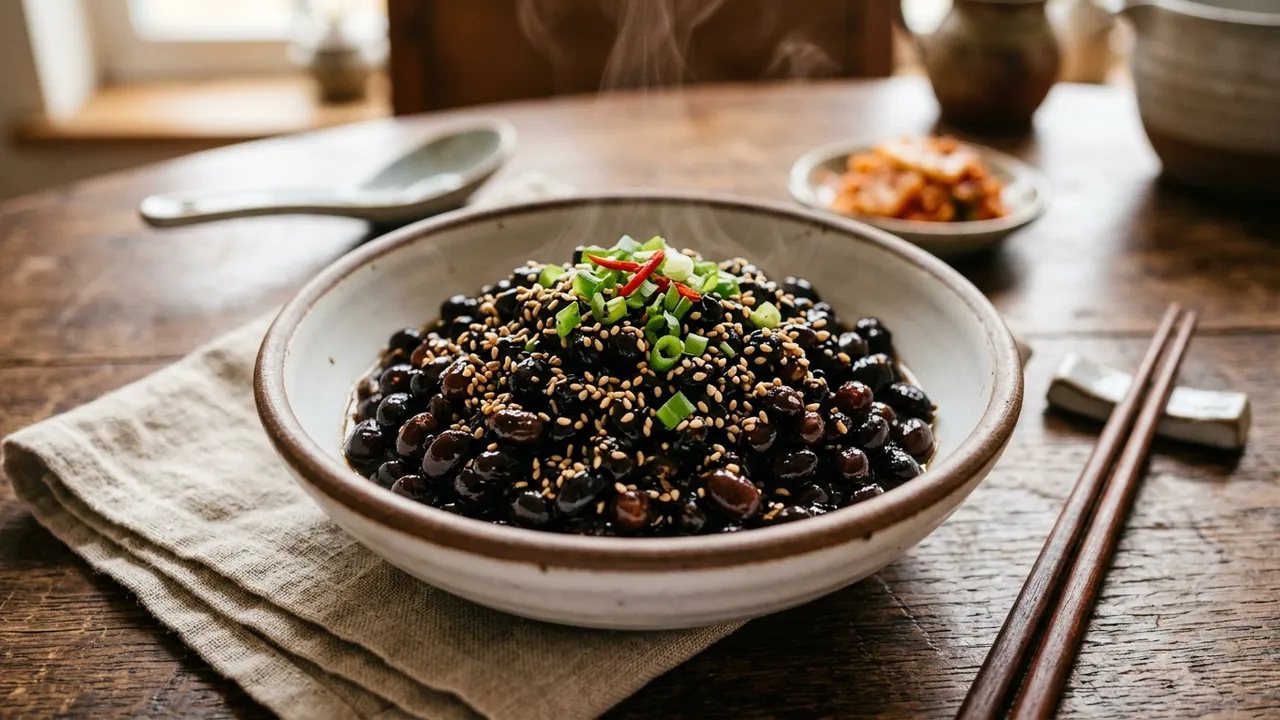
Seoritae Kongjaban (Braised Black Beans) Recipe
* 이미지는 AI가 생성한 참고 이미지로, 실제 조리 결과물과 다를 수 있습니다.
A recipe for soft and tender Kongjaban made with fresh Seoritae black beans (서리태), ensuring they are not hard.
📝 Editor's Notes
This Seoritae Kongjaban (서리태 콩자반) recipe is characterized by its soft and tender texture, rather than being hard.
It particularly stands out for using fresh beans and repurposing the bean soaking water, which helps to preserve the deep, natural flavor and nutrients of the beans.
The recipe cleverly uses dried kelp (dashima) twice to enhance the umami flavor, and adds sesame oil (chamgireum) at the very end to prevent the beans from hardening.
Its sweet, savory, and nutty flavor is exquisite, making it an excellent banchan (반찬, side dish) that everyone, young and old, will enjoy.
It's perfect not only as a side dish for rice but also for lunchboxes or as a healthy snack, enjoyable throughout all seasons.
The difficulty level is low to medium, but it requires a bit of patience during the soaking and simmering processes.
🛒 Ingredient Tips
The key to delicious Seoritae Kongjaban (서리태 콩자반) lies in selecting the right 'Seoritae' black beans.
To achieve a soft and tender texture, it's best to use fresh beans (햇콩) rather than old ones.
Look for fresh beans that are glossy, have smooth, unwrinkled skins, and are uniform in size.
It's also important to carefully check for any cracked skins or signs of insect damage.
Next, 'dried kelp (dashima)' is a crucial ingredient for adding umami.
Choose kelp that is thick and has a moderate amount of white powdery substance on its surface.
This white powder is a natural umami component, so don't wash it off; simply wipe it gently with a damp cloth before use.
Remember, good ingredients make good flavors!
🔄 Substitution Guide
If Seoritae black beans (서리태), the core ingredient, are unavailable or if you prefer a different texture, you can substitute them with regular black beans or medicinal black beans (쥐눈이콩 or 약콩).
However, since jwinunyi-kong (쥐눈이콩) are smaller and potentially harder than Seoritae, you may need to increase the soaking time or adjust the cooking time to achieve a tender texture.
For sweetness, instead of honey, you can use rice syrup (쌀 조청), corn syrup (물엿), or oligosaccharide.
Rice syrup offers a subtle and deep sweetness, corn syrup adds gloss and a chewy texture, and oligosaccharide helps reduce calorie intake.
If you don't have tuna sauce (참치액), you can substitute it with anchovy sauce (멸치액젓), but since anchovy sauce has a stronger aroma, you might want to use a slightly smaller amount or replace it with soy sauce to adjust the seasoning.
🥘 Ingredients
👨🍳 Cooking Points
There are three key cooking points in this recipe.
First, the 'bean soaking process.' You need to soak the beans thoroughly in lukewarm water for about 5 hours to ensure they cook softly and to reduce overall cooking time.
At this point, it's crucial not to discard the bean soaking water; set it aside.
Cooking the beans in this water preserves their nutrients and flavor, leading to a deeper taste.
Second, the 'timing of adding oil.' Add the sesame oil (chamgireum) at the very end, after turning off the heat.
Adding it too early can make the beans shrivel and become tough, so remembering this will help you achieve tender Kongjaban (콩자반).
Third, 'repurposing the dried kelp (dashima).' Don't discard the boiled dried kelp; finely chop it and add it back to the Kongjaban to enhance both umami and nutrition.
And don't forget to simmer slowly over low heat, leaving a moist sauce at the end!
👨🍳 Directions
Prepare 2 cups (200ml) of Seoritae black beans and wash them by rubbing gently until the water runs clear. Remove any beans that float to the surface, as they lack nutrients.
Soak the black beans in lukewarm water for about 5 hours.
Drain the soaked beans using a sieve, separating them from the soaking water. Do not discard the soaking water; set it aside.
Add the soaked beans to a wok, along with 3 cups (200ml) of the reserved soaking water and 7g of dried kelp (dashima).
Cover and boil vigorously for about 10 minutes.
Remove the boiled dried kelp (dashima) and do not discard it. (It will be finely chopped and added back to the Kongjaban later).
Reduce the heat to low and simmer gradually. Add 3 tbsp of soy sauce (jin-ganjang), 1 tbsp of tuna sauce (chamchi-aek), and 1 tbsp of sugar, then mix well.
Cover and then uncover, stirring occasionally, and simmer on low heat for about 5 more minutes until the beans are tender.
Continue to simmer on low heat for about 7 more minutes, until a small amount of liquid remains, keeping the beans moist.
Turn off the heat, add 2 tbsp of honey and 2 tbsp of sesame oil (chamgireum), and mix well to add a glossy finish.
Sprinkle 1 tbsp of sesame seeds (chamkkae) evenly and mix.
Finely julienne and chop the dried kelp (dashima) that was set aside earlier, then add it to the Kongjaban and mix.
💡 Tips
To make soft and tender Kongjaban (콩자반), use fresh Seoritae black beans (햇콩) rather than old ones.
Do not discard the bean soaking water; use it to cook the beans for a richer flavor.
When cooking Kongjaban (콩자반), do not add oil (sesame oil (참기름)) beforehand. Add it only after the beans are tender and the heat is turned off to prevent the beans from becoming tough and to maintain their soft texture.
For a moist Kongjaban (콩자반), it's best not to reduce the soy sauce mixture completely, leaving a small amount of liquid.
Instead of honey, you can use rice syrup (쌀 조청) or corn syrup (물엿).
📦 Storage & Reuse
Store the finished Kongjaban (콩자반) in an airtight container in the refrigerator for 5-7 days to keep it fresh.
For longer storage, you can divide it into portions and freeze, but note that the texture of the beans might become slightly harder or drier upon thawing.
It's best to consume it within 1-2 months when frozen.
To reheat, microwave briefly or warm gently in a pan over low heat, adding a little water to maintain moisture.
Leftover Kongjaban (콩자반) is also delicious mixed with warm rice, sesame oil (참기름), and crushed dried seaweed (김가루), or used as a filling for rice balls (주먹밥).
🥢 Who This Is For
This soft Seoritae Kongjaban (서리태 콩자반) is a dish that the whole family can enjoy, from growing children to seniors looking after their health.
Its tender texture makes it easy for those with sensitive teeth to eat without discomfort.
We highly recommend it as a hearty breakfast side dish or a nutritious lunchbox item.
It's also delicious when mixed generously with warm rice, or wrapped in dried seaweed (gim).
Pairing it with a spicy Kimchi jjigae (김치찌개) or a savory Doenjang jjigae (된장찌개) will balance the flavors and create an even richer meal.
🔥 Nutrition Info
Based on approximately 2 cups (200ml) of Seoritae black beans, this Kongjaban (콩자반) recipe yields a total of about 1800-1900 kcal.
Divided into 6 servings, each serving is estimated to be around 300-320 kcal.
It is expected to provide approximately 15-20g of protein, 10-15g of fat, and 30-35g of carbohydrates per serving.
Seoritae black beans are rich in protein, often called 'beef from the field,' and abundant in isoflavones, a plant estrogen, which are especially beneficial for women's health.
Furthermore, the anthocyanins found in their black skins are powerful antioxidants that help prevent aging and support eye health.
This healthy banchan (반찬, side dish) offers a balanced intake of various nutrients including dietary fiber, iron, calcium, and B vitamins.
💬 Frequently Asked Questions
- Q. What ingredients do I need for Seoritae Kongjaban (Braised Black Beans)?
- Main ingredients include Seoritae Black Beans (서리태), Bean Soaking Water, Dried Kelp (dashima), Soy Sauce (jin-ganjang), Tuna Sauce (chamchi-aek). The key to delicious Seoritae Kongjaban (서리태 콩자반) lies in selecting the right 'Seoritae' black beans. To achieve a soft and tender texture, it's best to use fresh beans (햇콩) rather than old ones. Look for fresh beans that are glossy, have smooth, unwrinkled skins, and are uniform in size. It's also important to carefully check for any cracked skins or signs of insect damage. Next, 'dried kelp (dashima)' is a crucial ingredient for adding umami. Choose kelp that is thick and has a moderate amount of white powdery substance on its surface. This white powder is a natural umami component, so don't wash it off; simply wipe it gently with a damp cloth before use. Remember, good ingredients make good flavors!
- Q. What are the key tips for making Seoritae Kongjaban (Braised Black Beans)?
- There are three key cooking points in this recipe. First, the 'bean soaking process.' You need to soak the beans thoroughly in lukewarm water for about 5 hours to ensure they cook softly and to reduce overall cooking time. At this point, it's crucial not to discard the bean soaking water; set it aside. Cooking the beans in this water preserves their nutrients and flavor, leading to a deeper taste. Second, the 'timing of adding oil.' Add the sesame oil (chamgireum) at the very end, after turning off the heat. Adding it too early can make the beans shrivel and become tough, so remembering this will help you achieve tender Kongjaban (콩자반). Third, 'repurposing the dried kelp (dashima).' Don't discard the boiled dried kelp; finely chop it and add it back to the Kongjaban to enhance both umami and nutrition. And don't forget to simmer slowly over low heat, leaving a moist sauce at the end!
- Q. How should I store leftover Seoritae Kongjaban (Braised Black Beans)?
- Store the finished Kongjaban (콩자반) in an airtight container in the refrigerator for 5-7 days to keep it fresh. For longer storage, you can divide it into portions and freeze, but note that the texture of the beans might become slightly harder or drier upon thawing. It's best to consume it within 1-2 months when frozen. To reheat, microwave briefly or warm gently in a pan over low heat, adding a little water to maintain moisture. Leftover Kongjaban (콩자반) is also delicious mixed with warm rice, sesame oil (참기름), and crushed dried seaweed (김가루), or used as a filling for rice balls (주먹밥).
- Q. How many calories are in Seoritae Kongjaban (Braised Black Beans)?
- Based on approximately 2 cups (200ml) of Seoritae black beans, this Kongjaban (콩자반) recipe yields a total of about 1800-1900 kcal. Divided into 6 servings, each serving is estimated to be around 300-320 kcal. It is expected to provide approximately 15-20g of protein, 10-15g of fat, and 30-35g of carbohydrates per serving. Seoritae black beans are rich in protein, often called 'beef from the field,' and abundant in isoflavones, a plant estrogen, which are especially beneficial for women's health. Furthermore, the anthocyanins found in their black skins are powerful antioxidants that help prevent aging and support eye health. This healthy banchan (반찬, side dish) offers a balanced intake of various nutrients including dietary fiber, iron, calcium, and B vitamins.
- Q. Can I substitute ingredients in Seoritae Kongjaban (Braised Black Beans)?
- If Seoritae black beans (서리태), the core ingredient, are unavailable or if you prefer a different texture, you can substitute them with regular black beans or medicinal black beans (쥐눈이콩 or 약콩). However, since jwinunyi-kong (쥐눈이콩) are smaller and potentially harder than Seoritae, you may need to increase the soaking time or adjust the cooking time to achieve a tender texture. For sweetness, instead of honey, you can use rice syrup (쌀 조청), corn syrup (물엿), or oligosaccharide. Rice syrup offers a subtle and deep sweetness, corn syrup adds gloss and a chewy texture, and oligosaccharide helps reduce calorie intake. If you don't have tuna sauce (참치액), you can substitute it with anchovy sauce (멸치액젓), but since anchovy sauce has a stronger aroma, you might want to use a slightly smaller amount or replace it with soy sauce to adjust the seasoning.
💬 Comments
No comments yet. Be the first to comment!