
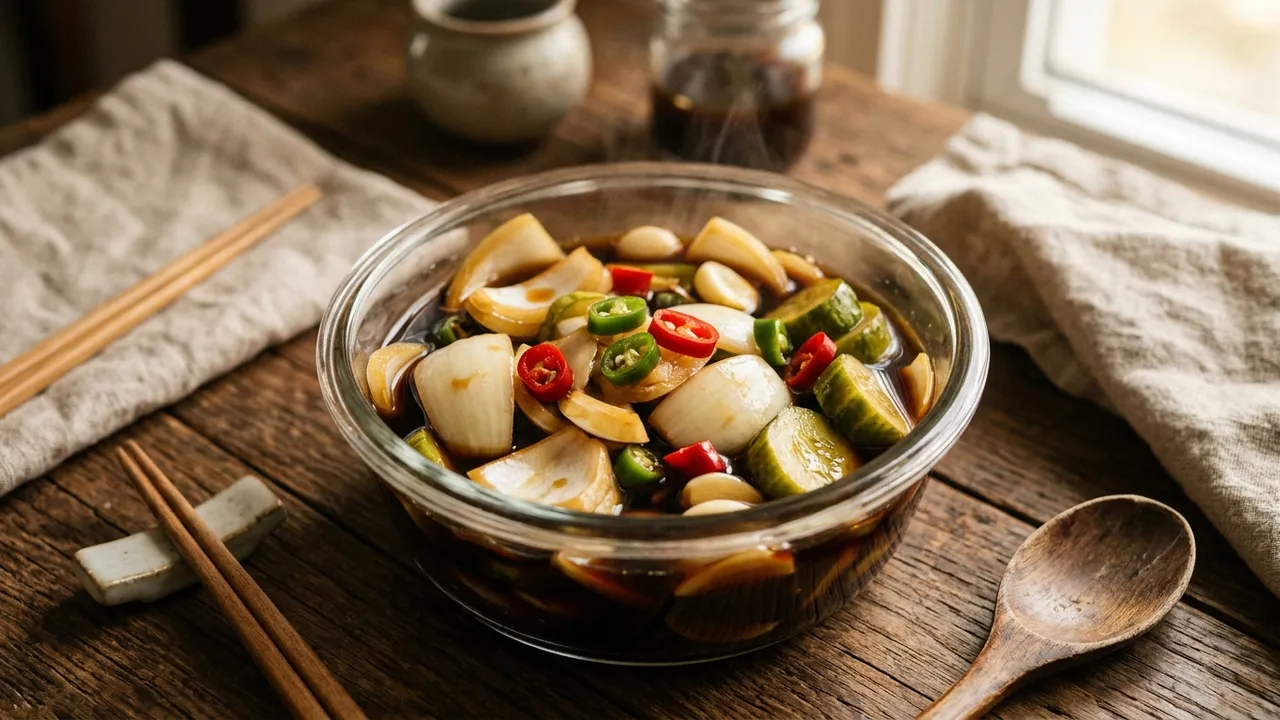
Sweet and Crispy Onion Jangajji (양파장아찌) Recipe
* 이미지는 AI가 생성한 참고 이미지로, 실제 조리 결과물과 다를 수 있습니다.
This recipe for Jangajji (장아찌) uses fresh onions, cucumbers, and chili peppers, offering a delightfully crisp and refreshing taste.
📝 Editor's Notes
Sweet and Crispy Onion Jangajji (양파장아찌) is a healthy side dish recipe made with fresh new season onions, crisp cucumbers, and chili peppers.
The sweet and sour flavor of the pickling liquid, the crunchy texture of the onions and cucumbers, and the refreshing kick of the chili peppers create a harmonious blend that perfectly whets your appetite.
The preparation process is relatively simple, and once made, it can be enjoyed for a long time, making it particularly popular among home cooks.
It's especially delicious and fresh when made with new season onions, which are in season from spring to early summer.
This magical dish will cut through the richness of grilled meats or oily foods.
🛒 Ingredient Tips
Selecting the right ingredients is crucial for making delicious jangajji (장아찌).
For fresh new season onions, choose ones with thin, glossy skins that are firm to the touch and not soft.
Fresh onions will have a short root end and no sprouts.
For cucumbers, look for straight, firm ones with vibrant color and intact spines.
It's also important to check that the stem end is not shriveled.
For Cheongyang chili peppers (청양고추) and red chili peppers, select those with bright, glossy colors and fresh stems.
Using in-season fresh onions will provide a much softer and sweeter flavor, so keep that in mind.
🔄 Substitution Guide
If fresh new season onions are difficult to find, regular onions can be used.
However, regular onions might be spicier and less crisp than fresh ones, so it's recommended to soak them in cold water for about 10 minutes after slicing to reduce their pungency.
If cucumbers are unavailable, you can substitute them with thickly sliced radishes.
Radishes offer a different kind of crisp texture, but note that they won't provide the unique aroma of cucumbers.
If mirin (맛술) is unavailable, as mentioned in the tips, you can substitute it with half a cup of soju (소주).
However, since soju lacks the sweetness of mirin, it's recommended to add about 0.5-1 tbsp of sugar to adjust the sweetness.
While substituting ingredients may alter the original flavor slightly, you can still enjoy a delicious jangajji with new nuances.
🥘 Ingredients
👨🍳 Cooking Points
There are three key cooking points for this recipe.
First, when boiling the pickling liquid, always keep the lid open.
If the lid is closed, the liquid might boil over, and the bay leaf aroma could become too strong.
It's important to remove the bay leaves after boiling for about 3 minutes to ensure their fragrance is sufficiently infused but not overpowering.
Second, add the vinegar and mirin (맛술) *after* turning off the heat.
Adding them while hot can cause the tartness of the vinegar and the aroma of the mirin to dissipate, resulting in less flavorful jangajji.
Lastly, it is crucial to let the completed pickling liquid cool completely before pouring it over the ingredients.
Pouring hot liquid can make the onions and cucumbers mushy, causing them to lose their crisp texture, and can also lead to spoilage of the jangajji. Please keep this in mind!
👨🍳 Directions
Wash all ingredients thoroughly and prepare them.
For the fresh onions, leave a small portion of the root end intact to prevent separation. Slice them attractively as desired.
Slice the cucumbers into thick rounds.
Slice the Cheongyang chili peppers (청양고추) and red chili peppers into thick, bite-sized pieces.
In a pot, combine 2.5 cups (600 ml) of water, 1.25 cups (300 ml) of soy sauce, 5 tbsp of sugar, 20 whole black peppercorns, and 5 bay leaves. Bring to a vigorous boil.
Once the soy sauce mixture comes to a vigorous boil, reduce the heat to low (or simmer) and continue to boil for about 3 minutes with the lid open to infuse the bay leaf aroma.
Turn off the heat and remove the bay leaves from the boiled soy sauce mixture. (Leave the whole black peppercorns in.)
Add 6.76 fl oz (200 ml) of vinegar and 6.76 fl oz (200 ml) of mirin (맛술) to the soy sauce mixture and mix well to complete the pickling liquid.
Place the prepared fresh onions, cucumbers, Cheongyang chili peppers (청양고추), and red chili peppers in a bowl, then pour the finished pickling liquid over them.
Gently press down the ingredients with a spoon or similar utensil to ensure they are submerged in the pickling liquid.
Once the pickling liquid has completely cooled, transfer the contents to an airtight container. Store at room temperature for about one day, then refrigerate.
It can be enjoyed deliciously after aging for about two days.
💡 Tips
Boiling the pickling liquid prevents the soy sauce flavor from changing and allows the jangajji to be stored for a longer period.
When boiling the pickling liquid, make sure to leave the lid open to prevent it from boiling over.
It is best to remove the bay leaves after boiling the pickling liquid to prevent their aroma from becoming too strong.
The amount of sugar or vinegar can be adjusted to your preference to control the sweetness and sourness.
If mirin (맛술) is unavailable, you can substitute it with half a cup of soju (소주).
It is crucial to allow the pickling liquid to cool completely before pouring it over the ingredients.
📦 Storage & Reuse
Once the Onion Jangajji (양파장아찌) is complete, allow the pickling liquid to cool completely before transferring it to an airtight container.
Let it ferment at room temperature for about a day, then refrigerate.
When refrigerated, it can be enjoyed fresh for approximately 2 weeks to 1 month.
Since the pickling liquid was boiled, it can be stored for a relatively long time, but it's best to consume it as soon as possible for optimal flavor.
Jangajji (장아찌) is not meant to be eaten warm, so it's best to take out only the desired amount and enjoy it chilled.
If you have leftover pickling liquid, don't throw it away!
You can use it to make jangajji with other vegetables or as a versatile soy sauce base for braised dishes.
🥢 Who This Is For
This sweet and crispy Onion Jangajji (양파장아찌) is a versatile side dish that pairs well with various occasions and preferences.
It is especially effective at cutting through the richness and refreshing the palate when served with greasy dishes like grilled samgyeopsal (삼겹살), galbijjim (갈비찜), or jeon (전) pancakes.
It's also a delightful treat when served over warm rice when you've lost your appetite.
It can be an excellent accent side dish for housewarming parties or when entertaining guests.
While adults typically prefer its flavor over children, the amount of chili peppers can be adjusted for the whole family to enjoy.
🔥 Nutrition Info
Considering this Onion Jangajji (양파장아찌) recipe is for a side dish eaten in multiple servings, the estimated calorie count per serving (approx. 50g) is about 70-100 kcal.
It primarily contains carbohydrates from sugar and onions, approximately 15-20g, and a small amount of protein from soy sauce, about 2-3g, with almost no fat.
Onions, a key ingredient, are rich in quercetin, vitamin C, and dietary fiber, which are good for vascular health.
Cucumbers provide hydration and vitamin K.
The capsaicin in chili peppers boosts metabolism and offers high vitamin C content.
The fermentation process during pickling can also add beneficial compounds that aid digestion.
💬 Frequently Asked Questions
- Q. What ingredients do I need for Sweet and Crispy Onion Jangajji (양파장아찌)?
- Main ingredients include Fresh Onions, Cucumbers, Cheongyang chili peppers (청양고추), Red chili peppers, Water. Selecting the right ingredients is crucial for making delicious jangajji (장아찌). For fresh new season onions, choose ones with thin, glossy skins that are firm to the touch and not soft. Fresh onions will have a short root end and no sprouts. For cucumbers, look for straight, firm ones with vibrant color and intact spines. It's also important to check that the stem end is not shriveled. For Cheongyang chili peppers (청양고추) and red chili peppers, select those with bright, glossy colors and fresh stems. Using in-season fresh onions will provide a much softer and sweeter flavor, so keep that in mind.
- Q. What are the key tips for making Sweet and Crispy Onion Jangajji (양파장아찌)?
- There are three key cooking points for this recipe. First, when boiling the pickling liquid, always keep the lid open. If the lid is closed, the liquid might boil over, and the bay leaf aroma could become too strong. It's important to remove the bay leaves after boiling for about 3 minutes to ensure their fragrance is sufficiently infused but not overpowering. Second, add the vinegar and mirin (맛술) *after* turning off the heat. Adding them while hot can cause the tartness of the vinegar and the aroma of the mirin to dissipate, resulting in less flavorful jangajji. Lastly, it is crucial to let the completed pickling liquid cool completely before pouring it over the ingredients. Pouring hot liquid can make the onions and cucumbers mushy, causing them to lose their crisp texture, and can also lead to spoilage of the jangajji. Please keep this in mind!
- Q. How should I store leftover Sweet and Crispy Onion Jangajji (양파장아찌)?
- Once the Onion Jangajji (양파장아찌) is complete, allow the pickling liquid to cool completely before transferring it to an airtight container. Let it ferment at room temperature for about a day, then refrigerate. When refrigerated, it can be enjoyed fresh for approximately 2 weeks to 1 month. Since the pickling liquid was boiled, it can be stored for a relatively long time, but it's best to consume it as soon as possible for optimal flavor. Jangajji (장아찌) is not meant to be eaten warm, so it's best to take out only the desired amount and enjoy it chilled. If you have leftover pickling liquid, don't throw it away! You can use it to make jangajji with other vegetables or as a versatile soy sauce base for braised dishes.
- Q. How many calories are in Sweet and Crispy Onion Jangajji (양파장아찌)?
- Considering this Onion Jangajji (양파장아찌) recipe is for a side dish eaten in multiple servings, the estimated calorie count per serving (approx. 50g) is about 70-100 kcal. It primarily contains carbohydrates from sugar and onions, approximately 15-20g, and a small amount of protein from soy sauce, about 2-3g, with almost no fat. Onions, a key ingredient, are rich in quercetin, vitamin C, and dietary fiber, which are good for vascular health. Cucumbers provide hydration and vitamin K. The capsaicin in chili peppers boosts metabolism and offers high vitamin C content. The fermentation process during pickling can also add beneficial compounds that aid digestion.
- Q. Can I substitute ingredients in Sweet and Crispy Onion Jangajji (양파장아찌)?
- If fresh new season onions are difficult to find, regular onions can be used. However, regular onions might be spicier and less crisp than fresh ones, so it's recommended to soak them in cold water for about 10 minutes after slicing to reduce their pungency. If cucumbers are unavailable, you can substitute them with thickly sliced radishes. Radishes offer a different kind of crisp texture, but note that they won't provide the unique aroma of cucumbers. If mirin (맛술) is unavailable, as mentioned in the tips, you can substitute it with half a cup of soju (소주). However, since soju lacks the sweetness of mirin, it's recommended to add about 0.5-1 tbsp of sugar to adjust the sweetness. While substituting ingredients may alter the original flavor slightly, you can still enjoy a delicious jangajji with new nuances.
💬 Comments
No comments yet. Be the first to comment!