
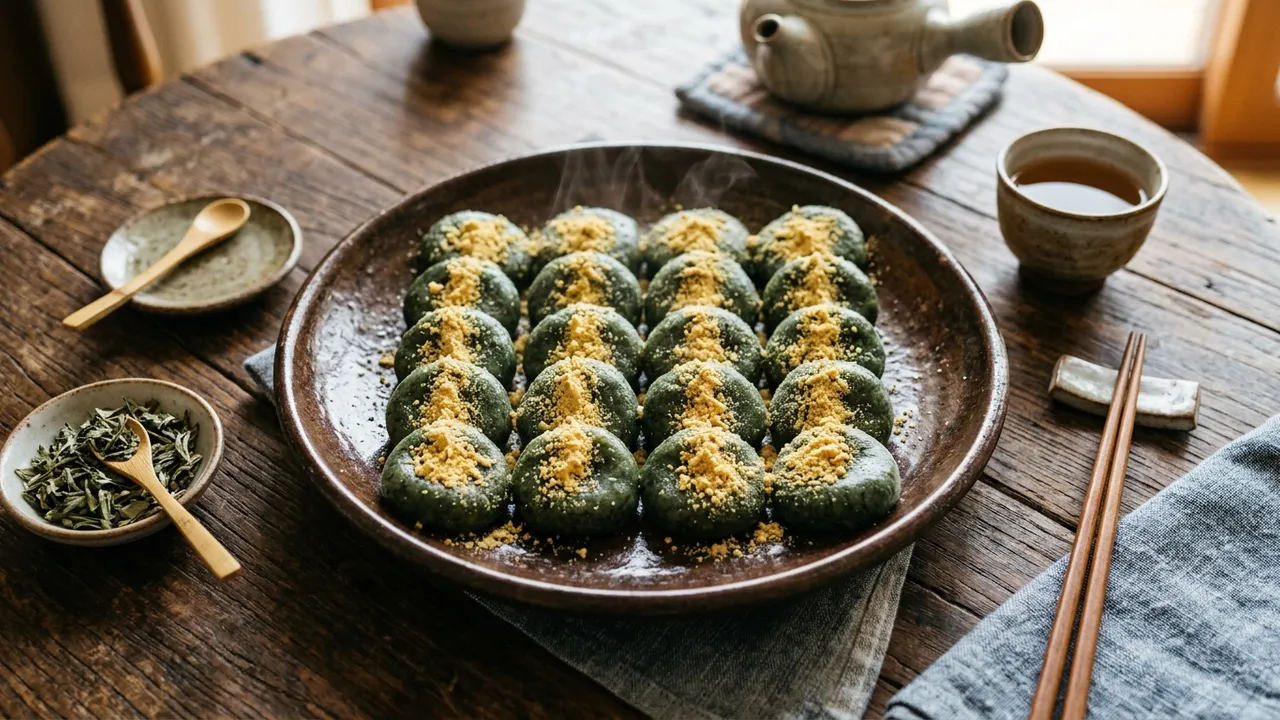
Mugwort Injeolmi (쑥 인절미) Recipe
* 이미지는 AI가 생성한 참고 이미지로, 실제 조리 결과물과 다를 수 있습니다.
Capturing the fragrant essence of spring, this Mugwort Injeolmi (쑥 인절미) recipe combines aromatic mugwort with chewy glutinous rice and savory mung bean powder, evoking a sense of nostalgic longing.
📝 Editor's Notes
Mugwort Injeolmi (쑥 인절미), imbued with the fragrant essence of spring, is a traditional snack loved by all ages, thanks to its chewy glutinous rice and savory mung bean powder.
Its unique, subtle mugwort aroma fills your mouth, evoking nostalgic memories.
While it requires meticulous effort, it rewards you with an exceptionally delicious and wholesome treat.
Perfect as a spring delicacy for guests or a family snack, it pairs wonderfully with warm tea for a more enjoyable experience.
This recipe is of medium difficulty, but by following a few key steps, you can successfully make delicious mugwort injeolmi at home.
🛒 Ingredient Tips
The key to delicious Mugwort Injeolmi is fresh mugwort!
Using young mugwort harvested in spring will give you a richer aroma and a more tender texture.
Look for bright green leaves that are soft, not too fibrous in the stems.
It's crucial to prepare and use it soon after purchasing before it wilts.
🌾 **Glutinous Rice**: Using good quality domestic glutinous rice (찹쌀) will help achieve the perfect chewy texture for injeolmi.
Opt for new harvest rice over older rice for better flavor and stickiness.
🌱 **Peeled Mung Beans**: Mung bean powder (녹두 고물) is an important ingredient that adds a savory richness to injeolmi.
Using peeled mung beans (깐녹두) makes preparation much easier.
Choose beans that are vibrant yellow, clear, and free from any signs of damage or insects.
Good ingredients make for delicious injeolmi.
🔄 Substitution Guide
If you're not accustomed to the scent of mugwort or have an allergy, you can make injeolmi using just glutinous rice.
Alternatively, you can add a small amount of sweet pumpkin powder or purple sweet potato powder for color and a subtle sweetness.
While you'll miss the unique fragrance of mugwort, you'll enjoy the distinct flavors of these other ingredients.
🌱 **Mung Bean Topping (Gomul)**: If peeled mung beans are hard to find or you prefer a different topping, the most common alternative is roasted soybean powder (콩가루).
Soybean powder offers a savory and rich flavor that pairs well with injeolmi, distinct from mung bean powder.
Black sesame powder or toasted sesame seed powder can also be used for a more aromatic and diverse flavor, though they will differ from the plain and soft texture of mung bean powder.
🍯 **Raw Sugar**: You can use regular sugar instead of raw sugar (원당), but you might lose some of the subtle sweetness and minerals unique to raw sugar.
Honey or jocheong (조청, Korean grain syrup) can provide a moister and deeper sweetness, but since they are liquid, be mindful of the amount to avoid affecting the consistency of the mugwort paste.
🥘 Ingredients
👨🍳 Cooking Points
The glutinous rice is the most crucial step in determining the texture of your injeolmi.
The key ratio is 3 cups of glutinous rice to 2 cups (400 ml) of water for a firm, non-mushy result.
By soaking the glutinous rice for 2 hours and cooking it on the white rice setting for 29 minutes, you'll achieve sticky rice that's both firm and chewy. This is the main point!
🌿 **Blanching & Grinding Mugwort**: When blanching mugwort, only do so briefly for about 3 minutes in boiling water to preserve its aroma and vibrant color.
Immediately cool it in cold water afterward and squeeze out excess moisture.
When grinding in a blender, add only 0.5 cup (100 ml) of water and pulse blend to create a fine, thick mugwort paste.
Be careful not to add too much water, as it can make the mixture too soft when combined with the sticky rice.
💪 **Pounding Mugwort Rice Cake**: Pounding the sticky rice and mugwort paste mixture for 20 minutes requires some arm strength, but it's vital for achieving the injeolmi's characteristic chewiness.
Lightly moistening the pestle with water as you pound will prevent the mugwort rice cake from sticking and make the process much easier.
Using slightly cooled sticky rice also makes it easier to pound and enhances its chewiness.
👨🍳 Directions
Soak 3 cups of glutinous rice for 2 hours. Transfer it to a rice cooker, add 0.5 tbsp sea salt and 2 cups (400 ml) of water. Press the white rice cooking button and cook for 29 minutes to make sticky rice.
Just before the water boils in a pot, place a steamer basket inside. Line it with a cotton cloth, add 250 g of peeled mung beans (soaked for 2 hours), cover with the cloth, and close the lid. Steam for 25 minutes.
Wash 300 g of mugwort thoroughly in lukewarm water. Add it to a pan of boiling water, stir, and blanch for 3 minutes. Turn off the heat and rinse with cold water to cool.
Squeeze out the water from the blanched mugwort, then chop it finely. Put it into a blender with 0.5 cup (100 ml) of water, 0.5 tbsp sea salt, and 2 tbsp raw sugar. Pulse blend until finely ground.
Once the steamed peeled mung beans have completely cooled, transfer them to a mortar. Pound them well, adding 0.5 tbsp raw sugar and 0.25 tbsp salt during the process. Continue pounding, then crumble by hand to prepare the mung bean powder topping (gomul).
Transfer the cooked glutinous rice from the rice cooker to a large bowl and let it cool for 5 minutes.
Add the ground mugwort paste to the cooled glutinous rice and pound with a pestle for 20 minutes. Lightly moistening the pestle with water while pounding will prevent the mugwort rice cake mixture from sticking.
Line a tray with plastic wrap and brush with an appropriate amount of sesame oil. Divide the pounded mugwort rice cake in half, spread each half into a long rectangular shape. Lightly grease a knife with sesame oil and cut into bite-sized pieces.
Coat the cut mugwort injeolmi pieces evenly with the prepared mung bean powder topping to finish.
💡 Tips
When cooking glutinous rice for injeolmi, make sure to use just enough water for the 2-hour soaked rice to achieve a firm, fluffy texture, not mushy.
Do not blanch the mugwort for too long, as its aroma will dissipate. Blanch lightly for about 3 minutes.
When grinding blanched mugwort, use minimal water and pulse blend to achieve a fine, dry paste.
Lightly moistening the pestle with water while pounding the mugwort glutinous rice will prevent sticking and help achieve a chewy texture.
For a crumbly texture, make sure the mung bean powder topping (gomul) is completely cooled before pounding.
📦 Storage & Reuse
Mugwort Injeolmi is best enjoyed on the day it's made, as glutinous rice cakes tend to harden over time.
Leftovers can be stored in an airtight container in the refrigerator for about a day.
For longer storage, freezing is recommended.
Wrap individual portions tightly in plastic wrap, then place them in an airtight container or freezer bag and store in the freezer for 1-2 months.
To thaw, simply leave at room temperature or gently warm in the microwave until soft again.
Alternatively, baking them in an air fryer yields a delightful snack with a crispy exterior and chewy interior.
Hardened injeolmi can also be enjoyed with honey or added to tteokbokki (떡볶이).
🥢 Who This Is For
This Mugwort Injeolmi (쑥 인절미) is an excellent healthy snack to enjoy with family on a warm spring afternoon.
It will particularly evoke fond memories for elders and introduce children to the natural flavors of spring.
It also makes for a wonderful treat when entertaining guests.
It pairs beautifully with warm plum tea or fragrant chrysanthemum tea, as well as refreshing sikhye (식혜, sweet rice punch) or sujeonggwa (수정과, cinnamon punch).
Surprisingly, it also offers a unique charm when enjoyed with a clean-tasting Americano.
🔥 Nutrition Info
Based on 3 cups of glutinous rice and 250 g of mung beans, this Mugwort Injeolmi (쑥 인절미) recipe yields approximately 6 servings.
Each serving is estimated to contain about 450-500 kcal.
The main ingredients, glutinous rice and mung beans, provide about 80-90 g of carbohydrates and 10-15 g of protein.
Fat content is relatively low, around 5 g, due to the minimal use of sesame oil.
Mugwort, in particular, is rich in various minerals like vitamins A and C, calcium, and iron, as well as fiber, aiding in immune system strengthening and fatigue recovery.
Mung beans support detoxification and diuretic functions and are high in protein, contributing to good nutritional balance.
The use of raw sugar (원당) instead of refined sugar to add a healthy sweetness is also a benefit.
💬 Frequently Asked Questions
- Q. What ingredients do I need for Mugwort Injeolmi (쑥 인절미)?
- Main ingredients include Mugwort, Glutinous Rice, Water (for glutinous rice), Sea Salt (for glutinous rice), Peeled Mung Beans. The key to delicious Mugwort Injeolmi is fresh mugwort! Using young mugwort harvested in spring will give you a richer aroma and a more tender texture. Look for bright green leaves that are soft, not too fibrous in the stems. It's crucial to prepare and use it soon after purchasing before it wilts. 🌾 **Glutinous Rice**: Using good quality domestic glutinous rice (찹쌀) will help achieve the perfect chewy texture for injeolmi. Opt for new harvest rice over older rice for better flavor and stickiness. 🌱 **Peeled Mung Beans**: Mung bean powder (녹두 고물) is an important ingredient that adds a savory richness to injeolmi. Using peeled mung beans (깐녹두) makes preparation much easier. Choose beans that are vibrant yellow, clear, and free from any signs of damage or insects. Good ingredients make for delicious injeolmi.
- Q. What are the key tips for making Mugwort Injeolmi (쑥 인절미)?
- The glutinous rice is the most crucial step in determining the texture of your injeolmi. The key ratio is 3 cups of glutinous rice to 2 cups (400 ml) of water for a firm, non-mushy result. By soaking the glutinous rice for 2 hours and cooking it on the white rice setting for 29 minutes, you'll achieve sticky rice that's both firm and chewy. This is the main point! 🌿 **Blanching & Grinding Mugwort**: When blanching mugwort, only do so briefly for about 3 minutes in boiling water to preserve its aroma and vibrant color. Immediately cool it in cold water afterward and squeeze out excess moisture. When grinding in a blender, add only 0.5 cup (100 ml) of water and pulse blend to create a fine, thick mugwort paste. Be careful not to add too much water, as it can make the mixture too soft when combined with the sticky rice. 💪 **Pounding Mugwort Rice Cake**: Pounding the sticky rice and mugwort paste mixture for 20 minutes requires some arm strength, but it's vital for achieving the injeolmi's characteristic chewiness. Lightly moistening the pestle with water as you pound will prevent the mugwort rice cake from sticking and make the process much easier. Using slightly cooled sticky rice also makes it easier to pound and enhances its chewiness.
- Q. How should I store leftover Mugwort Injeolmi (쑥 인절미)?
- Mugwort Injeolmi is best enjoyed on the day it's made, as glutinous rice cakes tend to harden over time. Leftovers can be stored in an airtight container in the refrigerator for about a day. For longer storage, freezing is recommended. Wrap individual portions tightly in plastic wrap, then place them in an airtight container or freezer bag and store in the freezer for 1-2 months. To thaw, simply leave at room temperature or gently warm in the microwave until soft again. Alternatively, baking them in an air fryer yields a delightful snack with a crispy exterior and chewy interior. Hardened injeolmi can also be enjoyed with honey or added to tteokbokki (떡볶이).
- Q. How many calories are in Mugwort Injeolmi (쑥 인절미)?
- Based on 3 cups of glutinous rice and 250 g of mung beans, this Mugwort Injeolmi (쑥 인절미) recipe yields approximately 6 servings. Each serving is estimated to contain about 450-500 kcal. The main ingredients, glutinous rice and mung beans, provide about 80-90 g of carbohydrates and 10-15 g of protein. Fat content is relatively low, around 5 g, due to the minimal use of sesame oil. Mugwort, in particular, is rich in various minerals like vitamins A and C, calcium, and iron, as well as fiber, aiding in immune system strengthening and fatigue recovery. Mung beans support detoxification and diuretic functions and are high in protein, contributing to good nutritional balance. The use of raw sugar (원당) instead of refined sugar to add a healthy sweetness is also a benefit.
- Q. Can I substitute ingredients in Mugwort Injeolmi (쑥 인절미)?
- If you're not accustomed to the scent of mugwort or have an allergy, you can make injeolmi using just glutinous rice. Alternatively, you can add a small amount of sweet pumpkin powder or purple sweet potato powder for color and a subtle sweetness. While you'll miss the unique fragrance of mugwort, you'll enjoy the distinct flavors of these other ingredients. 🌱 **Mung Bean Topping (Gomul)**: If peeled mung beans are hard to find or you prefer a different topping, the most common alternative is roasted soybean powder (콩가루). Soybean powder offers a savory and rich flavor that pairs well with injeolmi, distinct from mung bean powder. Black sesame powder or toasted sesame seed powder can also be used for a more aromatic and diverse flavor, though they will differ from the plain and soft texture of mung bean powder. 🍯 **Raw Sugar**: You can use regular sugar instead of raw sugar (원당), but you might lose some of the subtle sweetness and minerals unique to raw sugar. Honey or jocheong (조청, Korean grain syrup) can provide a moister and deeper sweetness, but since they are liquid, be mindful of the amount to avoid affecting the consistency of the mugwort paste.
💬 Comments
No comments yet. Be the first to comment!