
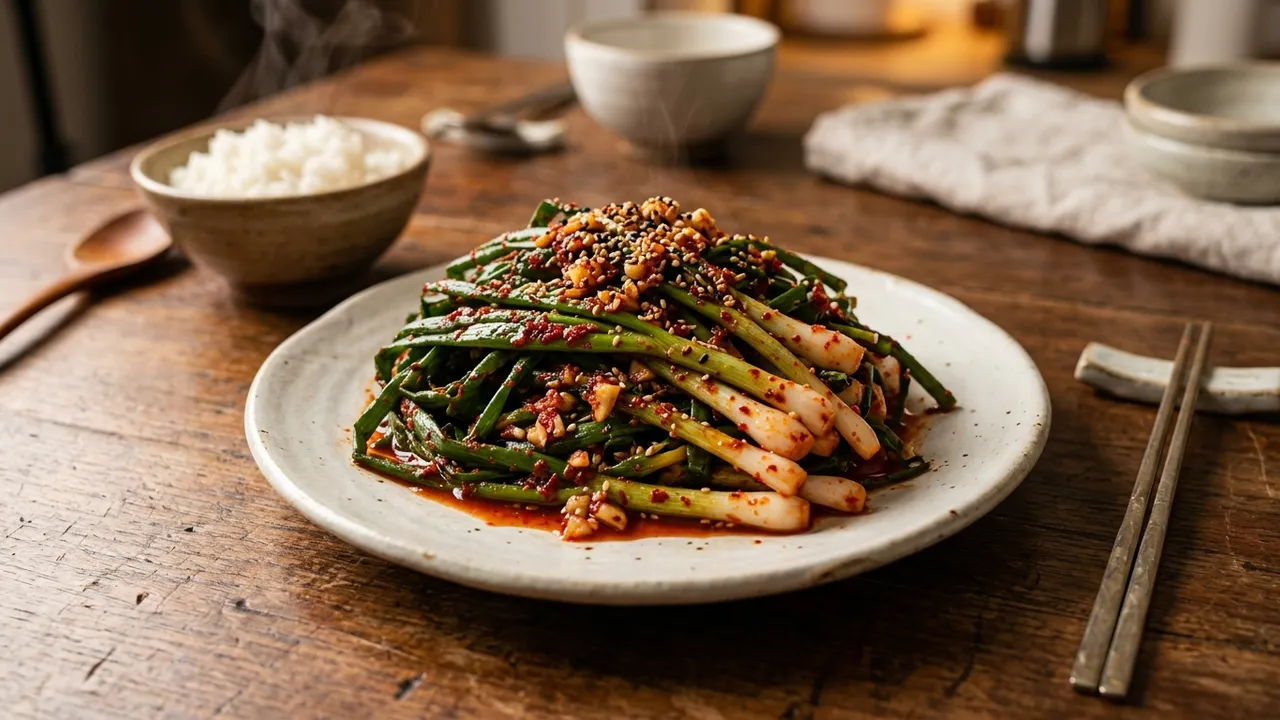
Appetite-Boosting Spring Tonic Side Dish: Scallion Salad (Jo
* 이미지는 AI가 생성한 참고 이미지로, 실제 조리 결과물과 다를 수 있습니다.
This Scallion Salad (Jokpa Muchim) recipe is a spring tonic side dish that's much easier to make than kimchi and as delicious as seasoned vegetables. It's a seasonal delicacy that helps purify the blood and revitalize the body.
📝 Editor's Notes
This Scallion Salad (Jokpa Muchim) is a refreshing and clean-tasting dish that will help you regain your appetite in spring.
It's much simpler than kimchi, yet its sweet, tangy, and spicy seasoning, combined with the fragrant scallions, will make you finish a whole bowl of rice in no time.
If you follow the blanching process carefully, even beginners can easily make this "easy" level tonic side dish.
It's especially perfect for spring days when you need an energy boost, as it's a healthy menu that purifies the blood and vitalizes the body.
🛒 Ingredient Tips
It's important to choose fresh scallions (jokpa).
Look for ones with vibrant green tips that aren't dry, and root ends that are firm and not too thick.
Thicker bulbs can be very pungent, so choose slender and uniform ones, or cleverly halve any thicker parts.
Plum extract (maesil-aek) is a key ingredient for the sweet and sour taste, so using a good quality one will yield a deeper flavor.
🔄 Substitution Guide
If scallions (jokpa) are unavailable, you can use young green onions, but the unique fragrance of scallions might be less prominent.
Green onions can be slightly tougher in texture than scallions, so adjust the blanching time accordingly.
Instead of plum extract (maesil-aek), you can mix sugar and vinegar for a sweet and sour taste, but the distinctive deep flavor of plum extract might be reduced.
If fish sauce (myeolchi aekjeot) is not available, you can substitute with tuna sauce or guk-ganjang (Korean soup soy sauce), but note that the type of umami flavor may vary slightly.
🥘 Ingredients
👨🍳 Cooking Points
The most crucial point of this recipe is "blanching the scallions." In rapidly boiling water with sea salt (cheonil-yeom), blanch the white parts briefly first.
For the green leafy parts, just give them a quick stir once, then immediately remove them and cool them in cold water.
This ensures a tender and soft texture without becoming chewy.
Blanching too long will make them mushy, while blanching too little will leave them pungent and tough.
Also, remember not to squeeze out the water too forcefully, and when mixing with the seasoning, toss gently to prevent the scallions from breaking apart!
👨🍳 Directions
Wash and trim 10.6 oz (300g) of scallions. Separate the white root ends from the green leafy parts and cut them. For the white parts, halve the root ends lengthwise to reduce pungency and make them easier to eat. If the green leafy parts are long, cut them once more and set aside separately.
In a large pot, bring plenty of water to a rolling boil. Add 0.5 tbsp of sea salt (cheonil-yeom). Add the white parts of the scallions first and blanch them. Once the water starts boiling again, add the green leafy parts, stir once, then immediately remove and immerse in cold water to cool.
Gently press to squeeze out the excess water from the cooled scallions.
In a mixing bowl, combine 0.5 tbsp gochujang (고추장), 1 tbsp gochugaru (고춧가루), 0.5 tbsp soy sauce, 0.5 tbsp fish sauce (myeolchi aekjeot), 0.5 tbsp vinegar, 2 tbsp plum extract (maesil-aek), 0.5 tbsp minced garlic, 0.5 tbsp sesame oil (chamgireum), and 0.5 tbsp oligosaccharide syrup. Mix well to create the seasoning sauce.
Before adding the squeezed scallions to the seasoning sauce, gently loosen them up. Then add them to the sauce and toss gently.
Taste both the green leafy parts and the white parts. If it tastes bland, add about 1.5 pinches of salt to adjust the seasoning. Finally, sprinkle with toasted sesame seeds and gently toss again. Your Scallion Salad (Jokpa Muchim) is ready.
💡 Tips
If the white bulb ends of the scallions are too thick, they can be too pungent. Choose slender and uniform scallions, or halve thicker bulbs lengthwise.
Blanching the scallions briefly helps them retain a tender and soft texture without becoming chewy.
While delicious immediately after mixing, Scallion Salad (Jokpa Muchim) becomes more moist and develops a deeper flavor as the seasoning permeates over time.
Serving it with meat dishes, rolled omelets (gyeran-mari), or grilled fish helps cut through richness and cleanses the palate.
📦 Storage & Reuse
While Scallion Salad (Jokpa Muchim) is delicious immediately, storing it in the refrigerator for a day or two allows the seasoning to fully penetrate, resulting in an even deeper and more moist flavor.
Stored in an airtight container in the refrigerator, it can be enjoyed fresh for about 2-3 days.
However, freezing is not recommended as it can make the scallions lose their crisp texture.
Leftover Scallion Salad (Jokpa Muchim) is fantastic mixed with warm rice or served alongside grilled pork belly (samgyeopsal), where it creates a perfect harmony of flavors.
🥢 Who This Is For
🍽️ This is a great dish for the whole family to enjoy in spring, especially when you've lost your appetite or need an energy boost.
It pairs perfectly with rich meat dishes or grilled fish, cutting through the greasiness with its refreshing taste.
It's also excellent served alongside rolled omelets (gyeran-mari), or simply mixed with warm white rice – you won't need any other side dishes!
It's also a wonderful and unique side dish suitable for a casual housewarming or guest meal.
🔥 Nutrition Info
This Scallion Salad (Jokpa Muchim) has a light calorie count, estimated at around 80-90 kcal per serving.
It's estimated to contain about 2-3g of protein, 2-3g of fat, and 12-15g of carbohydrates.
Notably, scallions (jokpa), the main ingredient, are rich in vitamins C, K, and A, and dietary fiber, which can help boost immunity and support blood health.
While there is some sugar from the plum extract (maesil-aek) and oligosaccharide syrup, it is generally considered a healthy and refreshing nutritious side dish.
💬 Frequently Asked Questions
- Q. What ingredients do I need for Appetite-Boosting Spring Tonic Side Dish: Scallion Salad (Jokpa Muchim)?
- Main ingredients include Scallions, Gochujang (고추장), Gochugaru (고춧가루), Soy sauce, Fish sauce (Myeolchi aekjeot). It's important to choose fresh scallions (jokpa). Look for ones with vibrant green tips that aren't dry, and root ends that are firm and not too thick. Thicker bulbs can be very pungent, so choose slender and uniform ones, or cleverly halve any thicker parts. Plum extract (maesil-aek) is a key ingredient for the sweet and sour taste, so using a good quality one will yield a deeper flavor.
- Q. What are the key tips for making Appetite-Boosting Spring Tonic Side Dish: Scallion Salad (Jokpa Muchim)?
- The most crucial point of this recipe is "blanching the scallions." In rapidly boiling water with sea salt (cheonil-yeom), blanch the white parts briefly first. For the green leafy parts, just give them a quick stir once, then immediately remove them and cool them in cold water. This ensures a tender and soft texture without becoming chewy. Blanching too long will make them mushy, while blanching too little will leave them pungent and tough. Also, remember not to squeeze out the water too forcefully, and when mixing with the seasoning, toss gently to prevent the scallions from breaking apart!
- Q. How should I store leftover Appetite-Boosting Spring Tonic Side Dish: Scallion Salad (Jokpa Muchim)?
- While Scallion Salad (Jokpa Muchim) is delicious immediately, storing it in the refrigerator for a day or two allows the seasoning to fully penetrate, resulting in an even deeper and more moist flavor. Stored in an airtight container in the refrigerator, it can be enjoyed fresh for about 2-3 days. However, freezing is not recommended as it can make the scallions lose their crisp texture. Leftover Scallion Salad (Jokpa Muchim) is fantastic mixed with warm rice or served alongside grilled pork belly (samgyeopsal), where it creates a perfect harmony of flavors.
- Q. How many calories are in Appetite-Boosting Spring Tonic Side Dish: Scallion Salad (Jokpa Muchim)?
- This Scallion Salad (Jokpa Muchim) has a light calorie count, estimated at around 80-90 kcal per serving. It's estimated to contain about 2-3g of protein, 2-3g of fat, and 12-15g of carbohydrates. Notably, scallions (jokpa), the main ingredient, are rich in vitamins C, K, and A, and dietary fiber, which can help boost immunity and support blood health. While there is some sugar from the plum extract (maesil-aek) and oligosaccharide syrup, it is generally considered a healthy and refreshing nutritious side dish.
- Q. Can I substitute ingredients in Appetite-Boosting Spring Tonic Side Dish: Scallion Salad (Jokpa Muchim)?
- If scallions (jokpa) are unavailable, you can use young green onions, but the unique fragrance of scallions might be less prominent. Green onions can be slightly tougher in texture than scallions, so adjust the blanching time accordingly. Instead of plum extract (maesil-aek), you can mix sugar and vinegar for a sweet and sour taste, but the distinctive deep flavor of plum extract might be reduced. If fish sauce (myeolchi aekjeot) is not available, you can substitute with tuna sauce or guk-ganjang (Korean soup soy sauce), but note that the type of umami flavor may vary slightly.
💬 Comments
No comments yet. Be the first to comment!