
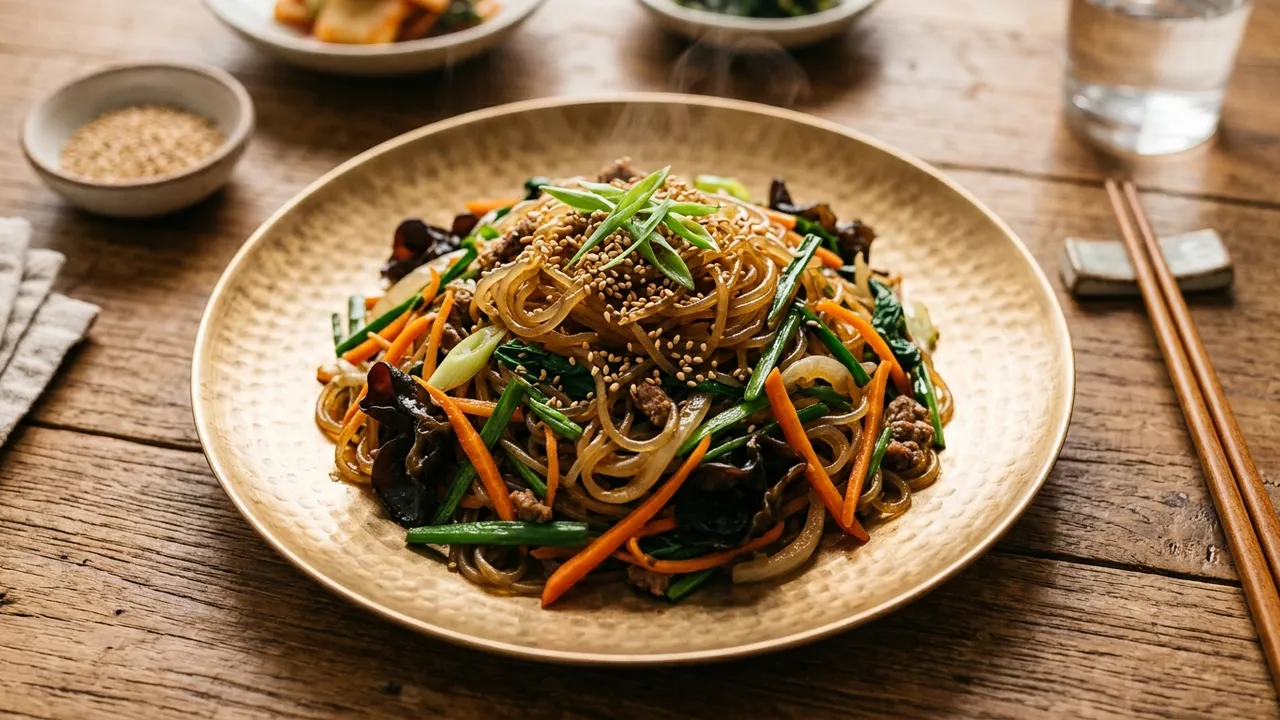
Japchae Recipe That Stays Firm
* 이미지는 AI가 생성한 참고 이미지로, 실제 조리 결과물과 다를 수 있습니다.
This is a Japchae recipe actually used by a famous Korean traditional restaurant, designed to prevent the noodles from getting soggy or mushy over time. The key is to cook the glass noodles directly in the seasoned sauce without pre-soaking them in water, allowing them to absorb the flavor and oil.
📝 Editor's Notes
This Japchae recipe features a secret technique from a traditional Korean restaurant, with its main characteristic being that it 'doesn't get soggy'.
By cooking the glass noodles directly in the seasoned sauce without pre-soaking or boiling them, they absorb sufficient flavor and oil, which is key to keeping the noodles from getting mushy while maintaining their chewy texture over time.
Its savory-sweet umami flavor is exquisite, and when combined with abundant vegetables, it's perfect for celebratory meals.
The difficulty level is intermediate, with precise control over the noodle cooking time being crucial.
It pairs wonderfully with special occasions or as a dish for entertaining guests.
🛒 Ingredient Tips
For the glass noodles, the star of Japchae, choosing a good quality product like 'Ottogi Pre-Cut Chewy Glass Noodles' is recommended.
Their pre-cut nature also adds to cooking convenience.
The flavor of the soy sauce greatly influences the overall taste of Japchae, so it's important to use a Jin Ganjang (진간장) that offers a deep, rich flavor, such as 'Masan Mongo Jin Ganjang'.
If it's hard to find, choose your favorite delicious Jin Ganjang.
Wood ear mushrooms, purchased dried, can be rehydrated in lukewarm water to add a delightful chewy texture.
🔄 Substitution Guide
If 'Masan Mongo Jin Ganjang (진간장)' specified in the recipe is unavailable, any commercially available Jin Ganjang from another brand can be used.
However, since the saltiness and flavor vary by brand, it's important to taste and adjust the seasoning sauce accordingly.
Caramel coloring enhances the appetizing color of Japchae, but it can be omitted for home cooking without significant impact on taste, only a slightly lighter color.
Dasida (다시다) and Miwon (미원) add umami, but if you're concerned about MSG intake, using shiitake mushroom powder or kelp broth (dashima yuksu) is a good alternative for a natural umami flavor.
The depth of taste might differ slightly.
🥘 Ingredients
👨🍳 Cooking Points
The most crucial cooking point is 'cooking the glass noodles directly in the seasoned sauce without pre-soaking them'.
This allows the noodles to uniformly absorb the seasoning and oil, preventing sogginess and developing a deep flavor.
Cook for about 6-7 minutes over medium heat, but since cooking times can vary depending on your stove's power, be sure to taste the noodles and adjust for doneness.
Also, sauté onions and carrots separately to maintain their vibrant color and texture.
Once the noodles are cooked, avoid stirring too much as they can break; gently mix in the sesame oil and black pepper. That's the key!
👨🍳 Directions
In a large pot or pan, combine 9.7 lb of water, 22.9 oz of Masan Mongo Jin Ganjang (진간장), 11.3 oz of brown sugar, 8.8 oz of cooking oil, 0.78 oz of caramel coloring, 0.56 oz of CJ Dasida (다시다), and 0.28 oz of Miwon (미원). Bring the seasoning sauce to a boil.
Once the seasoning sauce boils, immediately add 2.2 lb of un-soaked Ottogi Pre-Cut Chewy Glass Noodles and the soaked wood ear mushrooms. Cook for about 6-7 minutes over medium heat. (Stove heat varies, so use the time as a guideline but taste the noodles to adjust cooking time. Adding wood ear mushrooms with the glass noodles as they cook allows them to absorb the seasoning, making them much more flavorful.)
When the glass noodles are fully cooked, pour them into a colander to drain any remaining sauce. Transfer only the noodles to a large mixing bowl, then drizzle with sesame oil and sprinkle with black pepper to infuse a savory aroma. (Since the glass noodles have already absorbed the seasoning, stirring them too vigorously can cause them to break or become mushy, so mix gently.)
In a separate pan, sauté the julienned onion and julienned carrot separately. Season each with a little seasoned salt (맛소금) and black pepper.
Pour the sautéed onions and carrots over the finished Japchae and mix lightly.
When serving, place the Japchae and sautéed vegetables in a bowl. Garnish with garlic chives or straight-cut green onions, and finally, sprinkle with toasted sesame seeds. (Do not mix garlic chives or other green vegetables into the finished Japchae beforehand, as their color will quickly change over time, and there's a higher risk of spoilage. Garlic chives should always be added at the very end.)
💡 Tips
The key to preventing the glass noodles from becoming soggy and mushy is to cook the dry noodles directly in the seasoned sauce without pre-soaking or boiling and rinsing them in water, allowing them to directly absorb both the flavor and cooking oil.
Adding wood ear mushrooms along with the glass noodles as they cook allows them to absorb the seasoning, making them much more flavorful.
Julienned onions and carrots should be sautéed separately in a pan, not cooked with the glass noodles, to preserve their texture and vibrant color, resulting in a higher quality dish.
Green vegetables like garlic chives or green onions should not be mixed into the Japchae beforehand. Add them just before serving to prevent discoloration or spoilage.
For storing Japchae: For establishments with high turnover, cool the Japchae and store it in an insulated container. For establishments with lower turnover, cool the Japchae, wrap individual portions in parchment paper, refrigerate, and then microwave for 1 minute and 30 seconds just before serving to achieve a fresh-made texture.
📦 Storage & Reuse
Store the finished Japchae in an airtight container in the refrigerator for 2-3 days to keep it fresh.
Freezing is possible, but not recommended as the texture of the glass noodles may become tough or mushy.
It's best to portion out only what you plan to eat.
To reheat, microwave briefly or sauté in a pan with a little cooking oil over low heat.
Adding 1-2 tbsp of water or broth during reheating can help maintain moisture.
🥢 Who This Is For
This Japchae is highly recommended for entertaining guests or for celebratory meals because it doesn't get soggy easily over time.
You can prepare it in advance without worry, allowing for a relaxed cooking experience.
It's also great as a weekend special for the whole family.
It makes a hearty meal on its own with rice or can complement main dishes like bulgogi (불고기) or galbijjim (갈비찜) for a richer spread.
🔥 Nutrition Info
This recipe is for a large batch, so when converted to a single serving (approximately 7 oz), it is estimated to be around 550-650 kcal.
Carbohydrates from the glass noodles and brown sugar are predominant, and the fat content is high due to cooking oil and sesame oil.
Protein can be consumed in small amounts from wood ear mushrooms and other vegetables.
Especially given the Jin Ganjang (진간장), Dasida (다시다), and Miwon (미원), the sodium content can be quite high, so portion control is recommended.
While dietary fiber is supplemented by vegetables, it's advisable to be aware that this is generally a high-carbohydrate, high-fat, and high-sodium dish.
💬 Frequently Asked Questions
- Q. What ingredients do I need for Japchae Recipe That Stays Firm?
- Main ingredients include Ottogi Pre-Cut Chewy Glass Noodles, Water, Masan Mongo Jin Ganjang (진간장), Brown Sugar, Cooking Oil. For the glass noodles, the star of Japchae, choosing a good quality product like 'Ottogi Pre-Cut Chewy Glass Noodles' is recommended. Their pre-cut nature also adds to cooking convenience. The flavor of the soy sauce greatly influences the overall taste of Japchae, so it's important to use a Jin Ganjang (진간장) that offers a deep, rich flavor, such as 'Masan Mongo Jin Ganjang'. If it's hard to find, choose your favorite delicious Jin Ganjang. Wood ear mushrooms, purchased dried, can be rehydrated in lukewarm water to add a delightful chewy texture.
- Q. What are the key tips for making Japchae Recipe That Stays Firm?
- The most crucial cooking point is 'cooking the glass noodles directly in the seasoned sauce without pre-soaking them'. This allows the noodles to uniformly absorb the seasoning and oil, preventing sogginess and developing a deep flavor. Cook for about 6-7 minutes over medium heat, but since cooking times can vary depending on your stove's power, be sure to taste the noodles and adjust for doneness. Also, sauté onions and carrots separately to maintain their vibrant color and texture. Once the noodles are cooked, avoid stirring too much as they can break; gently mix in the sesame oil and black pepper. That's the key!
- Q. How should I store leftover Japchae Recipe That Stays Firm?
- Store the finished Japchae in an airtight container in the refrigerator for 2-3 days to keep it fresh. Freezing is possible, but not recommended as the texture of the glass noodles may become tough or mushy. It's best to portion out only what you plan to eat. To reheat, microwave briefly or sauté in a pan with a little cooking oil over low heat. Adding 1-2 tbsp of water or broth during reheating can help maintain moisture.
- Q. How many calories are in Japchae Recipe That Stays Firm?
- This recipe is for a large batch, so when converted to a single serving (approximately 7 oz), it is estimated to be around 550-650 kcal. Carbohydrates from the glass noodles and brown sugar are predominant, and the fat content is high due to cooking oil and sesame oil. Protein can be consumed in small amounts from wood ear mushrooms and other vegetables. Especially given the Jin Ganjang (진간장), Dasida (다시다), and Miwon (미원), the sodium content can be quite high, so portion control is recommended. While dietary fiber is supplemented by vegetables, it's advisable to be aware that this is generally a high-carbohydrate, high-fat, and high-sodium dish.
- Q. Can I substitute ingredients in Japchae Recipe That Stays Firm?
- If 'Masan Mongo Jin Ganjang (진간장)' specified in the recipe is unavailable, any commercially available Jin Ganjang from another brand can be used. However, since the saltiness and flavor vary by brand, it's important to taste and adjust the seasoning sauce accordingly. Caramel coloring enhances the appetizing color of Japchae, but it can be omitted for home cooking without significant impact on taste, only a slightly lighter color. Dasida (다시다) and Miwon (미원) add umami, but if you're concerned about MSG intake, using shiitake mushroom powder or kelp broth (dashima yuksu) is a good alternative for a natural umami flavor. The depth of taste might differ slightly.
💬 Comments
No comments yet. Be the first to comment!