
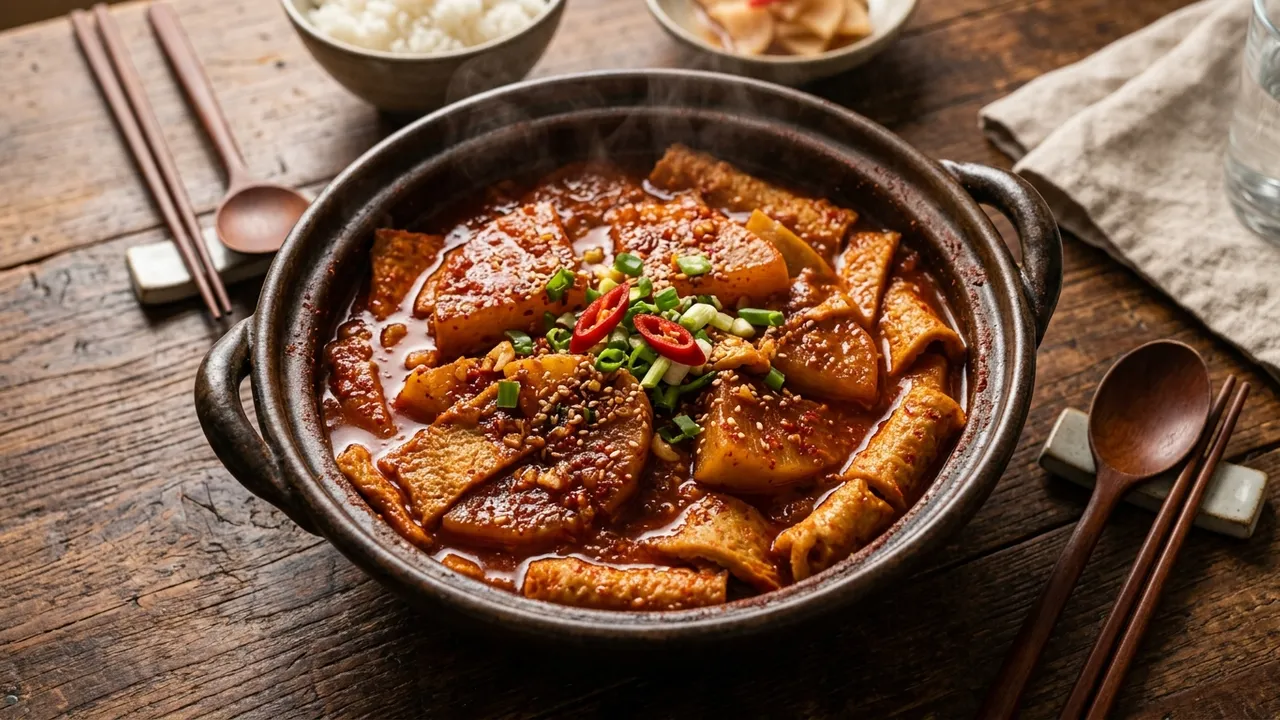
Chef Kim Dae-seok's Radish Water Kimchi (Mul-Kimchi) Recipe
* 이미지는 AI가 생성한 참고 이미지로, 실제 조리 결과물과 다를 수 있습니다.
Discover Chef Kim Dae-seok's 35 years of culinary expertise with this refreshing and spicy radish water kimchi (mul-kimchi) recipe, perfect for stimulating your appetite.
📝 Editor's Notes
Chef Kim Dae-seok's Radish Water Kimchi (Mul-Kimchi) is a superb recipe, embodying 35 years of accumulated expertise, resulting in a remarkably refreshing and spicy flavor.
The crispy texture of the thinly sliced radish combined with the tangy, fermented broth invigorates the palate.
Even beginners can confidently attempt this recipe, especially if they master slicing the radish with a mandoline.
It's an excellent side dish, particularly in hot weather or when serving oily foods.
The greatest charm of this kimchi lies in enjoying the well-fermented broth along with the radish.
🛒 Ingredient Tips
Choosing the right ingredients is crucial for delicious radish water kimchi.
First, select a radish that is firm, has a smooth surface, and feels heavy when lifted.
Avoid radishes that are too light or appear hollow.
For coarse sea salt (cheon-il-yeom), use a large-grained variety to properly draw out moisture from the radish and maintain its crispy texture.
Choose fresh, savory salted fermented shrimp (saeu-jeot) to add a deep umami flavor to the kimchi broth.
For the pear juice drink, opt for a product with natural sweetness rather than artificial sweetness to enhance the kimchi's overall flavor.
🔄 Substitution Guide
If you have difficulty finding certain ingredients or have allergies, consider these substitutions.
If you don't have artificial sweetener (Nyu-suga), you can replace it with sugar or oligosaccharide, but you might lose some of Nyu-suga's distinctive clean sweetness and crisp texture.
Adjust the amount to about 1/3 to half of the original recipe's quantity to taste.
Instead of salted fermented shrimp (saeu-jeot), you can use fish sauce (such as anchovy fish sauce or sand lance fish sauce), but it might result in a slightly different deep flavor compared to the refreshing umami of saeu-jeot.
While you can use apple juice or sugar water instead of the pear juice drink, you might not achieve the unique refreshing sweetness of pear or its radish-softening effect.
🥘 Ingredients
👨🍳 Cooking Points
The key to this radish water kimchi lies in three crucial aspects: 'slicing the radish,' 'the pickling process,' and 'fermentation.' First, it's very important to slice the radish thinly to 2mm (approx. 1/16 inch) using a mandoline.
This thickness creates the optimal crispy texture and allows the seasoning to absorb well.
Second, after pickling the radish for 30 minutes with artificial sweetener (Nyu-suga), coarse sea salt (cheon-il-yeom), and mineral water, mix in the soju (소주).
The crucial point here is not to discard the liquid released during pickling but to use it along with the seasoning paste.
Soju helps eliminate unwanted odors and enhances preservation, so don't skip it.
Finally, fermenting the kimchi in a cool place for two days is essential for developing its refreshing and spicy broth flavor.
Just remember these three points!
👨🍳 Directions
Trim both ends of the Korean radish. Without peeling, cut it in half lengthwise. Using a mandoline or a sharp knife, slice the radish thinly into 2mm (approx. 1/16 inch) thick pieces. If the slices are too wide, cut them in half again.
To the sliced radish, add 1/3 tbsp artificial sweetener (Nyu-suga), 3 heaping tbsp coarse sea salt (cheon-il-yeom), and 1/2 cup (approx. 3.4 fl oz / 100ml) mineral water. Mix thoroughly by hand and let it pickle for 30 minutes.
While the radish is pickling, prepare the seasoning paste. Roughly chop 1/2 onion, 5 red chili peppers (hong-gochu), 2 Cheongyang chili peppers (cheongyang-gochu), 1 piece ginger, and 8 cloves garlic. Place them into a blender.
To the blender, add 1 can (approx. 11.5 fl oz / 340ml) crushed pear juice drink (Gal-a-man-deun Bae), 1/3 cup sweet rice flour paste (chapssal-pul), 1 heaping tbsp salted fermented shrimp (saeu-jeot), 2 cups (approx. 13.5 fl oz / 400ml) mineral water, and 3 heaping tbsp Korean chili powder (gochugaru). Blend for 1 minute until finely pureed to make the seasoning paste.
After 30 minutes, add 3 tbsp soju (소주) to the pickled radish and mix well. Then, pour all the prepared seasoning paste into the radish and mix thoroughly by hand until evenly coated.
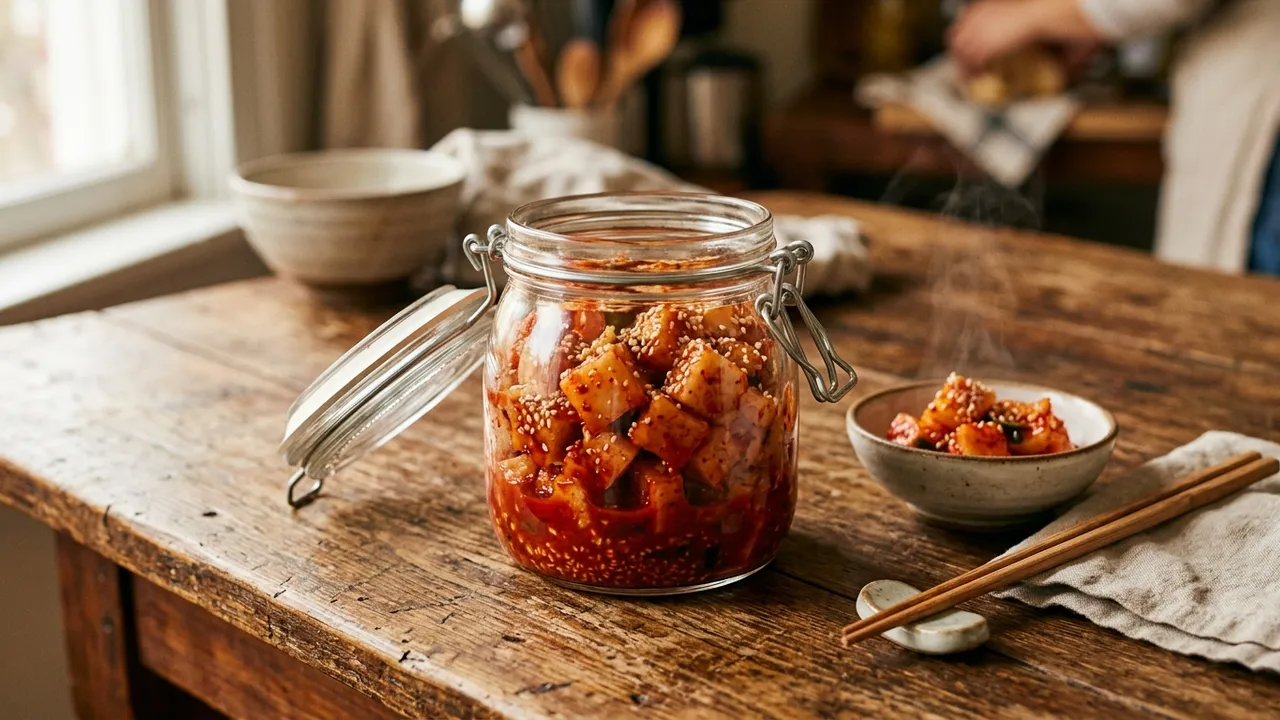
Transfer the finished radish water kimchi into a 4.1-liter (approx. 1.08 gallon) container. Let it ferment in a cool place, such as a balcony, for two days before serving.
💡 Tips
Slicing the radish 2mm thick yields the best texture.
When slicing radish with a mandoline, proceed slowly and carefully, especially towards the end, to prevent injury.
Adding soju (소주) when pickling the radish helps preserve the kimchi longer and eliminates any potential stale odors.
Sweet rice flour paste (chapssal-pul) can be prepared by dissolving 1 tbsp sweet rice flour in 1/2 cup (approx. 3.4 fl oz / 100ml) water and slowly simmering for about 2 minutes and 30 seconds. (This recipe uses 1/3 cup of prepared paste).
Do not discard the liquid released from the pickling radish; use it along with the seasoning paste to make delicious radish water kimchi.
📦 Storage & Reuse
After making the radish water kimchi, follow the recipe's instructions to ferment it in a cool place like a balcony for two days, then store it in the refrigerator.
It will stay cool and delicious for about 2-3 weeks in the fridge.
As time passes, fermentation continues, and the sourness intensifies, which is also a delightful flavor.
Leftover radish water kimchi can be enjoyed chilled with its broth, finely chopped and added to bibimbap, or used with somen noodles to make refreshing kimchi-mal-guksu (cold kimchi noodle soup).
It's also a great idea to take out just the radish pieces and add them to fried rice or stews for a unique flavor.
🥢 Who This Is For
Thanks to its refreshing and clean taste, this radish water kimchi pairs exceptionally well with rich and oily foods.
It perfectly cuts through the richness when served with meat dishes like samgyeopsal (grilled pork belly) or bossam (boiled pork wraps).
It's also incredibly delicious with hot kalguksu (knife-cut noodles) or janchi-guksu (feast noodles).
Moreover, when you've lost your appetite, simply mixing rice with cold water and adding a piece of this radish water kimchi makes for an unbeatable side dish.
It's a dish that anyone, regardless of age or gender, can enjoy if they love spicy yet invigorating flavors.
🔥 Nutrition Info
Chef Kim Dae-seok's Radish Water Kimchi is a healthy, very low-calorie kimchi, thanks to its main ingredient, radish.
Estimated per serving (approx.
100g / 3.5 oz), it is expected to be around 30-50 kcal.
Fat content is almost negligible.
Carbohydrates come from the radish, sweet rice flour paste (chapssal-pul), and pear juice drink, but the total amount is not high, roughly 5-10g.
A small amount of protein is consumed through salted fermented shrimp (saeu-jeot).
Notably, radish is rich in Vitamin C and dietary fiber, which aid digestion and promote gut health, while capsaicin from Korean chili powder (gochugaru) can help boost metabolism.
However, due to coarse sea salt (cheon-il-yeom) and saeu-jeot, the sodium content might be relatively high, so moderate consumption is recommended.
💬 Frequently Asked Questions
- Q. What ingredients do I need for Chef Kim Dae-seok's Radish Water Kimchi (Mul-Kimchi)?
- Main ingredients include Korean Radish (Mu), Coarse Sea Salt (Cheon-il-yeom), Artificial sweetener (Nyu-suga), Mineral water (for pickling radish), Soju (소주). Choosing the right ingredients is crucial for delicious radish water kimchi. First, select a radish that is firm, has a smooth surface, and feels heavy when lifted. Avoid radishes that are too light or appear hollow. For coarse sea salt (cheon-il-yeom), use a large-grained variety to properly draw out moisture from the radish and maintain its crispy texture. Choose fresh, savory salted fermented shrimp (saeu-jeot) to add a deep umami flavor to the kimchi broth. For the pear juice drink, opt for a product with natural sweetness rather than artificial sweetness to enhance the kimchi's overall flavor.
- Q. What are the key tips for making Chef Kim Dae-seok's Radish Water Kimchi (Mul-Kimchi)?
- The key to this radish water kimchi lies in three crucial aspects: 'slicing the radish,' 'the pickling process,' and 'fermentation.' First, it's very important to slice the radish thinly to 2mm (approx. 1/16 inch) using a mandoline. This thickness creates the optimal crispy texture and allows the seasoning to absorb well. Second, after pickling the radish for 30 minutes with artificial sweetener (Nyu-suga), coarse sea salt (cheon-il-yeom), and mineral water, mix in the soju (소주). The crucial point here is not to discard the liquid released during pickling but to use it along with the seasoning paste. Soju helps eliminate unwanted odors and enhances preservation, so don't skip it. Finally, fermenting the kimchi in a cool place for two days is essential for developing its refreshing and spicy broth flavor. Just remember these three points!
- Q. How should I store leftover Chef Kim Dae-seok's Radish Water Kimchi (Mul-Kimchi)?
- After making the radish water kimchi, follow the recipe's instructions to ferment it in a cool place like a balcony for two days, then store it in the refrigerator. It will stay cool and delicious for about 2-3 weeks in the fridge. As time passes, fermentation continues, and the sourness intensifies, which is also a delightful flavor. Leftover radish water kimchi can be enjoyed chilled with its broth, finely chopped and added to bibimbap, or used with somen noodles to make refreshing kimchi-mal-guksu (cold kimchi noodle soup). It's also a great idea to take out just the radish pieces and add them to fried rice or stews for a unique flavor.
- Q. How many calories are in Chef Kim Dae-seok's Radish Water Kimchi (Mul-Kimchi)?
- Chef Kim Dae-seok's Radish Water Kimchi is a healthy, very low-calorie kimchi, thanks to its main ingredient, radish. Estimated per serving (approx. 100g / 3.5 oz), it is expected to be around 30-50 kcal. Fat content is almost negligible. Carbohydrates come from the radish, sweet rice flour paste (chapssal-pul), and pear juice drink, but the total amount is not high, roughly 5-10g. A small amount of protein is consumed through salted fermented shrimp (saeu-jeot). Notably, radish is rich in Vitamin C and dietary fiber, which aid digestion and promote gut health, while capsaicin from Korean chili powder (gochugaru) can help boost metabolism. However, due to coarse sea salt (cheon-il-yeom) and saeu-jeot, the sodium content might be relatively high, so moderate consumption is recommended.
- Q. Can I substitute ingredients in Chef Kim Dae-seok's Radish Water Kimchi (Mul-Kimchi)?
- If you have difficulty finding certain ingredients or have allergies, consider these substitutions. If you don't have artificial sweetener (Nyu-suga), you can replace it with sugar or oligosaccharide, but you might lose some of Nyu-suga's distinctive clean sweetness and crisp texture. Adjust the amount to about 1/3 to half of the original recipe's quantity to taste. Instead of salted fermented shrimp (saeu-jeot), you can use fish sauce (such as anchovy fish sauce or sand lance fish sauce), but it might result in a slightly different deep flavor compared to the refreshing umami of saeu-jeot. While you can use apple juice or sugar water instead of the pear juice drink, you might not achieve the unique refreshing sweetness of pear or its radish-softening effect.
💬 Comments
No comments yet. Be the first to comment!