
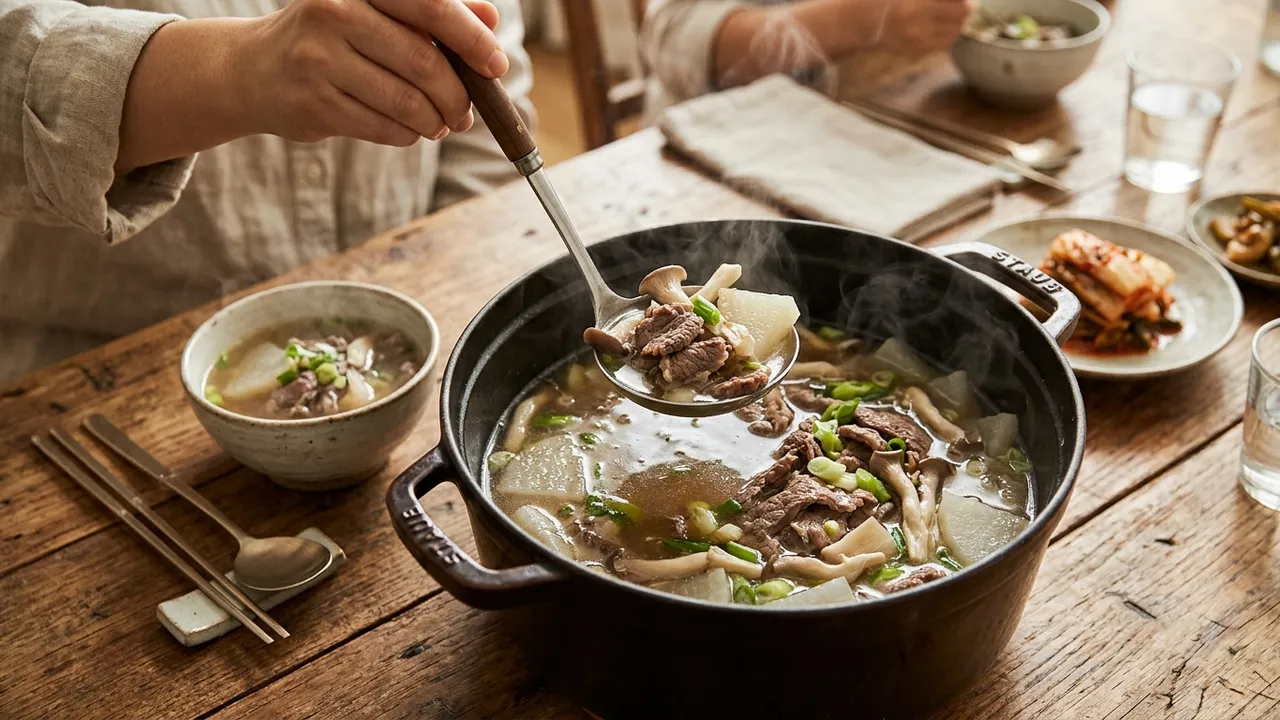
Chef Kim Dae-seok's Umami-Rich and Refreshing Beef and Radis
* 이미지는 AI가 생성한 참고 이미지로, 실제 조리 결과물과 다를 수 있습니다.
This is Chef Kim Dae-seok's recipe for Beef and Radish Soup, which is savory and refreshing even without pre-soaking to remove blood.
📝 Editor's Notes
Chef Kim Dae-seok's Beef and Radish Soup recipe is characterized by its quick and easy method of removing gamey odors using flour, without requiring a separate blood-draining step.
By boiling the beef directly without stir-frying, the broth remains clear and refreshing without any murkiness.
Marinating the radish beforehand with guk-ganjang (국간장) allows its sweetness and umami to deeply infuse, making the soup even more delicious.
With the added depth of kkanari aekjeot (까나리액젓) and the delightful texture of oyster mushrooms, this recipe makes for a warm and hearty meal perfect for the whole family.
It feels like a comforting, restorative dish, especially on chilly days or when you need a boost.
The difficulty level is intermediate, but beginners can easily follow along.
🛒 Ingredient Tips
For this Beef and Radish Soup, it's crucial to choose fresh beef brisket (yangji) that has a bright pink color and a good balance of fat and lean meat.
Avoid brisket with excessive marbling, as it can make the soup too oily; opt for a moderate amount.
For the radish, choose one that is firm, heavy, and has a smooth surface.
While winter radish is generally the sweetest and most flavorful, delicious radishes are available year-round these days.
When selecting dried kelp (geon-dashima, 건다시마), choose pieces that aren't too large and have a bit of thickness, as this will deepen the soup's flavor.
The white powdery substance on the surface of the kelp is an umami component, so don't wipe it off completely; just lightly dust off any impurities before use.
🔄 Substitution Guide
If beef brisket (yangji) is difficult to find or too expensive, you can use beef chuck (moksim) or beef shank (satae) instead.
Beef chuck is leaner than brisket, offering a lighter flavor, but it's important to simmer it a bit longer to ensure tenderness.
Beef shank provides a chewier texture.
Using potatoes or other root vegetables instead of radish will significantly change the taste and texture, so it's recommended to stick with radish if possible.
If kkanari aekjeot (까나리액젓) is unavailable, you can substitute it with myeolchi aekjeot (멸치액젓) (anchovy sauce).
Anchovy sauce also provides a deep umami flavor, offering a similar taste.
However, the saltiness can vary between different types of fish sauce, so it's crucial to taste and adjust the seasoning accordingly.
🥘 Ingredients
👨🍳 Cooking Points
There are three key cooking points in this recipe.
First, the method of drawing out blood from the beef using flour.
Thanks to flour's adsorptive power, kneading for about 20 seconds and waiting for 5 minutes quickly removes the blood, resulting in a clean broth free of gamey odors.
When rinsing, use cold water and swish it thoroughly several times until clean.
Second, the secret to a refreshing broth is to boil the beef directly without stir-frying.
Stir-frying can coagulate the meat juices, making the broth cloudy.
Third, the process of pre-marinating the radish in guk-ganjang (국간장).
This step prevents the radish from breaking apart and allows it to deeply absorb the seasoning, leading to a much more delicious radish soup.
Lastly, remember not to fully season the soup from the beginning; taste it midway and adjust with salt to your preference!
👨🍳 Directions
Cut 2 pieces of Korean radish (600g) into 3 sections, then slice them into 4-5mm (approx. 0.2 inch) thick squares.
Place the sliced radish in a bowl, add 2 tbsp of guk-ganjang (국간장), mix well by hand, and let it marinate for 20 minutes.
To 500g of beef brisket, add 1 heaping tbsp of flour and enough water to mix. Knead it thoroughly for about 20 seconds, then let it sit for 5 minutes to draw out the blood.
Rinse the beef thoroughly with cold water until clean, then drain well and set aside.
In a pot, bring 1.5 liters (approx. 6.3 cups) of water to a boil. Add the blood-drained beef brisket immediately without stir-frying, and continue to boil.
As it boils, completely skim off any foam and impurities that rise to the surface with a ladle.
Cover and simmer over medium heat for 15 minutes until the beef becomes tender. Lightly skim off any oil floating on top.
Pour both the marinated radish and its liquid into the pot, add 1 liter (approx. 4.2 cups) of water, then add 1 piece (20g) of dried kelp (geon-dashima, 건다시마).
Add 1 tbsp of minced garlic and 1 tbsp of kkanari aekjeot (까나리액젓), cover, and simmer for another 15 minutes.
After 15 minutes, remove the dried kelp, add 120g of oyster mushrooms, and stir once.
Taste the soup, and if it's a little bland, add 0.5 tbsp of salt and adjust seasoning to your preference.
Finally, add 1 stalk of green onion, split in half and finely chopped, and 2 pinches of black pepper to finish. Your Beef and Radish Soup is now complete.
💡 Tips
Marinating the radish with guk-ganjang (국간장) makes it less likely to break apart and allows it to absorb seasoning, resulting in a much tastier soup.
Using flour when preparing beef helps quickly draw out blood due to its adsorptive properties.
Adding the beef directly without stir-frying ensures a clear and clean-tasting broth.
Adding kkanari aekjeot (까나리액젓) greatly enhances the flavor of the soup.
It's best not to fully season the soup from the beginning. Taste it midway through cooking and adjust with salt to your preference.
📦 Storage & Reuse
The finished Beef and Radish Soup is best stored in an airtight container in the refrigerator for 3-4 days.
When the soup cools, the fat may solidify; simply skim it off before reheating for a cleaner taste.
For longer storage, portion it into individual servings and freeze.
It can be kept for up to a month.
To reheat after thawing, transfer it to a pot and warm gently over low heat, or use a microwave.
If the soup has reduced too much, add a little water to adjust the consistency.
You can also enjoy leftover soup by adding rice to make a porridge-like dish, or by adding cooked noodles for a delightful variation.
🥢 Who This Is For
This Beef and Radish Soup is a fantastic dish for the entire family to enjoy.
Its clear, refreshing, yet deeply savory flavor is sure to be loved by both children and adults.
Especially on a chilly day, a warm bowl will leave you feeling completely satisfied.
Served with rice and side dishes like kkakdugi (깍두기) (diced radish kimchi) or napa cabbage kimchi, it makes for an excellent and wholesome meal.
It's also perfect as a restorative dish when you're tired of rich holiday foods or feeling a bit under the weather, or simply to enrich your everyday dining table with a few simple side dishes.
🔥 Nutrition Info
One serving of this Beef and Radish Soup (based on a total of 4 servings) is estimated to be approximately 280-330 calories.
It contains about 28-35g of protein, 15-20g of fat, and 5-10g of carbohydrates, providing balanced nutrition.
Beef brisket (yangji), the main ingredient, is rich in high-quality protein, iron, and B vitamins, aiding in energy replenishment.
Radish is abundant in digestive enzymes, Vitamin C, and dietary fiber, which are beneficial for improving digestive function and gut health.
Dried kelp (geon-dashima, 건다시마) supplements minerals like iodine, contributing to overall health.
This is a nutritious soup that is both hearty and easy to enjoy without feeling heavy.
💬 Frequently Asked Questions
- Q. What ingredients do I need for Chef Kim Dae-seok's Umami-Rich and Refreshing Beef and Radish Soup?
- Main ingredients include Beef Brisket, Flour, Korean Radish, Guk-ganjang (국간장), Water (1st portion). For this Beef and Radish Soup, it's crucial to choose fresh beef brisket (yangji) that has a bright pink color and a good balance of fat and lean meat. Avoid brisket with excessive marbling, as it can make the soup too oily; opt for a moderate amount. For the radish, choose one that is firm, heavy, and has a smooth surface. While winter radish is generally the sweetest and most flavorful, delicious radishes are available year-round these days. When selecting dried kelp (geon-dashima, 건다시마), choose pieces that aren't too large and have a bit of thickness, as this will deepen the soup's flavor. The white powdery substance on the surface of the kelp is an umami component, so don't wipe it off completely; just lightly dust off any impurities before use.
- Q. What are the key tips for making Chef Kim Dae-seok's Umami-Rich and Refreshing Beef and Radish Soup?
- There are three key cooking points in this recipe. First, the method of drawing out blood from the beef using flour. Thanks to flour's adsorptive power, kneading for about 20 seconds and waiting for 5 minutes quickly removes the blood, resulting in a clean broth free of gamey odors. When rinsing, use cold water and swish it thoroughly several times until clean. Second, the secret to a refreshing broth is to boil the beef directly without stir-frying. Stir-frying can coagulate the meat juices, making the broth cloudy. Third, the process of pre-marinating the radish in guk-ganjang (국간장). This step prevents the radish from breaking apart and allows it to deeply absorb the seasoning, leading to a much more delicious radish soup. Lastly, remember not to fully season the soup from the beginning; taste it midway and adjust with salt to your preference!
- Q. How should I store leftover Chef Kim Dae-seok's Umami-Rich and Refreshing Beef and Radish Soup?
- The finished Beef and Radish Soup is best stored in an airtight container in the refrigerator for 3-4 days. When the soup cools, the fat may solidify; simply skim it off before reheating for a cleaner taste. For longer storage, portion it into individual servings and freeze. It can be kept for up to a month. To reheat after thawing, transfer it to a pot and warm gently over low heat, or use a microwave. If the soup has reduced too much, add a little water to adjust the consistency. You can also enjoy leftover soup by adding rice to make a porridge-like dish, or by adding cooked noodles for a delightful variation.
- Q. How many calories are in Chef Kim Dae-seok's Umami-Rich and Refreshing Beef and Radish Soup?
- One serving of this Beef and Radish Soup (based on a total of 4 servings) is estimated to be approximately 280-330 calories. It contains about 28-35g of protein, 15-20g of fat, and 5-10g of carbohydrates, providing balanced nutrition. Beef brisket (yangji), the main ingredient, is rich in high-quality protein, iron, and B vitamins, aiding in energy replenishment. Radish is abundant in digestive enzymes, Vitamin C, and dietary fiber, which are beneficial for improving digestive function and gut health. Dried kelp (geon-dashima, 건다시마) supplements minerals like iodine, contributing to overall health. This is a nutritious soup that is both hearty and easy to enjoy without feeling heavy.
- Q. Can I substitute ingredients in Chef Kim Dae-seok's Umami-Rich and Refreshing Beef and Radish Soup?
- If beef brisket (yangji) is difficult to find or too expensive, you can use beef chuck (moksim) or beef shank (satae) instead. Beef chuck is leaner than brisket, offering a lighter flavor, but it's important to simmer it a bit longer to ensure tenderness. Beef shank provides a chewier texture. Using potatoes or other root vegetables instead of radish will significantly change the taste and texture, so it's recommended to stick with radish if possible. If kkanari aekjeot (까나리액젓) is unavailable, you can substitute it with myeolchi aekjeot (멸치액젓) (anchovy sauce). Anchovy sauce also provides a deep umami flavor, offering a similar taste. However, the saltiness can vary between different types of fish sauce, so it's crucial to taste and adjust the seasoning accordingly.

💬 Comments
No comments yet. Be the first to comment!