
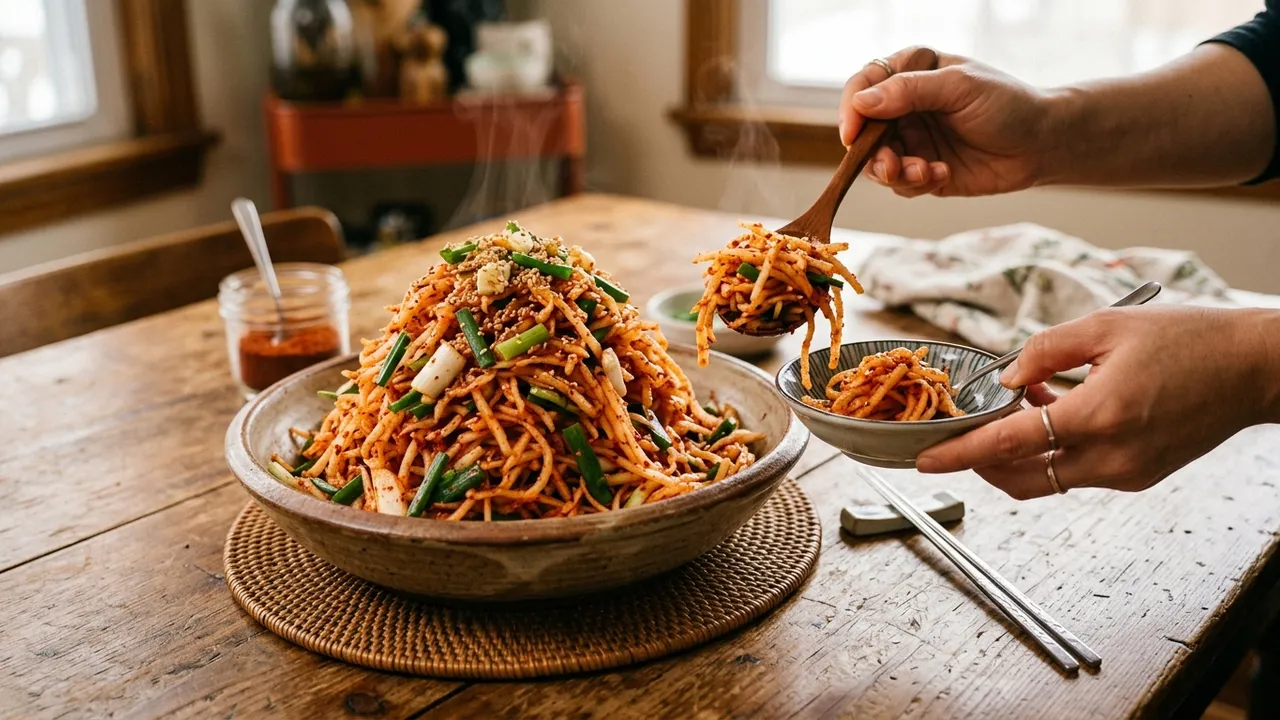
10-Minute Musaengchae (Seasoned Radish Salad) from a Banchan
* 이미지는 AI가 생성한 참고 이미지로, 실제 조리 결과물과 다를 수 있습니다.
This is a super easy golden recipe for Musaengchae (Seasoned Radish Salad), shared by a banchan shop owner, that can be made in just 10 minutes without salt, using fish sauce and corn syrup. Winter radishes, with their higher sweetness, make this dish even more delicious.
📝 Editor's Notes
This recipe is a super easy Musaengchae (Seasoned Radish Salad) that can be completed in just 10 minutes.
Its unique feature is pickling the radish with only Kkanari Aekjeot (까나리액젓 - sand lance fish sauce) and Mulyeot (물엿 - Korean corn syrup) instead of salt, resulting in a distinct yet deeply savory flavor.
Containing a banchan shop owner's secret, it will become a go-to side dish that you can quickly whip up even on busy days.
Especially, it maximizes the sweetness and crisp texture of winter radish, achieving an excellent balance of spicy, sweet, and sour flavors.
With its easy difficulty level, even cooking beginners can confidently try it, making it a versatile side dish that pairs well with any Korean meal.
🛒 Ingredient Tips
For the star of Musaengchae, the radish, using winter radish, especially Jeju winter radish, will make it even more delicious due to its higher sweetness and crisp texture.
A good radish should have smooth, white skin, feel heavy when lifted, and be firm.
Julienning it with the peel intact will further enhance its crisp texture, so make sure to wash it thoroughly.
Kkanari Aekjeot (까나리액젓) is a key ingredient that adds umami and depth to Musaengchae.
Choosing fresh, high-quality fish sauce will allow you to enjoy a richer flavor.
Mulyeot (물엿) not only provides sweetness but also coats the radish vibrantly and adds a glossy sheen, so make sure to include it.
🔄 Substitution Guide
If radish is unavailable, you can use kohlrabi or cabbage to create a similar textured vegetable dish.
While it may lack the unique refreshing taste of radish, you can still achieve a crisp texture.
If Kkanari Aekjeot (까나리액젓) is not available, you can substitute it with Myeolchi Aekjeot (멸치액젓 - anchovy fish sauce).
The flavor difference is not significant, but anchovy fish sauce might offer a slightly richer and deeper taste.
If using sugar or oligodang (oligosaccharide syrup) instead of Mulyeot (물엿), adjust the amount accordingly, as sugar is sweeter than corn syrup and has less coating effect, while oligodang is similar to corn syrup but may be slightly less sweet.
Miwon (미원) can be omitted if preferred, but a small addition is recommended if you wish to enhance the umami flavor.
🥘 Ingredients
👨🍳 Cooking Points
There are three crucial cooking points for this Musaengchae recipe.
First, julienne the radish using the thickest blade of a mandoline slicer.
This ensures you can fully enjoy the radish's crisp texture and allows the seasoning to be absorbed evenly.
Second, the 10-minute pickling process with fish sauce and Mulyeot (물엿) is key.
It's much faster than traditional salt pickling and is a secret to effectively drawing out moisture from the radish, creating a chewy yet crisp texture.
Tossing it once halfway through is even better.
Finally, when discarding the liquid from the pickled radish, absolutely do not squeeze it tightly!
Squeezing can cause the radish to lose its crispness, so it's important to only drain the water as much as possible.
Remembering these three points will help you make delicious Musaengchae without fail.
👨🍳 Directions
Lightly trim the tops and any dirty root ends from 1.5 radishes. (For Jeju winter radish, using it with the peel intact is recommended for a crispier texture.)
Cut the radishes into 4 manageable pieces, then julienne them using the thickest blade of a mandoline slicer.
Place the julienned radish in a large bowl. Add 1 cup of Kkanari Aekjeot (까나리액젓) and 1 cup of Mulyeot (물엿), mix gently, and let it pickle for 10 minutes. (Tossing them gently about halfway through, after 5 minutes, yields better results.)
While the radish is pickling, prepare the seasoning ingredients. Finely mince 2 stalks of green onion.
In another bowl, combine 14 tbsp of Gochugaru (고춧가루), 16 tbsp of Kkanari Aekjeot (까나리액젓), 5 tbsp of minced garlic, 1 tbsp of minced ginger, 6 tbsp of Mulyeot (물엿), and 1/3 tbsp of Miwon (미원). Mix well to create the seasoning sauce.
After 10 minutes, discard as much liquid as possible from the pickled radish. (It is crucial not to squeeze the radish tightly; simply drain the liquid to maintain its crisp texture.)
Add all of the prepared seasoning sauce to the drained radish and mix evenly.
Add the minced green onion and sprinkle a generous amount of toasted sesame seeds. Mix well one more time, and your Musaengchae (Seasoned Radish Salad) is complete.
💡 Tips
For Jeju winter radish, julienning it with the peel intact maintains its crisp texture, making it more delicious for Musaengchae or Kkakdugi (diced radish kimchi).
When pickling radish with fish sauce and Mulyeot (물엿 - Korean corn syrup), the osmotic action effectively draws out moisture, creating a chewy yet crisp texture. The viscosity of the Mulyeot (물엿) also helps coat the Gochugaru (고춧가루 - Korean chili powder) vibrantly.
When draining the liquid from the pickled radish, it's crucial not to squeeze it tightly. Simply discard the water to preserve the radish's crisp texture.
When adding sweetness with sugar or Mulyeot (물엿), adjust the amount based on the season and type of radish. (Summer radishes, in particular, may be less sweet.)
You can add about 1/3 tbsp of Miwon (미원 - MSG) according to your preference to create a more delicious and umami-rich Musaengchae. (Optional)
📦 Storage & Reuse
Once prepared, Musaengchae can be stored in an airtight container in the refrigerator for 3-5 days to maintain its freshness.
As time passes, the radish may release more liquid, so it's best to consume it as quickly as possible.
Since it's a cold side dish, there's no need to reheat it; in fact, it tastes even crispier and more delicious when eaten straight from the fridge.
If you have any leftover Musaengchae, try enjoying it as bibimbap by adding it to warm rice with a drizzle of sesame oil, or use it as an ingredient in kimchi jjigae or doenjang jjigae to add a spicy kick.
It also pairs wonderfully with boiled pork belly (Bossam).
🥢 Who This Is For
This Musaengchae is highly recommended for busy professionals and cooking beginners.
Since it can be quickly prepared in just 10 minutes, it's incredibly useful for unexpected guests or when your meal feels incomplete.
Its spicy and sweet flavor makes it delicious simply served over white rice, and it beautifully complements greasy main dishes like samgyeopsal (grilled pork belly) or galbijjim (braised short ribs), balancing out the richness.
It can also be used as an ingredient for bibimbap or enjoyed as a special side with hot ramen.
It will be a definite solution for anyone who frequently worries about daily side dishes.
🔥 Nutrition Info
This Musaengchae is packed with the nutrients of radish.
Per serving, it is estimated to be approximately 80-100 kcal, with carbohydrates around 15-20g, and protein and fat each less than 1-2g.
Radish is rich in Vitamin C, which helps boost immunity, and abundant in amylase and diastase enzymes that aid digestion, promoting comfortable meals.
Gochugaru (고춧가루) contains Vitamin A and capsaicin.
However, due to the use of fish sauce and Mulyeot (물엿), sodium and sugar content may be somewhat high, so it is advisable to consume in moderation for health.
It is also rich in dietary fiber, which can positively impact gut health.
💬 Frequently Asked Questions
- Q. What ingredients do I need for 10-Minute Musaengchae (Seasoned Radish Salad) from a Banchan Shop (No Salt, with Fish Sauce and Corn Syrup)?
- Main ingredients include Radish, Green Onion, Gochugaru (고춧가루), Kkanari Aekjeot (까나리액젓) (for seasoning), Minced Garlic. For the star of Musaengchae, the radish, using winter radish, especially Jeju winter radish, will make it even more delicious due to its higher sweetness and crisp texture. A good radish should have smooth, white skin, feel heavy when lifted, and be firm. Julienning it with the peel intact will further enhance its crisp texture, so make sure to wash it thoroughly. Kkanari Aekjeot (까나리액젓) is a key ingredient that adds umami and depth to Musaengchae. Choosing fresh, high-quality fish sauce will allow you to enjoy a richer flavor. Mulyeot (물엿) not only provides sweetness but also coats the radish vibrantly and adds a glossy sheen, so make sure to include it.
- Q. What are the key tips for making 10-Minute Musaengchae (Seasoned Radish Salad) from a Banchan Shop (No Salt, with Fish Sauce and Corn Syrup)?
- There are three crucial cooking points for this Musaengchae recipe. First, julienne the radish using the thickest blade of a mandoline slicer. This ensures you can fully enjoy the radish's crisp texture and allows the seasoning to be absorbed evenly. Second, the 10-minute pickling process with fish sauce and Mulyeot (물엿) is key. It's much faster than traditional salt pickling and is a secret to effectively drawing out moisture from the radish, creating a chewy yet crisp texture. Tossing it once halfway through is even better. Finally, when discarding the liquid from the pickled radish, absolutely do not squeeze it tightly! Squeezing can cause the radish to lose its crispness, so it's important to only drain the water as much as possible. Remembering these three points will help you make delicious Musaengchae without fail.
- Q. How should I store leftover 10-Minute Musaengchae (Seasoned Radish Salad) from a Banchan Shop (No Salt, with Fish Sauce and Corn Syrup)?
- Once prepared, Musaengchae can be stored in an airtight container in the refrigerator for 3-5 days to maintain its freshness. As time passes, the radish may release more liquid, so it's best to consume it as quickly as possible. Since it's a cold side dish, there's no need to reheat it; in fact, it tastes even crispier and more delicious when eaten straight from the fridge. If you have any leftover Musaengchae, try enjoying it as bibimbap by adding it to warm rice with a drizzle of sesame oil, or use it as an ingredient in kimchi jjigae or doenjang jjigae to add a spicy kick. It also pairs wonderfully with boiled pork belly (Bossam).
- Q. How many calories are in 10-Minute Musaengchae (Seasoned Radish Salad) from a Banchan Shop (No Salt, with Fish Sauce and Corn Syrup)?
- This Musaengchae is packed with the nutrients of radish. Per serving, it is estimated to be approximately 80-100 kcal, with carbohydrates around 15-20g, and protein and fat each less than 1-2g. Radish is rich in Vitamin C, which helps boost immunity, and abundant in amylase and diastase enzymes that aid digestion, promoting comfortable meals. Gochugaru (고춧가루) contains Vitamin A and capsaicin. However, due to the use of fish sauce and Mulyeot (물엿), sodium and sugar content may be somewhat high, so it is advisable to consume in moderation for health. It is also rich in dietary fiber, which can positively impact gut health.
- Q. Can I substitute ingredients in 10-Minute Musaengchae (Seasoned Radish Salad) from a Banchan Shop (No Salt, with Fish Sauce and Corn Syrup)?
- If radish is unavailable, you can use kohlrabi or cabbage to create a similar textured vegetable dish. While it may lack the unique refreshing taste of radish, you can still achieve a crisp texture. If Kkanari Aekjeot (까나리액젓) is not available, you can substitute it with Myeolchi Aekjeot (멸치액젓 - anchovy fish sauce). The flavor difference is not significant, but anchovy fish sauce might offer a slightly richer and deeper taste. If using sugar or oligodang (oligosaccharide syrup) instead of Mulyeot (물엿), adjust the amount accordingly, as sugar is sweeter than corn syrup and has less coating effect, while oligodang is similar to corn syrup but may be slightly less sweet. Miwon (미원) can be omitted if preferred, but a small addition is recommended if you wish to enhance the umami flavor.
💬 Comments
No comments yet. Be the first to comment!