
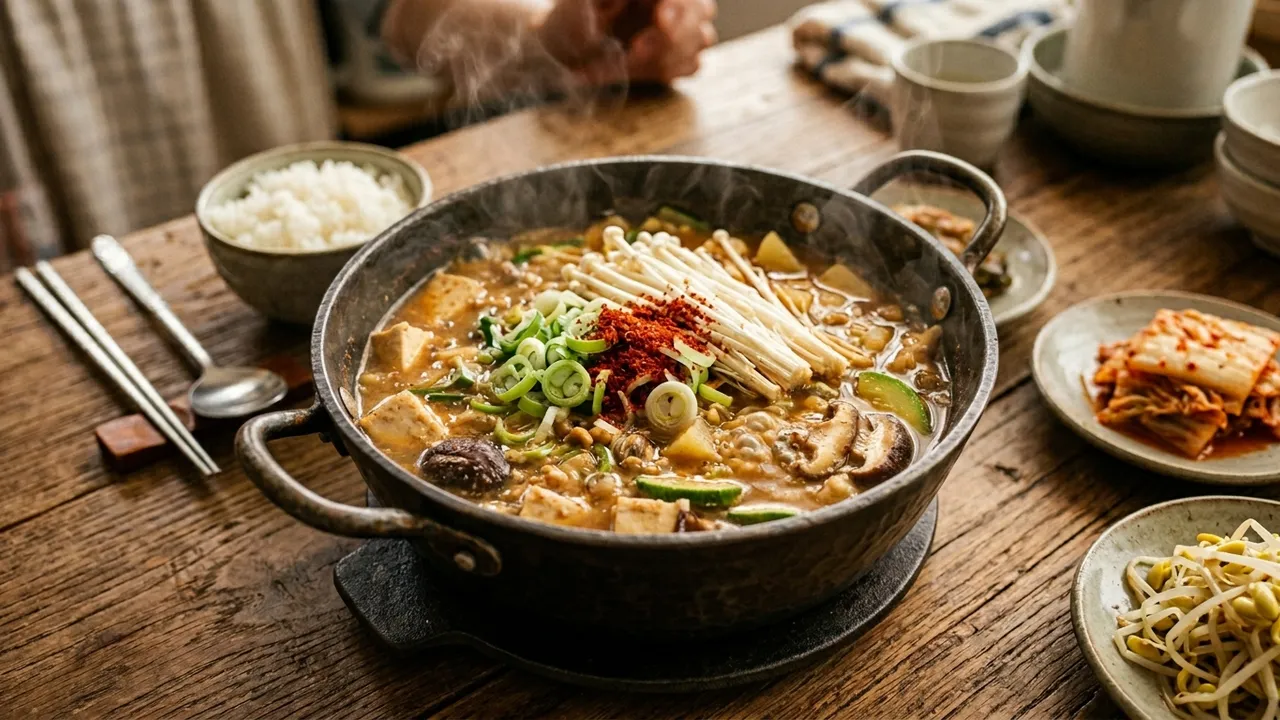
Baby Beast's Absolutely Delicious Radish Doenjang-jjigae
* 이미지는 AI가 생성한 참고 이미지로, 실제 조리 결과물과 다를 수 있습니다.
This Doenjang-jjigae (Korean soybean paste stew) recipe is made with plenty of radish (mu), simmered until refreshing and slightly reduced, making it perfect for mixing with rice.
📝 Editor's Notes
This recipe is a delightful Doenjang-jjigae (Korean soybean paste stew) that boasts the refreshing and savory taste of Korean radish (mu).
Its unique feature is stir-frying the radish in perilla oil until translucent, then stir-frying it with Doenjang (된장) to bring out a deep flavor.
The stew is simmered until the broth is slightly reduced, making it perfect for mixing with rice, which is a very appealing point.
The difficulty is easy, so even beginner cooks can follow it without trouble.
It's a wonderful dish for chilly days when you crave warm soup, or as a hearty homemade meal for the whole family to enjoy.
🛒 Ingredient Tips
The secret to delicious Doenjang-jjigae (Korean soybean paste stew) begins with good ingredients.
First, choose a firm, smooth, and clean Korean radish (mu) without blemishes.
A medium size is ideal, rather than too large or too small, and it's best if the radish greens are fresh.
For Doenjang (된장), as suggested in the tips, mixing traditional Doenjang with commercially available Doenjang can provide both deep and umami flavors.
If traditional Doenjang is unavailable, mixing two different types of commercial Doenjang is also a good option.
Rice water adds a savory depth to the stew, so make sure to collect it when washing your rice.
🔄 Substitution Guide
If you lack certain ingredients or desire a different flavor, try these substitutions.
Instead of Korean radish (mu), you can add potatoes for a fluffy texture and savory taste, or zucchini for a gentle sweetness.
However, the unique refreshing taste of radish might be reduced.
If you're short on Doenjang (된장) or don't have traditional Doenjang, try mixing in a small amount of ssamjang (쌈장, Korean dipping sauce).
Ssamjang is sweeter and saltier than Doenjang, so adjusting the quantity is important.
Substituting regular tofu with soft tofu (sundubu) will give you an even smoother texture, and adding other types of mushrooms (shiitake, oyster mushrooms, etc.) can enrich the aroma and texture.
🥘 Ingredients
👨🍳 Cooking Points
Remember these three key cooking points that determine the deliciousness of this Doenjang-jjigae (Korean soybean paste stew).
First, thoroughly stir-fry the diced Korean radish (mu) in perilla oil until translucent.
Stir-frying over medium heat for at least 5 minutes helps bring out the refreshing and deep flavor of the radish.
Second is the process of stir-frying the Doenjang (된장) with the radish.
Instead of immediately dissolving the Doenjang in water, stir-frying it with the radish for 1-2 minutes enhances its savory aroma and enriches the flavor.
Third, pouring in the rice water and simmering until slightly reduced is crucial.
Pour just enough to cover the ingredients, and reduce the broth so it's not too watery, making it perfect for mixing with rice.
If you follow these three steps, you'll be able to make a delicious Doenjang-jjigae.
👨🍳 Directions
Drizzle perilla oil into an earthen pot or regular pot.
Add the diced Korean radish (mu) and stir-fry until translucent.
Add 2 tbsp of Doenjang (된장) and stir-fry with the radish. (A mixture of traditional Doenjang and Sempio Tojang was used.)
Once the radish and Doenjang (된장) are well combined, pour in an appropriate amount of rice water.
Add diced zucchini, onion, and tofu, and simmer until the broth is reduced and shallow.
Finally, add enoki mushrooms and gochugaru (고춧가루).
💡 Tips
Using two types of Doenjang (된장) in your Doenjang-jjigae can create a deeper and richer flavor.
The more Korean radish (mu) you add, the more refreshing and profound the stew's flavor will be.
It's especially delicious when simmered until the broth is slightly reduced and mixed with rice.
📦 Storage & Reuse
The finished Doenjang-jjigae can be stored in the refrigerator for about 2-3 days while maintaining its freshness.
If you wish to store it longer, portion it into individual servings, place them in airtight containers, and freeze them.
They will keep for about a month.
To reheat frozen stew, transfer it to a pot and simmer gently over low heat, or thaw and reheat in the microwave.
Leftover stew is also delicious when mixed with rice, or even used to make Doenjang (된장) ramen.
🥢 Who This Is For
This Doenjang-jjigae (Korean soybean paste stew) is a hearty homemade meal perfect for the whole family to enjoy.
It's especially good on chilly days when you crave warm soup, or when you need a comforting hangover remedy.
When mixed generously with rice, it's so satisfying that you won't envy any other side dishes.
Pairing it with well-fermented kimchi, roasted seaweed (gim), or simple rolled omelet (gyeran-mari) will make for an even more fulfilling meal.
🔥 Nutrition Info
This Doenjang-jjigae (Korean soybean paste stew) is estimated to have a moderate calorie count of approximately 180 kcal per serving.
It provides balanced nutrition, consisting of about 6.5g of protein, 4g of fat, and 5.5g of carbohydrates.
Notably, Korean radish (mu) is rich in digestive enzymes and Vitamin C, which helps to soothe the stomach, while Doenjang (된장) supplies beneficial probiotics, plant-based protein, and dietary fiber for gut health.
Tofu also contributes high-quality plant-based protein.
Various vegetables like zucchini, onion, and enoki mushrooms add vitamins and minerals, making this a generally healthy and satisfying meal.
💬 Frequently Asked Questions
- Q. What ingredients do I need for Baby Beast's Absolutely Delicious Radish Doenjang-jjigae?
- Main ingredients include Perilla oil, Korean radish (mu), Doenjang (된장), Rice water, Zucchini. The secret to delicious Doenjang-jjigae (Korean soybean paste stew) begins with good ingredients. First, choose a firm, smooth, and clean Korean radish (mu) without blemishes. A medium size is ideal, rather than too large or too small, and it's best if the radish greens are fresh. For Doenjang (된장), as suggested in the tips, mixing traditional Doenjang with commercially available Doenjang can provide both deep and umami flavors. If traditional Doenjang is unavailable, mixing two different types of commercial Doenjang is also a good option. Rice water adds a savory depth to the stew, so make sure to collect it when washing your rice.
- Q. What are the key tips for making Baby Beast's Absolutely Delicious Radish Doenjang-jjigae?
- Remember these three key cooking points that determine the deliciousness of this Doenjang-jjigae (Korean soybean paste stew). First, thoroughly stir-fry the diced Korean radish (mu) in perilla oil until translucent. Stir-frying over medium heat for at least 5 minutes helps bring out the refreshing and deep flavor of the radish. Second is the process of stir-frying the Doenjang (된장) with the radish. Instead of immediately dissolving the Doenjang in water, stir-frying it with the radish for 1-2 minutes enhances its savory aroma and enriches the flavor. Third, pouring in the rice water and simmering until slightly reduced is crucial. Pour just enough to cover the ingredients, and reduce the broth so it's not too watery, making it perfect for mixing with rice. If you follow these three steps, you'll be able to make a delicious Doenjang-jjigae.
- Q. How should I store leftover Baby Beast's Absolutely Delicious Radish Doenjang-jjigae?
- The finished Doenjang-jjigae can be stored in the refrigerator for about 2-3 days while maintaining its freshness. If you wish to store it longer, portion it into individual servings, place them in airtight containers, and freeze them. They will keep for about a month. To reheat frozen stew, transfer it to a pot and simmer gently over low heat, or thaw and reheat in the microwave. Leftover stew is also delicious when mixed with rice, or even used to make Doenjang (된장) ramen.
- Q. How many calories are in Baby Beast's Absolutely Delicious Radish Doenjang-jjigae?
- This Doenjang-jjigae (Korean soybean paste stew) is estimated to have a moderate calorie count of approximately 180 kcal per serving. It provides balanced nutrition, consisting of about 6.5g of protein, 4g of fat, and 5.5g of carbohydrates. Notably, Korean radish (mu) is rich in digestive enzymes and Vitamin C, which helps to soothe the stomach, while Doenjang (된장) supplies beneficial probiotics, plant-based protein, and dietary fiber for gut health. Tofu also contributes high-quality plant-based protein. Various vegetables like zucchini, onion, and enoki mushrooms add vitamins and minerals, making this a generally healthy and satisfying meal.
- Q. Can I substitute ingredients in Baby Beast's Absolutely Delicious Radish Doenjang-jjigae?
- If you lack certain ingredients or desire a different flavor, try these substitutions. Instead of Korean radish (mu), you can add potatoes for a fluffy texture and savory taste, or zucchini for a gentle sweetness. However, the unique refreshing taste of radish might be reduced. If you're short on Doenjang (된장) or don't have traditional Doenjang, try mixing in a small amount of ssamjang (쌈장, Korean dipping sauce). Ssamjang is sweeter and saltier than Doenjang, so adjusting the quantity is important. Substituting regular tofu with soft tofu (sundubu) will give you an even smoother texture, and adding other types of mushrooms (shiitake, oyster mushrooms, etc.) can enrich the aroma and texture.
💬 Comments
No comments yet. Be the first to comment!