
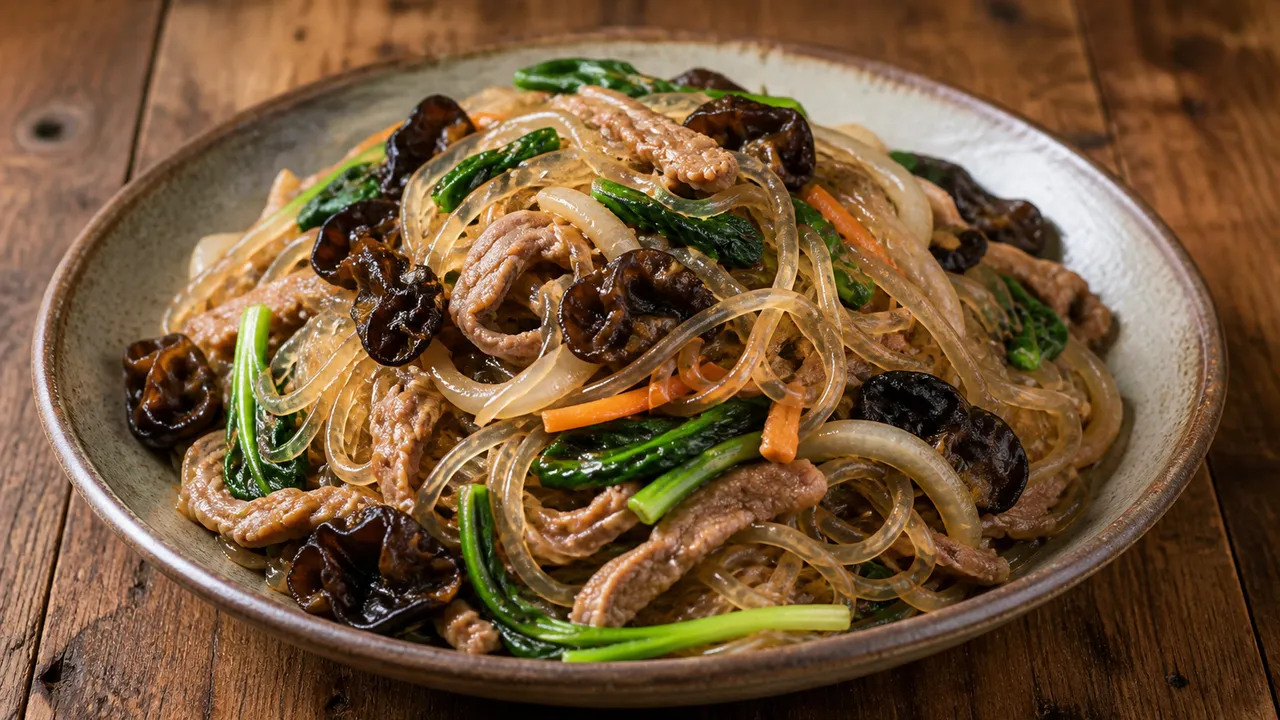
Baek Jong-won's Japchae: 2 Versions and Japchaebap Recipe
* 이미지는 AI가 생성한 참고 이미지로, 실제 조리 결과물과 다를 수 있습니다.
This recipe from Baek Jong-won presents two methods for making Japchae (stir-fried and blanched) to enjoy during the Chuseok holiday, along with a recipe for Japchaebap to use up any leftover Japchae.
📋 3 recipes — Select to view
This is a traditional japchae (잡채) made by stir-frying various vegetables and pork separately, then mixing them with glass noodles and seasoning.
📝 Editor's Notes
This japchae (잡채) recipe's main characteristic is its super simple method of blanching all ingredients at once.
By omitting the stir-frying process, cooking time is significantly reduced, allowing you to enjoy a light and clean taste.
It is much lighter and fresher than traditional japchae (잡채), highly recommended for those who find the oiliness of regular japchae (잡채) burdensome.
The cooking method is very simple, making it easy for beginner cooks to succeed.
It's also perfect for quickly and healthily preparing a meal during busy days or as a light side dish for entertaining guests.
While good to enjoy all year round, it particularly suits spring and summer when fresh vegetables are abundant.
🛒 Ingredient Tips
The key ingredient for japchae (잡채), glass noodles (dangmyeon), is all about its chewy texture.
Good glass noodles (dangmyeon) maintain their firm, springy texture without easily becoming mushy when boiled.
When purchasing, choose those that are transparent, glossy, and have minimal broken pieces.
For pork, preparing thinly julienned pieces specifically for japchae (잡채) will make cooking convenient.
Select fresh pork that has a bright reddish-pink color and a moderate distribution of fat.
Fresh spinach has vibrant green leaves that are not wilted and vivid red roots.
Seasonal spinach is sweeter and more nutritious, so try to use it if available.
🔄 Substitution Guide
You can use beef bulgogi (불고기) cut or chicken breast instead of pork.
Beef adds umami, while chicken breast adds a lean flavor, increasing protein intake.
For vegetarians, consider adding plenty of shiitake or king oyster mushrooms instead of meat for a chewy texture and aroma.
If spinach is unavailable, blanched bok choy or Korean cabbage (eolgal-i baechu) can be used.
The taste and texture may vary slightly, but it will help maintain nutritional balance.
Wood ear mushrooms (mok-i beoseot) can be substituted with other types of mushrooms or omitted, but note that you might miss their unique crunchy texture.
When using substitute ingredients, it's important to adjust the seasoning to your preference.
🥘 Ingredients
👨🍳 Cooking Points
For this japchae (잡채), it is crucial to thoroughly drain the blanched ingredients.
If too much water comes out from the vegetables, the japchae (잡채) can become watery and the seasoning bland.
After blanching, drain in a colander, cool, and then squeeze out as much water as possible by hand.
Remembering this alone will significantly improve the taste of your japchae (잡채).
Next, pre-season the glass noodles (dangmyeon) with minced garlic, brown sugar, soy sauce (jin-ganjang), and fine sea salt.
This helps the noodles absorb the seasoning well, balancing the overall flavor.
Finally, when mixing all ingredients, gently toss them to prevent the glass noodles (dangmyeon) from breaking.
👨🍳 Directions
Soak the glass noodles (dangmyeon) in water for about 30 minutes, then boil until cooked.
Remove the roots from the spinach and separate into individual stalks.
Thinly julienne the onion along the grain.
Julienne the carrot and slice the green onion (scallion) diagonally into long pieces.
Soak the wood ear mushrooms (mok-i beoseot) in water for about 30 minutes, then tear or cut into bite-sized pieces.
Heat about 1 tbsp of cooking oil in a frying pan, add a pinch of salt to the julienned pork, and stir-fry.
When the pork is about half cooked, add the onion, carrot, green onion (scallion), wood ear mushrooms (mok-i beoseot), and black pepper powder, and stir-fry briefly.
Once the vegetables have softened, add the spinach and stir-fry.
Spread the stir-fried vegetables on a large plate to cool.
Season the boiled glass noodles (dangmyeon) with minced garlic, brown sugar, soy sauce (jin-ganjang), and fine sea salt.
Add the stir-fried vegetables, mix evenly, then add dark soy sauce (noduyu) to adjust the color.
Drizzle with sesame oil, transfer to a serving dish, and sprinkle with toasted sesame seeds to finish.
💡 Tips
For better flavor, if possible, stir-fry the onion separately from other ingredients.
Stir-fry the pork until fully cooked before adding other vegetables.
Stir-fry the spinach until it is just wilted.
Spread the stir-fried vegetables on a large plate to cool.
📦 Storage & Reuse
Cooked japchae (잡채) can be stored in an airtight container in the refrigerator for 2-3 days.
Glass noodles (dangmyeon) can become soggy or hard over time, so it's best to eat them as soon as possible.
Freezing is not recommended as it can make the noodles mushy.
To reheat, microwave briefly or gently stir-fry in a pan with a small amount of water or sesame oil over low heat to maintain moisture.
Leftover japchae (잡채) can also be stir-fried with rice to make japchae-bap (잡채밥) or mixed with Korean pancake mix (buchim-garu) to make japchae-jeon (잡채전), a delicious variation.
🥢 Who This Is For
This japchae (잡채) recipe is perfect for beginner cooks or those seeking a healthy meal amidst a busy schedule.
Those who find traditional japchae (잡채) too oily will enjoy its clean and light taste.
It also makes an excellent side dish for family gatherings during holidays or for entertaining guests.
It's great as a single meal with warm rice, and pairing it with a hearty seaweed soup (miyeok-guk) or beef radish soup (sogogi muguk) creates an even more balanced meal.
🔥 Nutrition Info
Based on approximately 2-3 servings, this japchae (잡채) recipe is estimated to contain about 400-450 kcal per serving.
You can obtain approximately 65-70g of carbohydrates from the main ingredient, glass noodles (dangmyeon), and about 7-8g of protein from the pork.
Approximately 10-15g of fat will be consumed from sesame oil and pork.
Spinach is particularly rich in vitamin K and iron, aiding bone health and preventing anemia, while beta-carotene in carrots converts to vitamin A, which is good for eye health.
Wood ear mushrooms (mok-i beoseot) and various vegetables provide abundant dietary fiber, positively impacting gut health.
By omitting the stir-frying process, the fat content is lower than regular japchae (잡채), making it a lighter and healthier japchae (잡채) to enjoy.
💬 Frequently Asked Questions
- Q. What ingredients do I need for Baek Jong-won's Japchae: 2 Versions and Japchaebap?
- Main ingredients include Glass Noodles, Spinach, Pork (for Japchae), Dried Wood Ear Mushrooms, Onion. Choosing key ingredients that determine the taste of Japchae is important. For glass noodles, it's better to select a good quality product that is chewy and doesn't get soggy easily, rather than overly cheap ones. Adhering to the soaking time is also crucial. For spinach, choose fresh leaves with a vibrant green color and reddish roots. For pork, select a thinly julienned cut suitable for Japchae; using leaner cuts like loin or tenderloin will result in a more savory and cleaner-tasting Japchae. Dried wood ear mushrooms must be sufficiently rehydrated in water to achieve a soft texture, so allow about 30 minutes for soaking. Lastly, dark soy sauce (Nodu-yu) is essential for giving Japchae its appetizing brown color, so it's highly recommended to have it prepared.
- Q. What are the key tips for making Baek Jong-won's Japchae: 2 Versions and Japchaebap?
- There are three key cooking points for this Japchae recipe. First, boiling the glass noodles: If boiled too long, the noodles become soggy, but if undercooked, they will be hard and unappetizing. After soaking them sufficiently in water, the best state is al dente – transparent yet still with a slight chew. Second, the timing for stir-frying vegetables: As per the recipe tip, stir-fry spinach only until it barely wilts, then quickly remove it from the heat to maintain its crisp texture and vibrant color. Spread the stir-fried vegetables on a large plate to cool, preventing them from overcooking from residual heat. Third, achieving the golden ratio for seasoning: After seasoning the glass noodles, add the stir-fried vegetables and mix thoroughly to adjust the taste. At this point, dark soy sauce (Nodu-yu) is for color, so the flavor should be adjusted with regular soy sauce and salt. Finally, drizzle generously with sesame oil to add a savory aroma.
- Q. How should I store leftover Baek Jong-won's Japchae: 2 Versions and Japchaebap?
- Store finished Japchae in an airtight container in the refrigerator for 2-3 days. However, glass noodles can become soggy or hard over time, so it's best to consume it as soon as possible. Freezing is not recommended as it can make the noodles mushy, but if you must, store the noodles and vegetables separately or stir-fry them in a pan after thawing. To reheat, stir-fry in a pan with a small amount of water or sesame oil over medium-low heat to help the noodles retain some chewiness without becoming overly soft. Reheating in a microwave may make the noodles even softer. Leftover Japchae can be used as kimbap (김밥) filling or added to dumpling (만두) filling to create unique dumplings.
- Q. How many calories are in Baek Jong-won's Japchae: 2 Versions and Japchaebap?
- Since Japchae is often made in large quantities, the nutritional information can be estimated for approximately 4 servings. One serving is expected to provide about 380-450 kcal, with carbohydrates being the main energy source at around 55-65g, due to the high proportion of glass noodles. Approximately 8-12g of protein can be obtained from pork and spinach, and about 15-20g of fat is included from cooking oil, sesame oil, and pork. Various vitamins and minerals such as Vitamin A, Vitamin K, and iron can also be supplemented through spinach and carrots, contributing to good nutritional balance. However, due to the use of soy sauce, fine salt, and MSG, the sodium content may be somewhat high, so those who prefer a less salty taste are recommended to adjust the amounts of soy sauce and salt during cooking.
- Q. Can I substitute ingredients in Baek Jong-won's Japchae: 2 Versions and Japchaebap?
- You can use other ingredients instead of pork, which is a key component. If you don't eat pork or have an allergy, try using thinly julienned beef for bulgogi (불고기) or chicken breast. Beef offers a rich umami flavor, while chicken breast provides a lighter taste. For vegetarians, adding plenty of shiitake (표고버섯) or king oyster mushrooms (새송이버섯) can provide a meat-like texture and flavor. Instead of spinach, other leafy greens like chives (부추) or bok choy (청경채) can be used, though the distinct savory and tender taste of spinach might be altered slightly. If wood ear mushrooms are unavailable, dried shiitake mushrooms can be substituted to add more umami. The MSG in the recipe enhances the umami flavor, but it can be omitted if you prefer not to use it. However, the depth of flavor might be slightly reduced; in that case, we recommend using kelp (다시마) broth or adding more shiitake mushrooms for a natural umami boost. Dark soy sauce (Nodu-yu) is primarily for color, so it can be omitted if unavailable, but you would sacrifice the appetizing visual appeal of the Japchae.
💬 Comments
No comments yet. Be the first to comment!