
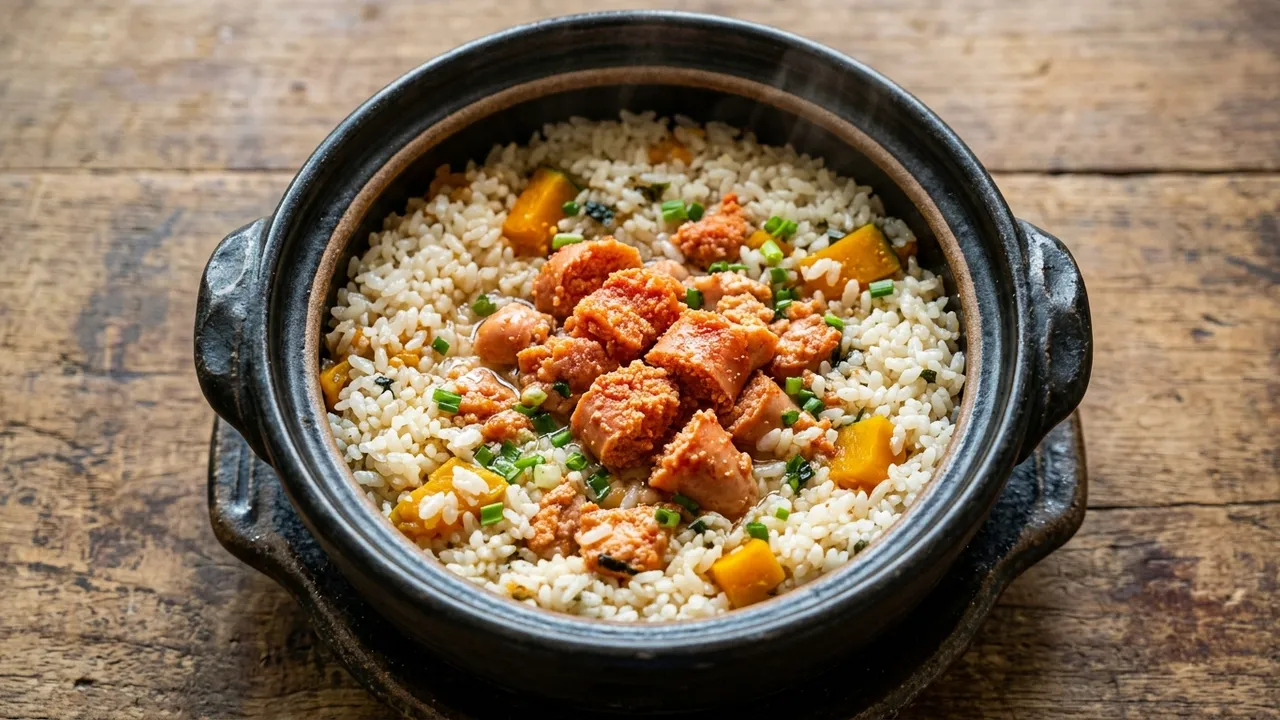
Collection of Five Pot Rice Recipes
* 이미지는 AI가 생성한 참고 이미지로, 실제 조리 결과물과 다를 수 있습니다.
A collection of pot rice recipes, including salted pollack roe, shepherd's purse and beef brisket, bean sprout, abalone, and matsutake mushroom, that evoke cherished memories of your grandmother's cooking.
📋 5 recipes — Select to view
This delicious sotbap (pot rice) features a savory combination of myeongnanjeot (명란젓, salted pollock roe) and sweet kabocha squash.
📝 Editor's Notes
This naengi chadolbaegi sotbap (냉이 차돌박이 솥밥, shepherd's purse and beef brisket pot rice) is packed with the vibrant energy of spring, combining aromatic shepherd's purse with savory beef brisket.
The harmony of the shepherd's purse fragrance infused into each grain of rice and the tender beef brisket is exquisite.
The sticky, warm texture unique to sotbap (솥밥) further enhances the rich, savory flavor of the beef brisket.
The difficulty level is moderate, and detailed tips are included so that even those unfamiliar with sotbap (솥밥) cooking can easily follow along.
We highly recommend this as a wonderful meal to enjoy with family or loved ones on a warm spring day.
It's also perfect as a special weekend meal or for entertaining guests.
🛒 Ingredient Tips
For fresh naengi (냉이, shepherd's purse), look for roots that are straight with few fine hairs, and leaves that are not wilted and have a vivid green color.
Thicker, firmer roots generally have better aroma and taste, so keep that in mind when choosing.
For beef brisket (차돌박이, chadolbaegi), it's best to choose meat that has a bright red color with white, evenly distributed fat layers.
Avoid pieces that are too thin or have discolored during thawing.
Using freshly milled new rice will significantly improve the taste of the sotbap (솥밥).
If using older rice, soaking it in rice water with kelp can enhance its flavor.
🔄 Substitution Guide
You can use beef sirloin or thinly sliced beef belly (우삼겹, usambyeop) instead of beef brisket (차돌박이, chadolbaegi).
Sirloin offers a clean flavor, while beef belly can provide a similar savory taste to brisket, though its texture might be slightly firmer than brisket.
If naengi (냉이, shepherd's purse) is hard to find or not preferred, you can substitute it with other aromatic vegetables like bomdong (봄동, Korean cabbage) or dallae (달래, wild garlic).
Bomdong (봄동) will add a crisp texture, and dallae (달래) will impart a pungent aroma.
However, you might need to slightly adjust cooking times or seasoning depending on the characteristics of the substitute ingredients.
If kelp broth is unavailable, you can use plain water, but remember that kelp broth significantly enhances the depth and umami of the rice flavor.
🥘 Ingredients
👨🍳 Cooking Points
There are two crucial points for this sotbap (솥밥).
First, adequately soaking the rice and draining it thoroughly.
Soaking the rice for at least 30 minutes ensures even cooking and a sticky texture.
Second, timing the addition of naengi (냉이, shepherd's purse) is important.
The tougher roots should be added from the beginning when cooking the rice, while the aromatic leaves should be added when the rice is almost fully cooked (after reducing to low heat and cooking for 15 minutes) to preserve their fresh aroma.
Finally, turning off the heat, placing the beef brisket (차돌박이, chadolbaegi) on top, and letting it steam for 5 minutes is a secret tip to infuse the rice grains with the meat's flavor and evenly spread the naengi (냉이) aroma throughout the entire dish, so make sure to follow it.
👨🍳 Directions
Wash the rice and soak it for about 30 minutes, then drain thoroughly in a sieve. (You can mix regular rice with sweet rice if desired.)
Finely chop the scallions. Thinly slice the kabocha squash with the skin on. Cut the myeongnanjeot (명란젓) into bite-sized pieces. In a bowl, mix all the ingredients for the soy sauce seasoning.
In a pot, add the soaked rice and kelp broth, then arrange the kabocha squash on top. Bring to a boil over medium heat.
Once the rice water comes to a rolling boil, reduce the heat to low and cook for 10-15 minutes. Turn off the heat, add the myeongnanjeot (명란젓), and let it steam for another 5-10 minutes.
Sprinkle the sotbap (솥밥) with chopped scallions and serve with the soy sauce seasoning.
💡 Tips
You can add other ingredients like ginkgo nuts or mushrooms as desired, and it's also delicious when wrapped in gim (김, seaweed).
Sprinkling chopped scallions over the sotbap (솥밥) makes it even more delicious.
📦 Storage & Reuse
The finished sotbap (솥밥) is best enjoyed immediately, but if there are leftovers, you can store them in an airtight container in the refrigerator and consume them by the next day.
When refrigerated, the rice may harden, so it's best to reheat it in a microwave or steam it.
Freezing is also possible, but the texture of the rice grains may change, so it's recommended to consume it as soon as possible.
Leftover sotbap (솥밥) can also be deliciously repurposed into kimchi-bokkeumbap (김치볶음밥, kimchi fried rice) or jumeokbap (주먹밥, rice balls).
The seasoned soy sauce can be prepared in advance and stored in the refrigerator, making it convenient for use in other dishes for several days.
🥢 Who This Is For
This naengi chadolbaegi sotbap (냉이 차돌박이 솥밥) is excellent for those looking for a special spring meal to stimulate their appetite.
It is especially recommended for families who enjoy warm and hearty Korean food.
Good side dishes to accompany it include refreshing kongnamul-guk (콩나물국, bean sprout soup) or miyeok-guk (미역국, seaweed soup), or crisp baek-kimchi (백김치, white kimchi).
Fresh cucumber salad (오이무침, oi-muchim) or freshly made kimchi (겉절이, geotjeori) will also enhance the flavor of the sotbap (솥밥).
🔥 Nutrition Info
One serving of this naengi chadolbaegi sotbap (냉이 차돌박이 솥밥) (based on 2-3 servings per recipe) is estimated to be approximately 500-600 kcal.
It provides about 25-30g of protein, 20-25g of fat, and 60-70g of carbohydrates.
Naengi (냉이, shepherd's purse) is rich in vitamins A and C, and also contains calcium and iron, helping to prevent spring fatigue.
Beef brisket (차돌박이, chadolbaegi) provides high-quality protein and essential amino acids, but its saturated fat content is high, so moderate consumption is important.
Overall, it can be a hearty and nutritionally balanced meal.
💬 Frequently Asked Questions
- Q. What ingredients do I need for Collection of Five Pot Rice Recipes?
- Main ingredients include rice, kelp broth, salted pollack roe (myeongnanjeot), kabocha squash, scallions. Here are some key ingredient selection tips for delicious pot rice. First, it's important to choose newly harvested rice (haepssal) of a good variety. Selecting grains that are translucent and unbroken will enhance the flavor of the rice. For salted pollack roe (myeongnanjeot), it's best to choose a low-sodium variety that isn't too salty. Fresh roe will have firm membranes, full roe sacs, and a vibrant red color. Finally, select a kabocha squash that has a shiny skin, feels heavy, and is firm. The stem end should not be dried out, and ripening it for a few days after purchase will deepen its sweetness.
- Q. What are the key tips for making Collection of Five Pot Rice Recipes?
- Keep these three key points in mind for successful salted pollack roe and kabocha squash pot rice. First, soaking the rice for about 30 minutes is crucial for the grains to cook evenly and achieve a soft texture. Skipping this step can result in undercooked or hard rice. Second, heat control is very important. Once the rice water boils over medium heat, immediately reduce it to low and cook for 10-15 minutes. Avoid opening the lid frequently during this time. Third, add the salted pollack roe during the 5-10 minute steaming period after turning off the heat. Adding it too early can make the roe overcooked and tough, or too salty. By following these three steps, you'll be able to make perfect pot rice every time.
- Q. How should I store leftover Collection of Five Pot Rice Recipes?
- If you have leftover pot rice, it's best to store it in a container while still warm. For refrigeration, place it in an airtight container and consume within 2-3 days. If you wish to store it longer, divide it into single-serving portions, wrap tightly with plastic wrap, or place in a freezer bag and freeze. It can be kept fresh in the freezer for about a month. To reheat, microwave or steam to enjoy its freshly cooked, moist texture. As for leftover salted pollack roe, you can freeze it or turn it into a mayo sauce by adding sesame oil and minced garlic.
- Q. How many calories are in Collection of Five Pot Rice Recipes?
- The estimated nutritional content for one serving of salted pollack roe and kabocha squash pot rice is approximately 450-500 kcal. Carbohydrates, primarily from rice and kabocha squash, provide about 80-90g, serving as the main energy source. Protein intake from salted pollack roe is estimated to be around 15-20g, which aids in cell composition and muscle maintenance. Fat content, depending on the sesame oil and roe, is estimated at 10-15g. Notably, salted pollack roe contains vitamin E and omega-3 fatty acids, which can positively impact antioxidant activity and cardiovascular health. Kabocha squash is rich in beta-carotene (a precursor to vitamin A), beneficial for boosting immunity and eye health, and also high in dietary fiber, which aids gut health. However, due to the salted pollack roe and soy sauce seasoning, the sodium content might be relatively high, so using low-sodium roe and adjusting the seasoning amount can make it a healthier dish.
- Q. Can I substitute ingredients in Collection of Five Pot Rice Recipes?
- If you don't have salted pollack roe or kabocha squash, or prefer other ingredients, here are some substitutions. Instead of salted pollack roe, you can use cod roe (daegualjeot) or finely minced shrimp, which offer a similar texture and umami flavor. Shrimp will provide a sweeter and chewier texture. For kabocha squash, thinly sliced chestnuts or sweet potatoes are good alternatives. Chestnuts will add a nuttier, more floury taste, while sweet potatoes will provide a sweet and soft texture similar to kabocha. If you don't have kelp broth, rice water (ssal-tteumul) can be used. Rice water enhances the savory flavor of the rice and also provides additional nutrients.

💬 Comments
No comments yet. Be the first to comment!