
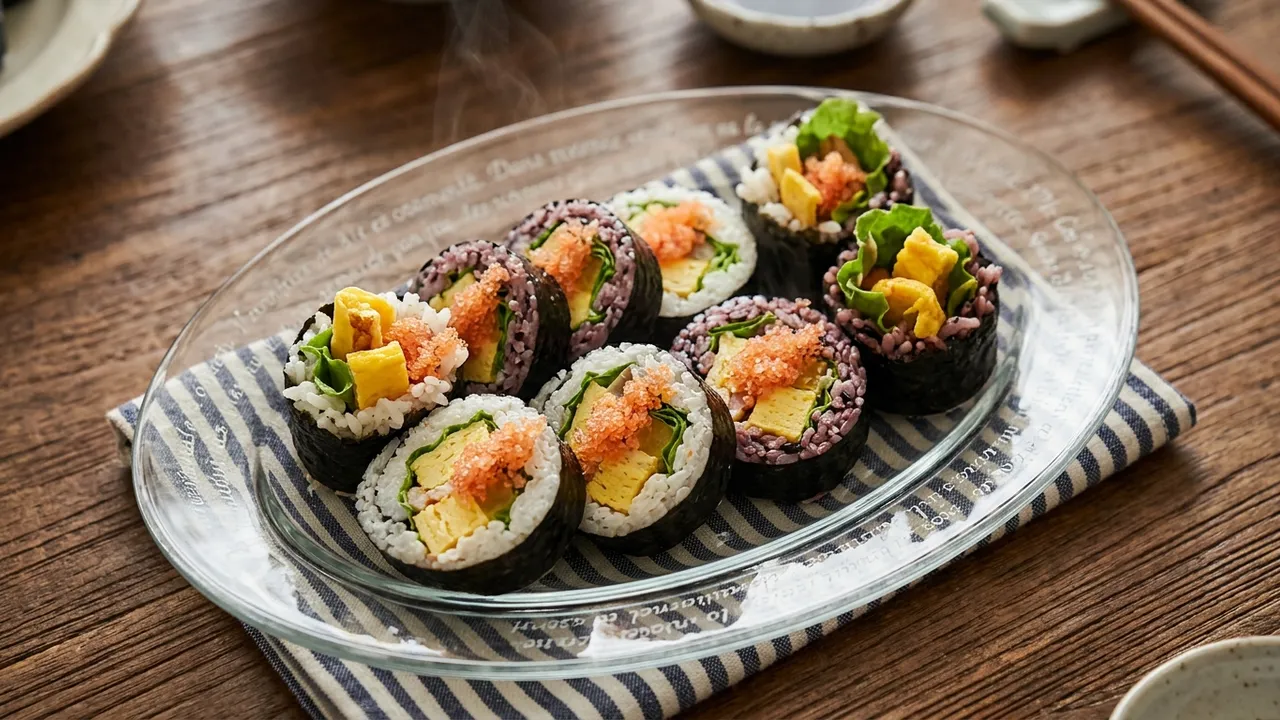
Botanical Garden Gimbap Recipe
* 이미지는 AI가 생성한 참고 이미지로, 실제 조리 결과물과 다를 수 있습니다.
A trendy Botanical Garden Gimbap recipe.
📝 Editor's Notes
Today's Botanical Garden Gimbap recipe features a harmonious blend of fresh vegetables, soft eggs, and savory myeongnanjeot (명란젓), making it a popular choice these days.
By reducing the amount of rice and generously filling it with ingredients, it achieves both health and deliciousness.
The wasabi mayonnaise, in particular, enhances the umami of the myeongnanjeot, adding a subtly pungent kick that makes it even more appealing.
The difficulty level is intermediate; once you master the technique for making the rolled omelet and rolling gimbap, anyone can create a beautiful dish.
It's perfect for spring or summer picnic lunches, a light meal, or an excellent option for those on a diet.
🛒 Ingredient Tips
The key ingredients for determining the freshness of this gimbap are eggs, myeongnanjeot (명란젓), and romaine lettuce.
🥚 Choose fresh eggs with an unbroken, smooth shell that don't make a sloshing sound when shaken.
Fresh eggs with a firm, raised yolk will enhance the flavor and color of the gimbap.
For myeongnanjeot (명란젓), look for bright pink roe that is glossy and unbroken, not too dark in color.
Thin skin and plump roe are characteristic of fresh and delicious myeongnanjeot.
For romaine lettuce, select leaves that are vibrant green, not wilted, and feel firm and crisp to the touch to fully enjoy their refreshing texture.
🔄 Substitution Guide
You can enjoy different flavors by substituting some of the key ingredients in this recipe.
🔄 Firstly, if you want to use an alternative to myeongnanjeot (명란젓), we recommend savory 'tuna mayo' or light 'chicken breast salad'.
While it may reduce the salty and umami charm of myeongnanjeot, tuna mayo offers a soft and savory taste, and chicken breast salad creates a gimbap that is clean and filling.
These are good alternatives for those with allergies or who find the saltiness too much.
Secondly, try using 'lettuce' or fragrant 'perilla leaves (깻잎)' instead of romaine lettuce.
Lettuce offers a slightly softer texture than romaine, while perilla leaves add their unique fragrance to the gimbap.
Thirdly, if you don't have heavy cream for the egg mixture, you can add a small amount of 'milk' or 'water'.
While it may be less soft and moist than with heavy cream, it will help maintain the eggs' tenderness without compromising their flavor.
🥘 Ingredients
👨🍳 Cooking Points
There are three key cooking points for successfully making this Botanical Garden Gimbap.
🔥 First, the soft rolled omelet determines both the visual appeal and texture of this gimbap.
When pouring the egg mixture into the pan, use a 50/50 mix of cooking oil and butter, and always cook it over 'low heat', gently scrambling it without browning until it takes shape.
The key is not to cook it quickly over high heat.
Second, it's crucial to spread the rice as thinly and evenly as possible.
If it's too thick, the flavor of the other ingredients will be overshadowed, and the gimbap will be prone to tearing.
Practice is needed to spread both white and black rice thinly and seamlessly over the seaweed.
Third, when rolling the gimbap, it's important to roll it 'tightly' so the ingredients don't fall apart.
Use a bamboo mat to support the ingredients with your hands, pressing firmly as you roll to ensure the shape holds and you get a beautiful cross-section.
It might be challenging at first, but you'll quickly get the hang of it after a few tries!
👨🍳 Directions
In a bowl, combine 3 eggs, 1 pinch of salt, 1 tbsp mirin, and 1 tbsp heavy cream, and mix well to prepare the egg mixture.
Heat a pan with a 50/50 mix of cooking oil and 15g butter. Pour the egg mixture gradually, gently scrambling it over low heat without browning to form a rolled omelet shape. Let it cool.
Season 2.5 tbsp white rice with 1/6 tsp sesame oil and 1/2 pinch salt, mixing well.
Prepare 2 tbsp black rice.
For 80g myeongnanjeot (명란젓), slice open the skin and scrape out only the roe using the back of a knife.
Combine 1.5 tbsp mayonnaise and wasabi (고추냉이) as needed to make wasabi mayonnaise.
Prepare 1.5 sheets of gim (김): cut one sheet in half, wet the edges, and attach it to the full sheet to create a longer sheet.
Spread the seasoned 2.5 tbsp white rice thinly over the gim sheet, then spread 2 tbsp black rice thinly next to it.
Place the pre-shaped rolled omelet on top of the rice, then drizzle with wasabi mayonnaise.
Next to the rolled omelet, place 20g danmuji (단무지), then lay 4 leaves of romaine lettuce next to it.
Place the myeongnanjeot (명란젓) on top of the romaine. Roll the gimbap (김밥) tightly, pressing down to ensure all ingredients are packed without gaps.
Brush the rolled gimbap (김밥) evenly with sesame oil. Carefully slice it into bite-sized pieces to complete the Botanical Garden Gimbap.
💡 Tips
When making the rolled omelet, butter alone can burn easily, so use a 50/50 mix with cooking oil.
To maintain a soft texture for the rolled omelet, gently scramble it over low heat without browning until it takes shape.
Adding the sauce made by mixing myeongnanjeot (명란젓), mayonnaise, and wasabi (고추냉이) enhances the smooth texture with a hint of pungent flavor.
Using less rice makes it suitable for diet control.
📦 Storage & Reuse
It's best to consume the finished Botanical Garden Gimbap as soon as possible for the best taste.
🧊 This is because refrigeration can harden the rice or reduce the freshness of the ingredients.
Leftover gimbap can be stored in an airtight container in the refrigerator for about a day, but the rice may become hard.
If the rice has hardened, you can microwave it for 30 seconds to 1 minute to warm it slightly, or dip it in egg wash and pan-fry it to make 'gimbap-jeon (김밥전)' for a soft and delicious treat.
Leftover myeongnanjeot (명란젓) can be stored in an airtight container in the freezer for about a month and is great for later use in dishes like myeongnan pasta or myeongnan steamed eggs.
Vegetables like romaine can be stored fresher by removing moisture, wrapping them in paper towels, and placing them in an airtight container.
🥢 Who This Is For
This Botanical Garden Gimbap is highly recommended for those who prefer light and healthy meals.
With less rice and abundant vegetables, it's also an excellent option for those on a diet or managing their meals.
👨👩👧👦 For children, you can adjust or omit the wasabi (고추냉이) so the whole family can enjoy it together.
If prepared for a picnic, it will be visually appealing and delicious, making it a crowd-pleaser.
Recommended side dishes include warm anchovy broth udon, refreshing seaweed soup, or a fresh fruit salad.
It also pairs wonderfully with a clean-tasting herbal tea or sparkling water.
🔥 Nutrition Info
One roll of this Botanical Garden Gimbap (based on the recipe) is estimated to be approximately 700-800 kcal.
🍎 It is likely to contain about 30-35g of protein, 40-45g of fat, and 30-35g of carbohydrates.
Eggs provide high-quality protein and vitamin D, while myeongnanjeot (명란젓) is rich in protein and minerals, but its sodium content is somewhat high, so excessive consumption should be avoided.
Romaine lettuce is rich in vitamin K, folate, and dietary fiber, contributing to gut health and overall nutritional balance.
A key feature is the reduced rice portion to lower carbohydrate intake.
Although the use of mayonnaise and butter contributes to a higher fat content, the composition primarily of fresh vegetables and protein makes it a balanced meal.
💬 Frequently Asked Questions
- Q. What ingredients do I need for Botanical Garden Gimbap?
- Main ingredients include Eggs, Salt, Mirin, Heavy cream, Cooking oil. The key ingredients for determining the freshness of this gimbap are eggs, myeongnanjeot (명란젓), and romaine lettuce. 🥚 Choose fresh eggs with an unbroken, smooth shell that don't make a sloshing sound when shaken. Fresh eggs with a firm, raised yolk will enhance the flavor and color of the gimbap. For myeongnanjeot (명란젓), look for bright pink roe that is glossy and unbroken, not too dark in color. Thin skin and plump roe are characteristic of fresh and delicious myeongnanjeot. For romaine lettuce, select leaves that are vibrant green, not wilted, and feel firm and crisp to the touch to fully enjoy their refreshing texture.
- Q. What are the key tips for making Botanical Garden Gimbap?
- There are three key cooking points for successfully making this Botanical Garden Gimbap. 🔥 First, the soft rolled omelet determines both the visual appeal and texture of this gimbap. When pouring the egg mixture into the pan, use a 50/50 mix of cooking oil and butter, and always cook it over 'low heat', gently scrambling it without browning until it takes shape. The key is not to cook it quickly over high heat. Second, it's crucial to spread the rice as thinly and evenly as possible. If it's too thick, the flavor of the other ingredients will be overshadowed, and the gimbap will be prone to tearing. Practice is needed to spread both white and black rice thinly and seamlessly over the seaweed. Third, when rolling the gimbap, it's important to roll it 'tightly' so the ingredients don't fall apart. Use a bamboo mat to support the ingredients with your hands, pressing firmly as you roll to ensure the shape holds and you get a beautiful cross-section. It might be challenging at first, but you'll quickly get the hang of it after a few tries!
- Q. How should I store leftover Botanical Garden Gimbap?
- It's best to consume the finished Botanical Garden Gimbap as soon as possible for the best taste. 🧊 This is because refrigeration can harden the rice or reduce the freshness of the ingredients. Leftover gimbap can be stored in an airtight container in the refrigerator for about a day, but the rice may become hard. If the rice has hardened, you can microwave it for 30 seconds to 1 minute to warm it slightly, or dip it in egg wash and pan-fry it to make 'gimbap-jeon (김밥전)' for a soft and delicious treat. Leftover myeongnanjeot (명란젓) can be stored in an airtight container in the freezer for about a month and is great for later use in dishes like myeongnan pasta or myeongnan steamed eggs. Vegetables like romaine can be stored fresher by removing moisture, wrapping them in paper towels, and placing them in an airtight container.
- Q. How many calories are in Botanical Garden Gimbap?
- One roll of this Botanical Garden Gimbap (based on the recipe) is estimated to be approximately 700-800 kcal. 🍎 It is likely to contain about 30-35g of protein, 40-45g of fat, and 30-35g of carbohydrates. Eggs provide high-quality protein and vitamin D, while myeongnanjeot (명란젓) is rich in protein and minerals, but its sodium content is somewhat high, so excessive consumption should be avoided. Romaine lettuce is rich in vitamin K, folate, and dietary fiber, contributing to gut health and overall nutritional balance. A key feature is the reduced rice portion to lower carbohydrate intake. Although the use of mayonnaise and butter contributes to a higher fat content, the composition primarily of fresh vegetables and protein makes it a balanced meal.
- Q. Can I substitute ingredients in Botanical Garden Gimbap?
- You can enjoy different flavors by substituting some of the key ingredients in this recipe. 🔄 Firstly, if you want to use an alternative to myeongnanjeot (명란젓), we recommend savory 'tuna mayo' or light 'chicken breast salad'. While it may reduce the salty and umami charm of myeongnanjeot, tuna mayo offers a soft and savory taste, and chicken breast salad creates a gimbap that is clean and filling. These are good alternatives for those with allergies or who find the saltiness too much. Secondly, try using 'lettuce' or fragrant 'perilla leaves (깻잎)' instead of romaine lettuce. Lettuce offers a slightly softer texture than romaine, while perilla leaves add their unique fragrance to the gimbap. Thirdly, if you don't have heavy cream for the egg mixture, you can add a small amount of 'milk' or 'water'. While it may be less soft and moist than with heavy cream, it will help maintain the eggs' tenderness without compromising their flavor.
💬 Comments
No comments yet. Be the first to comment!