
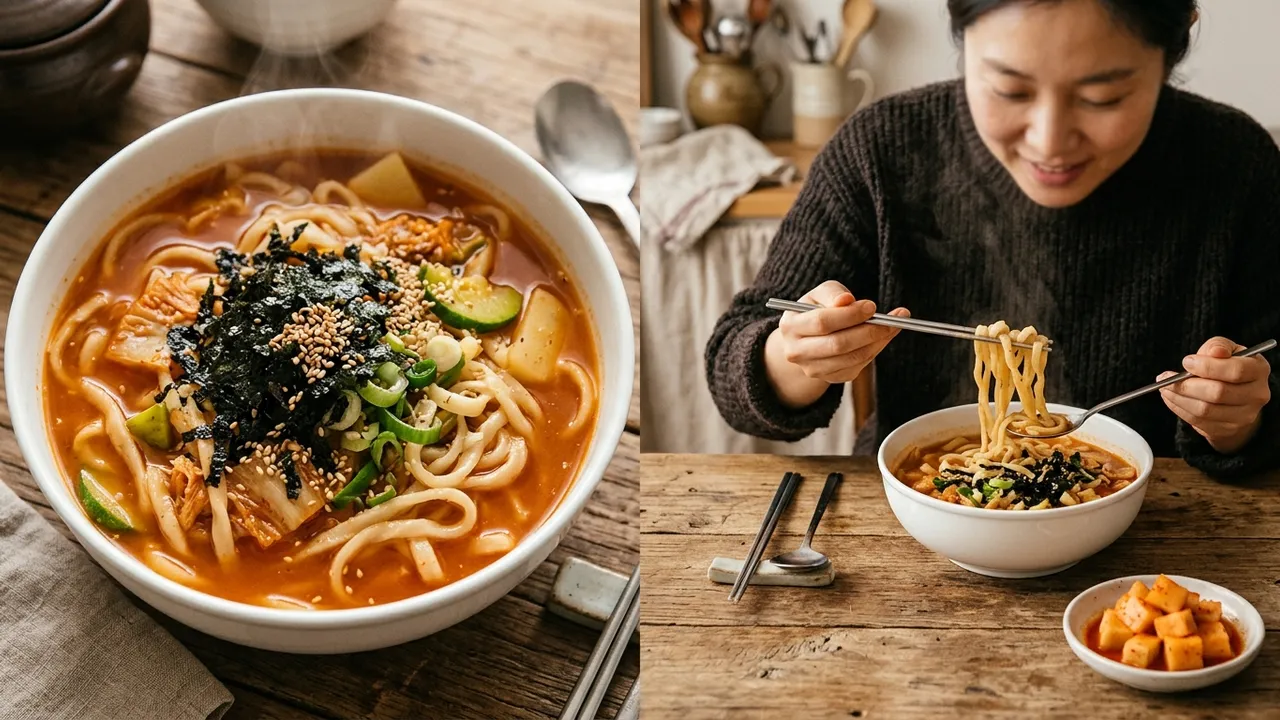
Jang Kalguksu (Spicy Noodle Soup with Gochujang and Doenjang
* 이미지는 AI가 생성한 참고 이미지로, 실제 조리 결과물과 다를 수 있습니다.
This recipe is for Jang Kalguksu, a warming noodle soup with a rich and hearty broth, perfect for chilly weather.
📝 Editor's Notes
Jang Kalguksu (Spicy Noodle Soup with Gochujang and Doenjang) is a soulful Korean dish, perfect for warming up on chilly days with its savory and spicy broth.
The harmonious blend of gochujang (고추장) and traditional doenjang (재래식 된장), combined with the umami of ground pork, creates a deep and robust flavor.
The julienned potatoes, Korean zucchini (애호박), and chewy Kalguksu noodles (칼국수면) come together to provide a satisfying and hearty meal.
While the cooking process is not overly complicated, making it suitable for beginners, it's crucial to properly manage the noodle cooking time and vegetable doneness.
This dish is ideal for autumn and winter, highly recommended for rainy days or as a weekend lunch.
Experience the comforting and hearty flavors that will warm you from head to toe! 🍜
🛒 Ingredient Tips
The key ingredients that define the deep flavor of Jang Kalguksu are traditional doenjang (재래식 된장) and gochujang (고추장).
Using traditional doenjang greatly helps in adding depth and a savory flavor to the broth.
As mentioned in the tip to double the amount if using commercially available doenjang, it's essential to taste and adjust the quantity as the saltiness and flavor vary among different types of doenjang.
Fresh Kalguksu noodles (칼국수면) are ideal for a chewy and soft texture, but they contain a lot of starch, so rinse them thoroughly under running water before cooking.
The trick is to handle the noodles gently to prevent them from breaking.
For the pork, using ground pork shoulder or front leg with a moderate amount of fat will add a rich, savory taste to the broth, enhancing the overall flavor. 🥕
🔄 Substitution Guide
If you wish to substitute the ground pork in this recipe, you can use ground beef or chicken breast.
Ground beef will add a richer umami flavor, while chicken breast offers a lighter taste, though they may lack the unique savory richness and fat of pork.
For vegetarians, finely chopped mushrooms (such as shiitake or king oyster mushrooms) or crumbled tofu can provide a rich texture and flavor without meat.
If Kalguksu noodles (칼국수면) are unavailable, you can use somyeon (소면) or jungmyeon (중면) (thin or medium wheat noodles), or even ramen noodles.
However, be aware that cooking times and broth consistency may vary depending on the type of noodle.
Somyeon offers a softer, lighter texture, while ramen noodles can result in a chewier and richer taste.
If Cheongyang chili peppers (청양고추) are too spicy, you can use regular green chilies or omit them entirely, adjusting the spiciness with the amount of coarse gochugaru (고춧가루). 🔄
🥘 Ingredients
👨🍳 Cooking Points
There are three crucial cooking points that determine the flavor of Jang Kalguksu.
First, the process of stir-frying traditional doenjang (재래식 된장) and gochujang (고추장).
After stir-frying ground pork and green onion, adding and stir-frying the doenjang and gochujang together brings out the deep flavors and aromas of the pastes, enriching the broth.
Maintain medium heat and stir well to prevent burning.
Second, the secret to achieving a spicy yet savory flavor is to turn off the heat and then stir-fry the fine gochugaru (고춧가루) and coarse gochugaru (고춧가루) to create chili oil.
Lastly, to prevent the broth from becoming cloudy and the noodles from sticking together, rinse the Kalguksu noodles (칼국수면) gently under running water to remove excess starch before adding them.
After adding the noodles, boil for about 4 minutes until they are chewy.
Then, add the Korean zucchini (애호박) and other remaining vegetables, boiling for only about 30 seconds more to preserve their crisp texture. 🔥
👨🍳 Directions
Julienne the onion, Korean zucchini (애호박), and potato to a thickness of 0.4 cm (approx. 0.16 inches). Since potatoes take longer to cook than other vegetables, slice them as thinly as possible.
Slice the green onion and Cheongyang chili pepper (청양고추) into thin rounds, about 0.3 cm (approx. 0.12 inches) thick. Set aside the green parts of the green onion for garnish.
Heat cooking oil in a deep frying pan or pot over medium heat.
Add the ground pork and the green onion (excluding the garnish portion), breaking up the pork as you stir-fry to prevent clumping.
Once the meat is cooked and the green onion is fragrant, add the traditional doenjang (재래식 된장) and gochujang (고추장), and stir-fry them together.
Once the traditional doenjang (재래식 된장) and gochujang (고추장) are well mixed, turn off the heat. Add the fine gochugaru (고춧가루) and coarse gochugaru (고춧가루), and stir-fry briefly to bring out the chili oil.
When the chili oil emerges, turn the heat to high. Add the water, potato, and onion, and bring to a boil.
Once the broth boils, season with guk-ganjang (국간장) and fine sea salt.
When the potatoes are cooked, rinse the Kalguksu noodles (칼국수면) under running water in a colander until the cloudy starch water is gone. Then, add the noodles directly to the broth. Be careful not to knead the noodles by hand, as they can break easily.
Gently loosen the noodles with chopsticks. Once the soup comes to a full boil again, reduce the heat to medium and simmer for about 4 minutes.
Add the Korean zucchini (애호박), Cheongyang chili pepper (청양고추), and minced garlic. Boil for about 30 seconds, then turn off the heat.
Transfer the Kalguksu to a bowl. Garnish with shredded dried seaweed (김가루), ground sesame seeds (간 깨), and the reserved green onion for garnish. Serve immediately.
💡 Tips
Adjust the amount of traditional doenjang (재래식 된장) based on its color and saltiness.
If using commercially available doenjang instead of Baekseok doenjang, double the amount.
Crushing whole sesame seeds using a mortar and pestle or an empty bottle before adding them will enhance their nutty flavor.
Carefully rinse fresh Kalguksu noodles (칼국수면) under running water to remove excess starch, ensuring not to knead them by hand to prevent breakage.
To maintain the Korean zucchini's (애호박) crisp texture, it's best to turn off the heat just before it's fully cooked.
📦 Storage & Reuse
Jang Kalguksu is best enjoyed immediately after cooking, as the noodles tend to get soggy quickly.
If you have leftovers, it's recommended to separate the noodles from the broth.
The broth can be stored in an airtight container in the refrigerator for 2-3 days.
When reheating, warm the broth and cook fresh Kalguksu noodles (칼국수면) separately before combining them to enjoy the same chewy texture as when it was first made.
Leftover ingredients like Korean zucchini (애호박), onion, and potato can be used in other stews or stir-fries, while ground pork can be added to kimchi fried rice or mandu (만두) dumpling filling. 🧊
🥢 Who This Is For
This Jang Kalguksu is recommended for anyone looking for a warm and hearty meal on a chilly day.
Those who especially enjoy spicy and savory broth dishes will surely be satisfied.
It's great for a solo meal or sharing a comforting bowl with family.
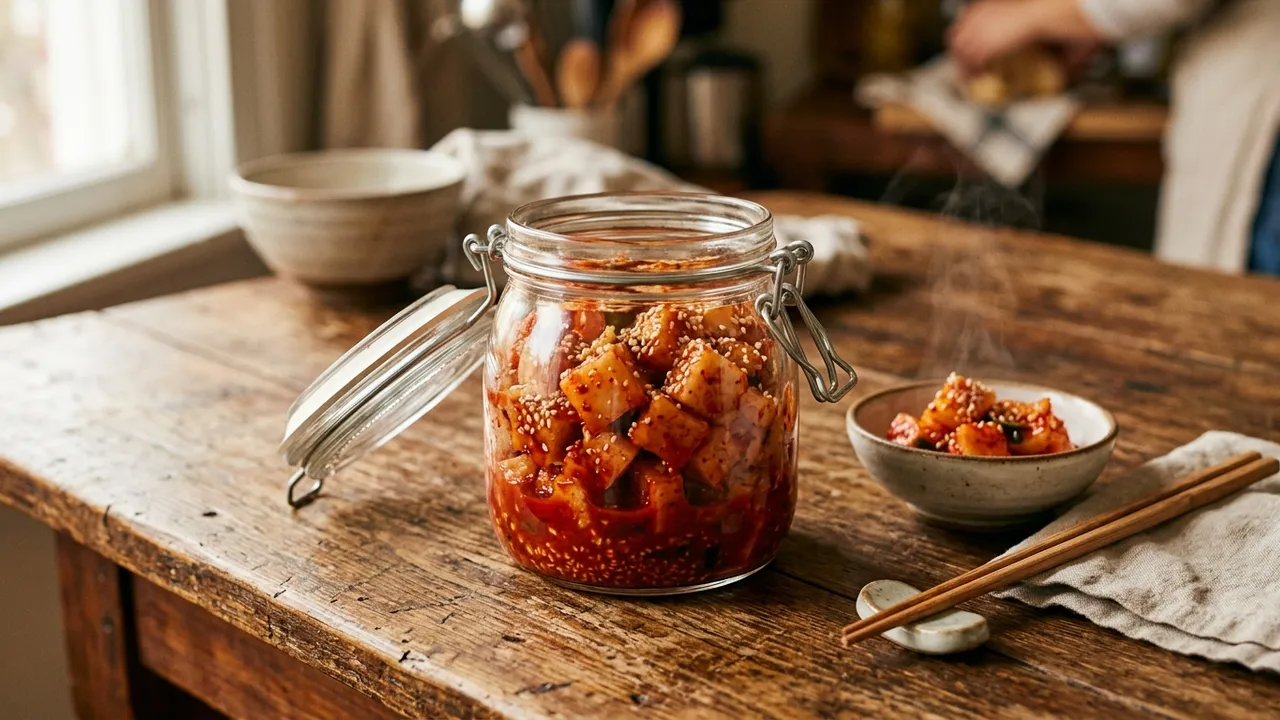
Excellent side dishes to pair with it include crunchy Kkakdugi (깍두기) (diced radish kimchi) or well-fermented Baechu-kimchi (배추김치) (napa cabbage kimchi).
Refreshing Dongchimi (동치미) (radish water kimchi) also complements the rich flavor of Jang Kalguksu, providing a clean counterpoint. 🍲
🔥 Nutrition Info
Based on the provided recipe per serving, a bowl of Jang Kalguksu is estimated to contain approximately 850-900 kcal.
The main nutrients consist of about 130g of carbohydrates, 35g of protein, and 20-25g of fat.
Kalguksu noodles (칼국수면) are the primary source of carbohydrates, while ground pork provides high-quality protein and fat.
Vegetables like Korean zucchini (애호박), onion, and potato supply vitamins, minerals, and dietary fiber, helping to balance the nutrition.
Particularly, pork is rich in B vitamins, beneficial for relieving fatigue, and the capsaicin in gochujang (고추장) and gochugaru (고춧가루) can help boost metabolism.
However, due to traditional doenjang (재래식 된장), gochujang, guk-ganjang (국간장), and salt, the sodium content can be high, so it's advisable to moderate your consumption of the broth. 💡
💬 Frequently Asked Questions
- Q. What ingredients do I need for Jang Kalguksu (Spicy Noodle Soup with Gochujang and Doenjang)?
- Main ingredients include Water, Kalguksu noodles (칼국수면), Korean zucchini (애호박), Ground pork, Onion. The key ingredients that define the deep flavor of Jang Kalguksu are traditional doenjang (재래식 된장) and gochujang (고추장). Using traditional doenjang greatly helps in adding depth and a savory flavor to the broth. As mentioned in the tip to double the amount if using commercially available doenjang, it's essential to taste and adjust the quantity as the saltiness and flavor vary among different types of doenjang. Fresh Kalguksu noodles (칼국수면) are ideal for a chewy and soft texture, but they contain a lot of starch, so rinse them thoroughly under running water before cooking. The trick is to handle the noodles gently to prevent them from breaking. For the pork, using ground pork shoulder or front leg with a moderate amount of fat will add a rich, savory taste to the broth, enhancing the overall flavor. 🥕
- Q. What are the key tips for making Jang Kalguksu (Spicy Noodle Soup with Gochujang and Doenjang)?
- There are three crucial cooking points that determine the flavor of Jang Kalguksu. First, the process of stir-frying traditional doenjang (재래식 된장) and gochujang (고추장). After stir-frying ground pork and green onion, adding and stir-frying the doenjang and gochujang together brings out the deep flavors and aromas of the pastes, enriching the broth. Maintain medium heat and stir well to prevent burning. Second, the secret to achieving a spicy yet savory flavor is to turn off the heat and then stir-fry the fine gochugaru (고춧가루) and coarse gochugaru (고춧가루) to create chili oil. Lastly, to prevent the broth from becoming cloudy and the noodles from sticking together, rinse the Kalguksu noodles (칼국수면) gently under running water to remove excess starch before adding them. After adding the noodles, boil for about 4 minutes until they are chewy. Then, add the Korean zucchini (애호박) and other remaining vegetables, boiling for only about 30 seconds more to preserve their crisp texture. 🔥
- Q. How should I store leftover Jang Kalguksu (Spicy Noodle Soup with Gochujang and Doenjang)?
- Jang Kalguksu is best enjoyed immediately after cooking, as the noodles tend to get soggy quickly. If you have leftovers, it's recommended to separate the noodles from the broth. The broth can be stored in an airtight container in the refrigerator for 2-3 days. When reheating, warm the broth and cook fresh Kalguksu noodles (칼국수면) separately before combining them to enjoy the same chewy texture as when it was first made. Leftover ingredients like Korean zucchini (애호박), onion, and potato can be used in other stews or stir-fries, while ground pork can be added to kimchi fried rice or mandu (만두) dumpling filling. 🧊
- Q. How many calories are in Jang Kalguksu (Spicy Noodle Soup with Gochujang and Doenjang)?
- Based on the provided recipe per serving, a bowl of Jang Kalguksu is estimated to contain approximately 850-900 kcal. The main nutrients consist of about 130g of carbohydrates, 35g of protein, and 20-25g of fat. Kalguksu noodles (칼국수면) are the primary source of carbohydrates, while ground pork provides high-quality protein and fat. Vegetables like Korean zucchini (애호박), onion, and potato supply vitamins, minerals, and dietary fiber, helping to balance the nutrition. Particularly, pork is rich in B vitamins, beneficial for relieving fatigue, and the capsaicin in gochujang (고추장) and gochugaru (고춧가루) can help boost metabolism. However, due to traditional doenjang (재래식 된장), gochujang, guk-ganjang (국간장), and salt, the sodium content can be high, so it's advisable to moderate your consumption of the broth. 💡
- Q. Can I substitute ingredients in Jang Kalguksu (Spicy Noodle Soup with Gochujang and Doenjang)?
- If you wish to substitute the ground pork in this recipe, you can use ground beef or chicken breast. Ground beef will add a richer umami flavor, while chicken breast offers a lighter taste, though they may lack the unique savory richness and fat of pork. For vegetarians, finely chopped mushrooms (such as shiitake or king oyster mushrooms) or crumbled tofu can provide a rich texture and flavor without meat. If Kalguksu noodles (칼국수면) are unavailable, you can use somyeon (소면) or jungmyeon (중면) (thin or medium wheat noodles), or even ramen noodles. However, be aware that cooking times and broth consistency may vary depending on the type of noodle. Somyeon offers a softer, lighter texture, while ramen noodles can result in a chewier and richer taste. If Cheongyang chili peppers (청양고추) are too spicy, you can use regular green chilies or omit them entirely, adjusting the spiciness with the amount of coarse gochugaru (고춧가루). 🔄
💬 Comments
No comments yet. Be the first to comment!